Janine Mothershed CPC, CPC-I
Updated for 2026
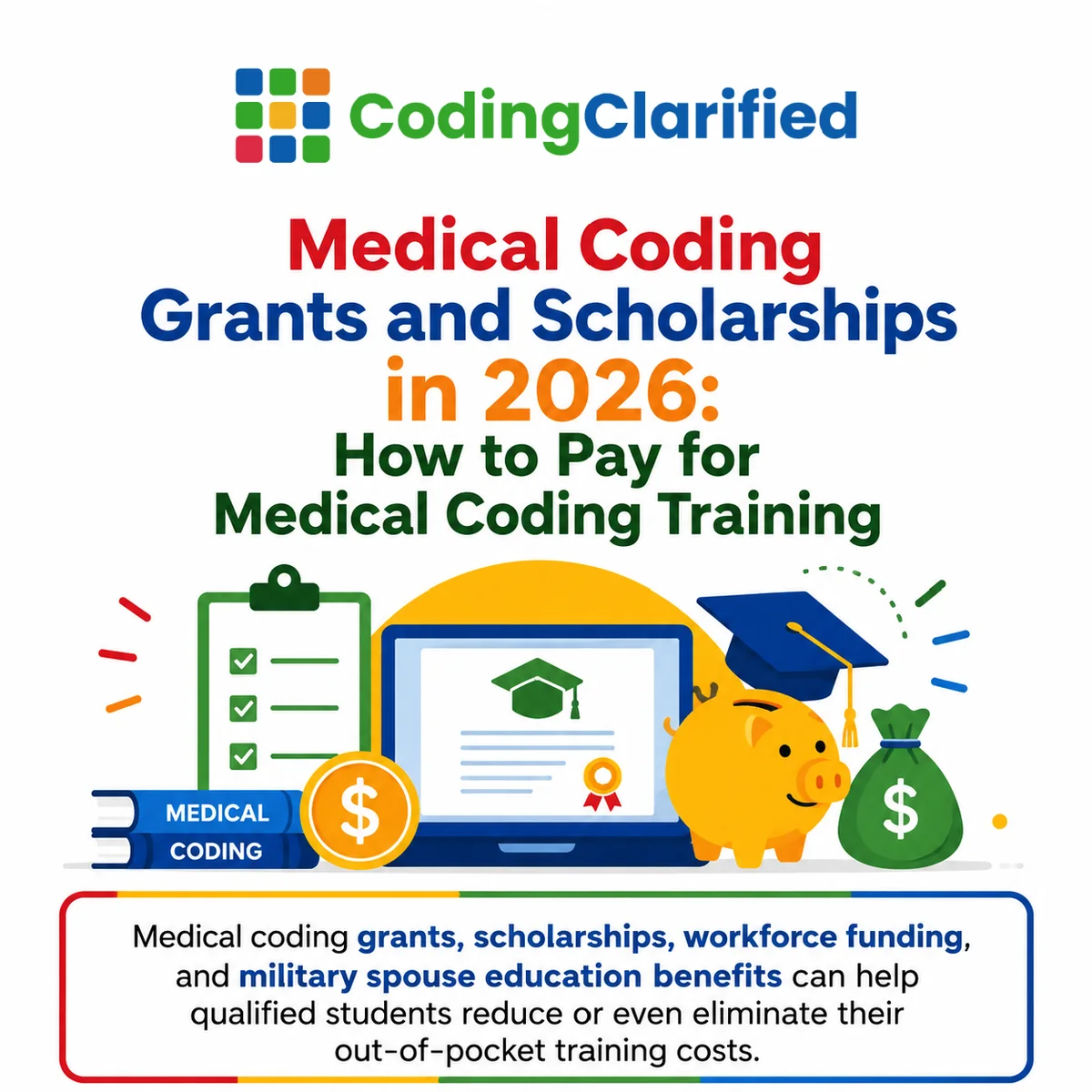
If you want to become a medical coder but are concerned about the cost of training, you may have more options than you realize. Medical coding grants, scholarships, workforce funding, and military spouse education benefits can help qualified students reduce or even eliminate their out-of-pocket training costs.
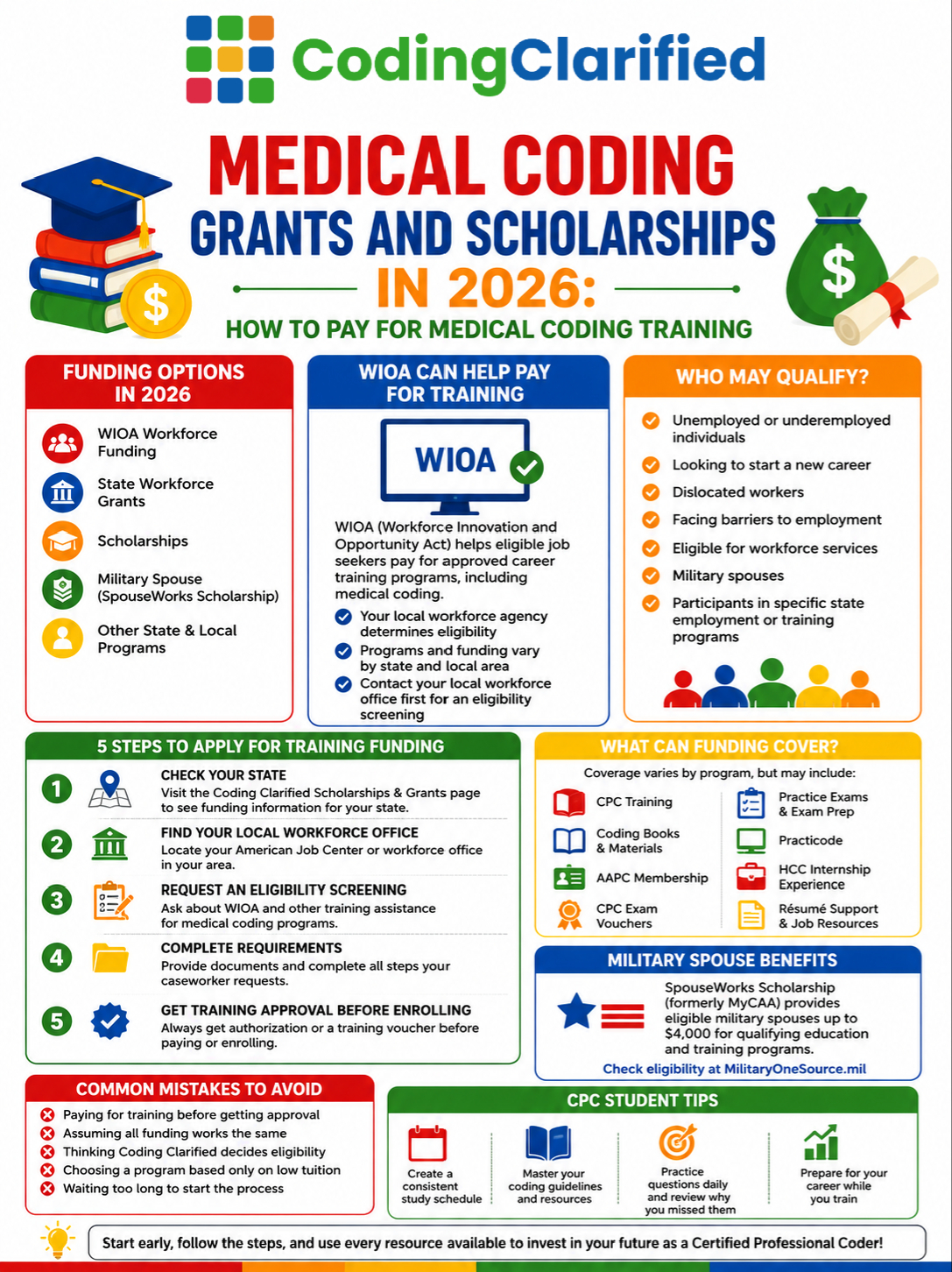
In 2026, one of the most important places to look for career-training assistance is your state or local workforce system. Programs funded through the Workforce Innovation and Opportunity Act (WIOA) may help eligible job seekers pay for approved medical coding career training. However, funding, eligibility requirements, approved schools, and available benefits vary by state and local workforce area.
Coding Clarified works with workforce agencies in many states as an approved medical coding training provider. Therefore, students interested in becoming Certified Professional Coders (CPCs) should investigate available funding before paying for medical coding training out of pocket.
Key Takeaways on Medical Coding Grants in 2026
- Medical coding students may qualify for WIOA funding, state workforce grants, scholarships, military spouse assistance, or other career-training programs.
- Coding Clarified provides information about medical coding scholarship and grant opportunities in 30+ states.
- WIOA funding decisions come from the student’s local workforce agency, not Coding Clarified.
- Your first step should usually be contacting your local workforce office and requesting an eligibility screening for medical coding career training.
- Eligible military spouses should investigate the SpouseWorks Scholarship, formerly known as MyCAA, which provides up to $4,000 in financial assistance for eligible education and training.
- Funding rules and availability can change. Therefore, always verify current 2026 requirements before enrolling.
- A grant or scholarship should support a training program that prepares you for a recognized medical coding credential and provides a clear path toward employment.
What Are Medical Coding Grants?
Medical coding grants are funds that may help eligible students pay for career education and certification training. Unlike a traditional student loan, grant funding generally does not need to be repaid when the student follows the program requirements.
However, the term “grant” can cover several types of funding. For example, some students receive assistance through state workforce programs. Others may qualify through WIOA, military spouse programs, employer programs, vocational rehabilitation, or another state or local initiative.
Most importantly, you should not assume that every medical coding school qualifies for every funding program. Many workforce programs require students to select training from an approved provider or Eligible Training Provider List.
CareerOneStop, which the U.S. Department of Labor sponsors, provides a WIOA Eligible Training Program Finder to help job seekers locate their state’s approved training directory.
What Is WIOA, and Can It Pay for Medical Coding Training?
The Workforce Innovation and Opportunity Act (WIOA) supports employment and training services for eligible job seekers. The U.S. Department of Labor explains that WIOA programs provide career services, workforce preparation, career development, classroom training, and work-based learning opportunities.
In addition, WIOA allows several types of training, including occupational skills training, private-sector training programs, skills upgrading, retraining, and certain workplace training programs.
Because medical coding is occupational career training, an approved medical coding program may qualify for WIOA funding when the student, training provider, and program meet applicable state and local requirements.
However, approval is not automatic. Your local workforce agency determines eligibility, available funding, and which programs it will approve.
For more details, read Coding Clarified’s guide: What Programs Does WIOA Pay For?
What Programs Does WIOA Pay For?
WIOA pays for job training in occupations your state lists as in demand, delivered by a training provider on your state’s Eligible Training Provider List (ETPL). Medical coding qualifies in many states because healthcare employers need trained coders. Coding Clarified’s CPC training program is approved on the ETPL in 30+ states, so WIOA funding can cover your training cost if your local workforce office approves you. Your workforce office decides eligibility and must approve funding before you enroll.
Who May Qualify for Medical Coding Grants in 2026?
Eligibility varies significantly. Consequently, there is no single income limit or nationwide checklist that guarantees approval for medical coding training.
Depending on the program, funding may be available to people who are:
- Unemployed
- Underemployed
- Looking to enter a new career
- Dislocated workers
- Facing barriers to employment
- Eligible for certain workforce services
- Military spouses
- Approved for specific state employment or training programs
Your local workforce agency makes the actual eligibility determination. Therefore, Coding Clarified cannot determine whether a prospective student qualifies for WIOA funding.
Instead, request an eligibility screening from your local workforce office. That screening allows the agency to review your circumstances and explain the programs currently available in your area.
How to Apply for a Medical Coding Grant Through Coding Clarified
The process is easier when you approach it in the correct order.
Step 1: Check Whether Funding Is Available in Your State
Start with the Coding Clarified Medical Coding Scholarships and Grants page.
Coding Clarified provides state-specific information for students looking for assistance with medical coding training. Because workforce programs operate at state and local levels, instructions and funding availability can vary.
Step 2: Locate Your Local Workforce Office
Next, find the workforce agency serving your area. Depending on where you live, it may be called an American Job Center, workforce center, career center, employment office, or workforce development office.
CareerOneStop also provides tools for locating workforce and training resources.
Step 3: Request an Eligibility Screening
When you contact the workforce office, explain that you are interested in medical coding career training and want to know whether you qualify for WIOA or another available workforce training program.
Additionally, tell your caseworker that you are interested in Coding Clarified if it is an approved provider for your area.
Do not simply ask, “Do you have scholarships?” Instead, specifically ask about WIOA training assistance, occupational skills training, and other workforce funding for an approved medical coding program.
That language may help the workforce representative understand exactly what you need.
Step 4: Complete Your Workforce Agency’s Requirements
Your caseworker may request documents or require additional steps before approving training. For example, you may need to complete an application, career assessment, employment plan, orientation, or other eligibility documentation.
Requirements vary. Therefore, follow the instructions from your assigned workforce representative carefully.
Step 5: Obtain Training Approval Before Enrolling
Do not assume that you can enroll first and receive reimbursement later.
Instead, obtain the required authorization or training voucher according to your workforce agency’s process. Then, follow Coding Clarified’s instructions for submitting your approved training documentation.
This step is especially important because workforce agencies may not reimburse training that you purchased before receiving approval.
What Can a Medical Coding Training Grant Cover?
Coverage depends on the funding source and the student’s approved training plan. However, funding may cover much more than basic tuition.
For students approved for the Coding Clarified CPC training program, the program provides resources designed to help students progress from education through CPC certification and career preparation.
The Coding Clarified CPC Training Program includes resources such as:
- AAPC CPC training
- CPT, ICD-10-CM, and HCPCS Level II coding resources
- Physical and electronic coding books
- Workbook and textbook materials
- Instructor notes and support
- One-on-one instructor time
- CPC exam review
- AAPC membership
- CPC exam vouchers
- Practice exams
- Practicode
- HCC internship experience
- Résumé support
- Job-search resources
Therefore, students should compare the total training package, rather than looking only at tuition.
A program that appears less expensive initially may cost considerably more once you add coding books, certification exams, memberships, exam preparation, and practical coding resources.
Medical Coding Scholarships vs. Grants vs. Financial Aid
Students often use these terms interchangeably, although they can describe different funding sources.
A grant generally provides financial assistance that does not require repayment when all program conditions are met. Meanwhile, a scholarship may come from a school, government program, nonprofit organization, employer, workforce agency, or another source.
Traditional financial aid can include grants, scholarships, work-study programs, and student loans. However, not every career-training program participates in federal student aid programs.
For that reason, asking whether a school “takes financial aid” is not specific enough. Instead, ask exactly which funding programs the school accepts and whether the medical coding program is approved by your workforce agency.
Military Spouse Medical Coding Funding in 2026
Military spouses should investigate another important funding option.
In 2026, the program previously known as the My Career Advancement Account Scholarship, or MyCAA, is called the SpouseWorks Scholarship. The program provides eligible military spouses with up to $4,000 in financial assistance toward qualifying licenses, certifications, associate degrees, and certain continuing education.
Because medical coding can lead to professional certification and portable career opportunities, eligible military spouses interested in CPC training should check current SpouseWorks requirements.
Military OneSource recommends checking eligibility and developing the required education and training plan through the SpouseWorks system.
Importantly, eligibility and program requirements can change. Therefore, military spouses should verify their current status directly through Military OneSource before making tuition commitments.
Why Choosing the Right Medical Coding Program Matters
Getting a grant is only part of the decision.
You also need a training program that prepares you for what happens after the funding ends. After all, completing a course is not the final goal. Building the medical coding skills and credentials needed to compete for coding jobs is.
When comparing programs, ask whether the training prepares you for a nationally recognized medical coding certification, such as AAPC’s Certified Professional Coder (CPC) credential.
Additionally, look at the coding resources, instructor access, certification exam preparation, hands-on coding experience, résumé assistance, and career resources included with the program.
Coding Clarified focuses specifically on medical coding education and CPC certification preparation. Consequently, students can concentrate on developing the coding knowledge needed for certification and future medical coding positions.
Learn more in Coding Clarified Medical Coding Scholarships. Coding Clarified: MyCAA
CPC Student Tips: Make the Most of Your Medical Coding Grant Funding
If a grant pays for your medical coding education, treat the opportunity just as seriously as you would if you were paying the full tuition yourself.
First, create a weekly study schedule. Medical terminology, anatomy, ICD-10-CM, CPT, HCPCS Level II, coding guidelines, and exam techniques require consistent practice.
Next, learn to navigate your coding resources efficiently. The CPC exam does not test memorization alone. Instead, students must understand coding guidelines, identify key details in a scenario, eliminate incorrect choices, and locate information quickly.
Additionally, take advantage of instructor support and practice questions. When you miss a question, do not simply memorize the correct answer. Determine why your answer was wrong and which coding guideline leads to the correct choice.
Finally, start thinking about employment before graduation. Build your résumé, gain hands-on coding experience when possible, and learn what employers expect from newly certified coders.
Common Mistakes to Avoid When Applying for Medical Coding Grants
One of the biggest mistakes is paying tuition before receiving funding approval. Your workforce agency may have a specific authorization process, so always confirm approval first.
Another common problem is assuming that all forms of education funding work the same way. WIOA, state workforce funding, scholarships, federal student aid, and military spouse benefits operate under different rules.
Additionally, do not assume that Coding Clarified determines your WIOA eligibility. The local or state workforce agency makes that decision.
Students should also avoid choosing a medical coding program based solely on the lowest advertised tuition. Instead, compare what the price includes, such as coding books, certification preparation, exam fees, membership, practical experience, and career support.
Finally, do not wait until the last minute. Workforce approval may involve several steps, and funding availability can change. Starting early gives you more time to complete the process correctly.
Authoritative Resources for Medical Coding Grants and Funding
For current information, students should use official resources whenever possible.
The U.S. Department of Labor WIOA Programs page explains federal workforce programs and available career and training services.
Additionally, CareerOneStop’s WIOA Eligible Training Program Finder can direct students to their state’s approved training program directory.
Military spouses can review current scholarship information through Military OneSource’s SpouseWorks Scholarship. Coding Clarified MyCAA
Students pursuing CPC certification can also visit AAPC website to learn more about the Certified Professional Coder credential and medical coding certification.
Start Your Medical Coding Career: You May Qualify for Grants
The cost of medical coding training should not automatically stop you from exploring a new career.
In 2026, WIOA, state workforce programs, medical coding scholarships, and military spouse benefits may provide valuable funding for eligible students. However, the key is researching your options before enrolling or paying tuition.
Start by visiting the Coding Clarified Medical Coding Scholarships and Grants page. Then, locate your state, contact the appropriate workforce agency, and request an eligibility screening.
If funding is available and you qualify, you may be able to move from career planning to CPC training with significantly less out-of-pocket expense.
Frequently Asked Questions About Medical Coding Grants in 2026
Quick answers to the questions students ask most about medical coding grants and funding.
Can I get a grant for medical coding school?
Yes, some students can qualify for workforce grants, WIOA training assistance, scholarships, military spouse benefits, or other programs. However, availability and eligibility depend on your location, circumstances, funding source, and chosen medical coding program.
Will WIOA pay for medical coding training?
WIOA can fund eligible occupational skills training. However, your local workforce agency must determine that you qualify and that the medical coding program meets applicable requirements. Therefore, contact your local workforce office before enrolling.
Can WIOA pay 100% of my medical coding tuition?
It may, depending on your local program, approved training plan, available funds, and individual eligibility. However, full tuition coverage is never guaranteed. Ask your workforce caseworker exactly what expenses your approval covers.
Does Coding Clarified decide whether I qualify for a medical coding scholarship?
No. For state or WIOA-funded programs, the appropriate workforce agency determines eligibility. Coding Clarified provides medical coding training program information and can help students understand the enrollment process after funding approval.
Do I need to be unemployed to receive a medical coding grant?
Not necessarily. Some workforce programs also assist underemployed workers, dislocated workers, and people who meet other eligibility criteria. Therefore, request an eligibility screening even if you currently have a job.
Can military spouses get help paying for medical coding training?
Potentially. Eligible military spouses can investigate the SpouseWorks Scholarship, formerly called MyCAA. In 2026, the program provides up to $4,000 toward qualifying education and training for eligible spouses. Always verify current eligibility through Military OneSource.
Should I enroll in medical coding school before applying for WIOA?
Generally, you should contact your workforce agency before paying for or beginning training if you expect WIOA to fund it. Your local program may require prior approval, an eligible training provider, and specific authorization paperwork.
Where should I start if I want a medical coding grant?
Start with the Coding Clarified Scholarships and Grants page to review available state information. Next, contact your local workforce agency and request an eligibility screening for medical coding career training. If you qualify, follow your caseworker’s instructions before enrolling.