If you are considering a new healthcare career, you may be asking: Is medical coding a good career in 2026?
For many people, the answer is yes. Medical coding can offer solid earning potential, career growth, certification-based entry into healthcare, and opportunities to work remotely. However, the field is changing. Artificial intelligence (AI), automation, updated payer rules, value-based care, and increasingly complex documentation requirements are changing what employers expect from medical coders.
That does not mean medical coding is disappearing. Instead, successful coders increasingly need to understand why a code is correct, not simply how to look one up.
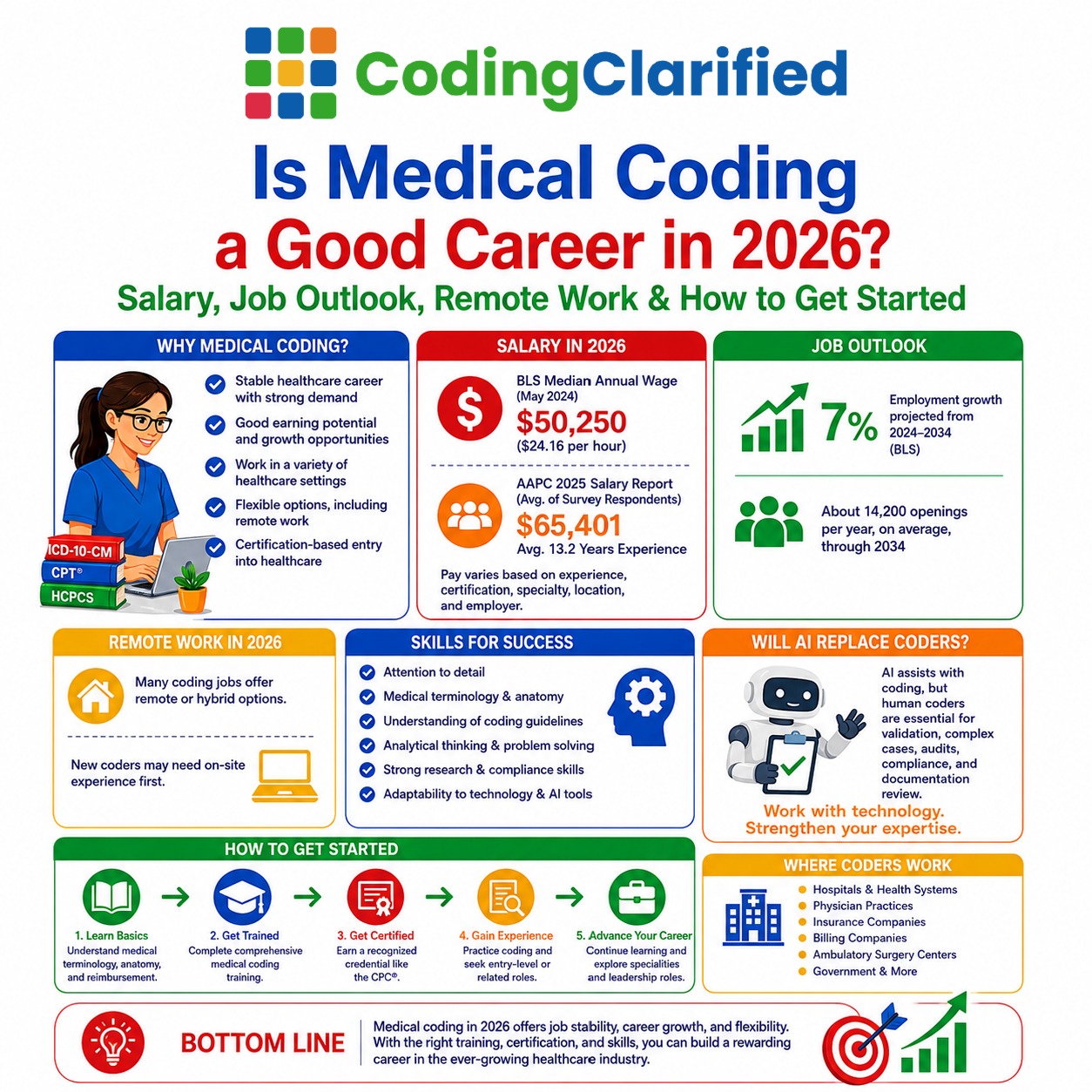
According to the U.S. Bureau of Labor Statistics (BLS), employment for medical records specialists is projected to grow 8% from 2025 through 2035, which is faster than the average for all occupations. BLS also projects approximately 14,000 openings each year, on average, during that period.
So, if you are thinking about becoming a medical coder in 2026, here is what you should know before starting.
Key Takeaways: Medical Coding Careers in 2026
- Medical coding remains a viable healthcare career in 2026.
- The BLS reports a $51,140 median annual wage for medical records specialists based on May 2025 wage data.
- AAPC’s 2025 Medical Coding and Billing Salary Report found that survey respondents earned an average of $65,401 annually, although those respondents averaged 13.2 years of experience.
- BLS projects 8% employment growth from 2025 to 2035 for medical records specialists.
- Certification, experience, specialty knowledge, location, and employer type can significantly affect income.
- Remote medical coding jobs exist, although new coders should not assume their first position will be remote.
- AI is changing medical coding, but human coders remain important for validation, compliance, audits, documentation review, and complex coding decisions.
- The CPC (Certified Professional Coder) remains one of the most recognized credentials for physician and professional-fee coding.
- Students should focus on job-ready skills rather than collecting multiple credentials without practical experience.
What Is Medical Coding?
Medical coding converts information from healthcare documentation into standardized diagnosis and procedure codes. These codes help healthcare organizations report services, submit claims, track healthcare data, and support reimbursement.
Depending on the setting, coders may work with ICD-10-CM, CPT, HCPCS Level II, and ICD-10-PCS.
For example, a physician may document a diagnosis, perform a procedure, and prescribe treatment. A medical coder reviews that documentation and determines which codes accurately represent the services and diagnoses.
However, coding involves much more than entering numbers into software. Coders must understand anatomy, medical terminology, documentation rules, payer requirements, coding guidelines, bundling rules, medical necessity, and compliance.
Therefore, a strong coder must know how to research a coding question and defend the final code selection.
Is Medical Coding a Good Career in 2026?
Medical coding can be a good career for someone who enjoys healthcare, problem-solving, research, rules, and detailed work.
Additionally, coding provides a way to enter healthcare without working directly with patients. You can still play an important role in the healthcare system because accurate coding affects reimbursement, data quality, compliance, and even quality reporting.
The career also offers several directions for advancement. For example, an experienced coder may eventually move into auditing, compliance, clinical documentation improvement, risk adjustment, education, management, revenue cycle, or specialty coding.
Still, medical coding is not a “get certified today and work from home tomorrow” career. New coders often need persistence to land that first position.
If you are preparing to enter the field, read our guide on How to Become a Medical Coder in 2026 for a step-by-step roadmap.
Medical Coder Salary in 2026: What Can You Actually Earn?
Salary is one of the biggest reasons people research medical coding as a career. However, you should be careful when comparing salary numbers because different reports measure different groups of workers.
The U.S. Bureau of Labor Statistics reports that medical records specialists earned a median annual wage of $51,140 in May 2025, or approximately $24.59 per hour.
The lowest 10% earned less than $37,000, while the highest 10% earned more than $81,150.
Meanwhile, AAPC’s 2025 Medical Coding and Billing Salary Report found an average annual salary of $65,401 among its survey respondents. Importantly, respondents averaged 13.2 years of experience, so a brand-new CPC should not assume that $65,401 represents a typical starting salary.
Several factors can affect medical coder pay, including:
- Years of coding experience
- Certification
- Specialty
- Geographic location
- Employer
- Inpatient versus outpatient coding
- Auditing or compliance responsibilities
- Management responsibilities
- Number and type of credentials
Consequently, salary should be viewed as a range rather than a guaranteed starting amount.
Once you receive an offer, our Medical Coding Salary Negotiation Guide can help you evaluate and negotiate compensation.
Medical Coding Job Outlook for 2026 and Beyond
The job outlook remains encouraging.
According to BLS projections, employment for medical records specialists should increase 8% between 2025 and 2035, which BLS describes as much faster than the average for all occupations. Additionally, BLS expects about 14,000 openings each year, on average.
An aging population and the continued treatment of chronic diseases contribute to the need for healthcare documentation and coding. At the same time, technology is making some coding processes more efficient.
This creates an important distinction for students: the future belongs to coders who can analyze documentation, validate automated coding, recognize errors, understand compliance, and solve complex coding problems.
Simply memorizing code ranges will not be enough.
Will AI Replace Medical Coders?
This is one of the most important career questions in 2026.
AI and computer-assisted coding systems can already suggest codes, identify documentation, and automate portions of repetitive coding workflows. In fact, BLS specifically notes that increased adoption of AI-powered solutions may affect demand for medical records specialists.
However, “affect demand” does not mean “eliminate medical coders.”
AI-generated coding still requires oversight, particularly when documentation is unclear, multiple guidelines apply, payer policies conflict, or a coding decision carries compliance risk. Moreover, healthcare organizations need qualified professionals who can audit results and identify incorrect code assignments.
Therefore, medical coders should learn to work with technology rather than compete against it.
The coder of the future may spend less time manually searching for obvious codes and more time validating automated suggestions, researching complex cases, reviewing documentation, preventing denials, supporting audits, and protecting coding compliance.
That shift makes strong coding knowledge even more valuable.
For a deeper look at what AI automates and the skills it cannot replace, read will AI replace medical coders.
Can Medical Coders Work From Home in 2026?
Yes. Many medical coding positions can be performed remotely because coders generally work with electronic health records, coding software, payer portals, and digital documentation.
However, remote work should not be confused with guaranteed entry-level remote employment.
Some employers prefer experienced coders for remote positions because those employees can work independently with less supervision. Therefore, your first opportunity may be an on-site, hybrid, billing, claims, revenue-cycle, or related healthcare position.
Once you gain experience, additional remote opportunities may become available.
For a deeper look at remote coding requirements, read Can Medical Coders Work From Home?.
Do You Need a College Degree to Become a Medical Coder?
Not necessarily.
BLS lists a postsecondary nondegree award as the typical entry-level education for medical records specialists. Some workers enter with different educational backgrounds, while employers may prefer professional certification.
For physician-office coding, the AAPC website describes its Certified Professional Coder credential as the gold standard for physician-office medical coding.
The CPC exam tests knowledge of physician and non-physician provider documentation, CPT, HCPCS Level II, ICD-10-CM, anatomy, medical terminology, compliance, and reimbursement concepts.
Therefore, a focused coding education followed by a respected certification can provide a more direct path into the profession than earning an unrelated four-year degree.
What Does the CPC Certification Cover in 2026?
AAPC’s CPC certification focuses primarily on professional services provided by physicians and other qualified healthcare professionals.
In 2026, AAPC states that the CPC exam contains 100 multiple-choice questions. Candidates can take it online with a live remote proctor or on a computer at an approved testing center in the United States.
The exam evaluates knowledge in areas such as:
- CPT
- ICD-10-CM
- HCPCS Level II
- Evaluation and management
- Surgery
- Anesthesia
- Radiology
- Pathology and laboratory
- Medicine
- Anatomy and physiology
- Medical terminology
- Compliance
- Reimbursement
Because coding rules change regularly, successful coders also need to continue learning after certification.
Who Medical Coding Is a Good Fit For
Medical coding works well for people who like detail, can study steadily, and want a healthcare career without hands on patient care. It is a strong fit for:
- Healthcare workers such as medical assistants, nurses, and EMTs who already know terminology and want a role off the floor.
- Career changers who want a credential based path into healthcare without a degree.
- Military spouses who need a portable career that can move with each relocation. Coding Clarified is MyCAA approved, so eligible spouses may be able to use MyCAA funds for training.
- Parents and caregivers who need remote work options once they have experience.
Who Medical Coding Is Not a Good Fit For
Be honest with yourself before you enroll. Medical coding may not suit you if you:
- Want hands on clinical work with patients.
- Dislike reading detailed documentation and guidelines for hours at a time.
- Expect a high paying remote job the week you pass the exam. Most new coders start in an entry level role and build from there.
- Cannot commit 12 to 15 study hours per week while you train.
What It Costs and How Long It Takes
Our online, instructor-guided CPC course follows a 16 week outline, and students plan 12 to 15 study hours per week. Most students are ready for the CPC exam in about four to six months. Tuition includes your CPC exam voucher, AAPC membership, code books, and Practicode. Many students train at little or no cost through scholarships and WIOA funding in 30+ states, and guaranteed in house financing is available in every state. For a full breakdown, read how much medical coding training costs.
The Gap Nobody Mentions: Certification Without Experience
Passing the CPC exam is only half the story. New coders earn the CPC-A, the apprentice version of the credential, and many employers hesitate to hire coders with no real chart experience. This is the gap most training programs never talk about.
We built our program to close it. Practicode is included in tuition and counts toward removing the A, and our HCC internship and Registered Apprenticeship give you real chart experience to put on your resume before your first job.
Where Can Medical Coders Work?
Medical coders are not limited to physician offices. In fact, coding knowledge can open doors throughout the healthcare revenue cycle.
Potential employers include hospitals, health systems, physician practices, ambulatory surgery centers, insurance companies, billing companies, consulting firms, government organizations, and specialty practices.
Furthermore, coding knowledge can support related positions such as claims examiner, authorization specialist, revenue-cycle representative, charge-entry specialist, medical record reviewer, auditor, compliance specialist, and risk-adjustment coder.
For entry-level options, see Who Hires New CPC-A and CPC Medical Coders?.
How to Become a Medical Coder in 2026
The exact path varies, but most new coders should focus on a few core steps.
First, learn medical terminology, anatomy, and the basic healthcare reimbursement process. Next, complete comprehensive coding training that teaches you how to use CPT, ICD-10-CM, and HCPCS Level II.
After training, prepare for a recognized certification such as the CPC. Then, practice coding real-world scenarios so that you learn how to abstract documentation instead of simply answering textbook questions.
Finally, create a coding-focused resume and start building experience.
Most importantly, do not wait for the perfect “remote medical coder” position before applying. Related revenue-cycle roles can help you gain healthcare experience and create a path into coding.
CPC Student Tips for Starting a Medical Coding Career
Learn the guidelines, not just the codes. Codes change, but understanding how to navigate the code books and apply guidelines gives you a lasting skill.
Practice coding from documentation. Real coding requires you to determine what information matters in a medical record.
Know anatomy and medical terminology. Strong foundational knowledge makes coding much easier, especially in surgery.
Become comfortable researching. Experienced coders still research unfamiliar procedures, payer policies, edits, and guidelines.
Do not collect certifications simply to compensate for lack of experience. One strong credential plus practical skills can be more useful than several credentials with no hands-on knowledge.
Keep learning after the CPC exam. Passing certification proves an important level of knowledge; however, your professional development has only started.
Common Mistakes to Avoid When Starting a Medical Coding Career
Expecting an Immediate Remote Job
Remote coding exists, but many employers prefer experience. Therefore, remain open to hybrid, on-site, billing, claims, and other revenue-cycle positions that can help you build your resume.
Assuming Certification Guarantees Employment
The CPC can strengthen your qualifications, but employers also evaluate experience, communication, accuracy, specialty knowledge, and professionalism.
Ignoring Medical Terminology and Anatomy
You cannot consistently code complex records if you do not understand what the provider documented. Consequently, these subjects should be treated as core coding skills rather than optional background knowledge.
Applying Only for Jobs With “Medical Coder” in the Title
Claims, billing, authorization, charge entry, reimbursement, and medical-record positions can provide valuable experience. Additionally, they may give new coders a way into an organization that promotes internally.
Assuming AI Makes Coding Knowledge Less Important
Automation makes weak coding knowledge more dangerous, not less important. Coders need enough expertise to recognize when software produces the wrong answer.
Why Medical Coding Can Still Be a Smart Career Move in 2026
Medical coding combines healthcare knowledge, technology, research, compliance, and problem-solving. Moreover, it provides several career paths without requiring direct patient care.
The field is changing, but change does not automatically mean decline.
Instead, healthcare organizations increasingly need professionals who understand both coding rules and the technology used to apply them. Coders who develop skills in auditing, documentation, compliance, denials, risk adjustment, and specialty coding may have even more ways to advance.
If you enjoy detail-oriented work and continuous learning, medical coding may be worth exploring.
Above all, approach it as a professional healthcare career, not a quick work-from-home opportunity.
Frequently Asked Questions About Medical Coding Careers in 2026
Quick answers to the questions people ask most about medical coding as a career.
Is medical coding a good career in 2026?
Yes, medical coding can still be a good career in 2026. BLS projects 8% growth for medical records specialists from 2025 through 2035. However, job seekers should expect technology and AI to change daily coding workflows.
How much do medical coders make in 2026?
The latest BLS wage data reports a median annual wage of $51,140 for medical records specialists as of May 2025. Meanwhile, AAPC’s 2025 salary report found an average of $65,401 among survey respondents, who averaged 13.2 years of experience. Actual pay varies based on experience, credentials, employer, specialty, and location.
Can I become a medical coder without a degree?
Yes. A four-year college degree is not universally required to become a medical coder. BLS lists a postsecondary nondegree award as the typical entry-level education for medical records specialists, while many employers prefer professional certification.
Can a new medical coder work from home?
Possibly, but new coders should not assume their first position will be remote. Some employers require previous coding experience before allowing coders to work independently from home. Therefore, remaining open to on-site and hybrid opportunities can improve your chances of gaining experience.
Will AI replace medical coding jobs?
AI will likely automate some routine coding tasks, but human coding expertise remains important for complex cases, audits, documentation review, compliance, and validating automated code assignments. Consequently, coders should learn how to use AI-assisted technology while strengthening their analytical skills.
What certification should a new medical coder get?
For physician-office and professional-fee coding, the CPC is one of the most widely recognized credentials. AAPC states that the CPC demonstrates proficiency in CPT, HCPCS Level II, ICD-10-CM, documentation review, compliance, and professional coding.
Is medical coding hard to learn?
Medical coding has a learning curve because students need to understand anatomy, terminology, coding guidelines, reimbursement, and multiple code sets. However, structured training and consistent practice can make these concepts easier to understand.
How do I get my first medical coding job with no experience?
Start by earning a recognized credential, practicing real-world coding, creating a targeted resume, networking, and applying broadly. In addition, consider related positions in billing, claims, prior authorization, revenue cycle, and medical records because these jobs can help you build experience that leads to a coding role.
Coding Clarified Final Thoughts
Medical coding in 2026 is not exactly the same career it was a decade ago. Technology is improving, AI is becoming more common, and employers increasingly value coders who can analyze documentation and solve complex problems.
Still, the fundamentals remain important: accurate coding, strong documentation knowledge, compliance, research skills, and healthcare expertise.
For the right person, medical coding can provide a long-term healthcare career with opportunities to specialize, advance, and potentially work remotely.
The key is to enter the field with realistic expectations, strong training, a recognized certification, and a willingness to continue learning as healthcare changes. Learn more about Coding Clarified.