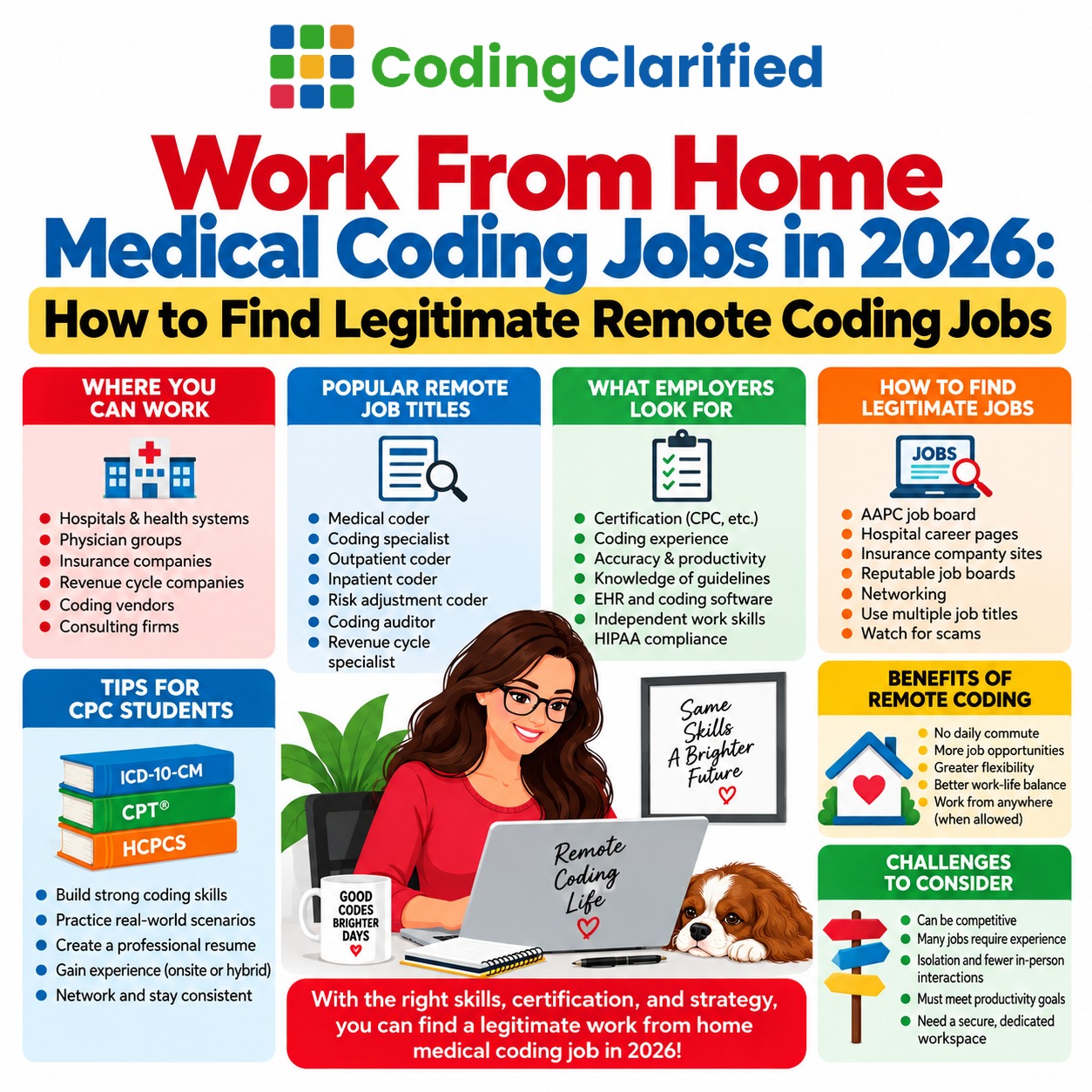
Working from home is one of the biggest reasons people become interested in medical coding. Fortunately, work from home medical coding jobs are available in 2026, and experienced, certified coders can find fully remote opportunities with hospitals, physician groups, insurance companies, revenue cycle organizations, consulting companies, and other healthcare employers.
However, there is an important reality new medical coders need to understand. Remote medical coding jobs can be competitive, and many employers prefer applicants who already have coding experience.
Therefore, earning a CPC certification can be an important first step, but certification alone does not guarantee an immediate remote position.
This 2026 guide explains where remote medical coders work, what employers are looking for, how much medical coders can earn, where to search for legitimate jobs, and how new CPC and CPC-A coders can improve their chances of getting hired.
Key Takeaways: Work From Home Medical Coding Jobs in 2026
- Remote medical coding jobs are available throughout the United States in 2026.
- Hospitals, health systems, insurance companies, physician groups, revenue cycle companies, and coding vendors hire remote coders.
- Certification such as the CPC, COC, CIC, CCS, or CRC can make candidates more competitive.
- Many remote positions require at least one to three years of coding experience, while advanced positions may require even more.
- Entry-level coders should not limit their search to jobs labeled “remote medical coder.”
- Employers may use titles such as coding specialist, coding analyst, risk adjustment coder, coding auditor, outpatient coder, professional coder, or revenue cycle specialist.
- Remote coders still must meet accuracy, productivity, compliance, and HIPAA privacy requirements.
- AI is changing coding workflows; however, human coders remain important for validation, documentation review, audits, compliance, and complex coding decisions.
- A private workspace, reliable high-speed internet, computer skills, and the ability to work independently are increasingly important.
- New CPC-A coders may need to gain experience through onsite positions, hybrid jobs, internships, apprenticeships, Practicode, or related healthcare roles before landing a fully remote coding job.
Can Medical Coders Really Work From Home in 2026?
Yes. Medical coding is well suited for remote work because most modern coding workflows use electronic health records, encoders, coding software, secure networks, and digital communication tools.
In fact, current 2026 job listings include fully remote medical coder, professional coder, outpatient coder, coding educator, risk adjustment, and contract coding positions.
Still, “remote” does not always mean “work from anywhere.”
For example, an employer may require employees to live in certain states because of payroll, tax, licensing, client, or employment requirements. Likewise, some organizations require remote employees to attend occasional meetings, training sessions, or onsite events.
Consequently, always read the location requirements before applying.
What Does a Remote Medical Coder Do?
A work-from-home medical coder performs many of the same duties as an onsite coder. The main difference is where the work occurs.
Depending on the position, remote medical coders may:
- Review electronic medical records.
- Abstract diagnoses and procedures from documentation.
- Assign ICD-10-CM diagnosis codes.
- Assign CPT and HCPCS Level II procedure and supply codes.
- Review modifiers and payer requirements.
- Code professional, outpatient, inpatient, surgical, emergency department, or specialty services.
- Review documentation for medical necessity.
- Identify missing or unclear documentation.
- Submit provider queries when appropriate.
- Follow official coding guidelines and payer policies.
- Meet productivity and accuracy standards.
- Participate in coding audits and education.
- Work with billing, compliance, CDI, and revenue cycle teams.
Furthermore, some experienced coders move beyond production coding into auditing, education, compliance, clinical documentation improvement, risk adjustment, or management.
Are Remote Medical Coding Jobs in Demand?
Medical coding remains part of a growing healthcare information workforce.
The U.S. Bureau of Labor Statistics classifies many medical coding professionals within the broader medical records specialist occupation. Based on its latest 2026 Occupational Outlook Handbook data, BLS projects employment of medical records specialists to grow 8% from 2025 through 2035, which is faster than the projected average for all occupations.
Additionally, BLS projects about 14,000 openings per year, on average, during that period.
Healthcare organizations still need people who can interpret clinical documentation, understand coding guidelines, identify errors, support reimbursement, and protect coding compliance. Meanwhile, automation and artificial intelligence are changing how some of this work gets completed.
As a result, coders who can evaluate AI-generated coding suggestions rather than simply accept them may become increasingly valuable.
Authoritative resource: U.S. Bureau of Labor Statistics – Medical Records Specialists
How Much Do Work From Home Medical Coders Make in 2026?
Pay varies significantly based on certification, experience, specialty, employer, geographic location, and job responsibilities.
According to the latest BLS data available in 2026, the median annual wage for medical records specialists was $51,140 in May 2025.
However, medical coding salaries can fall above or below that figure. An experienced surgical coder, auditor, inpatient coder, risk adjustment specialist, or coding educator may have different earning potential than someone beginning an entry-level coding career.
Additionally, remote status does not automatically mean higher pay. Some employers base compensation on the employee’s geographic location, while others use a national salary range.
What Certifications Help You Get a Remote Medical Coding Job?
Certification can demonstrate that you understand professional coding standards and guidelines.
AAPC offers several credentials, including:
- CPC – Certified Professional Coder
- COC – Certified Outpatient Coder
- CIC – Certified Inpatient Coder
- CRC – Certified Risk Adjustment Coder
- CPMA – Certified Professional Medical Auditor
- CPB – Certified Professional Biller
For many people entering physician-based medical coding, the CPC certification is a strong starting point.
AAPC describes the CPC as its primary professional coding credential and tests knowledge of areas such as medical terminology, anatomy, coding guidelines, compliance, CPT, ICD-10-CM, and HCPCS Level II.
Authoritative resource: AAPC – How to Get CPC Certified
If you are just beginning your career, read our guide: How to Become a Medical Coder in 2026: 10 Steps to Start Your Career.
Can You Get a Work From Home Medical Coding Job With No Experience?
It is possible, but it is usually more difficult.
One of the biggest misconceptions about medical coding is that a student completes a course, earns the CPC-A, and immediately receives a high-paying remote coding job.
That does happen for some people. Nevertheless, it should not be treated as the normal career path.
Many remote coding job postings ask for previous coding experience because employers expect remote employees to work independently. Current postings may request one, three, or even five years of experience depending on the coding specialty and level of responsibility.
For that reason, new coders should consider a wider range of opportunities.
An onsite coding position, billing job, patient accounts position, claims role, prior authorization job, charge entry position, medical records role, internship, apprenticeship, or hybrid coding job can provide valuable healthcare experience.
Then, once you have demonstrated accuracy and productivity, moving into remote coding may become much easier.
For more help, see The Truth About CPC-A Jobs: What New Medical Coders Need to Know.
Where to Find Legitimate Remote Medical Coding Jobs in 2026
Start with reputable healthcare job boards, employer career pages, professional associations, hospital systems, insurance companies, and established revenue cycle organizations.
AAPC maintains a healthcare job board that regularly includes remote coding opportunities.
Job resource: AAPC Healthcare Careers – Remote Jobs
However, do not search only for “work from home medical coder.”
Instead, try searches such as:
- Remote medical coder
- Remote CPC coder
- Remote coding specialist
- Remote professional coder
- Remote outpatient coder
- Remote inpatient coder
- Remote risk adjustment coder
- HCC coder
- Coding auditor
- Coding quality specialist
- Coding educator
- Revenue cycle specialist
- Medical billing and coding specialist
- Coding compliance specialist
- Clinical documentation specialist
Using several job titles can uncover opportunities that a narrow search may miss.
Our How to Find a Medical Coding Job in 2026 guide explains additional strategies for resumes, job searches, networking, and interviews.
What Employers Look for in Remote Medical Coders
Remote employers are not simply looking for someone who knows how to locate a code.
Instead, they need coders who can make accurate decisions with limited supervision.
Strong candidates typically demonstrate knowledge of current ICD-10-CM, CPT, and HCPCS Level II coding guidelines. Additionally, employers may evaluate experience with E/M coding, specialty coding, payer policies, medical terminology, anatomy, compliance, electronic health records, and coding software.
Accuracy and productivity are equally important.
Remote coders may have daily or weekly productivity requirements as well as minimum accuracy standards. Therefore, working from home does not mean working whenever you want or completing assignments without performance expectations.
What Do You Need to Work From Home as a Medical Coder?
Requirements vary by employer. However, a professional remote setup commonly includes reliable high-speed internet, a dedicated workspace, secure computer access, strong computer skills, and the ability to protect confidential information.
Employers may supply computer equipment and monitors. Conversely, others may have specific requirements regarding internet service or home office equipment.
Patient privacy remains essential.
Remote employees who access protected health information must follow their employer’s privacy and security policies. Therefore, coding from a busy coffee shop or leaving patient information visible to family members would generally conflict with a secure professional workflow.
Some current nationwide remote coding postings specifically require a dedicated work area separated from other living areas and procedures for keeping sensitive information secure.
Advantages of Working From Home as a Medical Coder
Remote coding can offer meaningful benefits. For example, eliminating a daily commute can save both time and transportation costs.
Additionally, remote work may provide:
- Access to employers outside your immediate area.
- Greater independence.
- Reduced commuting expenses.
- A quieter work environment.
- More employment options for people who do not live near major healthcare systems.
- Potential schedule flexibility, depending on the employer.
Nevertheless, remote coding is still a professional job. Employers generally expect coders to be available during assigned hours, attend meetings, meet deadlines, and achieve quality standards.
Challenges of Remote Medical Coding
Working from home is not ideal for everyone.
Isolation can be difficult, especially for new coders who benefit from immediate feedback. Likewise, communication with providers, auditors, managers, and other coders may require email, chat, video meetings, and workflow platforms instead of face-to-face conversations.
Productivity can also become challenging when home distractions are present.
For this reason, successful remote coders tend to have strong time-management skills, self-discipline, attention to detail, and the ability to ask questions when documentation or coding guidance is unclear.
Read How to Be a Successful Remote Medical Coder for additional work-from-home strategies.
How AI Is Changing Remote Medical Coding Jobs in 2026
Artificial intelligence is becoming more visible throughout healthcare revenue cycle operations.
AI-assisted coding systems can review documentation, suggest codes, flag records, and help prioritize workflows. However, coding is not simply matching words in a medical record to a code.
Coders must understand documentation context, official guidelines, payer rules, compliance requirements, sequencing, medical necessity, and when a suggested code is unsupported.
Therefore, students should learn how to validate technology rather than compete with it.
The coder who can identify why an AI-generated recommendation is wrong may provide far more value than someone who simply accepts the suggested code.
CPC Student Tips for Getting a Remote Medical Coding Job
If you are currently studying for the CPC exam, begin preparing for employment before you finish your course.
First, practice reading real-world medical documentation rather than relying only on short textbook questions. Next, strengthen your medical terminology, anatomy, ICD-10-CM, CPT, and HCPCS Level II skills.
Additionally, learn basic Excel, EHR navigation concepts, professional email communication, and time management.
Students should also create a professional resume and LinkedIn profile before certification. Then, begin networking with other coders and researching employers so your job search does not start from zero after passing the CPC exam.
Most importantly, do not reject an excellent first job simply because it is not remote.
Six months or a year of strong healthcare experience may help you become a much more competitive candidate for future work-from-home positions.
Common Mistakes to Avoid When Looking for Remote Medical Coding Jobs
Applying Only for Jobs With “Medical Coder” in the Title
Employers use many different job titles. Therefore, expand your search to coding specialist, coding analyst, revenue cycle specialist, risk adjustment coder, claims analyst, coding auditor, and related positions.
Applying Only for Remote Jobs
Remote positions often attract applicants from a much larger geographic area. Consequently, new coders may face experienced candidates from across the country.
Consider onsite and hybrid opportunities while building experience.
Assuming CPC Certification Guarantees Employment
Certification demonstrates knowledge, but employers may still want experience, speed, accuracy, specialty knowledge, and strong communication skills.
Instead, treat certification as the beginning of your professional development.
Using the Same Resume for Every Application
Applicant tracking systems may look for skills and keywords contained in the job posting.
Therefore, customize your resume to emphasize the experience and qualifications that match each legitimate position.
Ignoring Coding Assessments
Many employers test candidates before making an offer.
Practice coding complete cases under time limits, and make sure you can explain how you reached your answer.
Falling for Work-From-Home Job Scams
Be cautious when an alleged employer asks you to pay for equipment, send money, purchase gift cards, deposit suspicious checks, or provide sensitive financial information before normal hiring procedures occur.
Likewise, verify the employer and apply through established company career pages whenever possible.
The Best Strategy for Landing a Remote Coding Job
Think of remote medical coding as a career goal rather than a promise attached to certification.
Start by building strong coding knowledge. Then, earn a recognized credential, gain practical experience, develop professional references, and learn how healthcare organizations actually use coding data.
Next, search broadly and apply consistently.
If your first opportunity is onsite or hybrid, use it to build measurable experience. Track your coding specialties, accuracy rates, productivity, software experience, and responsibilities so you can show future employers what you have accomplished.
Ultimately, experience plus certification can make you far more competitive for remote opportunities.
Is Work From Home Medical Coding a Good Career in 2026?
For the right person, yes.
Medical coding can offer a healthcare career that does not require direct patient care, and many positions can eventually be performed remotely. Moreover, BLS continues to project faster-than-average growth for medical records specialists.
Still, students should enter the profession with realistic expectations.
A remote position may be your first job, but it may also be your second or third. Either path can lead to a successful work-from-home medical coding career.
Learn more in our complete guide: Is Medical Coding a Good Career in 2026? Salary, Job Outlook, Remote Work & How to Get Started.
Frequently Asked Questions About Work From Home Medical Coding Jobs
Quick answers to the questions coders ask most about work-from-home medical coding jobs.
Can medical coders work from home in 2026?
Yes. Hospitals, insurance companies, physician groups, revenue cycle organizations, coding companies, and other healthcare employers offer remote medical coding positions. However, specific requirements vary by employer.
Can a CPC-A get a remote medical coding job?
Yes, a CPC-A can qualify for some remote positions. However, many remote jobs prefer previous coding experience. Therefore, CPC-A candidates should also consider onsite, hybrid, internship, apprenticeship, billing, claims, and other related healthcare opportunities.
Do you need experience to become a remote medical coder?
Not every remote coding position requires experience, but many do. Current job postings commonly request one or more years of coding experience, while advanced positions may require several years.
What certification is best for working from home as a medical coder?
The right certification depends on the type of coding you want to perform. The CPC is widely used for professional-fee coding, while credentials such as the COC, CIC, CRC, CCS, and others may support different coding specialties and settings.
How much do remote medical coders make in 2026?
Salary varies based on certification, experience, specialty, employer, and location. The U.S. Bureau of Labor Statistics reports that medical records specialists earned a median annual wage of $51,140 in May 2025, based on the latest data available in 2026.
What equipment do remote medical coders need?
Requirements differ by employer. Generally, remote coders need reliable high-speed internet, a private workspace, secure computer access, and appropriate monitors or equipment. Employers may provide some or all required hardware.
Are remote medical coding jobs legitimate?
Yes, thousands of healthcare professionals perform coding and related revenue cycle work remotely. However, job seekers should verify employers carefully and watch for scams involving requests for money, suspicious checks, gift cards, or unusual requests for personal financial information.
Will AI replace remote medical coders?
AI is likely to change medical coding workflows rather than eliminate every coding role. In 2026, healthcare organizations still need knowledgeable professionals who can validate coding, interpret documentation, apply guidelines, perform audits, address compliance issues, and identify incorrect automated recommendations.
Coding Clarified Final Thoughts
Work from home medical coding jobs remain a realistic career option in 2026, but getting one requires more than searching for “remote coder” and submitting applications.
Certification, current coding knowledge, practical experience, accuracy, technology skills, and professionalism all matter. Furthermore, new coders who remain open to onsite, hybrid, internship, apprenticeship, and related healthcare positions can build the experience employers want. Learn more about Coding Clarified.
Remote medical coding can be an excellent long-term career goal. However, focus first on becoming a skilled, accurate, employable medical coder. Once you build that foundation, where you perform the work becomes much easier to negotiate.