ICD-10 Training Courses in 2026: How the Right Training Can Help Your Medical Coding Career
If you want to become a successful medical coder, learning ICD-10-CM is one of the most important steps you can take. Every diagnosis reported on a medical claim depends on accurate ICD-10-CM coding. Employers expect coders to understand coding guidelines, sequencing rules, documentation requirements, and payer expectations before they enter the workforce.
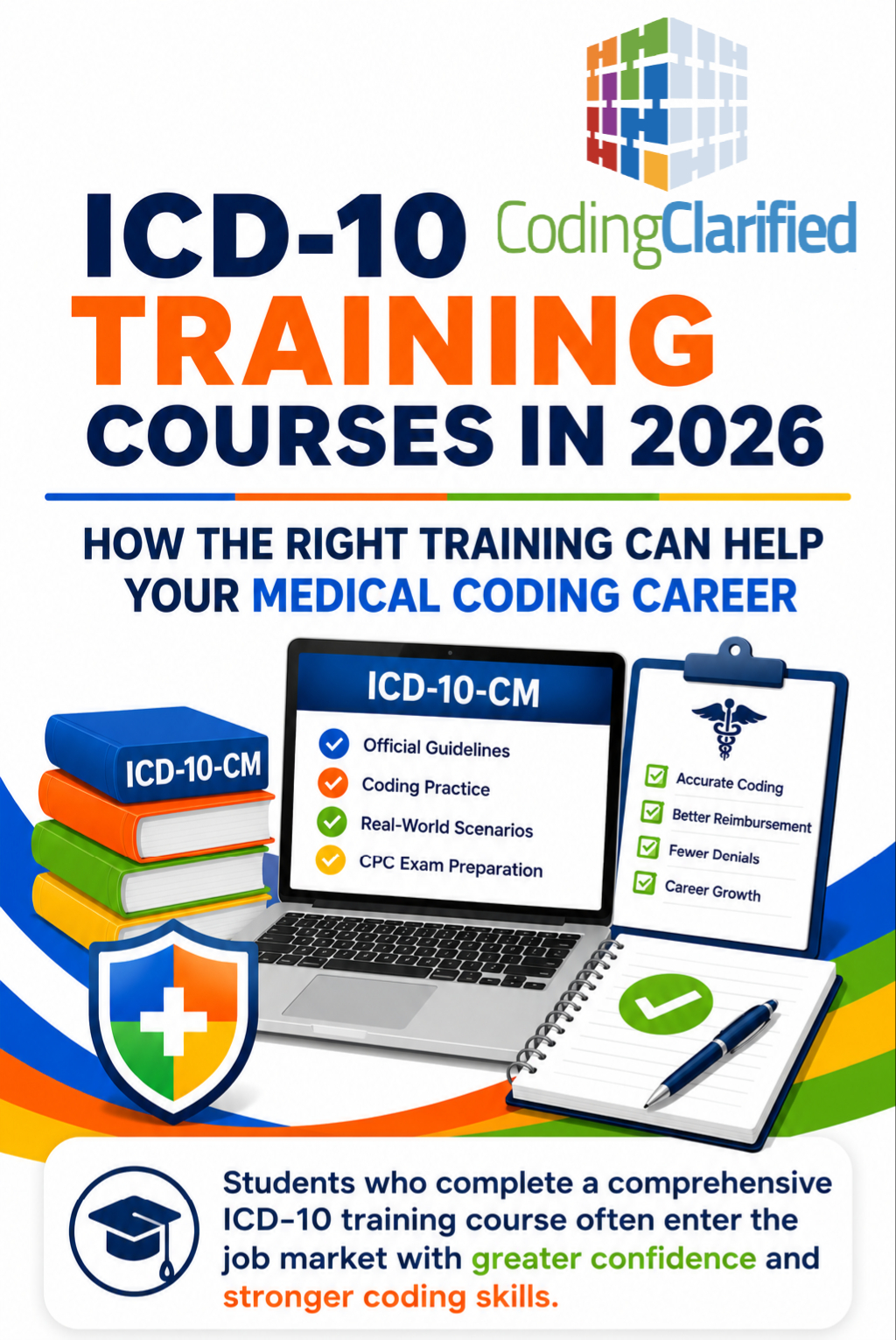
In 2026, healthcare organizations continue to place greater emphasis on coding accuracy, compliance, reimbursement, and data quality. Consequently, students who complete a comprehensive ICD-10 training course often enter the job market with greater confidence and stronger coding skills.
Whether you’re preparing for the AAPC CPC® exam, starting a new career, or improving your coding knowledge, quality ICD-10 training can make a significant difference.
Key Takeaways
- ICD-10 training teaches much more than diagnosis code lookup.
- Employers value coders who understand official coding guidelines.
- Strong ICD-10 knowledge improves CPC exam performance.
- Learning coding guidelines helps reduce claim denials.
- Continuous education remains essential because ICD-10 updates occur every year.
- Practical coding experience prepares students for real-world medical coding jobs.
Why ICD-10 Training Matters More Than Ever in 2026
Medical coding has become increasingly detailed over the past several years. Documentation requirements continue to expand, while payer policies become more complex.
ICD-10-CM contains tens of thousands of diagnosis codes, and selecting the correct diagnosis requires much more than locating a code in the Alphabetic Index.
Professional coders must understand:
- Official ICD-10-CM Coding Guidelines
- Laterality
- Combination codes
- Manifestation coding
- Etiology sequencing
- Excludes1 and Excludes2 notes
- Code First instructions
- Use Additional Code notes
- Seventh-character extensions
- Placeholder “X”
- Documentation requirements
A quality ICD-10 training course teaches students how all these concepts work together instead of simply memorizing diagnosis codes.
What Is ICD-10-CM?
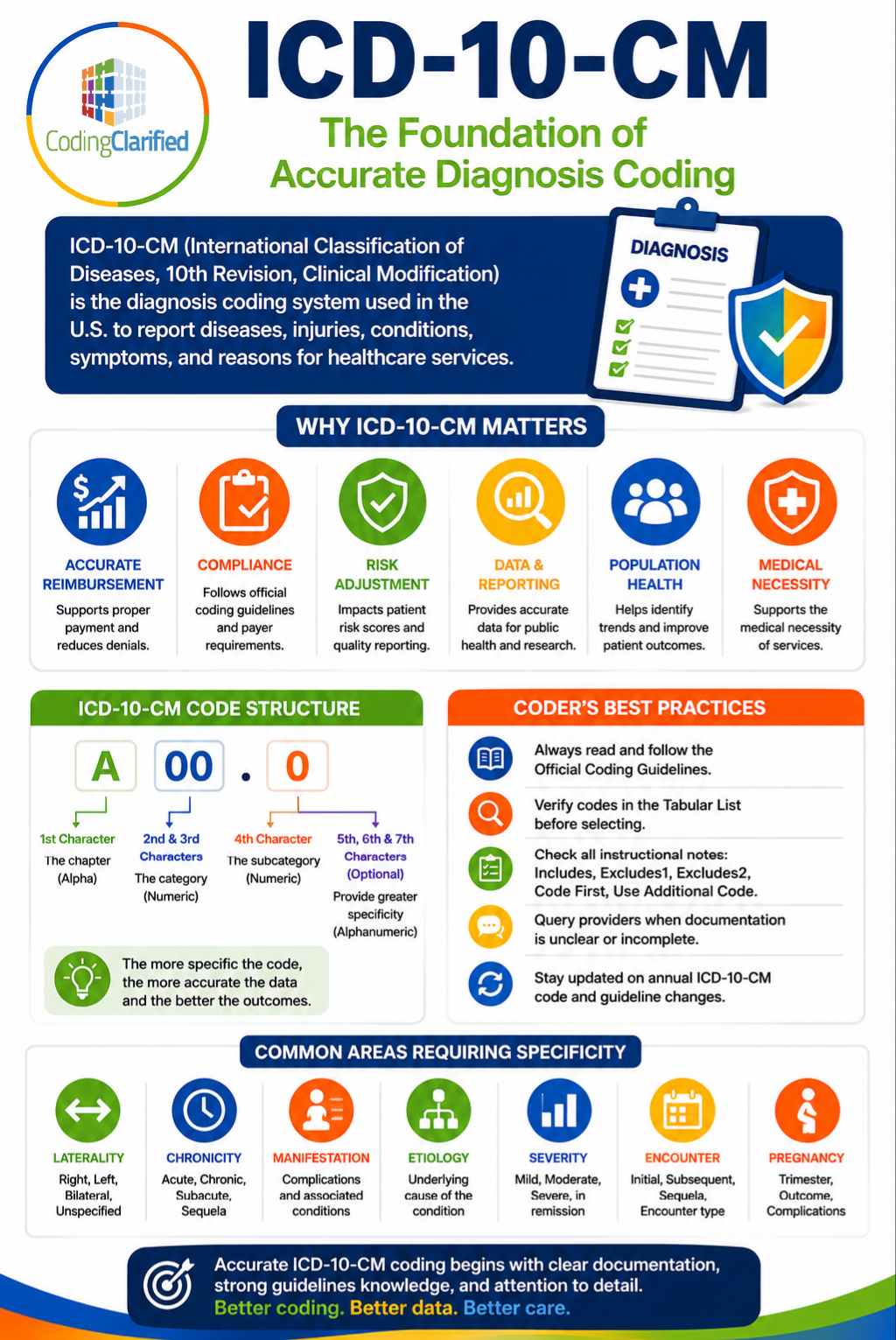
ICD-10-CM (International Classification of Diseases, 10th Revision, Clinical Modification) is the diagnosis coding system used throughout the United States to report diseases, injuries, illnesses, symptoms, and healthcare encounters.
Medical coders assign ICD-10-CM codes based entirely on provider documentation.
These diagnosis codes affect:
- Medical necessity
- Insurance reimbursement
- Risk adjustment
- Quality reporting
- Public health reporting
- Healthcare statistics
- Population health initiatives
Without accurate ICD-10 coding, providers may experience payment delays or claim denials.
What You’ll Learn in an ICD-10 Training Course
A quality training program should cover much more than code lookup.
Students should learn:
Medical Terminology
Understanding anatomy and medical language allows coders to interpret provider documentation correctly.
Students typically study:
- Prefixes
- Suffixes
- Root words
- Body systems
- Disease processes
- Common medical abbreviations
Without medical terminology, diagnosis coding becomes much more difficult.
Anatomy and Physiology
Coders must understand where diseases occur within the body.
For example:
A provider documents osteoarthritis of the right knee.
The coder must recognize:
- Joint involved
- Laterality
- Disease process
- Supporting documentation
That knowledge leads to the correct diagnosis code instead of guessing.
ICD-10-CM Guidelines
One of the biggest mistakes new coders make is focusing only on finding diagnosis codes.
Professional coders rely heavily on the Official ICD-10-CM Guidelines.
Students learn how to apply:
- Code First notes
- Use Additional Code notes
- Excludes1
- Excludes2
- NEC
- NOS
- Includes notes
- Laterality
- Placeholder X
- Seventh characters
These rules determine code selection every day.
Diagnosis Coding Practice
The best ICD-10 courses include hundreds of coding scenarios.
Students practice coding:
- Office visits
- Hospital encounters
- Emergency department cases
- Chronic diseases
- Injuries
- Obstetrics
- Pediatrics
- Mental health
- Surgical follow-up
- Preventive services
Hands-on practice builds confidence far more effectively than reading alone.
Why Employers Value Strong ICD-10 Skills
Healthcare employers want coders who can accurately assign diagnosis codes without excessive corrections.
Strong ICD-10 skills help reduce:
- Coding errors
- Claim denials
- Payment delays
- Compliance risks
- Audit findings
As a result, employers often prefer candidates who have completed structured ICD-10 training rather than relying solely on self-study.
ICD-10 Training Helps You Pass the CPC Exam
The AAPC CPC® certification exam tests diagnosis coding throughout the examination.
Students who understand ICD-10 guidelines generally perform better because they know how to apply coding rules rather than memorize answers.
Strong ICD-10 knowledge helps answer questions involving:
- Diagnosis sequencing
- Medical necessity
- Coding guidelines
- Documentation interpretation
- Compliance
- Combination codes
Since diagnosis coding appears throughout multiple exam sections, mastering ICD-10 improves overall exam readiness.
2026 ICD-10-CM Updates Continue Every Year
Many new students assume ICD-10 remains unchanged.
Actually, the code set receives annual updates.
Each year may include:
- New diagnosis codes
- Deleted codes
- Revised code descriptions
- Updated coding guidelines
- New instructional notes
Successful coders stay current by reviewing yearly updates and continuing education.
ICD-10 and CPT® Work Together
Medical coding involves both diagnosis and procedure coding.
While ICD-10-CM explains why the patient received care, CPT® explains what service the provider performed.
For example:
Diagnosis:
- M17.11 – Unilateral primary osteoarthritis, right knee
Procedure:
- 27447 – Total knee arthroplasty
Both codes must support medical necessity for reimbursement.
Understanding this relationship makes coders much more valuable to employers.
Who Should Take an ICD-10 Training Course?
ICD-10 education benefits many healthcare professionals.
Ideal students include:
- Future medical coders
- Medical billers
- CPC students
- CPB students
- Nurses
- Medical assistants
- Practice managers
- Revenue cycle professionals
- Insurance specialists
- Clinical documentation specialists
Even experienced coders benefit from refresher courses when guidelines change.
How to Choose the Best ICD-10 Training Program
Not every course provides the same level of education.
Look for programs that include:
- Experienced instructors
- Live support
- Coding scenarios
- Practice exams
- Current ICD-10-CM code books
- Updated 2026 guidelines
- CPC exam preparation
- Anatomy instruction
- Medical terminology
- Real-world coding cases
Programs offering instructor feedback often produce stronger coding skills than instructor-led reading alone.
CPC Student Tips
If you’re preparing for the CPC exam, these habits can improve your success:
- Read the ICD-10 guidelines before coding.
- Verify every diagnosis in the Tabular List.
- Never code directly from the Alphabetic Index.
- Practice coding every day instead of cramming.
- Highlight important instructional notes in your code book.
- Learn sequencing rules before memorizing codes.
- Review documentation carefully before selecting a diagnosis.
- Complete full-length practice exams under timed conditions.
Small improvements made consistently often lead to much higher exam scores.
Common Mistakes to Avoid
Many beginning coders slow their progress by making avoidable mistakes.
Common errors include:
- Coding directly from the Alphabetic Index.
- Ignoring Excludes notes.
- Missing laterality.
- Forgetting seventh characters.
- Selecting unspecified codes when documentation is more specific.
- Skipping the Official Coding Guidelines.
- Memorizing diagnosis codes without understanding the rules.
- Not staying current with annual ICD-10 updates.
Developing good habits early helps prevent these mistakes throughout your career.
Why Continuous ICD-10 Education Matters
Healthcare coding changes every year.
New technologies, diseases, quality initiatives, and payer requirements continue to shape coding practices.
Professional coders who continue learning often experience:
- Better job opportunities
- Greater confidence
- Higher coding accuracy
- Increased productivity
- Better audit outcomes
- Improved reimbursement knowledge
Learning should continue long after earning your certification.
Frequently Asked Questions (FAQ)
What is ICD-10-CM?
ICD-10-CM is the diagnosis coding system used in the United States to report diseases, injuries, conditions, symptoms, and reasons for healthcare services.
Is ICD-10 training required to become a medical coder?
Although there is no legal requirement, employers strongly prefer candidates with formal ICD-10 education because diagnosis coding is a core job responsibility.
How long does it take to learn ICD-10 coding?
Most students need several months of structured study, along with regular coding practice, to become comfortable applying ICD-10-CM guidelines.
Does ICD-10 change every year?
Yes. New diagnosis codes, revisions, deletions, and guideline updates are typically released annually, making continuing education important.
Is ICD-10 enough to become a medical coder?
No. Professional coders should also learn CPT®, HCPCS Level II, medical terminology, anatomy, physiology, and reimbursement concepts.
Does ICD-10 help with the CPC exam?
Absolutely. Diagnosis coding appears throughout the CPC exam, and a strong understanding of ICD-10-CM guidelines improves coding accuracy and exam performance.
Can experienced coders benefit from ICD-10 refresher courses?
Yes. Even experienced professionals benefit from annual update training because coding rules, documentation expectations, and payer requirements continue to evolve.
Additional Resources
Continue learning with these Coding Clarified articles:
- Ultimate Medical Coding AAPC CPC Certification Guide
- Medical Coding – Job Growth – CPC Certification – Job Search Strategy and Salary
- Coding Clarified CPC Course
- Coding Clarified Purchase Options
- Coding Clarified WIOA Scholarships
Authoritative References
- AAPC ICD-10 resources
- Centers for Medicare & Medicaid Services (CMS)
- National Correct Coding Initiative (NCCI)
- ICD-10-CM Official Guidelines for Coding and Reporting
Coding Clarified Final Thoughts
ICD-10 training remains one of the smartest investments aspiring medical coders can make in 2026. Strong diagnosis coding skills support accurate reimbursement, improve compliance, and prepare students for certification exams and real-world coding positions.
Rather than simply memorizing diagnosis codes, focus on understanding coding guidelines, sequencing, documentation, and critical thinking. Those skills will serve you throughout your medical coding career.
Whether you’re beginning your journey or refreshing your knowledge, comprehensive ICD-10 training provides the foundation needed for long-term success.