Choosing the right medical coding school can shape your entire career. Although many training programs promise fast results, not every school provides the education, support, and real-world preparation employers expect. Therefore, taking time to compare programs before enrolling can save you money, reduce frustration, and improve your chances of passing the CPC® exam on your first attempt.
Medical coding continues to be one of the fastest-growing healthcare careers that allows professionals to work in hospitals, physician offices, insurance companies, government agencies, and increasingly from home. However, employers are becoming more selective about who they hire. As a result, students who complete comprehensive training often have a significant advantage over those who choose the cheapest or shortest course available.
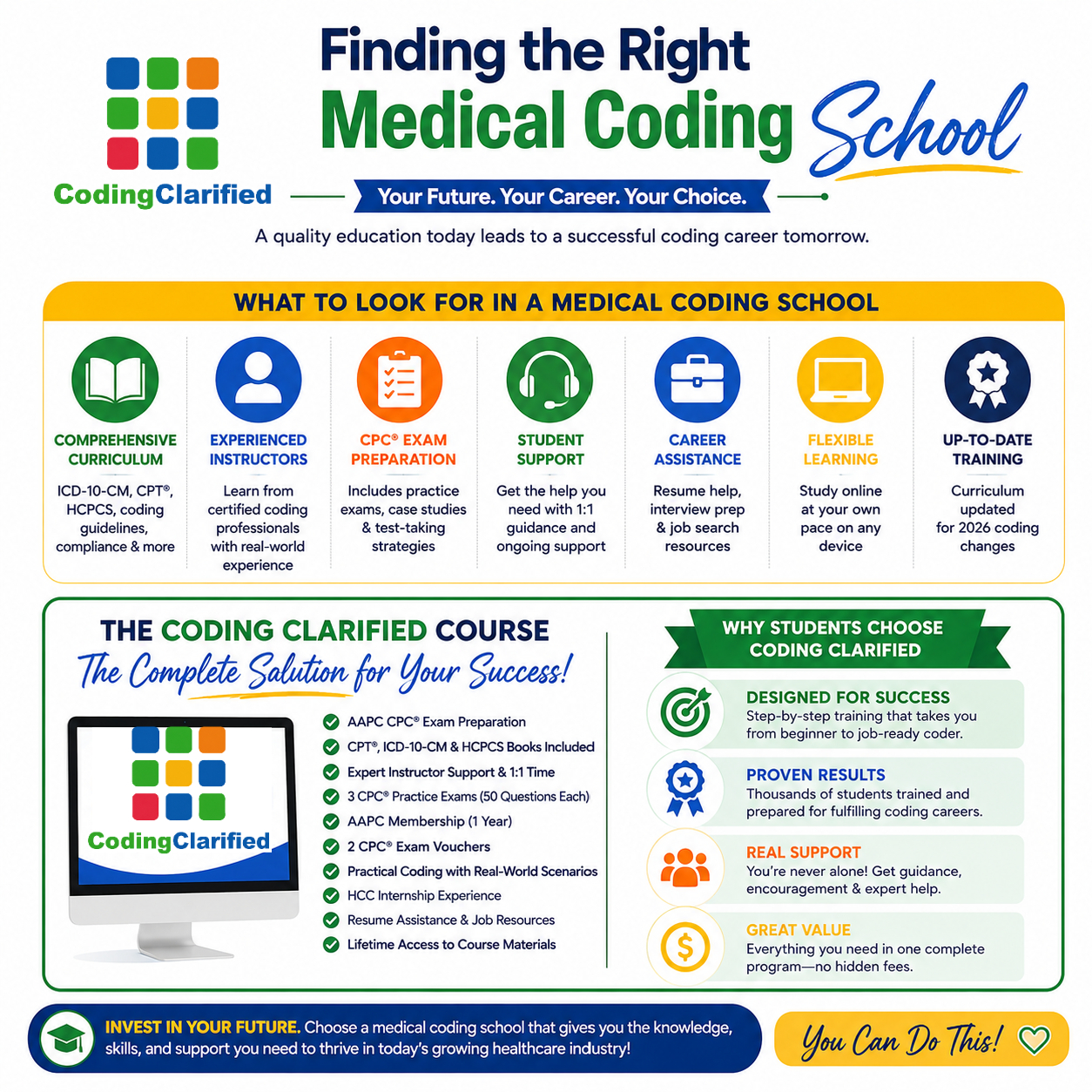
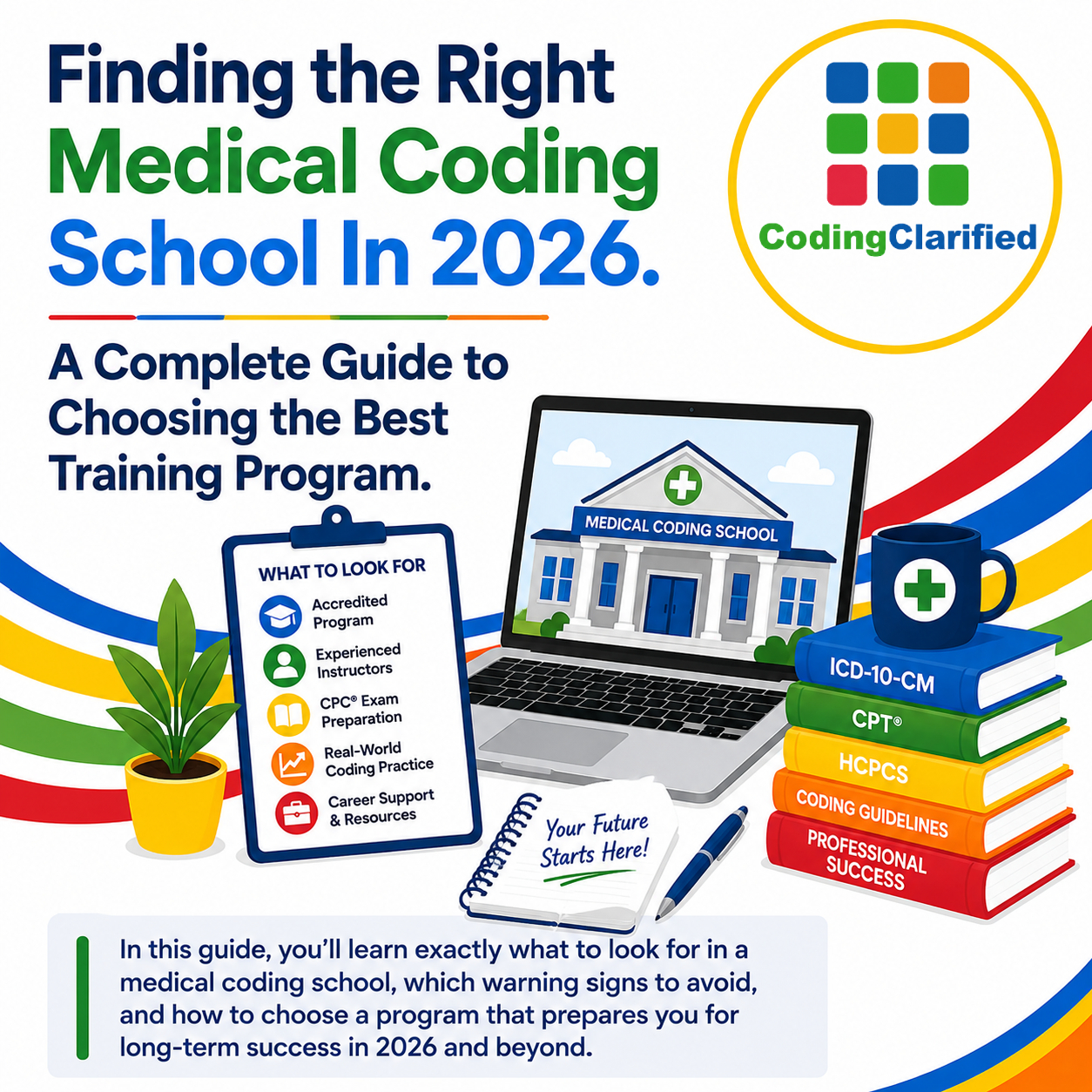
In this guide, you’ll learn exactly what to look for in a medical coding school, which warning signs to avoid, and how to choose a program that prepares you for long-term success in 2026 and beyond.
Key Takeaways for Choosing a Medical Coding School
- Choose a medical coding school that teaches ICD-10-CM, CPT®, and HCPCS Level II together.
- Look for experienced instructors with real-world coding experience.
- Verify whether the program prepares students for the CPC® certification exam.
- Compare student support, mentoring, internship opportunities, and job placement assistance.
- Consider total program value instead of choosing solely by price.
- Ask about graduate success rates, certification outcomes, and career resources.
- Ensure the curriculum includes the latest 2026 coding updates.
Why Choosing the Right Medical Coding School Matters
Medical coding is much more than assigning diagnosis and procedure codes.
Today’s professional coders interpret physician documentation, apply official coding guidelines, understand payer policies, reduce claim denials, and support healthcare reimbursement. Consequently, employers expect new coders to arrive with strong foundational knowledge rather than simply knowing how to look up codes.
A quality medical coding program teaches students how to think critically while applying coding rules correctly.
Unfortunately, many new students assume every medical coding school offers the same education. That simply isn’t true. Some programs consist only of prerecorded videos with little instructor interaction. Others provide live instruction, personalized coaching, exam preparation, and career assistance that can make a tremendous difference after graduation.
Furthermore, healthcare regulations change every year. Schools that continually update their curriculum help students remain current with annual coding revisions and payer expectations.
What Should a Good Medical Coding School Teach?
The best medical coding schools go far beyond memorizing code books.
Instead, students should learn how to analyze medical documentation and apply coding guidelines accurately.
A comprehensive curriculum should include:
- Medical terminology
- Human anatomy and physiology
- Disease processes
- Healthcare documentation
- Insurance basics
- Reimbursement methodologies
- ICD-10-CM
- CPT®
- HCPCS Level II
- Evaluation and Management coding
- Compliance and fraud prevention
- Medical coding ethics
- Coding guidelines
- Modifier usage
- Practical coding scenarios
- Certification exam preparation
Additionally, many leading programs now incorporate artificial intelligence awareness, electronic health record workflows, payer edits, and claim denial prevention because these skills continue to grow in importance throughout 2026.
Does the Medical Coding School Prepare You for Certification?
One of the most important questions to ask any medical coding school is whether it prepares students for professional certification.
Many employers either require or strongly prefer certification from recognized organizations.
The most common entry-level credential is the Certified Professional Coder (CPC®) credential offered by the AAPC.
A strong training program should include:
- CPC exam preparation
- Timed practice exams
- Coding case studies
- Test-taking strategies
- Instructor feedback
- Current coding manuals
- Ongoing review sessions
Programs that simply teach coding without certification preparation often leave graduates needing additional education before they feel ready to take the exam.
Look Beyond the Price Tag
Many prospective students compare schools based only on tuition.
However, the least expensive option frequently becomes the most expensive when students later need additional training, tutoring, or certification review courses.
Instead, compare the total value each program provides.
Ask questions such as:
- Are coding books included?
- Does tuition include the certification exam?
- Is the AAPC membership included?
- Will I receive one-on-one instructor support?
- Are live classes available?
- How long can I access the course?
- Are practice exams included?
- Does the school help with résumés?
- Is career coaching available?
- Are internships or apprenticeships offered?
Sometimes a higher-priced program actually costs less overall because it includes materials that other schools charge for separately.
Instructor Experience Makes a Difference
Experienced instructors often become one of the most valuable parts of a medical coding education.
Although prerecorded videos can explain concepts, they cannot answer questions specific to your learning style.
Look for instructors who have:
- Professional coding experience
- Current certifications
- Teaching experience
- Healthcare industry knowledge
- Experience preparing students for certification exams
Likewise, instructors who actively work in medical coding can share practical situations that textbooks rarely cover.
That real-world perspective often helps students understand why coding guidelines exist instead of simply memorizing them.
Online vs. In-Person Medical Coding Schools
Today, many excellent medical coding schools operate entirely online.
Online education provides flexibility for working adults, parents, military spouses, and students balancing multiple responsibilities.
However, flexibility should never come at the expense of quality.
A strong online medical coding school should provide:
- Structured lessons
- Live instructor access
- Discussion groups
- Assignment feedback
- Practice coding exercises
- Progress tracking
- Technical support
- Career guidance
Meanwhile, some students still prefer traditional classroom instruction because they enjoy face-to-face interaction.
Neither format is automatically better.
Instead, choose the learning environment that best matches your schedule, learning style, and career goals.
Red Flags to Watch for When Comparing Medical Coding Schools
Not every medical coding school offers the same level of education. While some programs prepare students for successful careers, others focus primarily on enrollment rather than long-term student success.
Before enrolling, watch for these warning signs:
- No information about instructor qualifications
- Outdated curriculum that doesn’t include 2026 coding updates
- Little or no CPC® exam preparation
- No access to instructors for questions
- No coding practice using real-world scenarios
- Hidden fees for textbooks or exams
- No refund policy
- Unrealistic promises of guaranteed jobs or high salaries
- Poor student reviews with unresolved complaints
- No career services after graduation
Likewise, be cautious of schools that promise you can become an expert medical coder in only a few weeks. Medical coding requires time, practice, and consistent learning. Quality education cannot be rushed.
Is Accreditation or State Licensing Important for a Medical Coding School?
Many students confuse accreditation with state approval or licensing.
Unlike colleges offering degree programs, many independent medical coding schools operate under state career school regulations rather than traditional college accreditation.
Therefore, ask whether the school complies with your state’s educational requirements and consumer protection laws. A legitimate school should clearly explain its legal status, refund policy, and business registration.
Additionally, determine whether the curriculum aligns with industry-recognized certification standards such as the CPC® credential offered by the AAPC. Employers generally care more about your coding knowledge, certification, and practical skills than whether you attended a traditional college.
Questions to Ask Before You Enroll in a Medical Coding School
Choosing a medical coding school becomes much easier when you ask the right questions.
Consider asking:
- Who teaches the course?
- Are instructors currently working in medical coding?
- Is the curriculum updated for 2026?
- How much instructor support is included?
- Does tuition include coding books?
- Are CPC® practice exams included?
- What is the average completion time?
- Is career coaching available?
- Are résumé and interview services included?
- Are there internship or apprenticeship opportunities?
- What happens if I need additional help?
- Is there a written refund policy?
The answers will quickly separate comprehensive programs from those offering only basic instruction.
What Employers Look for in New Medical Coders
Healthcare employers have raised their expectations in recent years.
Instead of hiring candidates based solely on completing a course, many organizations now seek applicants who can demonstrate practical coding skills.
Employers commonly look for:
- CPC® certification
- Strong knowledge of ICD-10-CM, CPT®, and HCPCS Level II
- Understanding of official coding guidelines
- Attention to detail
- Medical terminology knowledge
- Anatomy and physiology fundamentals
- Professional communication skills
- Experience using coding scenarios
- Critical thinking
- Willingness to continue learning
As healthcare reimbursement becomes increasingly complex, employers value coders who understand documentation, compliance, and payer policies—not just code lookups.
How Artificial Intelligence Is Changing Medical Coding Education
Artificial intelligence (AI) continues to transform healthcare, but it has not replaced professional medical coders.
Instead, AI assists coders by identifying possible diagnoses, suggesting procedure codes, flagging documentation gaps, and improving workflow efficiency. Human coders remain responsible for reviewing documentation, applying official coding guidelines, and ensuring coding accuracy.
As a result, today’s medical coding schools should introduce students to AI-assisted coding tools while emphasizing that coding decisions must still rely on official coding guidelines and sound clinical judgment.
Learning to work alongside AI is becoming an important career skill in 2026.
Don’t Overlook a Medical Coding School’s Career Services
Graduating from medical coding school is only one step toward building a successful career.
The best schools continue supporting students after graduation.
Look for programs offering:
- Résumé writing assistance
- LinkedIn profile guidance
- Mock interviews
- Job search coaching
- Employer networking
- Internship opportunities
- Apprenticeship guidance
- Continuing education resources
These services can significantly improve your confidence and competitiveness during your job search.
Apprenticeships Can Help You Gain Experience
Many employers prefer applicants with practical experience.
Fortunately, some medical coding schools partner with apprenticeship or internship programs that allow students to develop real-world coding skills while working under experienced professionals.
Apprenticeships may provide valuable exposure to:
- Physician office coding
- Documentation review
- Insurance claims
- Coding compliance
- Revenue cycle management
- Productivity standards
- Electronic health record systems
Practical experience often makes the transition from student to professional coder much smoother.
CPC Student Tips
If your goal is earning your CPC® credential, begin preparing long before your exam date.
Successful students often:
- Study consistently instead of cramming
- Learn coding guidelines before memorizing codes
- Practice coding full medical records
- Review anatomy and medical terminology regularly
- Time themselves using practice exams
- Organize their coding manuals appropriately
- Ask instructors questions whenever concepts are unclear
- Develop a weekly study schedule
Remember that becoming a confident coder takes practice. Every coding scenario you complete builds your speed and accuracy.
Common Mistakes to Avoid When Choosing a Medical Coding School
Many students unintentionally make decisions that slow their progress.
Avoid these common mistakes:
- Choosing a school based only on the lowest price
- Ignoring instructor qualifications
- Failing to compare what tuition includes
- Waiting until the last minute to study for certification
- Skipping anatomy or medical terminology
- Assuming AI can replace coding knowledge
- Not researching graduate support services
- Forgetting to verify curriculum updates for 2026
- Believing every online school offers the same quality
Taking time to evaluate each program carefully can help you avoid unnecessary expenses and frustration while setting yourself up for long-term success.
Coding Clarified Related Blog Links
Naturally link this section to related Coding Clarified articles, such as:
- Coding Clarified Medical Coding Course
- Coding Clarified Purchase Options
- What Coding Clarified School Resources Can Help You Become A CPC Medical Coder
- Coding Clarified Scholarship/Grant
- Coding Clarified Paid Medical Coding Apprenticeship FAQ
- About Coding Clarified
Suggested Authoritative External Resources
For deeper, official guidance while you research programs, these authoritative sources are worth bookmarking:
- American Academy of Professional Coders (AAPC)
- Centers for Medicare & Medicaid Services (CMS)
- National Correct Coding Initiative (NCCI)
- ICD-10-CM Official Guidelines for Coding and Reporting