Finding a medical coding job can feel challenging, especially when job postings ask for experience that a newly certified coder has not had the opportunity to gain. However, the medical coding job market in 2026 offers opportunities for candidates who know where to search, how to present their skills, and how to build practical experience.
The key is to approach the job search strategically rather than submitting the same resume to hundreds of positions.
Additionally, medical coding continues to change as artificial intelligence, computer-assisted coding, remote work, risk adjustment, and stricter compliance requirements reshape the profession. Employers still need trained coders who can interpret documentation, apply official guidelines, identify coding errors, and understand when technology-generated coding suggestions are incorrect.
Whether you recently earned your CPC®, currently hold the CPC-A® designation, or have coding experience and want a better position, this 2026 guide explains how to find medical coding jobs, where to look, what employers want, and how to improve your chances of getting hired.
Key Takeaways on Finding a Medical Coding Job
- Medical coding remains a viable healthcare career in 2026, but entry-level positions can be competitive.
- Certification can make you a stronger candidate, particularly credentials such as CPC®, CCS®, CCA®, CIC®, COC®, and CRC®.
- Do not search only for the job title “medical coder.” Employers use many different titles for coding-related positions.
- Tailor your resume to each position and include relevant keywords from the job description.
- Practical experience through internships, apprenticeships, Practicode, healthcare employment, or coding-related positions can strengthen your resume.
- Remote medical coding jobs often attract experienced candidates, so new coders should consider on-site and hybrid positions too.
- Networking remains an important part of the 2026 medical coding job search.
- Prepare for a coding assessment before you begin interviewing.
- Keep your knowledge of CPT®, ICD-10-CM, HCPCS Level II, payer policies, and annual coding updates current.
- AI is changing coding workflows, but employers still need professionals who understand documentation, compliance, coding guidelines, and data quality.
Coding Clarified students: use the CPC-A Job Board in your Student Portal. New entry level listings are added every day, you can filter by state, on-site, or remote, and when you mark a job as applied, our team follows up with resume help. Not a student yet? See the training program.
Are Medical Coding Jobs in Demand in 2026?
Yes. However, it is important to look at reliable labor data rather than claims that every certified coder will immediately find a job.
The U.S. Bureau of Labor Statistics groups many coding professionals under medical records specialists. BLS projects employment for medical records specialists to grow 8% from 2025 through 2035, which is faster than the average for all occupations. In addition, BLS projects about 14,000 openings per year, on average, during that period.
Still, technology continues to change the work. BLS specifically notes that increasing adoption of AI-powered solutions that improve coding efficiency may affect demand. Therefore, coders who can validate code selection, analyze documentation, apply official guidelines, recognize compliance problems, and work with technology may have an advantage.
Medical coding also creates pathways beyond traditional coding. For example, AHIMA identifies careers such as medical coder, coding auditor, risk adjustment coder, and revenue cycle specialist.
What Employers Look for in Medical Coders in 2026
Certification gets attention, but employers usually want more than credentials.
First, hiring managers want evidence that you understand medical terminology, anatomy, pathophysiology, CPT®, ICD-10-CM, HCPCS Level II, compliance, and documentation. Additionally, many employers look for EHR experience, coding software familiarity, specialty knowledge, and the ability to meet accuracy and productivity expectations.
AHIMA lists core coding competencies that include expertise in ICD-10-CM/PCS, CPT, and HCPCS as well as knowledge of medical terminology, disease processes, pharmacology, documentation, data integrity, and data quality.
Meanwhile, annual coding changes matter. CMS maintains the official ICD-10 resources and has published FY 2026 ICD-10-CM and ICD-10-PCS updates. Therefore, applicants should be prepared to demonstrate that they know how to locate and apply current guidelines rather than relying only on memorized codes.
For more help understanding what hiring managers want, read our guide to What Medical Coding Recruiters Are Looking for on a Resume in 2026.
How to Find a Medical Coding Job in 2026
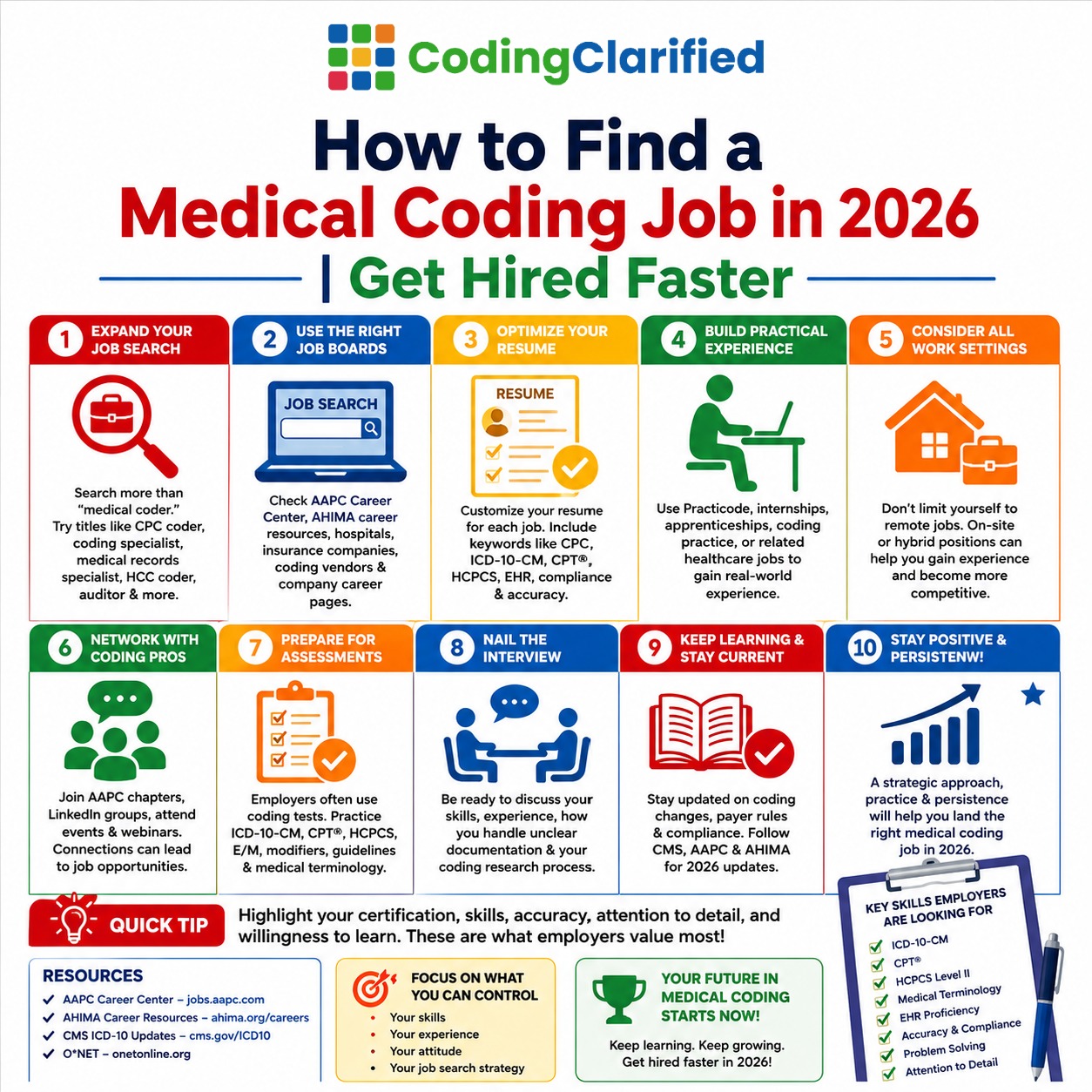
1. Search More Than “Medical Coder”
One of the biggest job-search mistakes is typing only medical coder into a job board.
Healthcare organizations use many job titles for positions that involve coding knowledge. Consequently, expanding your search terms can uncover opportunities that other applicants overlook.
Try searches such as:
- Medical coder
- Certified professional coder
- CPC coder
- CPC-A
- Coding specialist
- Coding associate
- Outpatient coder
- Physician coder
- Professional fee coder
- Hospital coder
- Risk adjustment coder
- HCC coder
- Coding quality specialist
- Coding auditor
- Medical records specialist
- Health information specialist
- Charge capture specialist
- Denials specialist
- Coding compliance specialist
- Coding trainee
- Coding apprentice
Additionally, search by specialty. Terms such as orthopedic coder, cardiology coder, surgery coder, emergency department coder, radiology coder, behavioral health coder, and primary care coder may uncover positions that a general search misses.
2. Use Medical Coding-Specific Job Boards
Large employment sites can help, but industry-specific job boards should also be part of your search.
AAPC maintains a healthcare career job board where employers post coding and related positions. As of August 2026, its search results include thousands of positions associated with CPC credentials, although totals change continually as employers add and remove openings.
Start with the AAPC Healthcare Careers Job Board.
AHIMA also offers career resources, a Career Map, career planning tools, and job-search support for health information professionals.
Explore AHIMA Career Advancement Resources.
However, do not stop there. Search hospital systems, physician groups, insurance companies, coding vendors, healthcare consulting companies, ambulatory surgery centers, and local healthcare organizations directly.
3. Optimize Your Medical Coding Resume for ATS
In 2026, submitting one generic resume to every employer is rarely the best strategy.
Instead, review each job description and identify the skills that genuinely match your training and experience. Then, naturally incorporate those terms into your resume.
For example, relevant keywords might include:
CPC, ICD-10-CM, CPT, HCPCS Level II, medical terminology, anatomy, outpatient coding, E/M coding, HCC, risk adjustment, compliance, Medicare, Epic, EHR, auditing, denials, coding accuracy, HIPAA, and medical records.
Never claim experience you do not have. However, if you learned a skill during training, Practicode, an internship, apprenticeship, or another healthcare position, make that knowledge easy for recruiters to find.
For a complete walkthrough, see our Medical Coding Resume Tips for 2026.
4. Build Experience Before an Employer Gives You the Title “Coder”
The classic problem for new coders is simple: employers want experience, but you need a job to gain experience.
Fortunately, a paid full-time coding position is not the only way to develop relevant skills.
Consider:
- Practicode
- Medical coding internships
- Registered apprenticeships
- Coding-related healthcare positions
- Medical records roles
- Claims or denials positions
- Charge entry or charge capture
- Prior authorization
- Revenue cycle positions
- Healthcare administrative roles
- Coding practice using de-identified or educational records
The goal is to show employers that you can move beyond multiple-choice questions and work through documentation.
AAPC also encourages newly credentialed professionals to maintain their certification, continue learning, network with other members, and use career resources when searching for employment.
If you are building real-world coding skills, read our guide to AAPC Practicode in 2026.
5. Do Not Limit Yourself to Remote Medical Coding Jobs
Many new coders want to work from home immediately. Remote coding is a legitimate career path; however, limiting your first job search to remote-only positions can reduce your opportunities.
Remote positions can attract applicants from a much larger geographic area. Additionally, employers may prefer experienced coders who can work independently with limited training.
Therefore, consider remote, hybrid, and on-site positions when trying to get your first coding job.
An on-site coding or health information position can give you valuable exposure to provider documentation, EHR systems, payer policies, compliance processes, coding edits, and real healthcare workflows. After gaining experience, you may become more competitive for remote positions.
6. Network With Other Medical Coders
Online applications are only one part of a successful job search.
AAPC chapters, professional groups, LinkedIn, conferences, webinars, and continuing education events can connect you with coders, auditors, managers, recruiters, and healthcare organizations.
Moreover, networking does not mean asking everyone you meet for a job. Instead, build professional relationships, participate in coding discussions, attend educational events, and let people know that you are pursuing coding opportunities.
AAPC specifically recommends networking with other members after earning certification.
AHIMA also recommends mentoring, professional networking, career planning, and volunteer opportunities as ways to prepare for a coding career.
7. Prepare for a Medical Coding Pre-Employment Assessment
Getting an interview does not always mean the testing is over.
Many coding employers use pre-employment assessments to evaluate whether candidates can apply coding rules accurately. Therefore, continue practicing after passing your certification exam.
An assessment may evaluate:
- ICD-10-CM guideline application
- CPT® coding
- HCPCS Level II
- Modifiers
- E/M coding
- Medical terminology
- Anatomy
- Operative report coding
- Diagnosis sequencing
- NCCI concepts
- Medicare rules
- Specialty-specific coding
Most importantly, read each question carefully. Employers may care about your reasoning and accuracy as much as speed.
8. Prepare for the Medical Coding Interview
Interview preparation should start before the employer calls.
Be ready to explain your certification, training, practical coding experience, strengths, and how you stay current. Additionally, prepare examples showing attention to detail, problem solving, communication, and the ability to research unfamiliar coding situations.
You may also hear questions such as:
How do you handle unclear provider documentation?
How do you maintain coding accuracy?
Which coding systems have you used?
How do you research a code when you are unsure?
What would you do if documentation did not support the code selected?
Instead of trying to memorize perfect answers, focus on demonstrating a compliant coding process.
For additional preparation, review our CPC Interview Tips.
CPC Student Tips: Start Preparing for Employment Before Certification
Do not wait until after the CPC exam to think about your job search.
While studying, start building a professional resume and LinkedIn profile. In addition, learn common job titles, review real job postings, and keep a list of skills employers request most often.
Pay close attention to subjects that appear repeatedly in job descriptions. For example, if local employers frequently request E/M coding, surgery coding, Epic experience, or risk adjustment knowledge, you now know where additional education may help.
Most importantly, practice coding complete documentation rather than relying entirely on multiple-choice questions. The CPC exam tests important knowledge, but an employer needs to know that you can apply that knowledge to real documentation.
What If You Have a CPC-A?
Do not treat the apprentice designation as something to hide.
Instead, emphasize what you can do and explain what you are doing to build experience.
Highlight your CPC certification, education, Practicode, internship, apprenticeship, prior healthcare experience, transferable skills, and continuing education.
Additionally, broaden your job search. Your first position may have a title such as coding associate, medical records specialist, charge capture specialist, denials specialist, or coding trainee rather than simply “medical coder.”
For more strategies, read How to Get Hired as a CPC-A.
How to Present Your Internship and Practicode Work
New coders often undersell the experience they already have. List it like a job:
- Medical Coding Intern, Coding Clarified HCC Internship. Describe the charts you coded, the code sets you used, and your accuracy scores.
- AAPC Practicode. Note the number of real, redacted cases you completed across specialties.
- Credentials. List CPC or CPC-A, and note the date you removed the A if you have.
Bring numbers to the interview. Employers hire coders who can show accuracy, not just a certificate. Learn more about our HCC internship.
Temp, Contract, and Hybrid Routes In
Healthcare staffing firms place new coders in temporary and contract roles that often turn permanent. Hybrid roles, where you train on-site and move home later, are another common path. Many successful coders, including our founder, started through a staffing firm. Do not skip these postings because they are not permanent or remote on day one.
A Realistic Timeline to Your First Coding Job
| Stage | Typical time |
|---|---|
| Training and CPC exam | About four to six months |
| Practicode | About 2 to 3 months part time |
| Internship or first role search | Varies; start applying while you finish Practicode |
Apply steadily, a few targeted applications every week, and follow up. Most new coders who keep at it find a first role, often on-site or hybrid, that leads to remote work later. Read what remote coding is really like.
Where Can New Medical Coders Gain Experience?
There are several legitimate ways to gain coding experience.
1. Registered Apprenticeships
One of the fastest-growing options in 2026 is a Registered Medical Coding Apprenticeship.
Unlike unpaid internships, apprenticeships combine:
- Paid employment
- Structured education
- Mentorship
- Progressive skill development
- Documented work experience
As a result, apprentices earn income while building the experience employers want.
Coding Clarified offers a Registered Medical Coding Apprenticeship that helps new coders transition into the workforce while completing required training and on-the-job learning.
Learn more here:
Coding Clarified Apprenticeship FAQs
2. Practicode
AAPC Practicode provides simulated coding experience that allows new coders to practice reviewing medical records and assigning codes.
Although Practicode is valuable, employers typically view actual employment or apprenticeship experience more favorably.
Coding Clarified Facebook Practicode group
3. Internships
Some educational programs offer coding internships that expose students to real healthcare environments.
Although not every internship leads directly to employment, they strengthen resumes and improve interviewing confidence.
4. Volunteer Opportunities
Some nonprofit clinics and healthcare organizations may allow supervised coding assistance.
Although these opportunities are less common, they can still provide valuable exposure.
Build a Resume That Gets Interviews
Your first coding resume should emphasize skills—not just work history.
Include:
- CPC certification
- Education
- Coding software familiarity
- Medical terminology
- Anatomy knowledge
- Coding coursework
- Practicode (if completed)
- Internship experience
- Apprenticeship participation
- Transferable healthcare experience
Even customer service, billing, scheduling, or insurance experience can strengthen your resume.
For more resume advice, read:
What Medical Coding Recruiters Are Looking for on a Resume in 2026
Continue Learning While Job Searching
Don’t stop coding after passing your exam.
Instead:
- Practice coding records weekly.
- Review Official Coding Guidelines.
- Study payer policies.
- Read Coding Clinic guidance when applicable.
- Stay current on annual updates.
- Follow CMS changes.
Continuous learning makes interviews much easier.
Common Mistakes to Avoid When Looking for a Medical Coding Job
One major mistake is applying only for remote coding jobs. Although working from home is appealing, new coders may face much stronger competition for fully remote positions.
Another mistake is submitting the same resume everywhere. Instead, tailor your resume to each job while keeping every statement truthful.
Likewise, do not stop learning after certification. Coding rules, payer requirements, and code sets change regularly. CMS has already published the official 2026 ICD-10 resources, reinforcing why current knowledge matters.
Avoid searching for only one job title as well. Coding knowledge applies to many healthcare positions, and a related position can become your entry point into a coding career.
Finally, do not assume certification guarantees immediate employment. A credential demonstrates knowledge; however, employers also evaluate accuracy, experience, communication, professionalism, specialty knowledge, and your ability to apply coding rules.
A Practical 30-Day Medical Coding Job Search Strategy
For the next 30 days, treat finding a coding position like a structured project.
During the first week, update your resume, LinkedIn profile, certifications, and skills section. Next, create job alerts using several coding-related titles rather than only “medical coder.”
During weeks two and three, apply selectively to positions that match your qualifications. Meanwhile, network with coding professionals, attend industry events, practice coding records, and prepare for assessments.
By week four, review your results. If you submitted many applications but received no interviews, your resume or job targeting may need improvement. Conversely, if you receive interviews but no offers, focus more heavily on interview preparation and coding assessments.
This approach helps you identify where the job-search process is breaking down instead of simply sending more applications.
The Future of Medical Coding Jobs: AI and Automation in 2026
AI will continue to influence medical coding, but that does not mean coders should stop pursuing the profession.
In fact, BLS still projects faster-than-average employment growth for medical records specialists from 2025 to 2035 while also acknowledging that AI-powered coding solutions may affect demand.
Therefore, future-ready coders should learn how to work with technology.
Strengthen the skills that require judgment: interpreting documentation, applying official guidelines, validating suggested codes, identifying compliance risks, communicating documentation concerns, understanding payer rules, and recognizing when automated output does not match the medical record.
Technology may change the workflow. However, accurate healthcare data still requires knowledgeable professionals who understand what the codes actually mean.
Final Thoughts: Finding a Medical Coding Job in 2026
Finding your first medical coding job may require persistence, but certification is only the beginning of your career strategy.
Build experience wherever you can. Additionally, broaden your job titles, customize your resume, network with coding professionals, practice for assessments, and remain open to on-site or hybrid opportunities.
Most importantly, keep learning.
Medical coding changes every year, and candidates who can demonstrate current knowledge, practical skills, accuracy, compliance awareness, and adaptability can distinguish themselves in a competitive job market.
Explore more career, certification, coding, and education resources in the Coding Clarified Medical Coding Blog. Learn more about Coding Clarified or explore our medical coding training program.
Frequently Asked Questions About Finding a Medical Coding Job in 2026
Quick answers to the questions job seekers ask most about finding a medical coding job.
Is it hard to get a medical coding job in 2026?
Getting your first coding position can be competitive because some employers prefer prior experience. However, candidates can improve their chances through certification, internships, apprenticeships, Practicode, related healthcare experience, networking, a targeted resume, and strong interview preparation.
Can I get a medical coding job with a CPC-A?
Yes. A CPC-A can apply for coding and coding-related positions. However, you should emphasize your training, certification, practical coding experience, healthcare knowledge, and steps you are taking to gain additional experience. Also, broaden your search beyond jobs titled only “medical coder.”
Can I get a medical coding job with no experience?
It is possible, although your first opportunity may require flexibility. Consider coding trainee positions, medical records, charge capture, denials, healthcare administrative roles, internships, apprenticeships, and other positions that help you gain relevant healthcare experience.
Can a new medical coder work from home?
Some new coders obtain remote jobs, but many remote positions attract experienced applicants. Therefore, new coders should consider remote, hybrid, and on-site opportunities rather than limiting the search to work-from-home positions.
Where should I look for medical coding jobs?
Search general job boards, healthcare organization career pages, hospitals, physician groups, insurers, coding companies, and professional job boards. AAPC maintains a healthcare career job board, while AHIMA provides career planning and job-search resources.
What certification is best for finding a medical coding job?
The right certification depends on the type of coding you want to perform. The CPC® is widely associated with professional-fee coding, while other credentials focus on areas such as inpatient, outpatient, risk adjustment, and health information. Review job postings in your target market before deciding which credential best supports your career goals.
How long does it take to find your first medical coding job?
There is no standard timeline. Location, certification, experience, job-search strategy, willingness to work on-site, specialty knowledge, and local employer demand can all affect how quickly you receive an offer. Instead of focusing only on time, track applications, interviews, assessments, and offers so you can identify what part of your strategy needs improvement.
Will AI replace medical coding jobs?
AI and computer-assisted coding will continue to change coding workflows. However, BLS still projects medical records specialist employment to grow 8% from 2025 through 2035 and notes that AI may affect demand. Coders can prepare by strengthening their skills in documentation analysis, coding guidelines, compliance, auditing, data quality, and validation of automated coding suggestions.