How to Get Hired as a CPC-A in 2026: 12 Proven Strategies for New Medical Coders
Passing the AAPC CPC exam is a major accomplishment. However, for many new medical coders, the next challenge can feel even harder: getting hired as a CPC-A without prior coding experience.
Employers often want experience, while new coders need a job to gain that experience. Therefore, breaking into medical coding requires more than sending the same résumé to dozens of remote coder positions.
The good news is that a CPC-A is still a Certified Professional Coder. The “A” simply identifies the apprentice designation. Moreover, there are several ways to strengthen your résumé, gain experience, remove the apprentice designation, and become more competitive.
This 2026 guide explains how to get hired as a CPC-A, where new medical coders should look for jobs, how to overcome the experience barrier, and what you can do while waiting for your first coding opportunity.
Key Takeaways
- A CPC-A is a Certified Professional Coder with an apprentice designation, not an uncertified coder.
- AAPC currently provides several paths for removing the apprentice designation, including combinations of education, Practicode, and work experience.
- Do not search only for jobs titled “Medical Coder.” Billing, denials, charge entry, revenue cycle, medical records, and related positions can provide valuable healthcare experience.
- Entry-level coders should tailor their résumés to each position instead of submitting one generic résumé everywhere.
- Networking through AAPC chapters, recruiters, LinkedIn, instructors, internships, and other coders can uncover opportunities that job boards do not.
- Remote coding is popular; however, new coders may find more entry-level opportunities by remaining open to onsite and hybrid positions.
- Coding knowledge alone is not enough. Employers may also evaluate accuracy, productivity, compliance knowledge, communication, EHR familiarity, and the ability to research coding questions.
- Above all, your first healthcare revenue-cycle job does not have to be your dream coding job. It can be the bridge that gets you there.
What Does CPC-A Mean in 2026?
When someone passes AAPC’s CPC certification exam without satisfying the required coding experience, AAPC awards the CPC-A designation.
The “A” stands for apprentice.
That distinction is important because you have passed the CPC examination and earned the credential. However, the apprentice designation shows employers that you are still building professional coding experience.
According to AAPC’s current requirements, there are several ways to remove the apprentice designation:
- Complete two years of qualifying on-the-job coding experience.
- Complete one year of qualifying work experience plus Practicode or an approved 80-hour coding course.
- Complete Practicode plus an approved 80-hour coding course.
AAPC states that successful completion of its full Practicode CPC-A program can satisfy one year of the experience requirement. Currently, the program includes 600 cases and requires an overall score of at least 70% for that credit.
Always verify current requirements directly with AAPC because certification policies can change.
If you are still preparing for certification, read our AAPC CPC Certification Guide for 2026 for a complete overview of becoming a CPC.
Can You Get a Medical Coding Job With a CPC-A?
Yes. Employers can hire CPC-A coders.
Still, certification does not guarantee employment. In addition, some coding positions require one, two, three, or more years of professional coding experience.
That does not mean you should automatically skip every position asking for experience. Instead, read the entire job description. If you meet most of the requirements and the experience requirement is reasonable, consider applying.
At the same time, broaden your search beyond positions labeled “Medical Coder.”
This is one of the biggest differences between a productive CPC-A job search and an unsuccessful one.
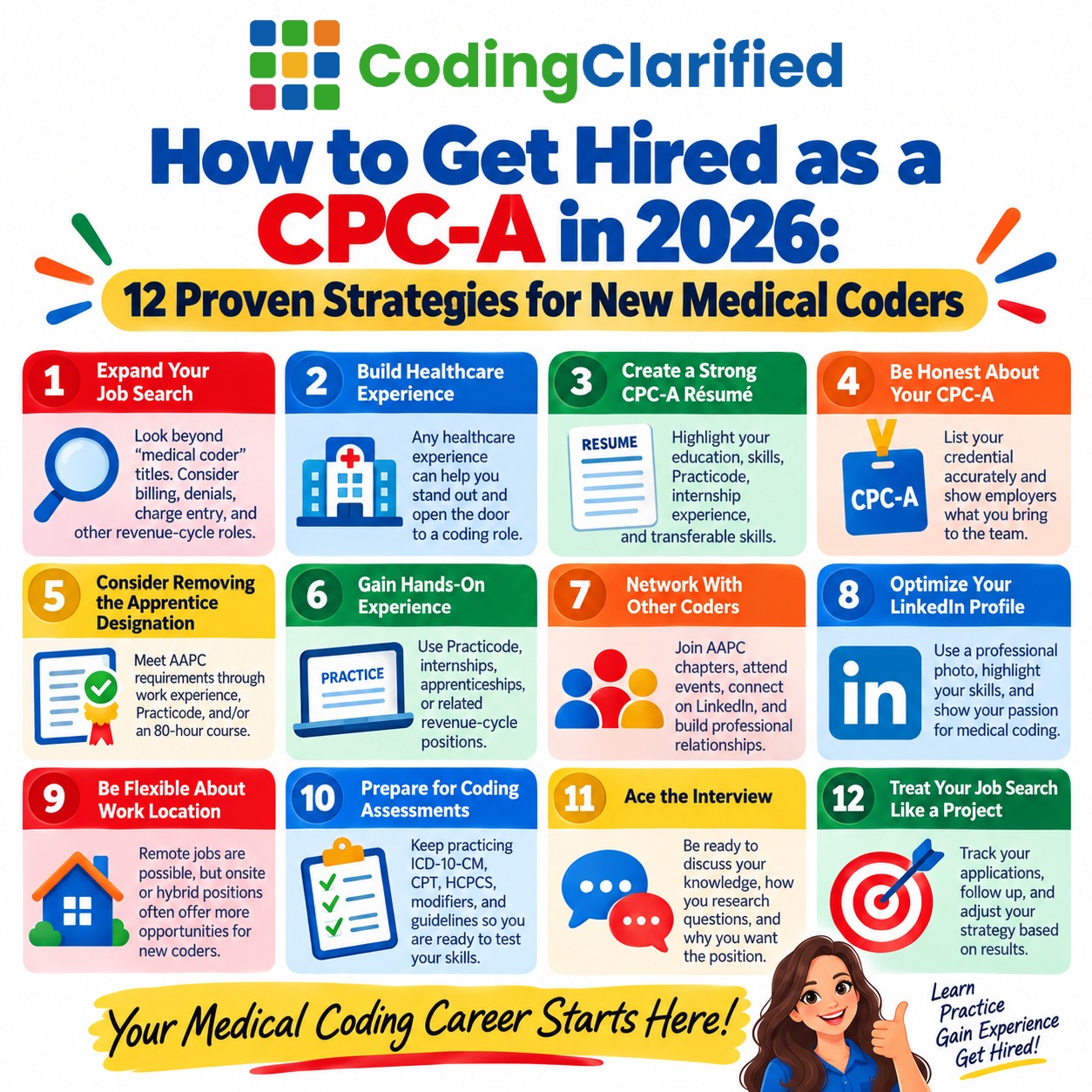
1. Stop Searching Only for “Medical Coder”
New coders commonly type “remote medical coder” into a job board and apply only to the results.
Unfortunately, that strategy can eliminate hundreds of positions that could help you enter the revenue cycle.
Instead, search for related titles such as:
- Medical coder
- CPC-A
- Coding apprentice
- Coding specialist
- Pro-fee coder
- Physician coder
- Charge entry specialist
- Medical billing specialist
- Patient accounts representative
- Accounts receivable specialist
- Denials specialist
- Claims specialist
- Payment posting specialist
- Revenue cycle specialist
- Prior authorization specialist
- Insurance verification specialist
- Medical records specialist
- Health information specialist
- Risk adjustment coding trainee
- Coding technician
- Revenue integrity assistant
Although these jobs are not identical, many expose you to claims, payer rules, medical records, reimbursement, EHR systems, denials, documentation, and healthcare workflows.
Consequently, a related position can become your foot in the door.
2. Build Healthcare Experience, Not Just Coding Experience
One of the most useful changes CPC-A candidates can make in 2026 is to stop thinking of experience as all-or-nothing.
A job in billing, claims, medical records, prior authorization, denials, or revenue cycle may not be a pure coding position. Nevertheless, it can give you experience that a future coding manager values.
For example, a denials specialist may learn why claims reject because of diagnosis-to-procedure relationships, modifiers, medical necessity, payer policies, or documentation problems.
Likewise, a charge entry specialist may gain exposure to CPT, HCPCS Level II, ICD-10-CM, modifiers, and provider documentation.
That experience can strengthen your next coding application.
3. Create a CPC-A Résumé That Shows What You Can Do
Your résumé should not focus on what you lack.
Instead, demonstrate the skills you already possess.
Include your:
- CPC-A credential
- Medical coding education
- Anatomy and medical terminology knowledge
- ICD-10-CM knowledge
- CPT knowledge
- HCPCS Level II knowledge
- Coding guideline knowledge
- Compliance training
- Practicode experience, when applicable
- Internship or externship experience
- EHR or practice-management software exposure
- Billing and reimbursement knowledge
- Previous healthcare experience
- Transferable skills from other careers
Additionally, tailor your résumé for each job.
If an employer repeatedly mentions “denials,” “physician coding,” “Epic,” “medical necessity,” or “revenue cycle,” those terms matter. Therefore, when you genuinely possess those skills, use appropriate keywords in your résumé.
Never add skills simply to pass an applicant tracking system. Instead, make sure you can discuss anything listed on your résumé during an interview or coding assessment.
For more help, see our guide to medical coder résumé tips.
4. Do Not Hide Your CPC-A
Some new coders worry that the apprentice designation will hurt their chances, so they consider listing only “CPC.”
Do not misrepresent your credential.
Instead, list it accurately as CPC-A and make the rest of your application show why you are worth interviewing.
For example, emphasize your coding education, training, Practicode completion, internship experience, specialties studied, previous healthcare work, and related revenue-cycle knowledge.
Integrity matters in medical coding. Therefore, your résumé should accurately represent your credentials and experience from the beginning.
5. Consider Removing the CPC-A Apprentice Designation
Removing the “A” can be worthwhile because some employers specifically request a CPC without apprentice status.
However, removing the designation does not automatically create professional coding experience.
That difference is important.
For example, completing Practicode can help satisfy AAPC’s apprentice-removal requirements. Still, an employer asking for two years of professional coding employment may have its own definition of qualifying experience.
Therefore, view CPC-A removal as one part of your career strategy rather than a guaranteed shortcut to employment.
You can learn more about AAPC’s current requirements through its Practicode and apprentice information.
6. Gain Hands-On Experience Wherever You Can
Practical experience makes it easier to demonstrate that you can apply coding guidelines to actual documentation.
Consider:
- Practicode
- Coding internships
- Externships
- Apprenticeships
- Temporary healthcare positions
- Billing positions
- Revenue-cycle positions
- Medical records positions
- Risk adjustment opportunities
- Supervised coding projects
However, be cautious about unpaid opportunities that involve real patient information. HIPAA, privacy, access controls, and organizational policies still apply.
Never obtain or code protected health information outside an authorized environment simply to gain experience.
7. Network With Medical Coders and Hiring Managers
Networking matters because not every opportunity begins with a public job advertisement.
Start with your local AAPC chapter. Attend meetings, ask thoughtful questions, participate in events, and introduce yourself to other coders.
Additionally, build relationships through LinkedIn, professional coding groups, former instructors, classmates, recruiters, and healthcare professionals.
Your goal should not be to repeatedly ask strangers for a job. Instead, become part of the professional community.
Over time, people may remember you when an entry-level opportunity appears.
8. Make Your LinkedIn Profile Recruiter-Friendly
LinkedIn can serve as an online extension of your résumé.
Use a professional photograph, accurate credential information, and a headline that clearly identifies your field.
For example:
CPC-A | Certified Professional Coder | ICD-10-CM, CPT & HCPCS Level II | Seeking Medical Coding & Revenue Cycle Opportunities
Next, complete your education, certification, skills, and experience sections.
Also, interact professionally with healthcare and coding content. Recruiters can view your activity, so your online presence should support the professional image you want to create.
9. Be Flexible About Remote Medical Coding Jobs
Many new coders want to work from home immediately. Remote medical coding is absolutely possible; however, limiting your first job search to remote-only positions can make the search harder.
Remote employers may expect coders to work independently with limited supervision. As a result, some organizations prefer experienced coders for these roles.
An onsite or hybrid position may provide more direct training and support.
Furthermore, your first onsite coding, billing, or revenue-cycle position may eventually lead to a remote opportunity after you build experience.
Read our guide to finding legitimate work-from-home medical coding jobs in 2026 before beginning a remote job search.
10. Prepare for Coding Assessments Before You Apply
Do not wait until an employer sends you a coding assessment to reopen your books.
Instead, keep practicing.
Review:
- ICD-10-CM Official Guidelines
- CPT guidelines
- HCPCS Level II
- Modifiers
- Evaluation and Management
- Medical terminology
- Anatomy
- Compliance
- NCCI edits
- Medical necessity
- Medicare policies
- Operative-report coding
Additionally, practice locating answers efficiently in authoritative resources.
Employers may care about accuracy and research ability just as much as memorization. Therefore, knowing where to verify an answer is an important professional skill.
The Centers for Medicare & Medicaid Services (CMS) provides Medicare policies, National Correct Coding Initiative information, Medicare Learning Network resources, and other materials coders should learn to navigate.
11. Prepare for the CPC-A Interview
Getting an interview means the employer already sees potential.
Now you need to explain what you bring to the organization.
Be prepared to discuss:
- Why you chose medical coding
- How you maintain coding accuracy
- How you research an unfamiliar coding question
- How you protect patient information
- What you would do when documentation is unclear
- Your knowledge of CPT, ICD-10-CM, and HCPCS Level II
- How you handle feedback
- Your previous work experience
- Why you want to work for that organization
- How you stay current with annual coding changes
Never pretend to know something you do not.
Instead, explain how you would research the issue using official guidelines, payer policies, CMS resources, coding references, or your organization’s procedures.
For additional preparation, review our CPC interview tips.
12. Treat Your Job Search Like a Project
Sending hundreds of identical applications is not necessarily better than submitting fewer, stronger applications.
Create a simple tracking system with:
- Employer
- Job title
- Date applied
- Job posting link
- Contact person
- Résumé version used
- Interview date
- Follow-up date
- Assessment status
- Result
Next, review your results.
If you submit 50 applications and receive no interviews, your résumé or job-targeting strategy may need work.
Alternatively, if you receive interviews but no offers, concentrate on interview preparation and coding assessments.
This approach turns rejection into information you can use.
CPC Student Tip: Start Preparing Before You Pass the Exam
Do not wait until you become a CPC-A to begin building your professional profile.
While studying, create your résumé, establish your LinkedIn presence, attend AAPC chapter meetings, research local employers, and learn about healthcare revenue-cycle roles.
Additionally, keep examples of the coding areas you have studied. Track your coursework, practice scores, specialties, software exposure, and training.
After certification, you will already have the foundation of your job-search materials.
Students preparing for the certification exam should also review what is on the AAPC CPC exam in 2026.
Common Mistakes to Avoid When Looking for a CPC-A Job
Applying Only for Remote Coder Positions
Remote coding jobs can attract a large applicant pool. Therefore, include onsite and hybrid positions when possible, especially for your first healthcare role.
Ignoring Billing and Revenue-Cycle Jobs
A billing or denials job may not be your final goal. However, it can provide valuable healthcare experience and expose you to claims, payer rules, coding, and reimbursement.
Using the Same Résumé for Every Application
Generic résumés can miss the keywords and skills an employer considers important. Instead, tailor your résumé while remaining truthful.
Collecting Credentials Instead of Experience
Additional credentials can expand your knowledge. Nevertheless, multiple certifications do not automatically replace professional experience.
Applying Without Reading the Job Description
A job title alone rarely tells you everything about a position. Consequently, review the actual responsibilities and requirements before deciding whether to apply.
Giving Up Too Quickly
The first medical coding job is often the hardest one to obtain. Rejection does not necessarily mean you chose the wrong career; instead, it may mean your strategy needs to change.
Medical Coding Job Outlook in 2026
The broader employment outlook for medical records specialists remains positive.
According to the U.S. Bureau of Labor Statistics, employment for medical records specialists is projected to grow 8% from 2025 through 2035, compared with 3% for all occupations. In addition, BLS projects about 14,000 openings per year on average over the decade.
The median annual wage for medical records specialists was $51,140 in May 2025, although actual medical coder salaries vary by credential, specialty, experience, employer, location, and job responsibilities.
BLS also notes that artificial intelligence may affect demand as AI-powered tools make parts of medical coding more efficient. However, coding continues to require skills involving documentation review, classification systems, accuracy, reimbursement, compliance, and communication with healthcare professionals.
See the latest data from the U.S. Bureau of Labor Statistics.
A Better 2026 Strategy for Getting Hired as a CPC-A
Think beyond one job title.
Your immediate goal may be “medical coder,” but your larger goal is to build credible healthcare coding and revenue-cycle experience.
For example:
CPC-A → Billing/Denials/Medical Records → Coding Opportunity → Professional Coding Experience → Career Advancement
Another candidate may follow:
CPC-A → Practicode → Apprentice Removal → Entry-Level Coding Position → Specialty Coding
Someone else might enter through an internship or apprenticeship.
There is no single path that every new coder must follow.
The key is to keep moving toward work that strengthens your coding knowledge, healthcare experience, and professional network.
Final Thoughts
Getting hired as a CPC-A in 2026 can take persistence, but your job search should also be strategic.
Do not depend on certification alone. Instead, combine your CPC-A with strong job-search materials, continued coding practice, networking, practical experience, and a willingness to consider related healthcare roles.
Most importantly, do not assume your first position has to be your forever position.
A billing, denials, medical records, revenue-cycle, internship, apprenticeship, or onsite opportunity may be exactly what helps you gain the experience required for the coding position you ultimately want.
Certification gets you started. Experience, accuracy, adaptability, and continued learning help build your medical coding career.
Frequently Asked Questions About Getting Hired as a CPC-A
Can You Get Hired With a CPC-A?
Yes. Employers can hire CPC-A coders, although individual employers may establish their own experience requirements. Therefore, search for both entry-level coding positions and related healthcare revenue-cycle roles.
What Does the “A” in CPC-A Mean?
The “A” means apprentice. You have passed the CPC certification exam; however, you have not yet met AAPC’s full experience requirement for removal of the apprentice designation.
How Do I Remove the “A” From My CPC?
AAPC currently provides multiple pathways. These include two years of qualifying work experience, one year of experience combined with Practicode or approved coding education, or a combination of Practicode and an approved 80-hour coding course. Because requirements can change, verify your specific eligibility with AAPC.
Does Practicode Count as Coding Experience?
AAPC currently allows successful completion of the full Practicode CPC-A program to satisfy one year toward its apprentice-removal requirement. However, an employer may define professional work experience differently. Therefore, do not assume Practicode automatically satisfies an employer’s requirement for one or more years of paid coding experience.
Should a CPC-A Apply for Jobs Requiring Experience?
Sometimes. If you meet most of the qualifications and the experience requirement is reasonable, consider applying. Nevertheless, be truthful about your actual experience and never claim professional coding experience you do not have.
What Jobs Should a CPC-A Apply For?
Look beyond “medical coder.” Consider coding apprentice, coding technician, billing specialist, denials specialist, charge entry, accounts receivable, claims, medical records, insurance verification, prior authorization, revenue-cycle, and similar healthcare positions.
Can a CPC-A Get a Remote Medical Coding Job?
Yes, but entry-level remote positions can be harder to find because some employers want experienced coders who can work independently. Therefore, remaining open to onsite and hybrid positions may expand your opportunities while you build experience.
How Long Does It Take to Get Your First Medical Coding Job?
There is no standard timeline. The length of a job search depends on your location, previous healthcare experience, job requirements, willingness to consider related positions, résumé quality, networking, and the number of suitable openings. Instead of focusing only on time, track interviews and responses so you can adjust your strategy when necessary.