Medical Coding for Renal Insufficiency Consultation: CPT, ICD-10-CM, and HCPCS Coding Guide (2026 Update)
By Janine Mothershed CPC, CPC-I
Key Takeaway
Accurate coding for renal insufficiency consultations requires careful analysis of physician documentation, laboratory findings, medical decision-making, and the relationship between acute and chronic conditions. In this case, the patient presents with a hypertensive emergency complicated by acute-on-chronic renal failure, chronic cocaine abuse, coronary artery disease, congestive heart failure, and COPD.
Therefore, coders must identify the principal diagnosis, assign all supported secondary diagnoses, and determine the appropriate Evaluation and Management (E/M) service level.
Additionally, this scenario highlights several coding concepts commonly tested on the CPC exam, including hypertensive emergencies, acute kidney injury, chronic kidney disease, substance abuse coding, and inpatient consultation coding. Consequently, mastering cases like this can improve both exam performance and real-world coding accuracy.
Medical Coding for Renal Insufficiency Consultation
Renal insufficiency consultations frequently involve multiple comorbidities, complex laboratory findings, and high-risk medical decision-making. As a result, coders must thoroughly review the documentation to ensure accurate code assignment.
In this scenario, the patient presents with severe hypertension, worsening renal function, and a history of significant cardiovascular and pulmonary disease. Furthermore, the physician identifies chronic cocaine abuse as a contributing factor to the hypertensive crisis.
Because kidney-related consultations are common in both hospital and specialty settings, understanding the coding guidelines for these encounters is essential. Moreover, accurate coding supports proper reimbursement, compliance, quality reporting, and risk adjustment initiatives.
For CPC students and experienced coders alike, this case provides an excellent opportunity to review ICD-10-CM diagnosis coding, CPT consultation coding, and HCPCS reporting considerations.
Clinical Scenario Overview
A 48-year-old male presents with a documented history of:
- Coronary artery disease (CAD)
- Congestive heart failure (CHF)
- Chronic obstructive pulmonary disease (COPD)
- Hypertension
- Chronic renal insufficiency
Significant Clinical Findings
- Blood pressure: 180/110
- BUN: 27
- Creatinine: 3.1
- Previous creatinine: 2.7
- BNP: 973
- Troponin: 0.18
- Urine drug screen positive for cocaine
Physician Assessment
- Hypertensive emergency
- Acute on chronic renal failure
- Positive urine drug screen
- Question CHF versus COPD exacerbation
Physician Plan
The physician notes that the renal insufficiency is most likely chronic in nature. Additionally, the provider states that the hypertensive emergency was worsened by chronic cocaine abuse. Therefore, blood pressure management becomes a primary treatment focus.
Why Accurate Coding Matters
First, accurate coding ensures proper reimbursement and supports medical necessity. Additionally, correct code assignment helps healthcare organizations maintain compliance with payer requirements and federal regulations.
Furthermore, detailed coding captures the true severity of the patient’s condition, which can directly impact quality reporting and risk adjustment. Because several diagnoses interact with one another, selecting the appropriate ICD-10-CM codes becomes especially important.
Likewise, determining the correct CPT code requires a thorough understanding of the physician’s medical decision-making. Therefore, this case serves as an excellent educational example for coding professionals.
Step 1: Identify the Principal Diagnosis
First and foremost, coders should review the physician’s final assessment. In this case, the provider clearly identifies a hypertensive emergency as the primary condition requiring immediate intervention.
Furthermore, the physician directly links the worsening renal function to uncontrolled hypertension. Consequently, hypertensive emergency becomes the principal diagnosis for this encounter.
Additionally, the patient’s blood pressure reading of 180/110 supports the severity documented by the physician.
ICD-10-CM Code
| Code | Description |
|---|---|
| I16.1 | Hypertensive emergency |
Coding Tip
Always code the condition chiefly responsible for the encounter first. In this scenario, the hypertensive emergency drives the consultation and management decisions. Therefore, I16.1 should be sequenced as the principal diagnosis.
Step 2: Code the Acute-on-Chronic Renal Failure
Next, coders must address the diagnosis of acute-on-chronic renal failure.
According to ICD-10-CM guidelines, acute renal failure is classified as acute kidney injury (AKI). However, the provider also documents chronic renal insufficiency. Therefore, both the acute and chronic conditions should be reported when supported by documentation.
Moreover, the patient’s creatinine increased from 2.7 to 3.1, demonstrating worsening renal function. Nevertheless, coders should not assign a specific CKD stage because the physician did not document one.
Instead, assign codes representing both the acute and chronic conditions.
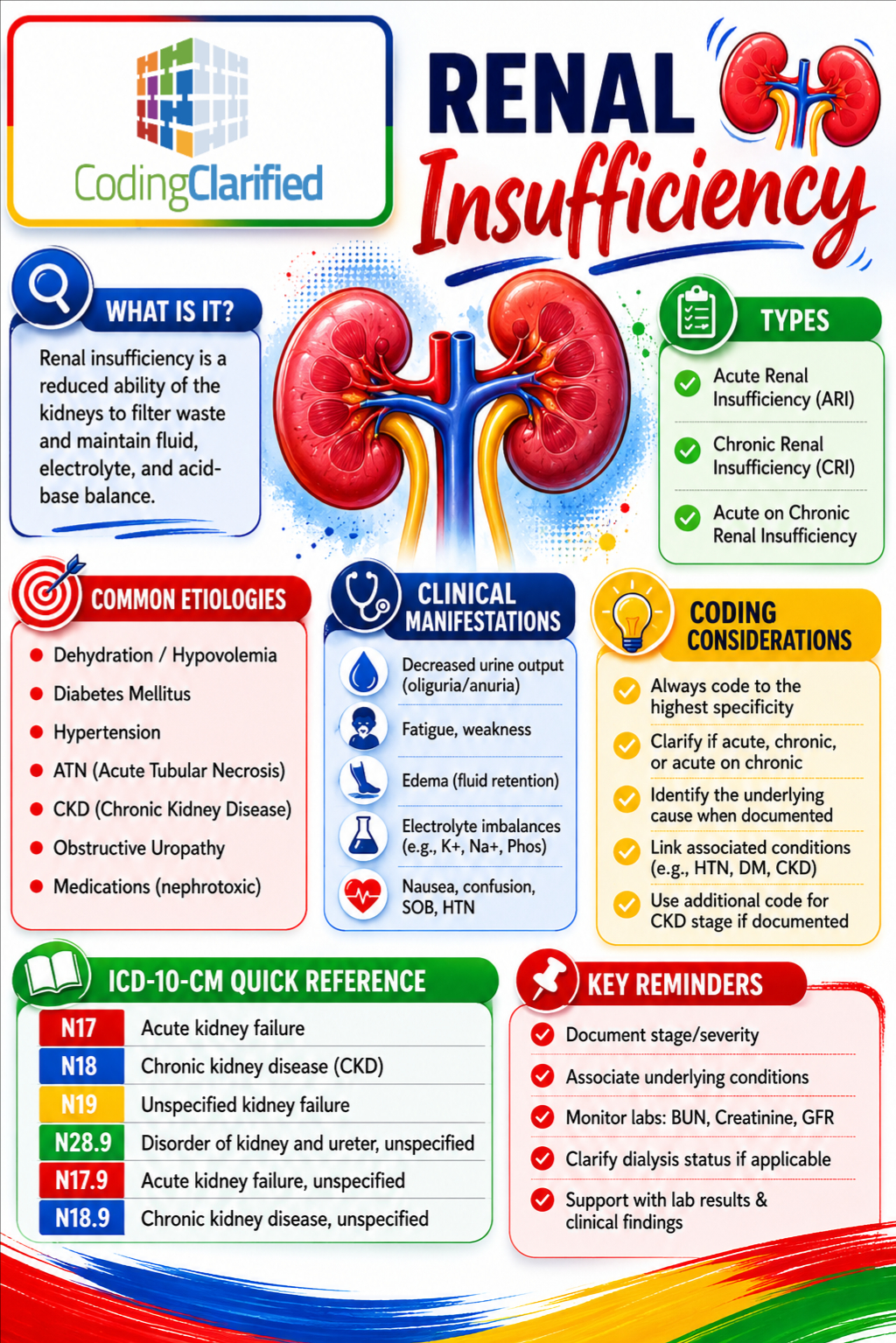
ICD-10-CM Codes
| Code | Description |
|---|---|
| N17.9 | Acute kidney failure, unspecified |
| N18.9 | Chronic kidney disease, unspecified |
Why This Matters
Many coders mistakenly report only the acute kidney injury. However, the provider clearly documents chronic renal insufficiency as well.
Consequently, failing to report both conditions may underrepresent the patient’s severity of illness.
Step 3: Code the Cocaine Abuse
In addition, the physician specifically states:
“Hypertensive emergency most likely related to cocaine drug abuse.”
Furthermore, the assessment references chronic cocaine abuse as a contributing factor.
Because abuse is clearly documented, the following diagnosis code is supported:
| Code | Description |
|---|---|
| F14.10 | Cocaine abuse, uncomplicated |
Important Coding Reminder
A positive drug screen alone does not support assigning a substance abuse diagnosis.
Instead, the provider must document abuse, dependence, intoxication, withdrawal, or another reportable condition. Because the physician specifically documents chronic cocaine abuse, coding F14.10 is appropriate.
Additionally, the documented relationship between cocaine abuse and hypertension increases the clinical significance of the diagnosis.
Step 4: Code Additional Chronic Conditions
Coronary Artery Disease
The patient has a documented history of coronary artery disease.
| Code | Description |
|---|---|
| I25.10 | Atherosclerotic heart disease of native coronary artery without angina pectoris |
Because CAD affects medical decision-making and treatment considerations, it should be reported.
Chronic Obstructive Pulmonary Disease (COPD)
The provider documents a history of COPD.
Although the assessment mentions possible COPD exacerbation, the diagnosis remains uncertain. Nevertheless, COPD itself remains a documented chronic condition.
| Code | Description |
|---|---|
| J44.9 | Chronic obstructive pulmonary disease, unspecified |
Congestive Heart Failure
The documentation references a history of congestive heart failure.
However, the physician states:
“Question CHF versus COPD exacerbation.”
Because the diagnosis remains uncertain, an acute CHF exacerbation should not be reported. Therefore, coders should avoid assigning active CHF exacerbation codes unless further documentation confirms the diagnosis.
Final ICD-10-CM Code Selection
Based on the documented consultation, the following diagnoses are supported:
| ICD-10-CM Code | Description |
|---|---|
| I16.1 | Hypertensive emergency |
| N17.9 | Acute kidney failure, unspecified |
| N18.9 | Chronic kidney disease, unspecified |
| F14.10 | Cocaine abuse, uncomplicated |
| I25.10 | Coronary artery disease |
| J44.9 | COPD, unspecified |
CPT Coding Analysis
Was This a Consultation?
Before assigning a CPT code, coders must determine whether consultation requirements have been met.
In this scenario, the physician:
- Reviews the patient’s history
- Performs a comprehensive examination
- Reviews laboratory findings
- Evaluates prior creatinine values
- Provides recommendations regarding treatment
Therefore, consultation coding may be appropriate if the payer recognizes consultation services.
CPT Consultation Coding Options
| CPT Code | Description |
|---|---|
| 99252 | Straightforward MDM |
| 99253 | Low MDM |
| 99254 | Moderate MDM |
| 99255 | High MDM |
Determining the Correct E/M Level
Number and Complexity of Problems
The physician evaluates:
- Hypertensive emergency
- Acute-on-chronic renal failure
- Cocaine abuse
- Coronary artery disease
- COPD
Consequently, the encounter involves multiple serious conditions with significant risk.
Data Reviewed
Additionally, the physician reviews:
- CBC
- Chemistry studies
- BNP
- Troponin
- Historical creatinine levels
- Drug screen results
Therefore, the amount and complexity of data reviewed are substantial.
Risk of Complications
Most importantly, the patient faces significant risk because of:
- Severe hypertension
- Acute kidney injury
- Chronic renal disease
- Cocaine abuse
- Possible cardiac involvement
As a result, the overall risk level is high.
Recommended CPT Code
CPT 99255
Initial inpatient consultation involving high-complexity medical decision-making.
Because the problems addressed are severe, the data reviewed is extensive, and the risk level is high, CPT 99255 is supported by the documentation.
Coding Note: Many payers, including Medicare, no longer recognize consultation codes. Therefore, always verify payer-specific requirements and determine whether an initial hospital care code may be more appropriate.
HCPCS Coding Considerations
Next, coders should determine whether any HCPCS Level II codes are supported.
Although multiple medications are listed, those medications represent the patient’s home medication regimen.
Therefore, no separately billable HCPCS drugs, supplies, or durable medical equipment are documented in this consultation.
HCPCS Assignment
No HCPCS Level II codes supported by the current documentation.
CPC Exam Tip
Many students incorrectly assign HCPCS codes simply because medications appear in the medical record. However, home medications do not automatically generate HCPCS reporting.
Instead, HCPCS codes generally apply to administered drugs, supplies, DME, and certain services.
Coding Summary
| Code Set | Code | Description |
|---|---|---|
| CPT | 99255 | Initial inpatient consultation, high MDM |
| ICD-10-CM | I16.1 | Hypertensive emergency |
| ICD-10-CM | N17.9 | Acute kidney failure, unspecified |
| ICD-10-CM | N18.9 | Chronic kidney disease, unspecified |
| ICD-10-CM | F14.10 | Cocaine abuse, uncomplicated |
| ICD-10-CM | I25.10 | Coronary artery disease |
| ICD-10-CM | J44.9 | COPD, unspecified |
| HCPCS | None | No HCPCS codes supported |
Common Mistakes to Avoid
Coding Only the Acute Kidney Injury
One of the most common coding errors involves reporting only N17.9.
However, the provider clearly documents chronic renal insufficiency as well. Therefore, both conditions should be reported.
Assigning a CKD Stage That Is Not Documented
Many coders attempt to determine CKD staging from laboratory values.
However, ICD-10-CM guidelines do not permit coders to infer a stage from creatinine levels alone.
Instead, report only the stage documented by the physician.
Coding a Positive Drug Screen Without a Diagnosis
Another frequent mistake occurs when coders assign substance abuse codes solely because a laboratory test is positive.
However, coding requires physician documentation of abuse, dependence, intoxication, withdrawal, or another reportable condition.
Coding Suspected Conditions as Confirmed
The physician documents:
“Question CHF versus COPD exacerbation.”
Because the diagnosis remains uncertain, coders should not report an acute CHF exacerbation.
Instead, follow ICD-10-CM guidelines and code only confirmed diagnoses.
Reporting HCPCS Codes for Home Medications
Although medications are listed in the medical record, they represent home medications.
Therefore, no HCPCS drug codes are supported by this documentation.
CPC Student Tips
First, always read the assessment and plan before selecting diagnosis codes. Frequently, the provider’s final diagnoses appear there rather than in the history section.
Next, look for phrases such as:
- Due to
- Secondary to
- Associated with
- Related to
These phrases often establish important coding relationships.
Additionally, pay close attention to acute-on-chronic conditions. On the CPC exam, these scenarios appear frequently because they test documentation analysis and diagnosis sequencing.
Furthermore, remember that laboratory values alone do not establish diagnoses. Instead, coders should report only documented conditions.
Finally, review the medical decision-making elements carefully. As a result, selecting the appropriate E/M level becomes much easier.
Related Coding Clarified Articles
Consider linking to these related articles:
- Hypertension Medical Coding and Billing Guidelines for 2026
- Medical Coding “Clarified” Acute on Chronic Kidney Failure
- Evaluation and Management (E/M) Guidelines for 2026: The Complete Guide
- Medical Coding Chronic Kidney Disease
- Medical Coding Hypertension
2026 Coding Update and Documentation Focus
As healthcare auditing continues to increase in 2026, documentation specificity remains more important than ever.
Furthermore, payers increasingly focus on medical necessity, risk adjustment, and accurate disease capture. Therefore, providers should clearly document:
- Acute versus chronic conditions
- Cause-and-effect relationships
- CKD stages
- Substance abuse diagnoses
- Severity of hypertension
Consequently, stronger documentation supports more accurate coding and cleaner claims submission.
Authoritative Resources
CMS ICD-10-CM Official Guidelines for Coding and Reporting
Frequently Asked Questions
What ICD-10-CM code is assigned for hypertensive emergency?
Hypertensive emergency is reported with I16.1.
How do you code acute-on-chronic renal failure?
Report both the acute kidney injury code and the chronic kidney disease code when both conditions are documented by the physician.
Can coders assign a CKD stage from laboratory values?
No. CKD staging requires provider documentation and should never be inferred solely from laboratory results.
Does a positive cocaine screen automatically support substance abuse coding?
No. The physician must document abuse, dependence, intoxication, withdrawal, or another reportable diagnosis.
What CPT code is supported in this consultation scenario?
Based on the documented high-complexity medical decision-making, 99255 is supported when consultation services are recognized by the payer.
Should coders report suspected CHF exacerbation?
No. Because the physician documented “question CHF versus COPD exacerbation,” the diagnosis remains uncertain and should not be coded as confirmed.
Why is chronic kidney disease coded along with acute kidney injury?
Because the physician documents acute-on-chronic renal failure, both the acute and chronic conditions should be reported.
What is one of the most common CPC exam mistakes involving renal coding?
One of the most common mistakes is reporting only the acute kidney injury while failing to report the documented chronic kidney disease.
Note disclaimer: CPT code selection can vary based on payer consultation policies, since many payers no longer recognize consultation codes and may instead require the appropriate initial hospital care E/M code.