How to Code an MRSA Infection Emergency Room Visit Using CPT®, ICD-10-CM, and HCPCS Manuals (2026 Guide)
Author: Janine Mothershed CPC, CPC-I
How to Correctly Code an MRSA Infection ER Visit in 2026
Medical coders working in emergency medicine must understand how to accurately assign diagnosis and procedure codes for infectious disease encounters, especially when resistant organisms such as Methicillin-resistant Staphylococcus aureus (MRSA) are involved. In 2026, coding accuracy continues to be a major focus because payers, auditors, and healthcare organizations are closely monitoring infection reporting, medical necessity, and documentation specificity.
This emergency department case involves a 14-day-old newborn evaluated for an MRSA skin infection after a positive culture result. Throughout this article, we will walk step-by-step through how to code this scenario using the CPT®, ICD-10-CM, and HCPCS Level II manuals while also reviewing official coding guidelines, coding tips, and common mistakes to avoid.
Key Takeaways
- Always code confirmed MRSA infections using combination ICD-10-CM codes when available.
- Emergency department E/M code selection in 2026 continues to rely on Medical Decision Making (MDM) or total time.
- Coders must review physician documentation carefully to determine whether cultures, procedures, or additional testing were performed.
- Newborn encounters require close attention to age-specific coding and infection risk factors.
- Resistant organism coding remains a high-risk audit area for hospitals and emergency departments.
Understanding the Clinical Scenario
This case involves a newborn infant presenting to the emergency room after a culture obtained by the private physician returned positive for MRSA. The infant had:
- Healing blister near the umbilicus
- New vesicle near the left temporal area
- Blood culture performed
- Herpes culture performed
- Infectious Disease consultation
- Oral antibiotics prescribed
- Discharge home in stable condition
Importantly, the documentation confirms:
“Methicillin-resistant Staphylococcus aureus infection.”
Because the diagnosis is confirmed, coders do not assign symptom-only codes such as blister or vesicle codes as the principal diagnosis
Step 1: Coding the ICD-10-CM Diagnosis
Main Diagnosis Code
The physician documents:
“Methicillin-resistant Staphylococcus aureus infection.”
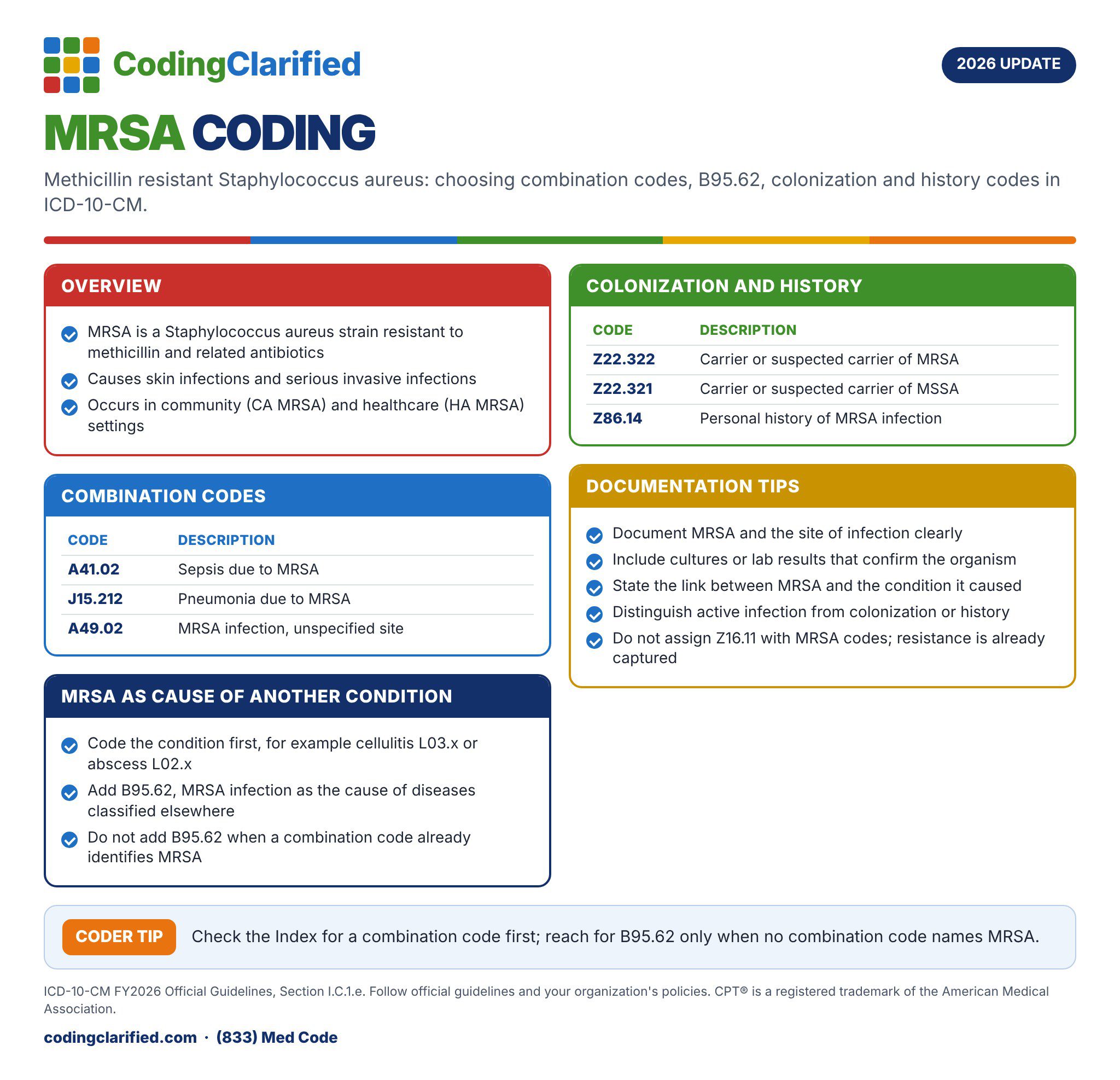
When coding MRSA conditions, coders must first determine whether a combination code exists.
Using the ICD-10-CM Alphabetic Index:
- Infection
- staphylococcus
- aureus
- methicillin resistant
This directs the coder to:
A49.02
Methicillin resistant Staphylococcus aureus infection, unspecified site
Because the provider did not document cellulitis, abscess, omphalitis, or another definitive anatomical diagnosis, the unspecified site code is appropriate.
Final ICD-10-CM Code
- A49.02 — Methicillin resistant Staphylococcus aureus infection, unspecified site
Why Not Use a Skin Infection Code?
One of the most common coding mistakes involves assigning both:
- MRSA infection code
- Skin infection code
However, coders should not assume cellulitis, abscess, or dermatitis unless clearly documented by the physician.
The provider documented:
- Vesicle
- Blister
- MRSA infection
No cellulitis or abscess diagnosis was documented.
Therefore, assigning cellulitis codes would be incorrect and could trigger payer denials or audit findings.
Should an Additional Resistance Code Be Assigned?
In ICD-10-CM, certain infections require an additional code from category B95-B97 or Z16 to identify resistance organisms.
However, A49.02 already identifies:
- The organism
- The resistant status
Therefore, an additional resistance code is not necessary.
Step 2: Coding the Emergency Department E/M Service
Emergency department coding changed significantly after the 2023 E/M revisions, and these guidelines remain important in 2026.
Emergency department E/M services are selected based on:
- Medical Decision Making (MDM)
Time is not used for emergency department E/M code selection.
CPT® Emergency Department Codes
The applicable code range is:
- 99281–99285
Analyzing the Medical Decision Making (MDM)
To determine the correct E/M level, coders must analyze:
- Number and complexity of problems addressed
- Amount and complexity of data reviewed
- Risk of complications and/or morbidity
Problem Complexity
This patient had:
- Confirmed MRSA infection in a neonate
- New lesion development
- Infectious Disease physician involvement
- Concern for possible bloodstream infection
- Additional herpes testing
This supports a moderate-to-high complexity problem.
Data Reviewed
The physician reviewed and/or ordered:
- Prior culture results
- Blood culture
- Herpes culture
- Infectious Disease consultation
This supports moderate data complexity.
Risk Level
Risk factors include:
- Neonatal patient
- Resistant bacterial infection
- Prescription drug management
- Infectious Disease consultation
Prescription medication management alone generally supports moderate risk.
Most Appropriate CPT® Code
Based on the documentation provided, the encounter most reasonably supports:
CPT® 99284
Emergency department visit for the evaluation and management of a patient requiring medically appropriate history and/or examination and moderate level of medical decision making
Final CPT® Code
- 99284
Why 99285 May Not Be Supported
Although the patient is a neonate with MRSA, the documentation does not fully support:
- Severe systemic toxicity
- Organ failure risk
- ICU-level concern
- High-complexity MDM
The patient was stable, feeding well, and discharged home.
Therefore, 99284 is likely the safest and most defensible code.
Step 3: Reviewing Potential Procedure Coding
Blood Culture
The emergency department performed a blood culture.
However, hospital facility coders typically report laboratory testing on the UB-04 claim rather than physician CPT coding unless separately billable by the physician.
Professional coders generally would not separately report the lab procedure unless instructed by facility policy.
Herpes Culture
Similarly, the herpes culture would usually be captured by the laboratory or facility billing department.
The physician documentation does not indicate a separately reportable physician procedure.
Step 4: HCPCS Level II Considerations
HCPCS Level II codes may apply for:
- Drugs administered
- Supplies
- Facility billing
However, this documentation does not indicate:
- Injectable medications
- Infusions
- Durable medical equipment
- Separately billable supplies
Therefore, no HCPCS Level II codes are clearly supported from the physician documentation alone.
Final Code Summary
ICD-10-CM
- A49.02 — Methicillin resistant Staphylococcus aureus infection, unspecified site
CPT®
- 99284 — Emergency department E/M service
HCPCS Level II
- None clearly supported from physician documentation
How to Find These Codes in the Manuals
Using the ICD-10-CM Manual
Step 1: Start in the Alphabetic Index
Look up:
- Infection
- staphylococcus
- aureus
- methicillin resistant
Step 2: Verify in the Tabular List
Confirm:
- A49.02
- Includes notes
- Excludes notes
- Instructional notes
Never code directly from the Alphabetic Index without tabular verification.
Using the CPT® Manual
Step 1: Locate Emergency Department Services
Find category:
- Evaluation and Management
- Emergency Department Services
Step 2: Review E/M Guidelines
Analyze:
- MDM level
- Risk
- Data
- Problem complexity
Step 3: Match Documentation
The encounter best supports moderate MDM.
Therefore:
- 99284
2026 Emergency Department Coding Updates
Medical coders should continue monitoring 2026 payer updates involving:
- Resistant organism reporting
- Emergency department MDM audits
- Pediatric sepsis screening initiatives
- Infection surveillance tracking
- Medical necessity validation
Additionally, many payers are increasing scrutiny of:
- Upcoded ER visits
- Unsupported high-level MDM
- Incomplete infection documentation
Because of this, coders should ensure physician documentation clearly supports the selected E/M level.
Common MRSA Coding Mistakes
1. Assigning Cellulitis Without Documentation
Never assume cellulitis or abscess unless explicitly documented.
2. Missing Combination Codes
MRSA infections often have combination codes that already include organism resistance information.
3. Overcoding Emergency Department Visits
Not every resistant organism encounter qualifies for 99285.
Documentation must support high MDM.
4. Coding Symptoms Separately
Do not separately code:
- Blister
- Vesicle
- Skin lesion
when these symptoms are integral to the confirmed diagnosis.
Documentation Tips for Providers
Strong provider documentation improves coding accuracy and reimbursement.
Providers should document:
- Infection site
- Severity
- Organism confirmation
- Resistant status
- Systemic involvement
- Treatment plan
- Differential diagnoses
- Consultations performed
Specificity becomes especially important for neonatal infections.
Why MRSA Coding Accuracy Matters
Hospitals and payers track MRSA infections closely because they affect:
- Quality metrics
- Infection surveillance
- Reimbursement
- Public health reporting
- Risk adjustment
- Audit vulnerability
Incorrect coding can lead to:
- Denials
- Compliance issues
- Revenue loss
- False infection reporting
Additional Emergency Medicine Coding Resources
For additional coding guidance, review these Coding Clarified resources:
ICD 10 Guidelines
How to code infectious diseases ICD-10
Authoritative Coding Resources
Coders should also review official guidance from:
These organizations publish annual coding updates, official guidelines, and payer education materials.
Frequently Asked Questions (FAQ)
What ICD-10-CM code is used for MRSA infection?
The correct ICD-10-CM code in this case is:
- A49.02 — Methicillin resistant Staphylococcus aureus infection, unspecified site
Always verify whether a combination code exists before assigning separate organism or resistance codes.
Can coders assign cellulitis when only a blister is documented?
No. Coders cannot assume cellulitis or abscess without physician documentation supporting those diagnoses.
Why is CPT® 99284 appropriate for this case?
The documentation supports moderate medical decision making due to:
- Resistant infection
- Prescription drug management
- Additional cultures
- Infectious Disease consultation
However, the patient remained clinically stable.
Is 99285 supported for every MRSA emergency visit?
No. High-level emergency department coding requires documentation supporting high MDM complexity.
MRSA alone does not automatically justify 99285.
Should blister or vesicle symptoms be coded separately?
Usually no. These findings are considered integral to the confirmed MRSA infection diagnosis.
Are blood cultures separately coded by the physician?
Typically, laboratory testing is billed by the facility or laboratory department unless physician billing rules specifically allow separate reporting.
Why are MRSA infections important in medical coding?
MRSA conditions affect:
- Infection tracking
- Quality reporting
- Reimbursement
- Audit risk
- Public health surveillance
Accurate coding is essential for compliance and data integrity.
What manuals should beginners use to learn this case?
Students should practice using:
- CPT® Professional Edition
- ICD-10-CM Official Code Book
- HCPCS Level II Manual
Learning directly from the manuals helps coders develop stronger coding logic and exam readiness.
Coding Clarified Final Thoughts
Emergency department coding requires careful analysis of provider documentation, especially when resistant organisms such as MRSA are involved. This neonatal ER case demonstrates the importance of reviewing infection specificity, evaluating MDM correctly, and avoiding unsupported diagnosis assumptions.
Most importantly, coders should continue practicing directly from the CPT®, ICD-10-CM, and HCPCS manuals rather than relying entirely on encoders. Strong manual coding skills remain essential for CPC® exam success, coding accuracy, compliance, and long-term career growth in 2026 and beyond.