What Medical Coding Recruiters Are Looking for on a Resume in 2026: How to Improve Your Chances of Getting Hired
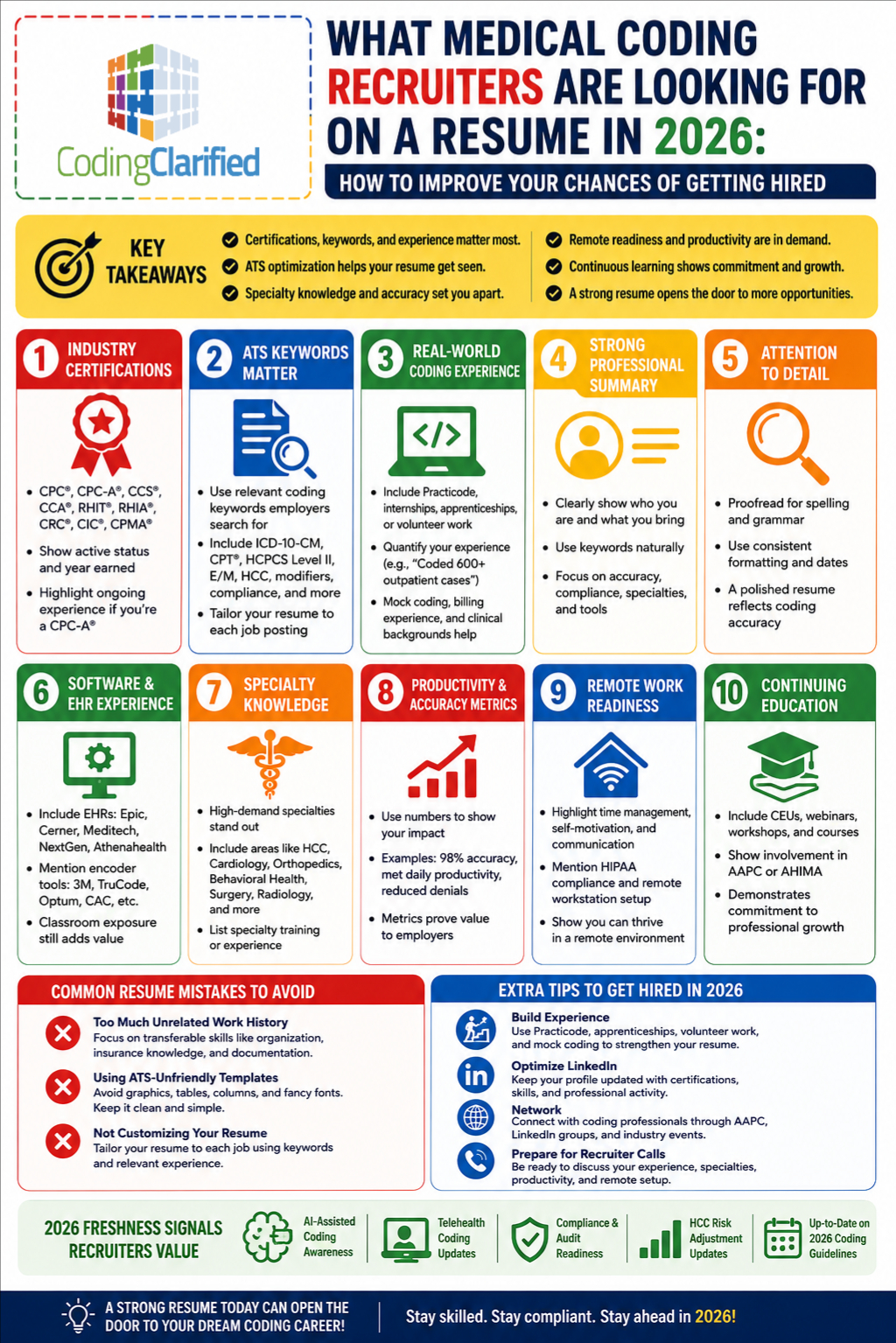
Medical coding recruiters review many resumes, so yours needs to stand out quickly. Medical coding continues to evolve rapidly in 2026. Consequently, recruiters are becoming far more selective when reviewing resumes for outpatient coding, inpatient coding, risk adjustment, auditing, and remote coding positions. Employers are no longer searching only for certifications. Instead, they want candidates who demonstrate coding accuracy, adaptability, compliance awareness, productivity potential, and strong communication skills.
Additionally, because many employers now use Applicant Tracking Systems (ATS), your resume must be optimized with the correct medical coding keywords and formatting to even reach a recruiter’s desk. Therefore, understanding what recruiters truly want can dramatically improve your chances of landing interviews and securing employment opportunities.
Whether you are a brand-new AAPC CPC®, a CPC-A®, a AHIMA CCS®, or an experienced coder pursuing remote positions, this guide explains exactly what medical coding recruiters are looking for in 2026 and how you can stand out in today’s competitive job market.
Key Takeaways
- Recruiters prioritize certifications, ATS keywords, coding accuracy, and specialty knowledge.
- Many employers now use ATS software to filter resumes before human review.
- Remote coding positions remain highly competitive in 2026.
- Practical experience such as Practicode, internships, apprenticeships, and mock coding projects can strengthen entry-level resumes.
- Specialty knowledge in HCC, cardiology, surgery, radiology, orthopedics, and behavioral health is increasingly valuable.
- Professional formatting, measurable achievements, and continuing education can significantly improve hiring opportunities.
- Recruiters frequently review LinkedIn profiles and social media professionalism before interviews.
Why Medical Coding Resumes Matter More Than Ever in 2026
Healthcare organizations continue facing increased pressure related to compliance, reimbursement accuracy, claim denials, payer audits, and staffing shortages. Therefore, recruiters are searching for coders who can contribute immediately while maintaining productivity and compliance standards.
In addition, the expansion of telehealth services, HCC risk adjustment, AI-assisted coding tools, and updated reimbursement methodologies has changed what employers expect from modern coders.
As a result, recruiters are carefully evaluating resumes for evidence of:
- ICD-10-CM knowledge
- CPT® coding accuracy
- HCPCS Level II familiarity
- Specialty coding experience
- Encoder software experience
- EHR navigation skills
- Remote work readiness
- Productivity potential
- Compliance awareness
- Communication and documentation skills
Moreover, recruiters often spend fewer than 10 seconds scanning a resume initially. Because of this, organization, readability, and keyword optimization are extremely important.
What Medical Coding Recruiters Are Looking for on a Resume
1. Industry Certifications
First and foremost, recruiters want to see recognized coding certifications prominently displayed near the top of your resume.
Common certifications include:
- CPC®
- CPC-A®
- CCS®
- CCA®
- RHIT®
- RHIA®
- CRC®
- CIC®
- CPMA®
Additionally, recruiters want to know whether the certification is active and current.
Example
AAPC Certified Professional Coder (CPC®), Active
If you are currently a CPC-A®, avoid hiding the apprentice designation. Instead, explain how you are actively gaining experience through:
- Practicode
- Coding apprenticeships
- Internships
- Volunteer coding
- Independent coding practice
- Continuing education
Consequently, recruiters often view proactive candidates more favorably than applicants who simply list credentials without demonstrating growth.
For official credential information, review resources from AAPC and AHIMA.
2. ATS-Friendly Medical Coding Keywords
Many employers now use Applicant Tracking Systems (ATS) to automatically screen resumes before human review. Therefore, resumes lacking proper coding terminology may never be seen by recruiters.
Strong ATS keywords include:
- ICD-10-CM
- CPT®
- HCPCS Level II
- HCC Coding
- Risk Adjustment
- E/M Coding
- Medical Necessity
- NCCI Edits
- Medicare Guidelines
- Compliance
- Denial Management
- Telehealth Coding
- Modifier Usage
- Auditing
- Revenue Cycle
- Encoder Software
- Prior Authorization
Additionally, recruiters often search for specialty-specific terminology, including:
- Cardiology
- Orthopedics
- Behavioral Health
- Emergency Medicine
- Pediatrics
- Surgery
- Radiology
- OBGYN
- Interventional Radiology
Because of this, tailoring your resume to each job posting can dramatically improve visibility within ATS systems.
For updated coding guidance, coders should routinely review CMS Coding Resources.
3. Real-World Coding Experience
Even entry-level coders should demonstrate practical coding exposure whenever possible.
Although many new coders worry about lacking professional experience, recruiters still want evidence of hands-on coding practice.
Helpful examples include:
- Practicode completion
- Coding internships
- Registered apprenticeships
- Volunteer coding
- Medical billing experience
- Clinical backgrounds
- Coding school projects
- Operative report practice
- Mock coding cases
Furthermore, measurable experience strengthens resumes significantly.
Weak Example
“Completed coding practice.”
Strong Example
“Completed over 600 outpatient coding cases utilizing ICD-10-CM, CPT®, and HCPCS Level II guidelines.”
As a result, your resume appears far more credible and results-oriented.
4. A Strong Professional Summary
Your professional summary is one of the first sections recruiters review. Therefore, it should immediately communicate your value.
Unfortunately, many coding resumes fail because summaries are vague or generic.
Weak Summary
“Seeking a coding position where I can grow.”
Strong Summary
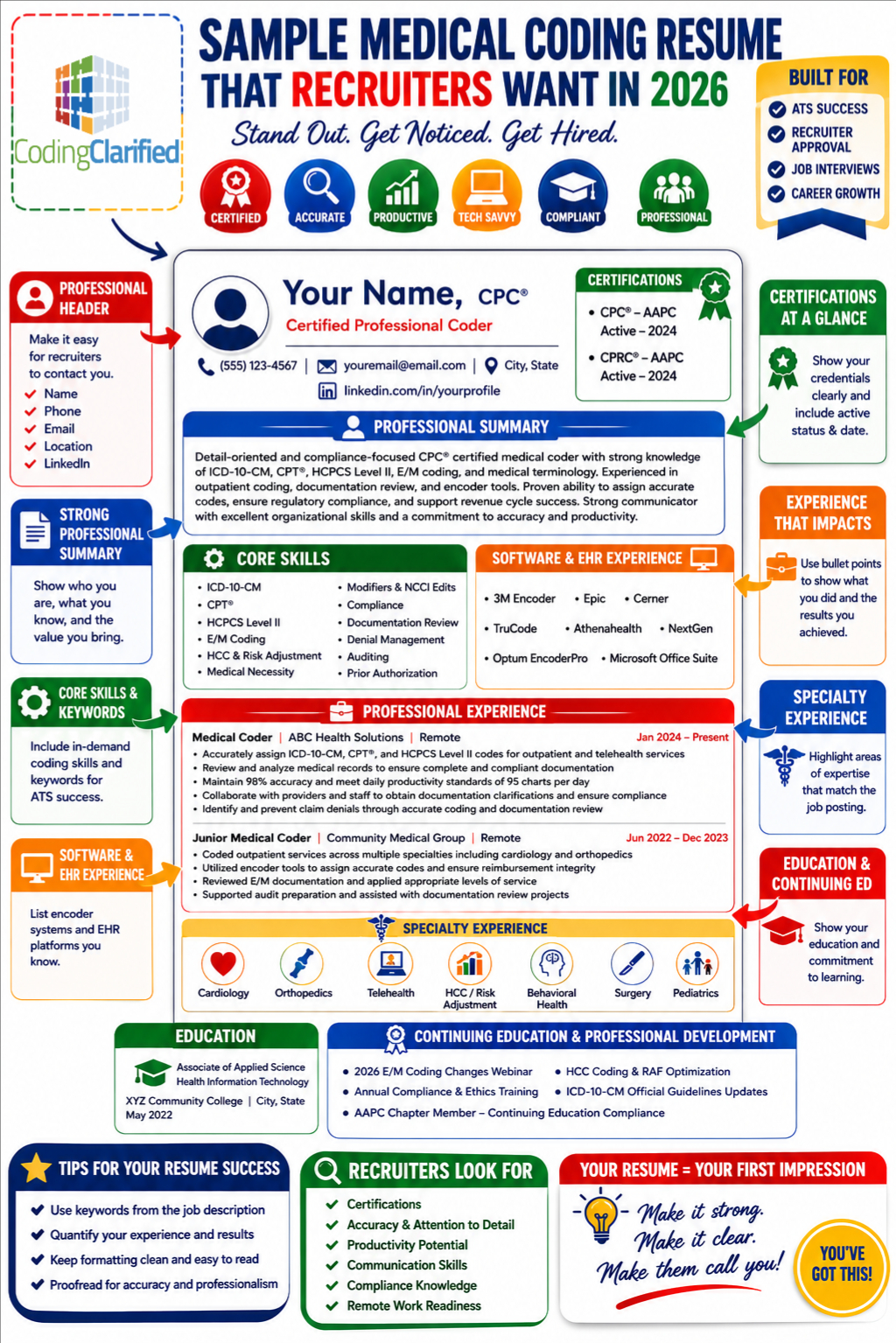
“Detail-oriented CPC-certified medical coder with training in ICD-10-CM, CPT®, HCPCS Level II, E/M coding, medical terminology, and compliance guidelines. Experienced with outpatient coding scenarios, encoder tools, and documentation review. Strong organizational, communication, and productivity skills with a focus on coding accuracy.”
Additionally, your summary should naturally include important ATS keywords.
2026 Freshness Signals Recruiters Are Paying Attention To
Medical coding recruiters increasingly want candidates who stay current with coding changes and healthcare trends.
In 2026, recruiters are especially interested in applicants familiar with:
- AI-assisted coding workflows
- Updated E/M documentation guidelines
- Telehealth coding changes
- HCC Risk Adjustment Model V28
- Medicare compliance updates
- Remote patient monitoring services
- Revenue integrity initiatives
- Denial prevention strategies
- Coding audit readiness
Therefore, mentioning recent coursework, webinars, conferences, or continuing education related to 2026 coding updates can help demonstrate professional engagement.
5. Attention to Detail
Coding accuracy matters tremendously in healthcare reimbursement. Consequently, recruiters often judge resumes as indicators of coding precision.
Recruiters immediately notice:
- Spelling mistakes
- Grammar issues
- Misaligned formatting
- Inconsistent dates
- Poor organization
- Incomplete sections
Even minor resume mistakes may raise concerns regarding coding accuracy and compliance performance.
Therefore, proofreading is essential.
Additionally, ask another professional to review your resume before applying.
6. Software and EHR Experience
Healthcare employers increasingly expect coders to navigate electronic systems efficiently.
Recruiters often search for experience with:
- Epic
- Cerner
- Meditech
- Athenahealth
- NextGen
- 3M Encoder
- TruCode
- Optum EncoderPro
- CAC software
- Microsoft Office
Even classroom exposure can strengthen entry-level resumes.
Example
“Familiar with Epic EHR workflows and encoder navigation through coding coursework and simulated chart review.”
7. Specialty Coding Knowledge
Specialty coding expertise can significantly increase recruiter interest.
In fact, many employers now prefer candidates with focused specialty knowledge rather than general coding exposure alone.
High-demand specialties in 2026 include:
- Risk Adjustment/HCC
- Cardiology
- Orthopedics
- Emergency Department
- Behavioral Health
- Telehealth
- Pediatrics
- Surgical Coding
- Radiology
- Interventional Radiology
Consequently, highlighting specialty coursework or coding practice can help differentiate your resume.
You may also find these Coding Clarified resources helpful:
- Medical Coding for Urology in 2026
- Medical Coding Clarified Acute on Chronic Kidney Failure
- 2027 Maternity Care Services Code Changes
- Medical Coding Blog
8. Productivity and Accuracy Metrics
Experienced coders should include measurable achievements whenever possible.
Recruiters love performance metrics because they demonstrate immediate value.
Examples include:
- Maintained 98% coding accuracy
- Met daily productivity benchmarks
- Reduced claim denials
- Assisted with audit correction workflows
- Improved documentation clarification processes
- Supported compliance initiatives
Additionally, quantifiable achievements often help resumes stand out during competitive hiring processes.
9. Remote Work Readiness
Remote coding positions remain highly competitive in 2026. Consequently, recruiters want evidence that candidates can work independently and maintain productivity remotely.
Helpful skills to include:
- Time management
- Self-motivation
- HIPAA compliance
- Communication skills
- Remote workstation setup
- Productivity monitoring
- Team collaboration platforms
Furthermore, prior remote experience can significantly improve your competitiveness.
10. Continuing Education and Professional Growth
Recruiters appreciate coders who continue investing in professional development.
Examples include:
- CEUs
- Coding webinars
- Specialty workshops
- Compliance training
- Coding conferences
- AAPC chapter involvement
- Audit education
- Anatomy refreshers
Additionally, ongoing education demonstrates dedication and long-term career commitment.
Common Resume Mistakes That Hurt Medical Coding Candidates
Including Too Much Unrelated Work History
Although prior work experience matters, unrelated jobs should not dominate your resume.
Instead, emphasize transferable skills such as:
- Organization
- Customer service
- Insurance knowledge
- Documentation
- Data entry
- Compliance awareness
Using ATS-Unfriendly Resume Templates
Many overly designed templates perform poorly within ATS systems.
Avoid:
- Graphics
- Tables
- Fancy fonts
- Complex columns
- Excessive colors
Instead, use:
- Clear headings
- Standard fonts
- Organized bullet points
- Simple formatting
- Consistent spacing
Sending the Same Resume Everywhere
One of the biggest mistakes coding candidates make is using identical resumes for every application.
However, recruiters can quickly identify generic applications.
Therefore, customize your resume by:
- Matching keywords from job postings
- Highlighting relevant specialties
- Adjusting your professional summary
- Prioritizing relevant experience
As a result, your resume becomes more targeted and ATS-friendly.
How to Improve Your Chances of Getting Hired in Medical Coding
Build Experience While Job Searching
If interviews are limited, continue strengthening your resume.
Helpful options include:
- Practicode
- Coding apprenticeships
- Volunteer work
- Specialty courses
- Audit practice
- Mock coding cases
- Medical billing exposure
Consequently, your qualifications continue improving while you apply.
Optimize Your LinkedIn Profile
Recruiters frequently search LinkedIn for coding candidates.
Therefore, your LinkedIn profile should include:
- Professional headshot
- Certification credentials
- Coding keywords
- Detailed experience
- Continuing education
- Specialty interests
- Professional networking activity
Additionally, avoid unprofessional social media behavior because employers often review online presence before hiring.
Network With Coding Professionals
Networking remains extremely valuable in medical coding.
Helpful opportunities include:
- AAPC chapters
- Coding webinars
- LinkedIn groups
- Coding conferences
- Professional forums
- Medical coding Facebook groups
Furthermore, networking frequently leads to hidden job opportunities that never appear publicly.
Prepare for Recruiter Screening Calls
Once your resume attracts attention, the next step is often a recruiter screening interview.
Common topics include:
- Certification status
- Coding specialties
- Productivity expectations
- Remote work setup
- Experience level
- Availability
- Salary expectations
Therefore, practicing responses beforehand can improve confidence significantly.
CPC Exam and Career Tips for New Coders
If you are newly certified, remember that many successful coders started with minimal experience.
To improve your opportunities:
- Continue coding daily
- Practice operative reports
- Study coding guidelines consistently
- Strengthen anatomy knowledge
- Learn E/M coding thoroughly
- Understand modifier usage
- Review denial scenarios
- Stay current on 2026 coding updates
Most importantly, remain persistent. Although entering the medical coding field can initially feel challenging, consistency and professional growth often create long-term opportunities.
Coding Clarified Final Thoughts
Medical coding recruiters in 2026 are looking for much more than certifications alone. They want candidates who demonstrate professionalism, coding knowledge, productivity potential, compliance awareness, adaptability, and real-world readiness.
Therefore, creating a strong, keyword-optimized, ATS-friendly resume is essential for standing out in today’s increasingly competitive medical coding industry.
Additionally, continuing education, specialty training, networking, and practical coding experience can dramatically improve your chances of receiving interviews and job offers. Whether you are a brand-new CPC-A® or an experienced coder seeking advancement, presenting yourself strategically can help open doors throughout the healthcare industry.
Frequently Asked Questions (FAQ)
What is the best certification for medical coding jobs in 2026?
The CPC® from AAPC remains one of the most recognized certifications for outpatient and physician-based coding. Additionally, the CCS® from AHIMA is highly respected for inpatient coding roles.
Do recruiters hire CPC-A® candidates without experience?
Yes. However, recruiters prefer candidates who demonstrate proactive efforts to gain experience through Practicode, apprenticeships, internships, volunteer work, or mock coding projects.
What keywords should I include on a medical coding resume?
Important keywords include ICD-10-CM, CPT®, HCPCS Level II, HCC coding, E/M coding, compliance, encoder software, medical necessity, telehealth coding, denial management, and specialty-specific terminology.
Are remote medical coding jobs difficult to get in 2026?
Yes. Remote coding positions remain highly competitive. Therefore, candidates with productivity metrics, specialty experience, strong communication skills, and remote workflow familiarity often stand out more quickly.
What should entry-level medical coders include on a resume?
Entry-level coders should include certifications, coding coursework, Practicode, internships, mock coding projects, specialty training, encoder familiarity, and measurable coding practice experience.
How important is LinkedIn for medical coders?
LinkedIn has become increasingly important because recruiters actively search for coding candidates online. A professional LinkedIn profile can improve visibility and networking opportunities.
What resume format works best for ATS systems?
Simple, clean formatting works best. Use standard fonts, bullet points, consistent headings, and keyword-rich descriptions while avoiding graphics, tables, and overly designed templates.
What specialties are most in demand for medical coders in 2026?
High-demand specialties include HCC/risk adjustment, cardiology, orthopedics, radiology, surgery, behavioral health, emergency medicine, telehealth, and interventional radiology.