Hypertension Medical Coding and Billing Guidelines for 2026: ICD-10-CM Codes, Documentation, and Reimbursement Strategies
By Janine Mothershed CPC, CPC-I
Hypertension remains one of the most commonly diagnosed chronic conditions in the United States. Consequently, medical coders, billers, providers, and CPC students must understand how to accurately document, code, sequence, and bill hypertension-related conditions.
Because hypertension frequently coexists with chronic kidney disease (CKD), heart disease, diabetes, obesity, and vascular disorders, coding errors can significantly impact reimbursement, risk adjustment, quality reporting, and audit outcomes.
Therefore, this updated 2026 guide explains the most important ICD-10-CM hypertension codes, documentation requirements, sequencing rules, billing considerations, and common coding mistakes.
Key Takeaways
- Coders use I10 for essential (primary) hypertension.
- Hypertension and CKD have a presumed relationship under ICD-10-CM guidelines unless documentation clearly states otherwise.
- Hypertension and heart disease may require combination codes when a causal relationship is documented or presumed.
- Secondary hypertension requires coding both the hypertension and the underlying cause.
- In addition, accurate sequencing affects reimbursement and medical necessity.
- Likewise, documentation must identify complications, severity, and associated conditions.
- Proper hypertension coding supports quality reporting, risk adjustment, and compliance initiatives in 2026.
Why Accurate Hypertension Coding Matters in 2026
In fact, hypertension affects millions of patients and appears in nearly every medical specialty. As a result, it is one of the most frequently reported diagnoses on insurance claims.
Moreover, hypertension often contributes to:
- Heart failure
- Coronary artery disease
- Chronic kidney disease
- Stroke
- Peripheral vascular disease
- Hypertensive emergencies
Because reimbursement increasingly depends on accurate clinical documentation, coders must ensure that every diagnosis reflects the provider’s complete assessment of the patient.
Additionally, value-based care initiatives continue to place greater emphasis on chronic disease management. Therefore, correct hypertension coding plays a significant role in risk adjustment and quality metrics.
Understanding the Types of Hypertension
Essential (Primary) Hypertension
Essential hypertension, also called primary hypertension, develops without a specific identifiable cause. It remains the most common form of hypertension.
Common risk factors include:
- Family history
- Obesity
- Smoking
- Sedentary lifestyle
- Excess sodium intake
- Advanced age
ICD-10-CM Code
I10 – Essential (Primary) Hypertension
Use I10 when the provider documents hypertension without identifying a secondary cause.
Example
Documentation:
“Patient presents for follow-up of stable essential hypertension controlled with lisinopril.”
Code:
- I10
Secondary Hypertension
Secondary hypertension occurs when another disease process causes elevated blood pressure.
Common causes include:
- Renal disease
- Renal artery stenosis
- Endocrine disorders
- Obstructive sleep apnea
- Certain medications
ICD-10-CM Codes
- I15.0 – Renovascular hypertension
- I15.1 – Hypertension secondary to renal disorders
- I15.2 – Hypertension secondary to endocrine disorders
- I15.8 – Other secondary hypertension
- I15.9 – Secondary hypertension, unspecified
Coding Tip
Always code:
- The underlying condition
- The secondary hypertension code
Otherwise, failure to capture both diagnoses often results in incomplete coding.
Hypertensive Heart Disease
Furthermore, long-standing hypertension can damage cardiac structures and contribute to heart failure.
ICD-10-CM Codes
- I11.0 – Hypertensive heart disease with heart failure
- I11.9 – Hypertensive heart disease without heart failure
When heart failure exists, assign an additional code from category I50 to identify the specific type of heart failure.
Example
Documentation:
“Hypertensive heart disease with chronic systolic heart failure.”
Codes:
- I11.0
- I50.22
Hypertensive Chronic Kidney Disease (CKD)
One of the most important ICD-10-CM hypertension guidelines involves chronic kidney disease.
Under ICD-10-CM guidelines, hypertension and CKD have a presumed causal relationship unless documentation specifically states another cause.
ICD-10-CM Codes
- I12.0 – Hypertensive CKD with Stage 5 CKD or ESRD
- I12.9 – Hypertensive CKD with Stage 1-4 CKD or unspecified CKD
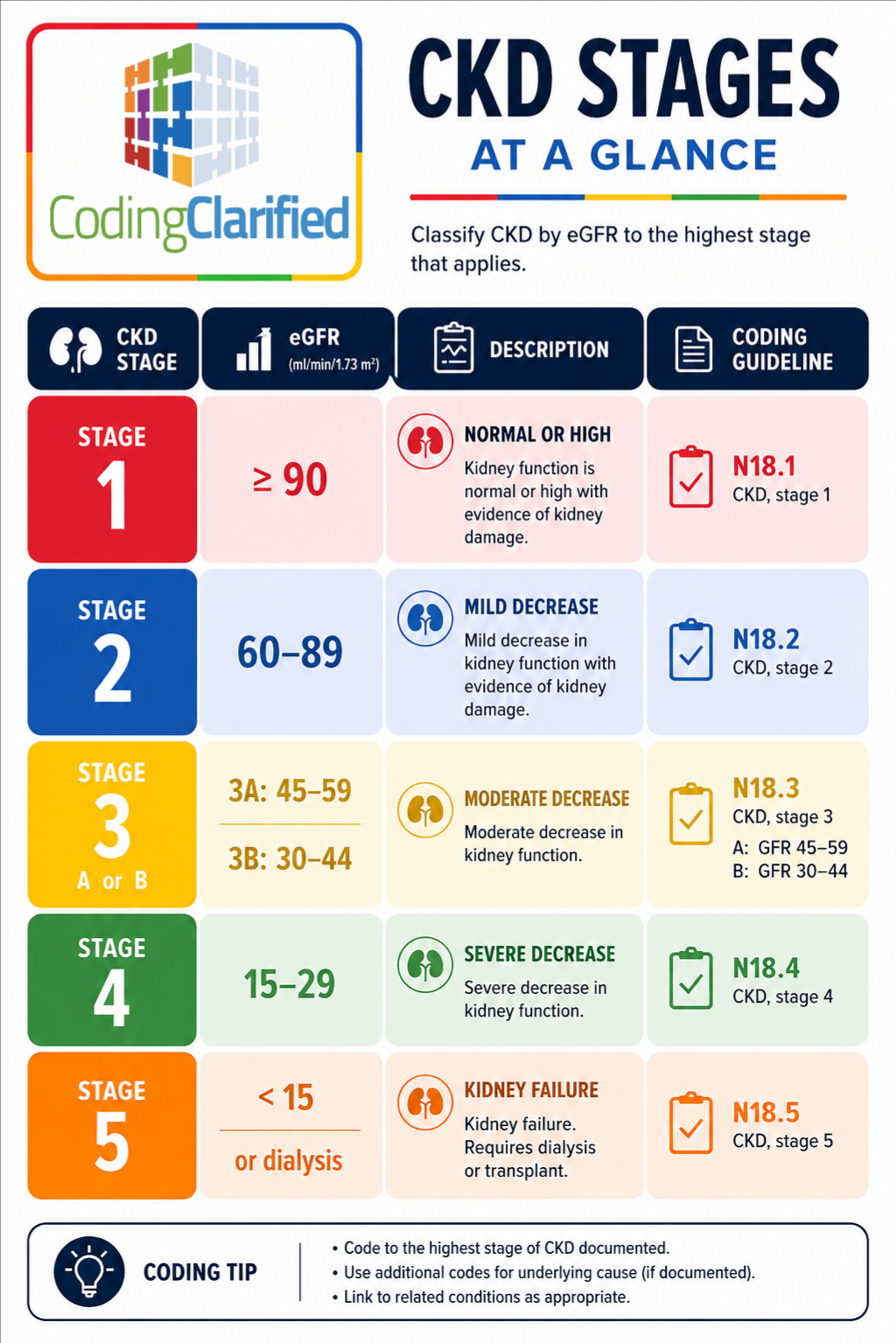
In addition, assign a CKD stage code:
- N18.1 – CKD Stage 1
- N18.2 – CKD Stage 2
- N18.30 – CKD Stage 3 unspecified
- N18.4 – CKD Stage 4
- N18.5 – CKD Stage 5
- N18.6 – ESRD
Example
Documentation:
“Hypertension with Stage 4 CKD.”
Codes:
- I12.9
- N18.4
Hypertensive Heart and Chronic Kidney Disease
Some patients experience both cardiac and renal complications.
ICD-10-CM Category
I13.-
Examples include:
- I13.0
- I13.10
- I13.2
In addition, these combination codes often require additional heart failure and CKD stage codes.
Because these encounters can become complex, coders should carefully review documentation before assigning codes.
Hypertensive Crisis
Providers may document hypertensive urgency, hypertensive emergency or hypertensive crisis. Each term maps to its own code.
ICD-10-CM Codes
- I16.0 – Hypertensive urgency
- I16.1 – Hypertensive emergency
- I16.9 – Hypertensive crisis, unspecified
Documentation should clearly identify whether acute organ damage is present.
ICD-10-CM Sequencing Guidelines for Hypertension
Above all, correct sequencing remains critical for claim accuracy.
Scenario 1: Essential Hypertension
Codes
- I10
The hypertension code serves as the principal diagnosis when hypertension is the primary reason for treatment.
Scenario 2: Hypertension and CKD
Documentation
“Hypertension with Stage 4 CKD.”
Codes
- I12.9
- N18.4
Because ICD-10-CM presumes a relationship, use the combination code first.
Scenario 3: Secondary Hypertension
Documentation
“Renovascular hypertension due to renal artery stenosis.”
Codes
- Underlying renal condition
- I15.0
In this case, the underlying cause receives sequencing priority.
Documentation Requirements for Hypertension Coding
Above all, strong documentation supports accurate reimbursement and reduces denials.
Providers should document:
Type of Hypertension
- Essential
- Secondary
- Hypertensive urgency
- Hypertensive emergency
Associated Conditions
- CKD
- Heart failure
- Coronary artery disease
- Stroke history
Disease Severity
- CKD stage
- Heart failure type
- Presence of end-organ damage
Treatment Plan
- Medication management
- Monitoring
- Follow-up recommendations
In short, the more specific the documentation, the more accurate the coding.
Billing Guidelines for Hypertension Services
Evaluation and Management (E/M) Services
In general, hypertension often contributes to medical decision-making complexity.
Factors affecting E/M levels include:
- Medication management
- Review of laboratory studies
- Assessment of complications
- Management of multiple chronic conditions
Consequently, hypertension frequently influences E/M code selection.
Preventive Medicine Services
Hypertension screening commonly occurs during preventive visits.
Examples include:
- 99381–99387
- 99391–99397
Documentation should distinguish preventive services from problem-oriented services when both occur on the same date.
Remote Patient Monitoring (RPM)
Blood pressure monitoring continues to grow in 2026.
Common CPT codes include:
- 99453
- 99454
- 99457
- 99458
These services may support chronic hypertension management when documentation meets CMS requirements.
Common Mistakes to Avoid
Using I10 When a Combination Code Applies
Many coders incorrectly assign I10 when hypertensive CKD or hypertensive heart disease exists.
Instead, review the hypertension chapter carefully before defaulting to I10.
Missing CKD Stage Codes
A hypertensive CKD diagnosis often requires both:
- I12 category code
- N18 category code
As a result, missing the CKD stage code creates an incomplete claim.
Incorrect Sequencing
Secondary hypertension frequently causes sequencing errors.
Always code the underlying condition first when guidelines require it.
Overusing Unspecified Codes
Although unspecified codes exist, providers should document enough specificity to avoid them whenever possible.
Ignoring Documentation of Heart Failure
When hypertension and heart failure appear together, review ICD-10-CM guidelines to determine whether a hypertensive heart disease code applies.
CPC Student Tips for Exam Success
If you are preparing for the CPC exam, focus on these hypertension concepts:
Know the Difference Between:
- I10
- I11
- I12
- I13
- I15
Memorize the Presumed Relationships
ICD-10-CM presumes relationships between:
- Hypertension and CKD
- Hypertension and heart disease (when documented appropriately)
Review Official Guidelines
Many CPC exam questions test guideline application rather than code memorization.
Therefore, spend time studying Chapter 9 guidelines.
Practice Sequencing
For example, exam questions frequently challenge students with sequencing scenarios involving CKD and secondary hypertension.
Related Coding Clarified Articles
For additional coding guidance, review:
Medical Coding Chronic Kidney Disease
Medical Coding “Clarified” Acute on Chronic Kidney Failure
Overall, these resources help reinforce diagnosis coding, sequencing, and documentation principles.
Authoritative Resources
For official coding guidance, review:
CMS ICD-10-CM Official Guidelines for Coding and Reporting
Frequently Asked Questions (FAQ)
What is the ICD-10-CM code for essential hypertension?
The ICD-10-CM code for essential (primary) hypertension is I10.
When should I use I12.9 instead of I10?
Use I12.9 when documentation supports hypertensive chronic kidney disease with Stage 1-4 CKD or unspecified CKD.
Does ICD-10-CM presume a relationship between hypertension and CKD?
Yes. ICD-10-CM presumes a causal relationship between hypertension and CKD unless documentation clearly states another cause.
Can hypertension affect E/M code selection?
Yes. In particular, medication management, monitoring, and treatment complexity can increase medical decision-making and influence E/M code selection.
What is the difference between hypertensive urgency and hypertensive emergency?
Hypertensive emergency includes evidence of acute end-organ damage, while hypertensive urgency does not.
How do you code secondary hypertension?
Assign a code for the underlying condition first, followed by the appropriate secondary hypertension code from category I15.
What are the most common hypertension coding errors?
For example, common mistakes include incorrect sequencing, failure to report CKD stage, overuse of unspecified codes, and missing combination codes.
Why is hypertension important for risk adjustment?
Specifically, hypertension frequently coexists with chronic diseases that impact risk scores, reimbursement, and quality reporting programs.
Coding Clarified Final Thoughts
Clearly, hypertension coding extends far beyond assigning code I10. In fact, coders must evaluate documentation for heart disease, chronic kidney disease, secondary causes, and hypertensive crises before selecting the correct ICD-10-CM codes.
Furthermore, proper sequencing, complete documentation, and adherence to official guidelines help reduce denials and improve reimbursement accuracy. As coding rules continue to evolve in 2026, staying current with CMS and AAPC guidance remains essential for both working coders and CPC students.