Medical Coding Sequencing in 2026: How to Sequence Diagnosis and Procedure Codes Correctly
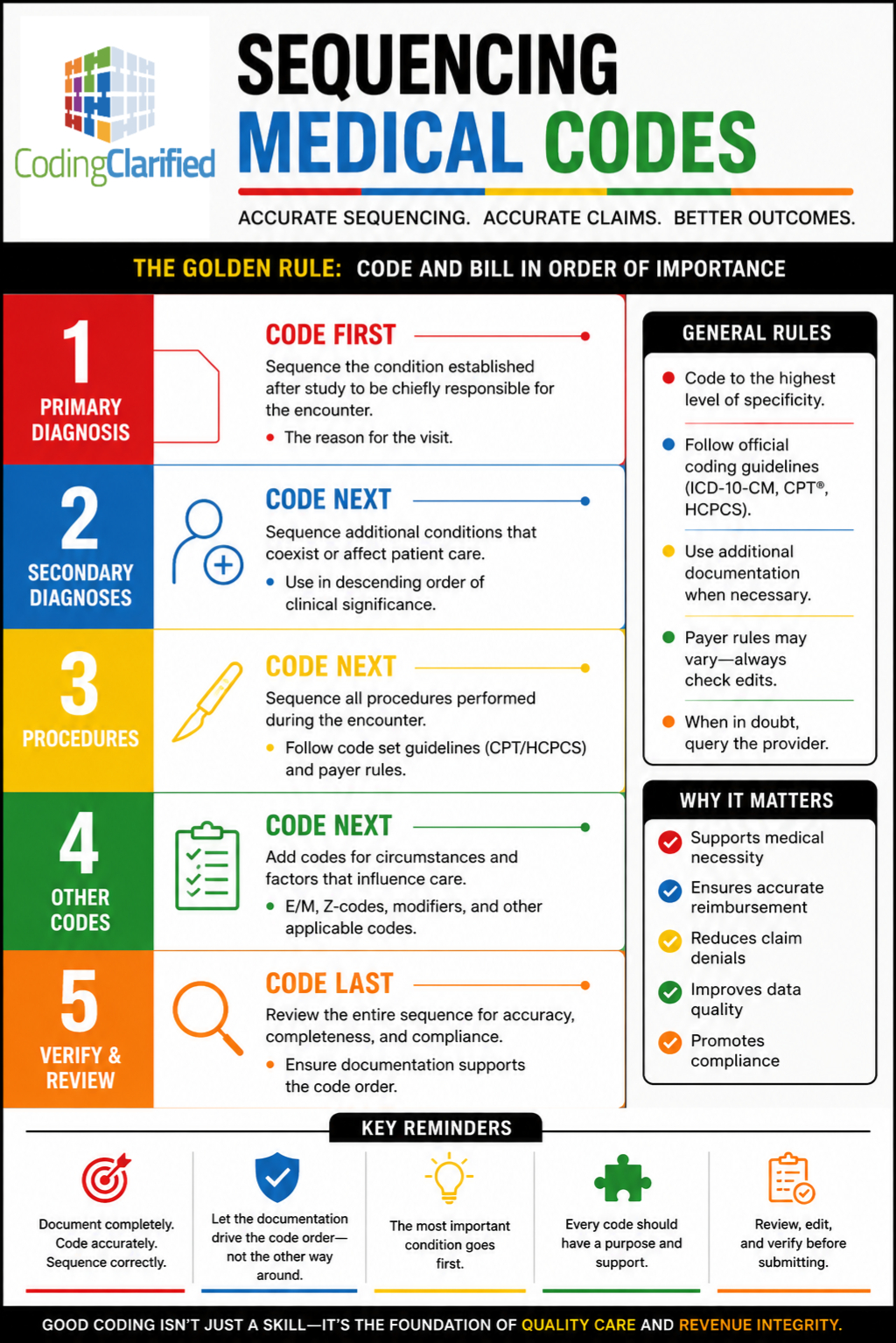
Medical coding sequencing is one of the most important skills every coder must master. Choosing the correct diagnosis and procedure codes is only part of the job. You must also place those codes in the proper order so they accurately tell the patient’s clinical story and support medical necessity.
Incorrect sequencing can lead to claim denials, delayed reimbursement, compliance concerns, inaccurate quality reporting, and even audit findings. Whether you’re preparing for the CPC exam or working in a healthcare practice, understanding sequencing rules is essential.
This updated 2026 guide explains ICD-10-CM diagnosis sequencing, CPT procedure sequencing, payer expectations, and practical examples to help you code with confidence.
Key Takeaways
- Medical code sequencing determines the order of diagnosis and procedure codes submitted on a claim.
- The first-listed diagnosis should explain the primary reason for the encounter in outpatient coding.
- In inpatient coding, the principal diagnosis follows the Official ICD-10-CM Coding Guidelines.
- CPT procedure codes should generally be listed according to payer rules, medical necessity, and reimbursement guidelines.
- Correct sequencing reduces denials, improves compliance, and supports accurate reimbursement.
- CPC students should practice sequencing just as much as code selection because sequencing questions frequently appear on certification exams.
What Is Medical Coding Sequencing?
Medical coding sequencing is the process of arranging diagnosis and procedure codes in the correct order on a medical claim.
Although every reported code may be correct individually, placing them in the wrong sequence can cause the payer to reject or deny the claim.
Think of sequencing as telling the patient’s medical story in the proper order.
The primary diagnosis explains why the patient received care. Procedure codes then identify what services were performed.
When the diagnosis and procedures are sequenced correctly, the claim clearly demonstrates medical necessity
Why Proper Sequencing Matters in 2026
Healthcare reimbursement continues to rely heavily on accurate coding.
Insurance companies increasingly use automated claim edits that compare diagnosis sequencing with procedure sequencing before claims are processed.
Proper sequencing helps:
- Reduce claim denials
- Support medical necessity
- Improve reimbursement
- Reduce audit risk
- Improve quality reporting
- Ensure compliance with payer policies
Additionally, accurate sequencing creates a clearer medical record for future providers.
Diagnosis Sequencing Rules
Diagnosis sequencing differs depending on whether the patient receives outpatient or inpatient services.
Outpatient Diagnosis Sequencing
For physician offices and outpatient facilities, the first-listed diagnosis should represent the primary reason the patient was seen.
Additional diagnoses follow in order of importance.
For example:
Patient presents for diabetes follow-up with diabetic neuropathy.
Diagnosis sequencing:
- E11.40 Type 2 diabetes mellitus with diabetic neuropathy, unspecified
- I10 Essential hypertension
- E78.5 Hyperlipidemia, unspecified
The diabetes diagnosis appears first because it was the primary reason for today’s visit.
Inpatient Diagnosis Sequencing
Hospital inpatient coding follows different rules.
The principal diagnosis is:
“That condition established after study to be chiefly responsible for occasioning the admission.”
For example:
Patient admitted with pneumonia after evaluation.
Principal diagnosis:
J18.9 Pneumonia, unspecified organism
Secondary diagnoses:
I10 Essential hypertension
E11.9 Type 2 diabetes mellitus without complications
Understanding Primary, Principal, and Secondary Diagnoses
Many new coders confuse these terms.
Primary Diagnosis
Used primarily in outpatient settings.
Represents the chief reason for the encounter.
Principal Diagnosis
Used for inpatient hospital admissions.
Represents the condition responsible for the admission after study.
Secondary Diagnoses
These are additional conditions that affect treatment, evaluation, or patient care.
They may influence medical decision-making, reimbursement, and risk adjustment.
CPT Procedure Sequencing
Procedure sequencing is just as important as diagnosis sequencing.
Generally, CPT codes should be listed in the order that best reflects:
- Primary procedure performed
- Medical necessity
- Payer reimbursement requirements
- Relative complexity
Usually, the major procedure appears first.
Example:
Patient undergoes:
- Colonoscopy with biopsy
- Polypectomy
The higher-valued procedure is generally listed before the lesser service according to CPT and payer guidelines.
Always verify National Correct Coding Initiative (NCCI) edits before submitting claims.
Diagnosis Codes Must Support Medical Necessity
Each procedure should be linked to the diagnosis that justifies the service.
For example:
Procedure:
93000 Electrocardiogram
Supporting diagnosis:
R07.9 Chest pain, unspecified
Incorrect sequencing might place unrelated diagnoses before the medically necessary diagnosis, leading to denials.
Common Sequencing Situations
Chronic Conditions
Report chronic diseases that affect today’s treatment.
Example:
Primary:
I10 Essential hypertension
Secondary:
E78.5 Hyperlipidemia
Acute Conditions
Acute conditions generally take sequencing priority when they are the reason for today’s visit.
Example:
Primary:
J02.9 Acute pharyngitis
Secondary:
J30.9 Allergic rhinitis
Injury Encounters
When coding injuries, sequence the injury before associated symptoms.
Correct:
S52.501A Unspecified fracture of the lower end of right radius, initial encounter
Do not sequence pain first unless instructed by the ICD-10-CM guidelines.
Pregnancy
Pregnancy-related diagnoses frequently receive sequencing priority.
Always review Chapter 15 sequencing instructions carefully.
Follow-Up Visits
Use follow-up and aftercare codes when appropriate.
Do not automatically report the original condition if the guidelines direct otherwise.
Sequencing Examples
Example 1
Patient seen for uncontrolled diabetes with diabetic chronic kidney disease.
Correct sequencing:
- E11.22
- N18.3
- I10
Example 2
Patient presents for chest pain ultimately diagnosed as GERD.
Correct sequencing:
- K21.9
- R07.9 (only if appropriate based on Official Guidelines)
Example 3
Patient treated for cellulitis caused by diabetes.
Correct sequencing:
- E11.628
- L03.90
Always review instructional notes, Includes notes, Excludes notes, and “Code first” or “Use additional code” instructions.
Sequencing and Medical Necessity
Many denials occur because diagnosis sequencing fails to support procedures.
Example:
Procedure:
71046 Chest X-ray
Supported diagnosis:
R05.9 Cough
If an unrelated diagnosis appears first, automated edits may deny the service.
Proper sequencing demonstrates why the provider ordered the test.
CPC Student Tips
If you’re preparing for the CPC exam, remember these sequencing strategies:
- Read the entire scenario before selecting codes.
- Determine the main reason for the encounter first.
- Watch for “Code First” notes.
- Never ignore “Use Additional Code” instructions.
- Review instructional notes before assigning final code order.
- Practice sequencing separately from code lookup.
- Learn the difference between outpatient and inpatient sequencing rules.
- Always verify payer-specific requirements when applicable.
Many CPC exam questions test sequencing instead of code selection.
Common Mistakes to Avoid
Many coding errors occur because coders know the correct codes but sequence them incorrectly.
Avoid these common mistakes:
- Listing symptoms before confirmed diagnoses when guidelines prohibit it.
- Ignoring “Code First” notes.
- Forgetting “Use Additional Code” instructions.
- Sequencing chronic conditions before the actual reason for the visit.
- Reporting secondary diagnoses before the principal diagnosis.
- Failing to link procedures with supporting diagnoses.
- Assuming every payer follows identical sequencing rules.
- Overlooking NCCI edits when sequencing CPT procedures.
Carefully reviewing documentation before finalizing claims greatly reduces these errors.
Best Practices for Accurate Sequencing
Successful coders follow a consistent process.
Review the provider documentation completely before assigning codes.
Next, identify the primary reason for the encounter.
Then verify all ICD-10-CM instructional notes.
Afterward, assign diagnosis codes in the proper order.
Finally, sequence CPT procedures according to payer rules and medical necessity while confirming NCCI edits.
Following the same workflow every time improves both speed and accuracy.
2026 Coding Update
Although the fundamentals of sequencing remain consistent, coders should continue reviewing:
- Annual ICD-10-CM updates
- CPT code revisions
- CMS National Correct Coding Initiative edits
- Medicare Local Coverage Determinations (LCDs)
- National Coverage Determinations (NCDs)
- Individual payer medical necessity policies
Remaining current helps prevent denials and supports compliant coding throughout 2026.
Coding Clarified Conclusion
Correct medical coding sequencing is one of the foundations of accurate coding. Selecting the right codes is only the beginning. Placing those codes in the proper order tells the complete clinical story, supports medical necessity, improves reimbursement, and helps maintain compliance.
Whether you’re a new CPC student or an experienced coder, strengthening your sequencing skills will improve coding accuracy and reduce costly claim errors.
Taking a few extra moments to verify sequencing before claim submission can save significant time and frustration later.
Frequently Asked Questions
What is medical coding sequencing?
Medical coding sequencing is the process of placing diagnosis and procedure codes in the correct order so the claim accurately reflects the patient’s condition and the services provided.
What is the difference between a primary diagnosis and a principal diagnosis?
A primary diagnosis is used mainly for outpatient encounters and represents the main reason for the visit. A principal diagnosis is used for inpatient admissions and identifies the condition chiefly responsible for the hospitalization after study.
Why is sequencing important in medical coding?
Proper sequencing supports medical necessity, improves reimbursement, reduces denials, and helps healthcare organizations remain compliant with payer requirements.
Do CPT codes have sequencing rules?
Yes. CPT procedure codes should generally be sequenced according to the primary procedure, payer guidelines, medical necessity, and applicable NCCI edits.
Can incorrect sequencing cause claim denials?
Absolutely. Even when every code is correct, improper sequencing may cause automated claim edits to reject or deny the claim.
How can CPC students improve sequencing skills?
Practice full coding scenarios instead of memorizing codes alone. Review the ICD-10-CM Official Guidelines, pay close attention to instructional notes, and understand the differences between outpatient and inpatient coding.
Does every insurance company use the same sequencing rules?
No. Although ICD-10-CM and CPT guidelines provide the foundation, individual payers may have additional coverage policies or claim submission requirements.
Where can I learn more about medical coding sequencing?
Review the ICD-10-CM Official Guidelines for Coding and Reporting, the AMA CPT Professional Edition, CMS National Correct Coding Initiative guidance, and trusted educational resources such as Coding Clarified Academy.
Continue Learning
Expand your coding knowledge with these Coding Clarified resources:
- Coding Clarified Blog
- How to Prepare for Your Proctored AAPC Exam in 2026
- Medical Coding Steps for ICD-10-CM
- Earn your CPC certification
- How to Approach a Long Medical Coding Exam Scenario
- Place Of Service
Authoritative References