How to Approach a Long Medical Coding Exam Scenario in 2026: CPC Exam Strategy, Time Management & Case Study Tips
Long medical coding scenarios can be some of the most intimidating questions on the AAPC CPC exam. You may see a lengthy operative report, office note, or medical record filled with diagnoses, medications, procedures, laboratory results, and clinical details. However, you usually do not need every word in the documentation to answer the question.
Instead, successful CPC students learn how to abstract the important information quickly.
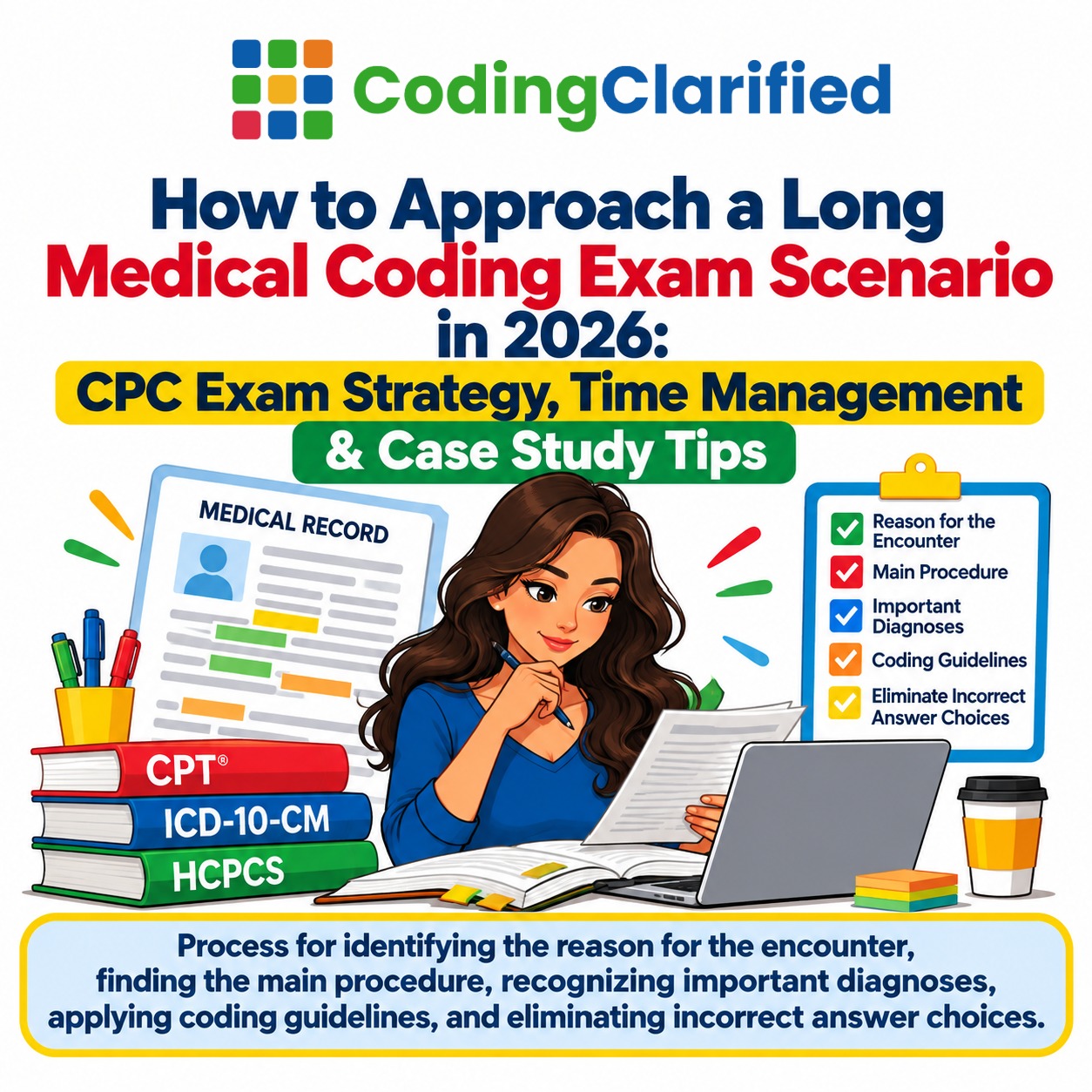
The goal is not to memorize every CPT or ICD-10-CM code. Rather, you need a repeatable process for identifying the reason for the encounter, finding the main procedure, recognizing important diagnoses, applying coding guidelines, and eliminating incorrect answer choices.
In 2026, this skill remains especially important because the CPC exam includes longer medical-record cases that require students to combine coding knowledge with documentation analysis.
Key Takeaways: How to Solve Long Medical Coding Exam Scenarios
- Read the question before getting buried in the medical record. Know what you are being asked to code.
- Identify the main reason for the encounter before looking up codes.
- For procedure questions, find the procedure, anatomy, approach, technique, and purpose.
- For diagnosis questions, separate confirmed conditions, symptoms, history, and ruled-out diagnoses.
- Use the Alphabetic Index first and Tabular List second when assigning ICD-10-CM codes.
- Read CPT section guidelines and instructional notes instead of relying only on the code descriptor.
- Eliminate obviously incorrect answer choices before researching every possible code.
- Do not spend too much time on one difficult case. Mark it and return later when necessary.
- Practice reading real medical documentation so lengthy cases become less intimidating.
- Remember that CPC questions primarily test CPT, ICD-10-CM, HCPCS Level II, anatomy, terminology, modifiers, and coding guidelines.
Why Are Long CPC Exam Scenarios So Difficult?
Long scenarios create a problem that new coders often do not expect: too much information.
A medical record may tell you about the patient’s past medical history, medications, allergies, previous surgeries, vital signs, family history, examination findings, laboratory results, imaging, anesthesia, surgical preparation, and postoperative condition.
Nevertheless, only a small portion of that information may determine the correct answer.
For example, an operative report could contain several paragraphs describing patient positioning, sterile preparation, trocar placement, irrigation, closure, and recovery. However, the answer may depend primarily on three facts:
- What procedure was performed?
- What anatomical structure was treated?
- What technique or approach did the physician use?
Therefore, learning to separate coding clues from clinical background information can save valuable exam time.
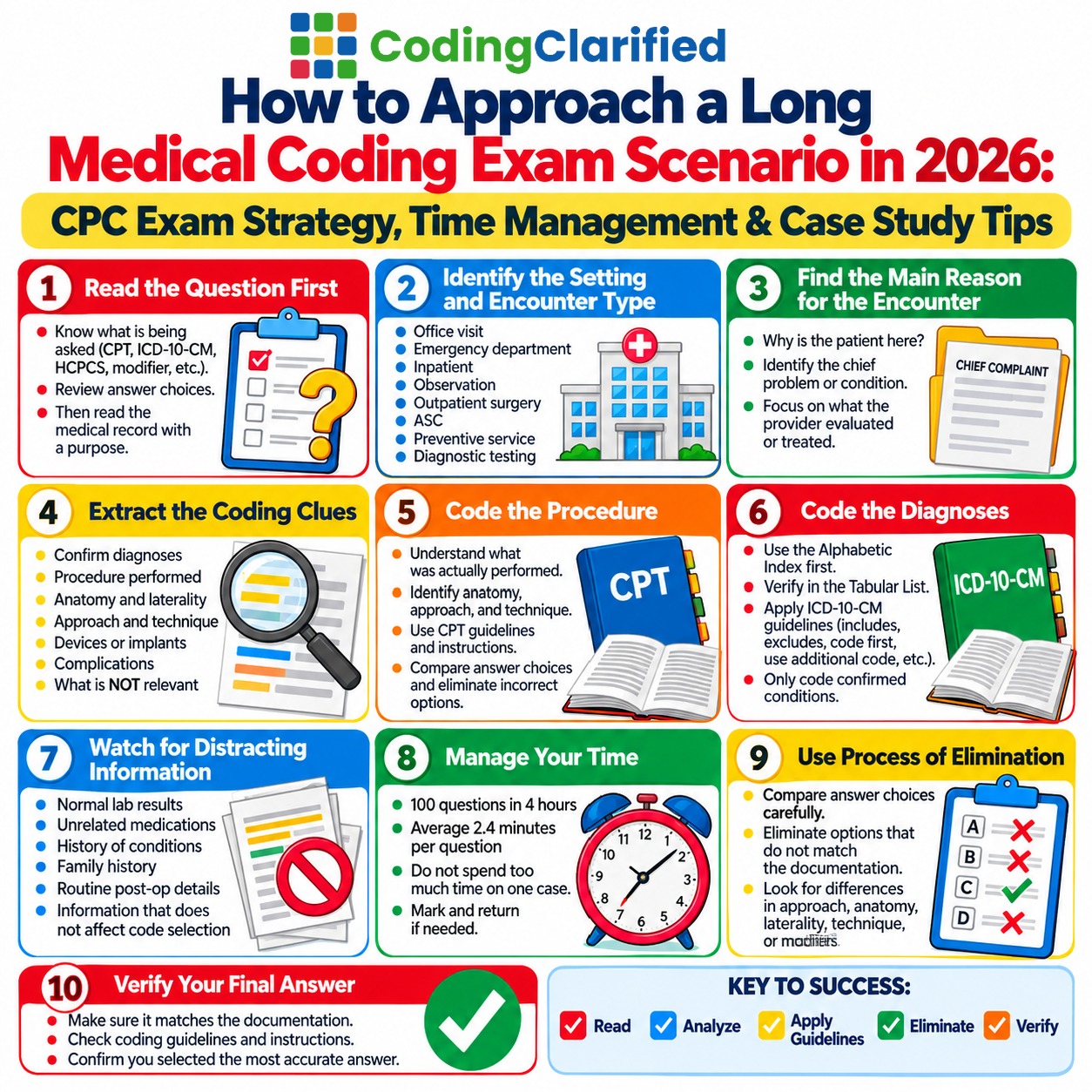
Step 1: Read the Question Before You Code the Scenario
Before researching anything, determine exactly what the question wants.
For example, does it ask for:
- The CPT code?
- The ICD-10-CM diagnosis?
- A CPT and ICD-10-CM combination?
- The correct modifier?
- The first-listed diagnosis?
- The correct E/M service?
- A HCPCS Level II code?
This simple step prevents unnecessary work.
For instance, if the question asks only for the procedure code, you probably do not need to spend several minutes researching every chronic diagnosis in the patient’s history. Conversely, a diagnosis question may not require you to analyze every procedural detail.
CPC Student Tip: Read the final question and answer choices before deeply analyzing a long case. Then, read the documentation with a purpose.
Step 2: Identify the Type of Encounter
Next, establish the setting and encounter type.
Look for clues such as:
- Office or clinic visit
- Emergency department
- Hospital inpatient
- Hospital observation
- Outpatient surgery
- Ambulatory surgery center
- Preventive service
- Diagnostic testing
- Surgical procedure
Additionally, determine whether the patient is new or established when that distinction applies.
The setting matters because coding rules can change depending on where and how the service occurred. Therefore, do not automatically apply an inpatient rule to an outpatient scenario or vice versa.
Step 3: Find the Main Reason for the Encounter
Ask one simple question:
Why is the patient here today?
That question often cuts through several paragraphs of distracting information.
For a surgical case, ask:
What problem is the surgeon trying to fix?
For an office visit, ask:
What conditions did the provider actually evaluate or manage?
For a diagnostic service, determine why the test was ordered and what the documentation supports.
However, avoid assuming that every condition appearing in the medical record should receive a code. A problem appearing on a historical problem list, for example, does not automatically mean that it should be reported for the current encounter.
Step 4: Break the Medical Record Into Coding Clues
Instead of treating a long medical record as one giant paragraph, break it into smaller pieces.
Diagnosis clues
Look for:
- Confirmed diagnoses
- Signs and symptoms
- Acute versus chronic conditions
- Laterality
- Complications
- Cause-and-effect relationships
- History of conditions
- Status conditions
- Ruled-out diagnoses
- External causes when relevant
Procedure clues
Identify:
- Procedure performed
- Anatomical site
- Laterality
- Surgical approach
- Technique
- Device or implant
- Number of lesions or sites
- Size when code selection depends on measurement
- Whether a procedure was diagnostic or therapeutic
Consequently, a two-page operative report may become only five or six important coding facts.
Step 5: Identify the Procedure Before Opening the CPT Book
One of the biggest time-wasters on a coding exam is searching CPT before you understand what happened.
First, summarize the procedure in plain language.
For example:
Laparoscopic bilateral tubal occlusion using a device.
That short summary gives you several valuable clues:
- Laparoscopic approach
- Fallopian tubes
- Bilateral procedure
- Occlusion
- Device used
Then, use those facts to locate and verify the appropriate CPT code.
The AMA explains that CPT provides standardized five-digit codes and terminology for reporting medical services and procedures. Therefore, understanding what service the physician actually performed should come before choosing a code.
Step 6: Do Not Code From the Procedure Heading Alone
An operative report title provides a useful starting point. However, the body of the operative report establishes what the surgeon actually performed.
For example, the heading might say:
“Laparoscopic evaluation with possible repair.”
The operative note may later document that the surgeon completed a repair.
Alternatively, the surgeon might inspect the area but determine that no repair was necessary.
Therefore, read enough of the operative report to establish the actual procedure before selecting your final answer.
This principle becomes especially important with complicated surgical cases. Our Thoracoabdominal Aortic Aneurysm Repair Coding Case Study demonstrates how a lengthy operative report can contain many technical steps even though only specific details drive final code selection.
Step 7: Apply ICD-10-CM Guidelines Instead of Guessing
When the question requires diagnosis coding, never choose an ICD-10-CM code because it simply “looks right.”
Start with the Alphabetic Index. Then, verify the code in the Tabular List.
Check for:
- Includes notes
- Excludes1 notes
- Excludes2 notes
- Code first instructions
- Use additional code instructions
- Laterality
- Required characters
- Seventh characters
- Combination codes
The official ICD-10-CM guidelines state that the classification’s conventions and instructions take precedence. Therefore, students should develop the habit of verifying codes rather than relying on memory.
This habit also matters because ICD-10-CM changes each fiscal year. CMS has already published the FY 2027 ICD-10-CM files for services beginning October 1, 2026, which reinforces why coders must work from the code set and guidelines appropriate for the date of service.
Step 8: Pay Attention to CPT Guidelines and Parenthetical Instructions
Finding a CPT code is not the end of the process.
Before choosing the answer, check:
- Section guidelines
- Subsection guidelines
- Parenthetical instructions
- Add-on code requirements
- Separate procedure rules
- Modifier requirements
- Bundling issues
- Code ranges
Additionally, compare the complete code descriptor against the documentation.
CPT changes annually, so students should avoid relying entirely on memorized code numbers. The AMA maintains the CPT code set and publishes the current CPT Professional Edition with codes, descriptors, and official guidelines.
Step 9: Use Process of Elimination
You do not always need to prove that all four answer choices are wrong or right.
Instead, eliminate choices using the strongest documentation clues.
Suppose the answers include procedures performed by:
- Open approach
- Percutaneous approach
- Endoscopic approach
- Laparoscopic approach
If the operative note clearly documents laparoscopic ports and visualization through a laparoscope, you may immediately eliminate choices describing an open approach.
Likewise, laterality, anatomy, procedure type, or technique can quickly remove incorrect answers.
This method can dramatically reduce the amount of codebook research required. For more practice, review our Process of Elimination for the AAPC CPC Exam.
Step 10: Watch for Distracting Information
Not every detail deserves equal attention.
Long scenarios may include:
- Normal laboratory results
- Unrelated medications
- Stable chronic conditions
- Family history
- Normal examination findings
- Anesthesia details
- Surgical preparation
- Suture materials
- Estimated blood loss
- Routine postoperative instructions
Although these details matter clinically, they may not affect the coding question.
Therefore, continually ask:
Does this detail change my code selection?
If the answer is no, move on.
Step 11: Know the Difference Between “Mentioned” and “Codeable”
A diagnosis appearing somewhere in the chart does not automatically become a reportable diagnosis.
For example, documentation may say:
“History of pneumonia, resolved.”
That statement does not mean the patient currently has pneumonia.
Similarly, outpatient documentation stating “rule out pneumonia” does not automatically support coding pneumonia as a confirmed diagnosis.
Students should also avoid coding diagnoses based solely on medications. Insulin may alert you to look for diabetes documentation, for example, but the medication alone should not replace the provider’s documented diagnosis and applicable coding guidelines.
Step 12: Manage Your Time
Time management matters because the CPC exam contains 100 multiple-choice questions and allows four hours for completion. A passing score is 70%.
Four hours equals 240 minutes. Therefore, the overall pace averages about 2.4 minutes per question.
However, that does not mean every question deserves exactly 2.4 minutes.
Some questions may take less than a minute, while longer medical-record cases may require several minutes. Consequently, answering shorter questions efficiently creates extra time for difficult scenarios.
If a case begins consuming too much time, mark your best answer and return later if the testing format allows you to do so.
For a complete look at the current exam structure, read What Is on the AAPC CPC Exam in 2026? Complete 100-Question Exam Breakdown.
A Simple CPC Long-Case Formula
When a long scenario appears, use this sequence:
QUESTION → SETTING → REASON → DIAGNOSIS → PROCEDURE → ANATOMY → APPROACH → GUIDELINES → ELIMINATE → VERIFY
In other words:
- What is the question asking?
- Where did the encounter occur?
- Why is the patient being treated?
- What diagnosis is documented?
- What procedure was performed?
- What anatomy matters?
- What approach or technique was used?
- Which coding instructions apply?
- Which answers can you eliminate?
- Does the final answer match the documentation?
This method gives you a repeatable process instead of rereading the entire case several times.
Mini CPC Practice Scenario
A patient presents for laparoscopic sterilization. The surgeon inserts a laparoscope and applies Falope rings to both fallopian tubes. No complications occur.
Instead of focusing on every detail of the operative report, extract the coding clues:
Reason: Permanent sterilization
Approach: Laparoscopic
Anatomy: Bilateral fallopian tubes
Technique: Occlusion using a device
Diagnosis: Encounter for sterilization — Z30.2
Procedure: Laparoscopic occlusion of the oviducts by device — 58671
Now compare the answer choices against those facts.
For example, 58670 describes laparoscopic fulguration of the oviducts. However, the surgeon used Falope rings rather than fulguration. Therefore, the documented technique helps distinguish 58671 from 58670.
This is exactly how process of elimination can turn a lengthy operative report into a manageable exam question.
Common Mistakes to Avoid on Long Medical Coding Exam Scenarios
Reading Every Word With Equal Importance
Students often spend too much time trying to memorize the entire chart. Instead, identify the information that affects code selection.
Looking Up Codes Before Understanding the Procedure
Searching too early creates confusion. First determine what happened; then find the code.
Coding From Memory
You may remember a familiar code, but annual updates, guidelines, and instructional notes can change the answer. Therefore, verify your selection.
Coding Every Diagnosis Mentioned
Historical, resolved, ruled-out, and unrelated conditions require careful evaluation. Do not automatically code every condition appearing in the chart.
Ignoring CPT Guidelines
A code descriptor alone may not give you everything needed to select the correct answer. Always consider applicable guidelines and instructions.
Missing Laterality or Anatomy
Right versus left, proximal versus distal, and specific anatomical structures can completely change the answer.
Missing the Surgical Approach
Open, percutaneous, percutaneous endoscopic, laparoscopic, and other approaches may lead to different code choices. Therefore, locate the approach early.
Overthinking the Question
CPC questions often provide enough documentation to distinguish the best answer. Avoid inventing facts that the scenario does not provide.
Spending Too Long on One Question
One difficult case should not consume time needed for several easier questions. Make your best selection, flag the question when possible, and continue.
CPC Student Tips for Long Coding Cases
Use your answer choices as clues. If the choices differ only by approach, find the approach. If they differ by anatomy, identify the anatomical site. Likewise, if they differ by modifier, determine what circumstance supports the modifier.
Practice abstraction instead of memorization. Real coding requires extracting useful information from documentation. Our Medical Record Abstraction in 2026 guide explains how to identify relevant documentation inside complex medical records.
Learn your coding manuals. Know where section guidelines, modifier information, anatomical illustrations, indexes, and major code families appear.
Highlight selectively. Too much highlighting can make a long scenario harder to read. Instead, focus on procedure, anatomy, diagnosis, laterality, approach, and key coding terminology.
Practice under timed conditions. Untimed practice builds knowledge; however, timed practice builds exam skills. You need both.
Review why you missed questions. Do not simply record the correct answer. Determine whether you missed the question because of anatomy, terminology, guidelines, code lookup, documentation interpretation, or time management.
2026 CPC Exam Preparation: Practice the Skill, Not Just the Codes
Medical coding code sets continue to change. For example, the AMA updates CPT annually, while ICD-10-CM receives fiscal-year updates. Therefore, students who depend heavily on memorization can struggle when documentation or code choices look unfamiliar.
Instead, develop skills that transfer from one scenario to another:
- Documentation abstraction
- Anatomy recognition
- Terminology
- Codebook navigation
- Guideline application
- Process of elimination
- Time management
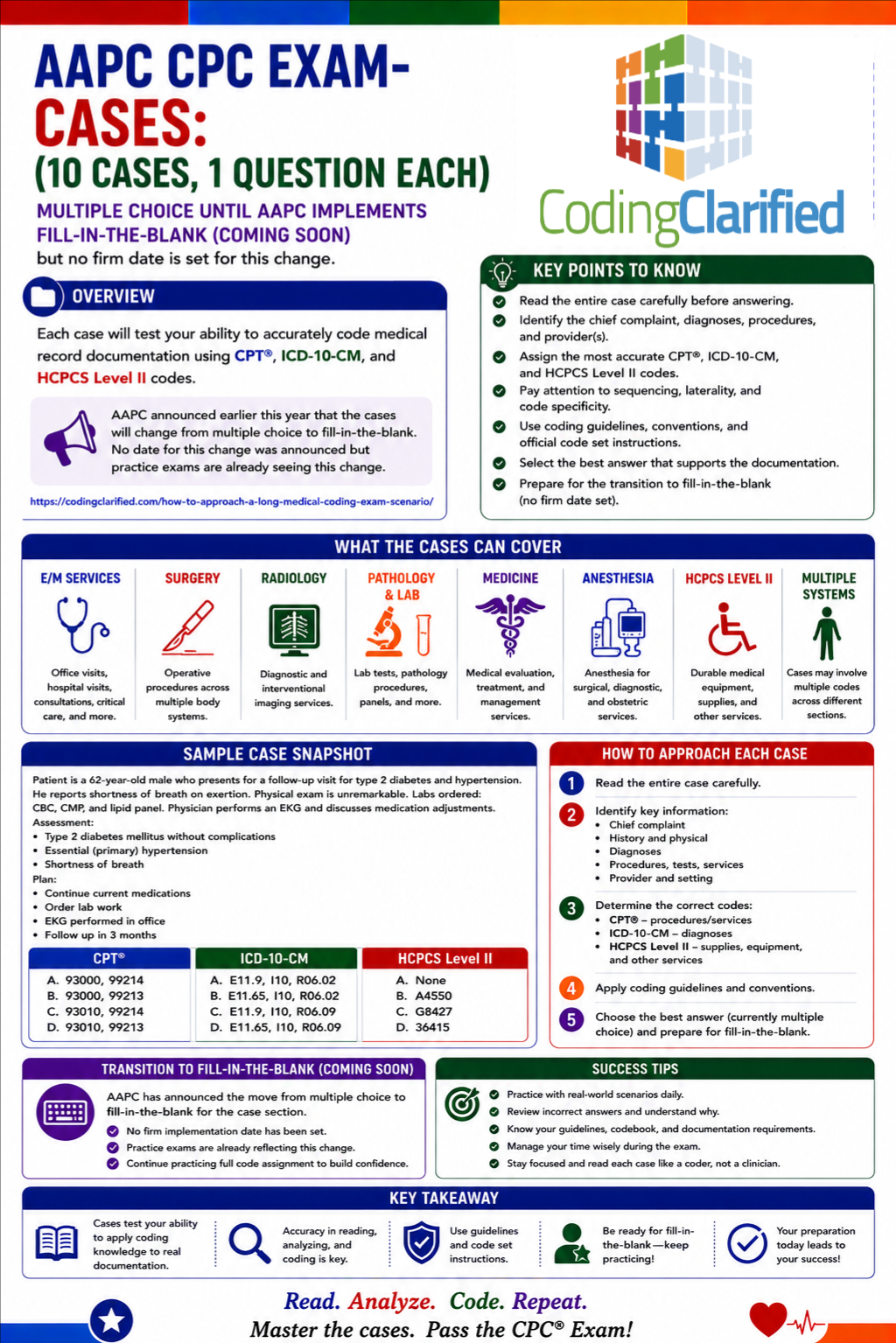
The CPC exam includes 10 longer medical-record cases that combine CPT, ICD-10-CM, HCPCS Level II, anatomy, medical terminology, guidelines, modifiers, and documentation interpretation.
Consequently, practicing realistic medical records is one of the best ways to prepare.
Students who want a broader certification overview can also review our AAPC CPC Certification Guide 2026.
Authoritative Medical Coding Resources
Students should use current, authoritative references when preparing for certification and practicing coding.
AAPC provides information about CPC certification, study resources, exams, and professional medical coding education.
CMS ICD-10 Coding Resources provides current ICD-10 files, updates, and official resources.
American Medical Association CPT Resources provides information about the CPT code set and how CPT codes are maintained.
Frequently Asked Questions About Long CPC Exam Scenarios
How should I approach a long medical coding scenario on the CPC exam?
Start by reading the question so you know what you need to find. Then identify the setting, reason for the encounter, diagnosis, procedure, anatomy, approach, and other details that affect code selection. Finally, use your coding manuals and process of elimination to verify the best answer.
Should I read the entire medical record before looking at the answer choices?
You should understand the case, but you do not need to treat every sentence as equally important. Reading the question and answer choices early can show you which details matter most. Then, review the documentation for those specific coding clues.
How much time should I spend on a long CPC exam question?
The 100-question, four-hour CPC exam averages approximately 2.4 minutes per question. However, long medical-record cases may require more time. Complete shorter questions efficiently, and avoid allowing one difficult case to consume too much of your exam.
Should I memorize CPT and ICD-10-CM codes for the CPC exam?
No. Familiarity with common codes can help, but understanding codebook navigation and guidelines is more important. CPT and ICD-10-CM change regularly, so verify codes and instructions instead of relying entirely on memory.
What should I highlight in a long operative report?
Focus on the main procedure, diagnosis, anatomy, laterality, surgical approach, technique, devices, measurements when relevant, and any documentation that changes code selection. Avoid highlighting so much information that the important details become difficult to find.
What are the most common traps in long medical coding scenarios?
Common problems include coding ruled-out diagnoses incorrectly, overlooking laterality, missing the surgical approach, coding from the procedure heading alone, reporting bundled services separately, choosing a modifier without documentation, and spending too much time on distracting details.
Are ICD-10-PCS codes tested on the CPC exam?
The CPC credential focuses primarily on professional coding using CPT, ICD-10-CM, and HCPCS Level II. Therefore, students preparing specifically for the CPC exam should focus their long-case strategy on those code sets rather than treating ICD-10-PCS as a core CPC exam code set.
What is the best way to get faster at long medical coding scenarios?
Practice real medical records repeatedly. After each case, identify which documentation actually determined the answer. Over time, you will begin recognizing important words and phrases faster, which can improve both accuracy and exam speed.
Final Thoughts
A long medical coding exam scenario becomes much easier when you stop treating it as one giant block of information.
First, determine what the question asks. Next, identify the reason for the encounter and extract the diagnosis, procedure, anatomy, approach, and other coding clues. Then, apply the appropriate guidelines, eliminate incorrect choices, and verify your final code.
Most importantly, practice this process until it becomes automatic.
The goal is not to become the fastest reader in the room. Instead, become a focused medical record abstractor who knows which details matter for coding and which details do not.
That skill can help you on the CPC exam in 2026, and it will remain valuable when you begin coding real medical records.