If you want to become a certified medical coder in 2026, the AAPC Certified Professional Coder (CPC®) credential is one of the most recognized certifications for physician-based medical coding.
However, earning your CPC involves much more than passing an exam. You need to understand medical terminology, anatomy, ICD-10-CM, CPT®, HCPCS Level II, coding guidelines, compliance, and real-world medical documentation. Additionally, you need a plan for gaining experience after certification.
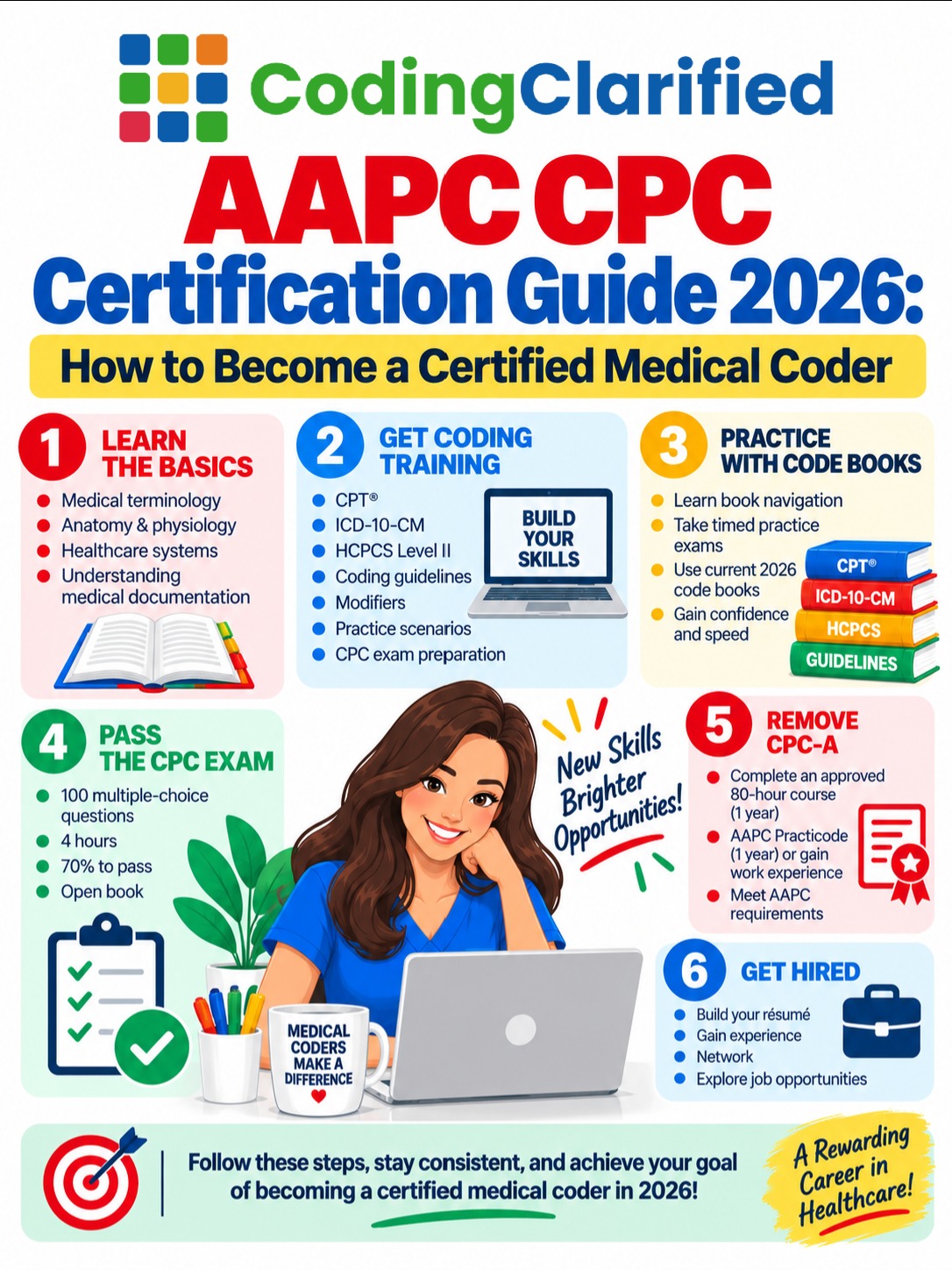
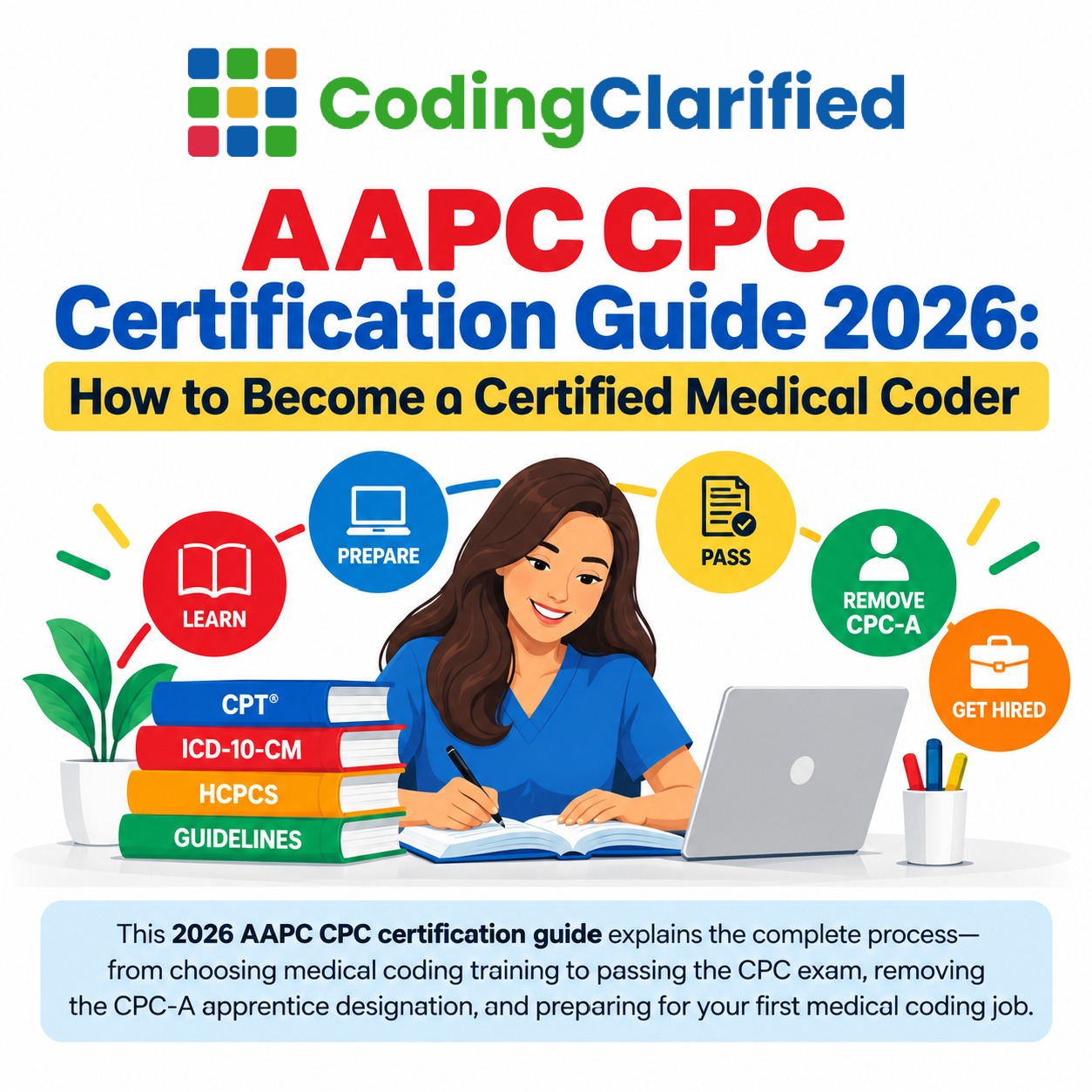
This 2026 AAPC CPC certification guide explains the complete process—from choosing medical coding training to passing the CPC exam, removing the CPC-A apprentice designation, and preparing for your first medical coding job.
Key Takeaways
- The AAPC CPC exam has 100 multiple-choice questions, a 4-hour time limit, and requires a 70% score to pass.
- The CPC exam tests CPT®, ICD-10-CM, HCPCS Level II, anatomy, medical terminology, coding guidelines, modifiers, and compliance.
- The exam is open book, but students need strong code-book navigation and time-management skills.
- Most new coders who pass the CPC exam receive the CPC-A apprentice designation until AAPC’s experience requirements are met.
- An approved 80-hour coding course can count as one year toward CPC-A removal, while AAPC Practicode can count as another year.
- Certification helps you qualify for coding positions; however, it does not guarantee an immediate remote coding job.
- Practical coding experience, a strong résumé, networking, and a broad job search can make new coders more competitive.
- Medical coding continues to offer career opportunities in 2026, although AI is changing how coders work.
- Students should use current coding resources because CPT®, ICD-10-CM, HCPCS Level II, payer rules, and coding guidance change regularly.
What Is the AAPC CPC Certification?
The Certified Professional Coder (CPC®) credential is offered by AAPC. It focuses primarily on professional-fee coding for physician and outpatient services.
CPC coders learn how to review clinical documentation and assign codes that accurately describe diagnoses, procedures, services, and supplies. Therefore, the credential requires much more than memorizing code numbers.
Professional coders commonly work with three major coding systems:
- CPT® — reports physician procedures and services.
- ICD-10-CM — reports diagnoses, conditions, symptoms, and reasons for encounters.
- HCPCS Level II — reports many supplies, medications, durable medical equipment, and other services.
In addition, coders must understand modifiers, National Correct Coding Initiative edits, medical necessity, payer requirements, and documentation rules.
The Centers for Medicare & Medicaid Services (CMS) publishes official ICD-10 resources and updates. Consequently, students and working coders should always verify that they are using the correct code set and guidelines for the applicable date of service.
What Does a Certified Medical Coder Actually Do?
A medical coder reviews healthcare documentation and converts the documented diagnoses and services into standardized codes.
For example, coders may review office notes, operative reports, laboratory services, imaging reports, procedures, and other clinical records. Next, they determine which codes and modifiers accurately represent the documented encounter.
A coder may also:
- Review documentation for completeness.
- Apply ICD-10-CM and CPT® guidelines.
- Determine whether services are separately reportable.
- Verify medical necessity.
- Research payer policies.
- Review NCCI edits.
- Identify coding errors.
- Query providers when appropriate.
- Assist with denials and audits.
- Monitor annual coding changes.
Accuracy matters because coding affects reimbursement, compliance, healthcare data, and the medical record.
If you are completely new to the profession, read our guide on How to Become a Medical Coder in 2026.
How Do You Become CPC Certified in 2026?
The path becomes much easier when you approach it in stages.
Step 1: Learn Medical Terminology and Anatomy
Before tackling complex coding scenarios, build a solid medical foundation.
Students should understand medical terminology, anatomy, physiology, and common disease processes. Otherwise, reading operative reports and clinical documentation can become much harder.
For instance, you cannot confidently code a surgical procedure if you do not understand the body part, approach, and procedure described in the operative note.
Step 2: Complete Comprehensive Medical Coding Training
Next, learn how to use CPT®, ICD-10-CM, and HCPCS Level II.
A strong CPC preparation program should teach you how to apply guidelines rather than simply find codes. Furthermore, students need practice reading actual coding scenarios and determining why one answer is better than another.
Look for training that includes:
- CPT® coding
- ICD-10-CM coding
- HCPCS Level II
- Modifiers
- Anatomy and terminology
- Coding guidelines
- Compliance
- Practice questions
- Case-based coding
- CPC exam preparation
- Access to an experienced instructor
Most importantly, check exactly what the tuition includes before enrolling.
Step 3: Practice Using Your Coding Manuals
The CPC exam is open book, but that does not make it easy.
With 100 questions and four hours, you have an average of only 2.4 minutes per question. Therefore, repeatedly searching unfamiliar sections of your manuals can quickly consume your testing time.
Instead, practice navigating your books while completing timed questions.
Learn where to find guidelines, parenthetical instructions, modifiers, tables, appendices, and major code sections. Additionally, become comfortable using the ICD-10-CM Alphabetic Index and Tabular List correctly.
What Is on the AAPC CPC Exam in 2026?
According to AAPC, the CPC certification exam contains:
- 100 multiple-choice questions
- 4 hours to complete the exam
- 70% minimum passing score
- Open-book coding questions
- Questions covering CPT®, ICD-10-CM, HCPCS Level II, guidelines, anatomy, terminology, and compliance
The test covers surgical CPT® sections as well as evaluation and management, anesthesia, radiology, pathology and laboratory, medicine, ICD-10-CM, HCPCS Level II, and coding guidelines.
Additionally, students encounter medical cases that require them to pull information together rather than answer a simple code lookup question.
For the detailed 100-question breakdown, see What Is on the AAPC CPC Exam in 2026? Complete 100-Question Exam Breakdown.
You should also review AAPC’s current CPC certification information before scheduling your exam because testing policies can change.
CPC Student Tips for Passing the Exam
Knowing medical coding is important; however, knowing how to take a timed coding exam matters too.
First, practice under realistic conditions. Complete timed practice questions with your coding manuals rather than relying only on untimed quizzes.
Next, learn when to move on. One difficult question can consume several minutes, so mark challenging questions and return to them when possible.
Also, read the question before researching every detail in a long scenario. Determine what the question actually wants you to code.
Finally, practice eliminating incorrect choices. Often, you can narrow four answers to two by spotting an incorrect code family, modifier, diagnosis, or coding rule.
CPC Student Tip: Do not try to memorize the entire CPT® manual. Instead, learn its structure and how to locate and verify information quickly.
What Happens After You Pass the CPC Exam?
Many new coders receive the CPC-A after passing the exam. The “A” represents apprentice status.
AAPC requires the equivalent of two years of coding experience before removing the apprentice designation. Fortunately, education and Practicode can help satisfy that requirement.
Under AAPC’s current pathway, an 80-hour qualifying medical coding course may count as one year of experience. Additionally, completion of AAPC Practicode may count as another year.
Therefore, a student may be able to satisfy the two-year requirement through:
- 80-hour qualifying coding course + Practicode
- 80-hour course + one year of qualifying work experience
- Practicode + one year of qualifying work experience
- Two years of qualifying coding experience
Always verify your individual documentation and eligibility directly with AAPC before submitting an apprentice-removal application.
Does CPC Certification Guarantee a Medical Coding Job?
No. A CPC credential is valuable, but certification does not automatically guarantee employment.
Employers need coders who can accurately interpret medical records, meet productivity standards, research difficult cases, and protect the organization from compliance and reimbursement errors.
Consequently, new coders should start preparing for employment before they finish training.
Build practical experience whenever possible through Practicode, internships, apprenticeships, chart exercises, or related healthcare roles. Meanwhile, create a résumé that highlights coding skills and transferable experience.
Our guide The Truth About CPC-A Jobs in 2026 explains why the first coding position can be challenging and how new coders can improve their chances.
Can New CPC Coders Work From Home?
Remote medical coding jobs exist, but many employers prefer experienced coders for fully remote positions.
A remote coder often works independently while meeting strict productivity and accuracy standards. Therefore, employers may want proof that a coder can handle charts without constant supervision.
New coders should not limit their search to “remote CPC-A jobs.”
Instead, consider physician offices, hospitals, billing companies, clinics, insurance organizations, revenue-cycle companies, hybrid positions, and related healthcare jobs. Getting your foot in the door can create opportunities to move into coding later.
Is Medical Coding Still a Good Career in 2026?
Medical coding continues to offer career opportunities, although technology is changing the profession.
The U.S. Bureau of Labor Statistics projects employment for medical records specialists to grow 8% from 2025 through 2035, which is faster than the projected average for all occupations. BLS also projects about 14,000 openings per year, on average, during that period.
AI deserves attention as well. Automated coding tools can suggest codes, identify patterns, and make routine work faster. However, coders still need to evaluate documentation, apply coding rules, handle exceptions, recognize compliance risks, and validate automated results.
As a result, tomorrow’s strongest coders will not compete against technology by ignoring it. Instead, they will combine coding expertise with the ability to review and validate technology-assisted results.
How Much Can a CPC Medical Coder Make?
Medical coding salaries vary widely based on experience, location, employer, specialty, credentials, and job responsibilities.
New students should be cautious when a school advertises a high national salary as an expected starting salary. Experienced auditors, managers, specialty coders, educators, and coders with multiple credentials can raise overall salary averages.
Instead, search current job postings in your own area. Compare entry-level requirements, pay ranges, required credentials, and experience expectations.
Over time, coders may move into specialties such as risk adjustment, auditing, compliance, inpatient coding, clinical documentation integrity, education, or management.
How Can You Pay for CPC Training in 2026?
Do not assume you must pay the entire cost of career training yourself.
Depending on your eligibility and location, workforce programs, scholarships, military-spouse programs, and other funding sources may help.
For example, the Workforce Innovation and Opportunity Act (WIOA) can provide career-training assistance to eligible individuals through state and local workforce programs. However, eligibility, funding, and approved training providers vary by location.
Read Medical Coding Grants and Scholarships in 2026: How to Pay for Medical Coding Training before assuming training is financially out of reach.
Common Mistakes to Avoid When Pursuing CPC Certification
Choosing a course based only on price: A cheap course that does not adequately prepare you for certification or employment can cost more in the long run.
Assuming certification guarantees a remote job: Remote positions are often competitive, especially for new CPC-A coders.
Memorizing codes instead of learning guidelines: Code numbers change. Strong coders understand how to research and apply rules.
Ignoring anatomy and medical terminology: Clinical knowledge makes both exam questions and real-world charts easier to understand.
Using outdated information: Coding rules and code sets change regularly. For example, CMS publishes annual ICD-10-CM updates and official guidelines.
Waiting until certification to think about employment: Start building your résumé, professional network, practical skills, and job-search strategy while you are still training.
Only applying for jobs titled “Medical Coder”: Related revenue-cycle and healthcare positions may help you gain valuable experience and access internal coding opportunities.
What Should You Look for in a CPC Training Program?
Compare programs based on what you actually receive, not just the advertised tuition.
Ask whether the program includes current coding books, instructor access, exam preparation, practice exams, CPC exam vouchers, Practicode, membership, job-search assistance, and opportunities for practical experience.
Additionally, find out whether the course meets AAPC’s requirements for education credit toward CPC-A removal.
The best program should prepare you for three separate goals: learning medical coding, passing the CPC exam, and becoming employable.
That practical distinction matters because passing the test is only one part of becoming a successful medical coder.
Coding Clarified Final Thoughts: Is AAPC CPC Certification Worth It in 2026?
For students who want to enter physician-based and professional-fee medical coding, the CPC remains a strong certification option in 2026.
Success, however, requires realistic expectations.
Learn the fundamentals first. Then, complete comprehensive coding training, master your coding manuals, practice timed questions, pass the CPC exam, and continue developing real-world skills.
After certification, focus on experience rather than waiting only for the perfect remote job. Furthermore, keep learning because coding rules, payer policies, technology, and healthcare regulations continue to change.
A CPC credential can open the door. Your coding accuracy, experience, professionalism, and continued education determine how far you take your career.
Frequently Asked Questions About AAPC CPC Certification in 2026
Is the AAPC CPC exam hard?
The CPC exam can be challenging because students must answer 100 questions within four hours. Additionally, questions test application of coding rules rather than simple memorization. Strong preparation, book-navigation skills, and timed practice can make the exam much more manageable.
How many questions are on the CPC exam in 2026?
The AAPC CPC exam contains 100 multiple-choice questions. Students have four hours to complete the exam and need a score of at least 70% to pass.
Is the CPC exam open book?
Yes. AAPC allows approved coding manuals under its current exam rules. However, students should verify the latest book and testing requirements directly with AAPC before their exam date.
Can I become a medical coder without a college degree?
A college degree is not required to earn the CPC credential. Nevertheless, students need strong training in coding, anatomy, medical terminology, and guidelines to prepare for certification and employment.
What is the difference between CPC and CPC-A?
CPC-A indicates that the coder holds the CPC credential but remains in apprentice status. Once AAPC’s experience requirements are met and approved, the apprentice designation can be removed.
How do I remove the A from my CPC-A?
AAPC requires the equivalent of two years of coding experience. Under current rules, an 80-hour qualifying coding course can satisfy one year, while Practicode can satisfy another year. Qualifying work experience can also meet the requirement.
Can I get a remote medical coding job immediately after passing the CPC exam?
It is possible, but new coders should not expect remote employment automatically. Many employers prefer experienced coders for remote positions because those employees must work independently while meeting accuracy and productivity standards.
Is medical coding being replaced by AI?
AI is changing medical coding, but human expertise remains important. Automated tools can assist with code suggestions and routine work; however, trained coders still need to validate results, interpret documentation, apply guidelines, address exceptions, and protect compliance.
Authoritative 2026 Medical Coding Resources
For current rules and official information, medical coding students and professionals should regularly consult:
- AAPC — CPC Certification and Exam Information
- CMS — ICD-10 Coding Resources
- CMS — FY 2026 ICD-10-CM Official Guidelines for Coding and Reporting
- U.S. Bureau of Labor Statistics — Medical Records Specialists