If you already have a medical coding certification, you may be wondering whether earning another credential is worth the time and money. In 2026, specialized medical coding certifications can help experienced coders demonstrate expertise in areas such as auditing, risk adjustment, inpatient coding, compliance, cardiology, surgery, anesthesia, and other specialties.
However, collecting certifications without a clear career goal is not always the best strategy.
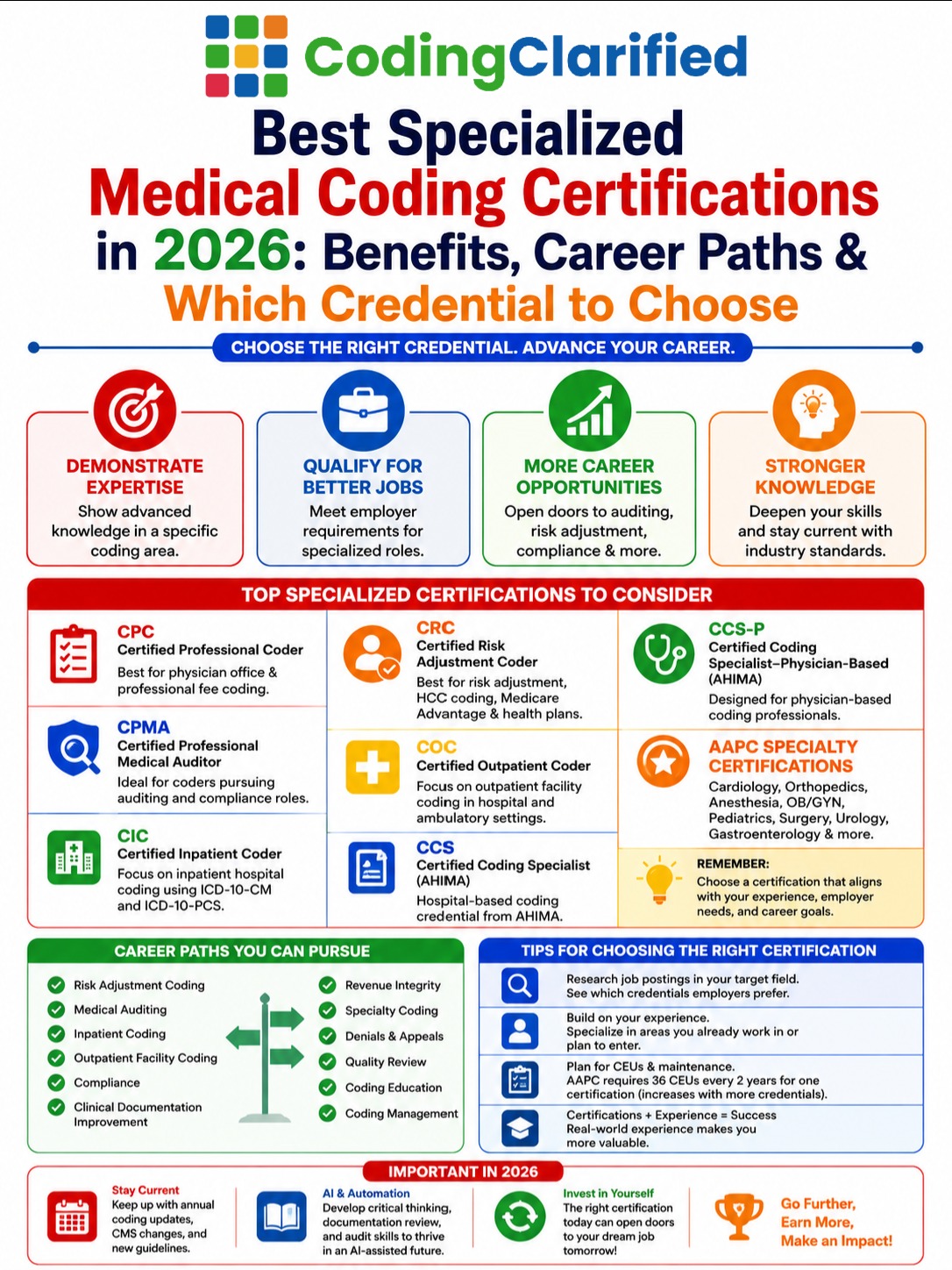
The right specialized certification should support the type of coding work you want to do. For example, a coder interested in Medicare Advantage and HCC coding may benefit more from a CRC than an unrelated surgical specialty credential. Meanwhile, a coder who wants to move into auditing may find the CPMA more useful.
AAPC currently offers core credentials including CPC, COC, CIC, CRC, CPMA, CDEO, CPCO, and others. It also offers specialty coding certifications in areas such as cardiology, anesthesia, gastroenterology, orthopedics, OB/GYN, urology, pediatrics, general surgery, and hematology/oncology.
Here is what medical coders should know before pursuing an additional certification in 2026.
Key Takeaways: Specialized Medical Coding Certifications in 2026
- A specialized medical coding certification can demonstrate advanced knowledge in a specific coding area.
- The best certification depends on your current experience, employer needs, and long-term career goals.
- New coders should usually build a strong coding foundation before collecting multiple specialty credentials.
- Popular career paths include risk adjustment, auditing, inpatient coding, outpatient facility coding, compliance, documentation improvement, and specialty physician coding.
- AAPC offers both core and specialty credentials, while AHIMA offers credentials such as the CCS and CCS-P.
- Additional credentials require ongoing maintenance, including continuing education.
- Experience plus certification is generally more powerful than certification alone.
- In 2026, coders should also develop documentation, compliance, research, auditing, and technology skills as AI-assisted coding becomes more common.
What Is a Specialized Medical Coding Certification?
A specialized medical coding certification demonstrates knowledge beyond basic entry-level coding.
A broad credential such as the CPC establishes a foundation in professional-fee coding. From there, coders may choose to develop deeper skills in a particular setting, specialty, or function.
Specialization can focus on a healthcare setting, such as inpatient hospital coding, or a job function, such as auditing. Other credentials concentrate on specific clinical specialties, including cardiology, orthopedics, gastroenterology, and OB/GYN.
This distinction matters.
You do not necessarily need a specialty credential simply because you already hold a CPC. Instead, consider where you want your career to go next.
If you are still working toward your first credential, start with our guide on How to Become a Medical Coder in 2026.
What Are the Benefits of Specialized Medical Coding Certifications?
Additional credentials can provide several career benefits when they match your work experience and career direction.
1. Demonstrate Specialized Knowledge
A specialty credential gives employers another way to evaluate your knowledge.
For example, a coder who holds a CRC has demonstrated knowledge related to risk adjustment coding. A coder who earns the CPMA demonstrates knowledge related to medical auditing.
Certification does not replace experience. However, it can provide evidence that you have studied and tested your knowledge in a defined area.
2. Help You Qualify for Specialized Coding Positions
Some job postings list specific credentials as required or preferred qualifications.
A hospital coding position may seek an inpatient-focused credential. Likewise, a risk adjustment company may prefer a CRC, while an auditing position may list CPMA among its preferred certifications.
Search job postings before choosing your next certification. Look at 20–30 positions that interest you and record which credentials employers request most often.
That simple exercise can prevent you from spending money on a certification that does not support your career goal.
For more job-search strategies, see our guide to finding a medical coding job in 2026.
3. Create More Career Paths
Medical coding experience can lead to careers beyond production coding.
Experienced coders may move into:
- Auditing
- Compliance
- Risk adjustment
- Clinical documentation improvement
- Revenue integrity
- Coding education
- Coding management
- Denials
- Quality review
- Specialty coding
- Inpatient or outpatient facility coding
A carefully chosen credential can help support that transition.
4. Strengthen Your Professional Knowledge
Preparing for another certification forces you to study topics in greater depth.
For example, risk adjustment requires strong ICD-10-CM knowledge, documentation review skills, understanding of chronic conditions, and familiarity with risk adjustment concepts. Auditing requires a different set of skills involving coding accuracy, documentation, compliance, and reimbursement.
As a result, the value of certification is not limited to the letters after your name. The knowledge gained while preparing can improve your daily work.
Best Medical Coding Certifications to Consider in 2026
There is no single “best” certification for every coder. Your ideal credential depends on where you work and what you want to do next.
Here are several major options to consider.
CPC – Certified Professional Coder
The CPC remains an important starting credential for coders interested in professional-fee and physician-based coding.
AAPC describes the CPC as its primary physician-office coding certification. The credential covers CPT, ICD-10-CM, HCPCS Level II, coding guidelines, compliance, reimbursement, anatomy, and medical terminology.
For many new coders, building strong CPC-level skills should come before adding multiple specialized certifications.
If you are still preparing for your first exam, read our How to Study for the AAPC CPC Exam guide.
CRC – Certified Risk Adjustment Coder
The CRC is an excellent option for coders who want to work in risk adjustment.
Risk adjustment coding focuses heavily on ICD-10-CM diagnosis coding, chronic conditions, documentation, and accurately representing a patient’s health status. AAPC states that CRC professionals demonstrate expertise in disease complexity, chronic conditions, comorbidities, ICD-10-CM guidelines, and risk adjustment guidelines.
The CRC may be a good fit if you want to work with:
- Medicare Advantage
- HCC coding
- Risk adjustment vendors
- Health plans
- Provider organizations
- Retrospective record review
- Prospective coding programs
- Risk adjustment audits
Risk adjustment continues to receive significant attention as organizations adapt to changing CMS-HCC models and increased compliance oversight.
For a deeper explanation, read our HCC Coding in 2026: CMS-HCC V28, Risk Adjustment, RAF Scores, and Documentation Guide.
CPMA – Certified Professional Medical Auditor
Coders interested in auditing may want to consider the CPMA.
Auditors review coding, billing, documentation, reimbursement, and compliance. Instead of simply assigning codes, an auditor evaluates whether codes and services were reported correctly.
This path can appeal to experienced coders who enjoy research, finding errors, reviewing documentation, explaining coding rules, and identifying compliance risks.
AAPC lists the CPMA among its core certifications.
Auditing can also provide a natural advancement path for coders who have developed strong accuracy and guideline knowledge.
CIC – Certified Inpatient Coder
The CIC focuses on inpatient hospital and facility coding.
Inpatient coding differs significantly from physician coding because coders must work with ICD-10-CM and ICD-10-PCS, inpatient guidelines, hospital documentation, and facility reimbursement concepts.
AAPC identifies the CIC as one of its core coding certifications and describes its inpatient training as focused on hospital/facility coding.
Coders who want to transition from professional coding to inpatient hospital coding should understand that earning the credential alone does not instantly create inpatient experience. Practice with full inpatient records and ICD-10-PCS remains important.
COC – Certified Outpatient Coder
The COC focuses on outpatient facility coding.
It can be useful for coders working in hospital outpatient departments, ambulatory settings, and other facility-based environments.
AAPC distinguishes the COC from the CPC and CIC based on setting: CPC preparation focuses on physician-office coding, COC preparation focuses on outpatient hospital/facility coding, and CIC preparation focuses on inpatient hospital/facility coding.
Therefore, your desired workplace should influence which credential you choose.
CCS – Certified Coding Specialist
The CCS is offered by AHIMA and is another respected coding credential.
AHIMA describes the CCS as appropriate for professionals skilled in classifying medical data from health records. The organization recommends substantial coding education or experience, although its listed pathways are recommendations rather than universal prerequisites.
A notable 2026 update is that AHIMA requires candidates taking the CCS exam on or after May 1, 2026, to use the required 2026 code books.
The CCS may appeal to coders interested in hospital-based coding and professionals who want an AHIMA credential.
CCS-P – Certified Coding Specialist–Physician-Based
AHIMA’s CCS-P focuses on physician-based coding.
According to AHIMA, CCS-P professionals work in settings such as physician offices, group practices, multispecialty clinics, and specialty centers. The credential covers diagnosis coding, procedure coding, research, compliance, and revenue cycle concepts.
Like the CCS, the CCS-P transitioned to the required 2026 code book list for exams delivered on or after May 1, 2026.
AAPC Specialty Medical Coding Certifications
Coders who already work in a specific clinical area may want an AAPC specialty credential.
AAPC currently lists specialty certifications that include:
- CASCC – Ambulatory Surgery Center
- CANPC – Anesthesia and Pain Management
- CCC – Cardiology
- CCVTC – Cardiovascular and Thoracic Surgery
- CPCD – Dermatology
- CEDC – Emergency Department
- CEMC – Evaluation and Management
- CFPC – Family Practice
- CGIC – Gastroenterology
- CGSC – General Surgery
- CHONC – Hematology and Oncology
- CIRCC – Interventional Radiology Cardiovascular
- COBGC – Obstetrics/Gynecology
- COSC – Orthopedic Surgery
- CPEDC – Pediatrics
- CRHC – Rheumatology
- CUC – Urology
AAPC maintains study materials for these specialty credentials and lists the current specialty certification options through its certification resources.
A specialty certification makes the most sense when you already work in that specialty or have a realistic plan to enter it.
Which Medical Coding Certification Should You Get Next?
Before registering for another exam, ask yourself three questions.
First: What job do I want?
Do not start with the certification. Start with the position.
If you want to become a risk adjustment coder, research CRC job postings. If you want to audit, review CPMA-related positions. Someone targeting inpatient hospital coding should research CIC and CCS requirements.
Second: What experience do I already have?
Build on your existing knowledge when possible.
A cardiology coder with several years of experience may gain more immediate value from the CCC than from a credential unrelated to cardiology.
Third: Are employers actually requesting the credential?
Search current job listings in your target market.
Employer demand should carry more weight than simply choosing the certification that sounds most impressive.
CPC Student Tips: When Should You Get a Specialized Medical Coding Certification?
If you are currently studying for the CPC, do not feel pressured to earn several certifications immediately.
Focus first on becoming a strong coder.
Learn how to use the CPT, ICD-10-CM, and HCPCS Level II code sets efficiently. Practice reading operative reports and identifying the diagnoses and procedures that affect code selection.
Next, work on anatomy, medical terminology, modifiers, NCCI concepts, documentation, and coding guidelines.
After earning your CPC, look for opportunities to gain practical experience.
Your first coding-related job may teach you more about your preferred specialty than another exam will.
Most importantly, remember this rule:
Choose your next credential because it supports your career plan—not because you think more letters automatically guarantee a job.
Continuing Education Matters for Multiple Medical Coding Certifications
Additional certifications also create maintenance responsibilities.
AAPC currently requires 36 CEUs every two years for one certification. The requirement increases to 40 CEUs for two certifications, 44 for three, 48 for four, and 52 for five or more. Certain credentials also require topic-specific CEUs.
Therefore, consider the long-term cost and time involved before earning several credentials.
Certification is an ongoing professional commitment, not just an exam you take once.
Medical Coding Certifications and AI in 2026
AI-assisted coding is another reason to think strategically about specialization.
Technology can help identify diagnoses, suggest codes, review documentation, and automate routine processes. However, complex coding still requires knowledge of guidelines, documentation, compliance, payer policies, and clinical context.
In fact, AAPC’s 2026 education offerings include training focused specifically on critical thinking for medical coders in an AI-enabled future.
Coders who can validate automated results, audit documentation, research complex cases, identify compliance problems, and explain why a coding decision is correct may become even more valuable as technology improves.
Specialization can help develop those deeper skills.
Common Mistakes to Avoid With Medical Coding Certifications
Collecting Certifications Without Experience
Five certifications do not automatically make someone more employable than a coder with one credential and strong experience.
Use certifications to support practical knowledge rather than replace it.
Choosing a Credential Without Researching Jobs
Do not spend months preparing for an exam before checking whether employers in your target field actually request the credential.
Research first.
Assuming Another Certification Guarantees a Raise
A new credential may strengthen your qualifications, but salary depends on many factors, including experience, employer, responsibilities, specialty, location, and performance.
Ignoring Certification Maintenance Costs
Additional credentials may mean additional CEU requirements, renewal responsibilities, study materials, and professional expenses.
Plan for those costs before registering.
Specializing Too Early
New CPC students sometimes believe they need multiple certifications before applying for jobs.
Usually, building practical coding skills and gaining experience should be the priority.
Choosing the Most Difficult Credential Instead of the Most Useful One
The goal is not to collect the hardest exam.
Choose the credential that best connects your current skills to the job you want next.
Are Specialized Medical Coding Certifications Worth It in 2026?
Yes, specialized medical coding certifications can be worth it when they have a clear purpose.
A credential may help demonstrate expertise, strengthen your resume, prepare you for advanced responsibilities, or support a move into a new area of healthcare.
Still, certifications work best when combined with experience.
The strongest career strategy is often:
Foundation + experience + targeted specialization.
For example, a coder might earn the CPC, gain professional coding experience, discover an interest in risk adjustment, and then pursue the CRC. Another coder may develop strong surgical coding experience before pursuing an orthopedic or general surgery specialty credential.
That approach creates a career story employers can understand.
As you plan your future, also consider the broader career outlook in our guide, Is Medical Coding a Good Career in 2026?.
Frequently Asked Questions About Specialized Medical Coding Certifications
Quick answers to the questions coders ask most about specialized medical coding certifications.
What is the best medical coding certification in 2026?
There is no single best certification for everyone. The CPC remains a strong choice for professional-fee coding, while CIC and CCS can support inpatient coding careers. COC focuses on outpatient facility coding, CRC focuses on risk adjustment, and CPMA supports auditing. Specialty credentials can be useful for experienced coders working in specific clinical areas.
Should I get another certification after my CPC?
Consider another certification when you know which career direction you want to pursue. If you are a new CPC with little experience, gaining practical experience may provide more value than immediately collecting additional credentials.
Is the CRC certification worth it in 2026?
The CRC can be valuable for coders who want to work in risk adjustment, Medicare Advantage, HCC coding, health plans, or related areas. AAPC states that the credential tests knowledge of ICD-10-CM diagnosis coding and risk adjustment concepts.
Which certification is best for inpatient medical coding?
AAPC’s CIC and AHIMA’s CCS are two credentials commonly associated with inpatient and hospital coding career paths. Compare job postings from the employers you want to work for before deciding which credential fits your goal.
Which medical coding certification is best for auditing?
The CPMA is specifically designed around medical auditing and may be a logical choice for experienced coders who want to move into audit-related positions. A strong coding foundation and real-world experience are still important.
Do specialty medical coding certifications increase salary?
They can strengthen your qualifications for specialized or advanced roles, but no certification guarantees a specific salary or raise. Experience, employer, responsibilities, specialty knowledge, geographic market, productivity, and accuracy can all influence compensation.
How many medical coding certifications should I have?
There is no ideal number. One respected certification combined with strong experience can be more valuable than several unrelated credentials. Add certifications when they support a specific career objective.
Can I earn a specialty certification before getting coding experience?
Requirements vary by credential, so always verify the current rules with the certifying organization. Even when an exam allows you to test, practical experience can make advanced specialty concepts easier to understand and can make the credential more useful when applying for jobs.
Final Thoughts: Build a Medical Coding Career, Not a Collection of Certifications
Specialized medical coding certifications can help you advance your career in 2026, but the strategy behind the credential matters.
Start with a strong coding foundation. Gain practical experience whenever possible. Then identify the specialty, setting, or advanced role that fits your strengths.
From there, choose a certification that helps close the gap between where you are now and where you want to go.
Whether that path leads to risk adjustment, auditing, inpatient coding, outpatient coding, compliance, documentation improvement, or specialty coding, your goal should remain the same: develop skills that make you a more accurate, knowledgeable, and valuable medical coding professional.
In a healthcare environment shaped by annual coding changes, tighter compliance expectations, changing reimbursement models, and AI-assisted workflows, coders who continue developing deeper expertise will be better prepared for the future. Learn more about Coding Clarified or explore our medical coding training program to find the certification pathway that fits your goals.