Hierarchical Condition Category (HCC) coding remains one of the most important areas of medical coding, especially for Medicare Advantage, risk adjustment, and value-based healthcare. However, HCC coding in 2026 looks different from just a few years ago.
Most importantly, 2026 marks the completion of CMS’s transition to the updated CMS-HCC risk adjustment model, commonly called V28. Therefore, medical coders, providers, auditors, CDI professionals, and CPC students need to understand how accurate ICD-10-CM diagnosis coding affects HCC assignment, Risk Adjustment Factor (RAF) scores, compliance, and reimbursement.
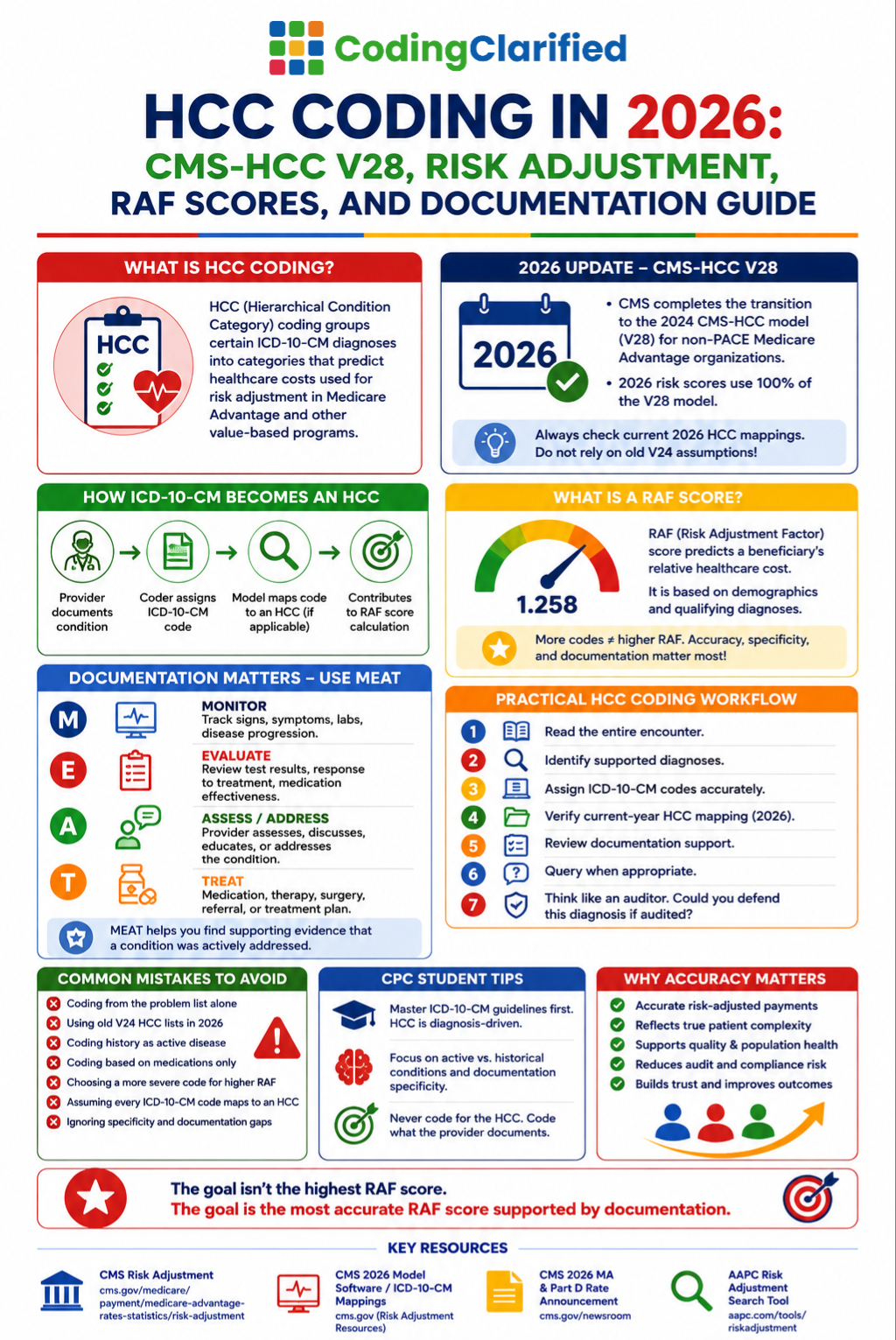
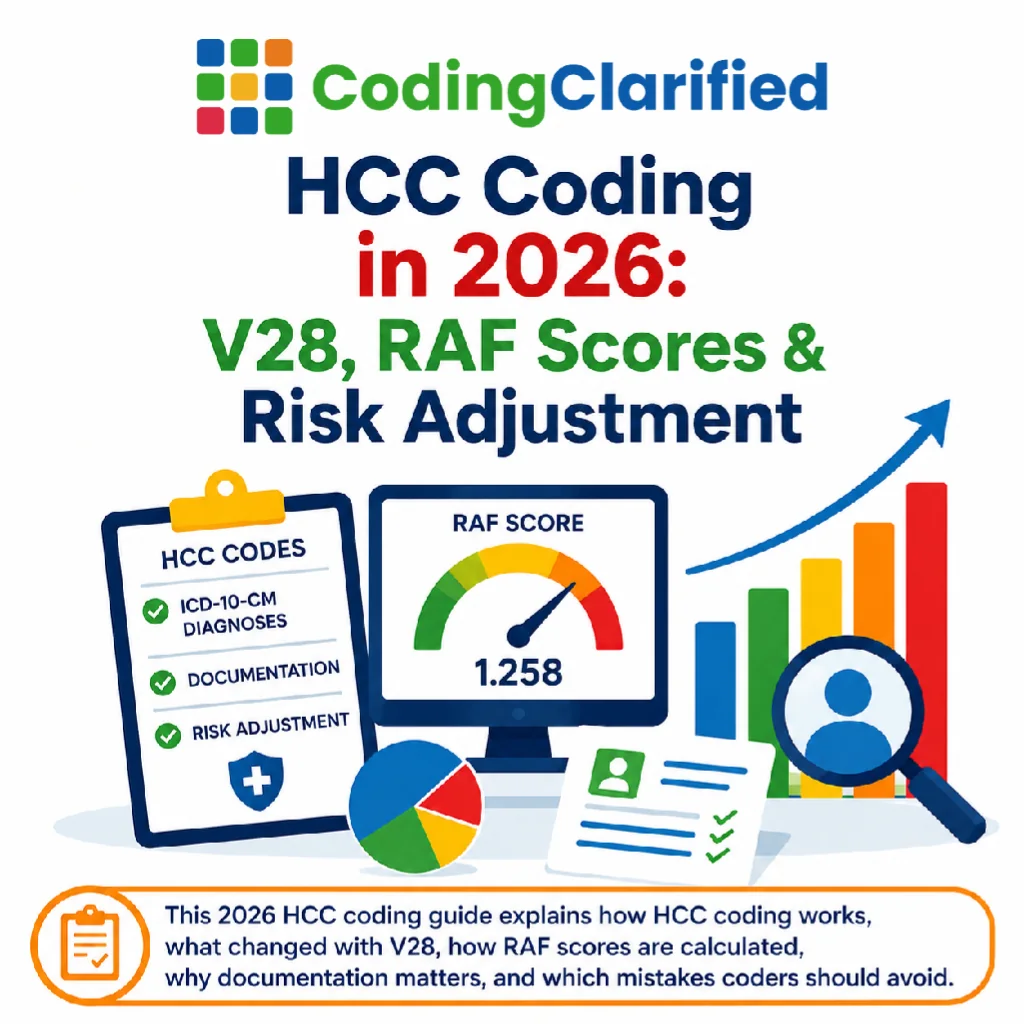
This 2026 HCC coding guide explains how HCC coding works, what changed with V28, how RAF scores are calculated, why documentation matters, and which mistakes coders should avoid.
Key Takeaways on HCC Coding in 2026
- HCC stands for Hierarchical Condition Category and plays a major role in risk adjustment.
- CMS uses diagnosis data and demographic information to estimate expected healthcare costs for Medicare Advantage beneficiaries.
- In 2026, CMS calculates non-PACE Medicare Advantage risk scores using 100% of the 2024 CMS-HCC model, often referred to as V28.
- An ICD-10-CM diagnosis does not automatically affect an HCC or RAF score. Coders must verify current-year mappings.
- Chronic conditions generally need to be evaluated and documented during the applicable data collection period to contribute to risk adjustment.
- Documentation must support every reported diagnosis.
- More diagnoses do not automatically mean better HCC coding. Instead, accuracy, specificity, and clinical support matter most.
- HCC coding should reflect the patient’s true health status rather than an attempt to maximize reimbursement.
- Coders should verify current CMS mappings because HCC assignments and model rules can change.
For a deeper look at the current model, see Coding Clarified’s Medical Coding: Risk Adjustment Model V28.
What Is HCC Coding?
HCC stands for Hierarchical Condition Category. In simple terms, HCC models organize certain diagnosis codes into groups that represent similar clinical conditions and expected healthcare costs.
Risk adjustment models use these categories to help predict how much healthcare a patient may need. Consequently, a patient with several serious chronic conditions may have a different expected cost than a healthy patient of the same age.
HCC coding is especially important in:
- Medicare Advantage
- Risk adjustment
- Value-based care
- Accountable care arrangements
- Population health
- Quality and financial analytics
- Coding compliance and auditing
However, HCC coding is not simply about finding diagnoses that increase payment. Medical coders must first code the patient’s documented conditions correctly according to ICD-10-CM rules. Then, the applicable risk adjustment model determines how qualifying diagnoses affect the patient’s risk score.
What Is Risk Adjustment?
Risk adjustment is a payment methodology designed to account for differences in patient health status.
For example, one health plan may care for many beneficiaries with diabetes, heart failure, chronic kidney disease, cancer, and other serious illnesses. Meanwhile, another plan may have a generally healthier population.
Without risk adjustment, plans serving patients with greater healthcare needs could face higher costs without corresponding payment adjustments.
Therefore, CMS uses risk adjustment to help account for differences in expected healthcare spending.
A patient’s risk score may consider factors such as:
- Age
- Sex
- Medicaid or dual-eligible status
- Disability status
- Certain disease interactions
- Qualifying diagnoses
- Applicable HCC categories
- Other model-specific demographic factors
As a result, accurate diagnosis coding becomes essential.
For additional CMS information, review the official CMS Risk Adjustment resources.
What Changed With HCC Coding in 2026?
The biggest Medicare Advantage risk adjustment change for 2026 is the full implementation of the updated CMS-HCC model.
CMS began phasing in the 2024 CMS-HCC model in 2024. During 2025, CMS calculated non-PACE Medicare Advantage risk scores using a blend of the older and newer models.
In 2026, that transition is complete.
CMS now calculates 100% of the applicable non-PACE Medicare Advantage risk score using the 2024 CMS-HCC model.
This change makes 2026 particularly important for coders because old V24 assumptions may no longer apply.
Why V28 Matters
V28 changed the structure of the CMS-HCC model. Additionally, CMS revised disease categories and ICD-10-CM mappings to better align the model with current clinical and cost patterns.
As a result:
- Some diagnoses map differently than they did under V24.
- Certain diagnoses may no longer generate the same risk-adjustment impact.
- Disease categories have been reorganized.
- Documentation specificity has become even more important.
- Coders should not rely on outdated HCC lists or memory.
Most importantly, always verify the current year’s CMS mapping.
CMS publishes official 2026 Model Software and ICD-10-CM Mappings.
What Is a RAF Score?
RAF stands for Risk Adjustment Factor.
A RAF score represents a beneficiary’s predicted relative healthcare cost under the applicable risk adjustment model. Generally, demographic information establishes part of the score, while qualifying documented diagnoses may contribute additional factors.
However, RAF scoring is more complicated than simply adding up diagnoses.
For example, the model uses hierarchies so that when related conditions fall within the same disease hierarchy, the more severe condition may supersede a less severe category. Additionally, disease interactions and demographic factors can affect the final calculation.
Therefore:
More ICD-10-CM codes ≠ automatically higher RAF score.
Instead, the goal is:
Accurate diagnoses + complete documentation + correct ICD-10-CM coding + correct model mapping = accurate risk adjustment.
That distinction is extremely important for compliance.
How Do ICD-10-CM Codes Become HCCs?
Medical coders assign ICD-10-CM codes from the provider’s documentation. Then, qualifying diagnoses may map into HCC categories under the applicable model.
Consider diabetes as a general example.
A patient may have uncomplicated type 2 diabetes documented as E11.9. Another patient may have type 2 diabetes with diabetic chronic kidney disease documented as E11.22, along with the appropriate CKD stage code.
These patients do not necessarily represent the same level of clinical complexity. Therefore, coders must capture the condition exactly as documented and follow ICD-10-CM guidelines rather than selecting a diagnosis simply because it has a desirable HCC value.
For more diabetes-specific coding guidance, review our Guidelines for Coding and Billing Diabetes in 2026.
HCC Hierarchies Explained
The word hierarchical is critical.
Suppose two related diagnoses belong to categories within the same disease hierarchy. In that case, the model may recognize the more severe category instead of adding both category coefficients independently.
This approach helps prevent risk scores from becoming artificially inflated simply because a patient has several diagnoses representing different levels of the same disease process.
Therefore, coders should not assume:
Two HCC-related diagnoses always equal two separate additions to the RAF score.
Instead, coders need to understand how the applicable model organizes related conditions.
HCC Coding and Documentation Requirements
Documentation is the foundation of accurate risk adjustment coding.
A diagnosis should never be reported solely because:
- It appeared on an old problem list.
- The patient had it several years ago.
- A medication suggests the condition.
- Another coder reported it previously.
- The condition appeared on a prior claim.
- The diagnosis increases the RAF score.
Instead, the medical record for the applicable encounter must support code assignment under current coding and risk-adjustment rules.
Coders should look for clear evidence of the patient’s current condition and the provider’s assessment.
Think About MEAT, But Use It Correctly
HCC coders often use the acronym MEAT as a documentation-review tool:
M – Monitor
Signs, symptoms, disease progression, laboratory results, or other clinical indicators.
E – Evaluate
Test results, medication effectiveness, response to treatment, or disease status.
A – Assess/Address
Discussion, review, assessment, counseling, or consideration of the condition.
T – Treat
Medication, therapy, surgery, referral, or another treatment plan.
MEAT can help coders recognize whether documentation shows that a condition was actively addressed. However, it is a practical review concept rather than a replacement for the ICD-10-CM Official Guidelines, CMS risk-adjustment requirements, payer rules, or the provider’s actual documentation.
Chronic Conditions and Annual HCC Capture
One major difference between risk adjustment coding and ordinary problem-list review is the importance of the applicable data collection period.
A chronic diagnosis documented in a previous year does not simply remain available for future risk adjustment forever.
For example, a patient may continue to have:
- Diabetes
- COPD
- Chronic kidney disease
- Heart failure
- Peripheral vascular disease
Nevertheless, the current record must appropriately establish and document the patient’s conditions when reported.
This is why annual wellness visits and chronic-care encounters often provide important opportunities to review the patient’s current health status.
Still, providers should never document a diagnosis merely to create an HCC. The medical record must accurately describe the patient.
Active Disease vs. History of Disease
HCC coding requires careful attention to whether a condition remains active.
For example, active cancer and a personal history of cancer are not the same thing.
If a patient no longer has an active malignancy, assigning an active cancer diagnosis simply because it produces an HCC would be incorrect.
Likewise, coders should distinguish between:
- Active disease
- Resolved disease
- Personal history
- Status conditions
- Current complications
- Suspected conditions
- Rule-out diagnoses
Therefore, always code what the documentation supports.
For an example of how active disease differs from history coding, see our Breast Cancer ICD-10 Coding Comprehensive Reference Guide.
Why Specificity Matters More in 2026
Accurate ICD-10-CM specificity has always mattered. However, V28 makes current coding knowledge especially important because mappings differ from the older model.
For instance, documentation may need to identify:
- Type of heart failure
- CKD stage
- Diabetes complications
- Cancer status
- Disease severity
- Manifestations
- Current versus historical disease
Additionally, FY 2026 ICD-10-CM changes became effective October 1, 2025. Coders must therefore use the code set applicable to the date of service while also checking the correct risk-adjustment model and mapping year.
Review Coding Clarified’s ICD-10-CM 2026 Updates for more information.
A Practical HCC Coding Workflow for 2026
A reliable workflow can help reduce both missed diagnoses and unsupported coding.
Step 1: Read the Entire Encounter
Do not jump directly to the assessment list. Instead, review the relevant documentation to understand the patient’s current clinical picture.
Step 2: Identify Supported Diagnoses
Determine which conditions the provider actually establishes for the encounter.
Step 3: Assign ICD-10-CM Codes
Use the Alphabetic Index and then verify each code in the Tabular List. Additionally, follow instructional notes, combination-code rules, sequencing guidelines, and required additional codes.
Step 4: Verify Current-Year HCC Mapping
Do not assume a diagnosis maps because it did last year. Instead, check the official 2026 mapping or a reliable current-year HCC tool.
AAPC provides a useful Risk Adjustment Search Tool for checking HCC assignments.
Step 5: Review Documentation Support
Ask whether the medical record supports the reported diagnosis and its specificity.
Step 6: Query When Appropriate
If clinically relevant documentation is unclear, incomplete, or conflicting, follow compliant provider-query procedures.
Step 7: Think Like an Auditor
Finally, ask:
Could I defend this diagnosis using this medical record if it were audited?
If the answer is no, investigate before reporting it.
Common Mistakes to Avoid in HCC Coding
1. Coding From the Problem List Alone
A problem list may contain outdated, duplicated, resolved, or inaccurate conditions. Therefore, confirm that the encounter documentation supports code assignment.
2. Assuming Every Chronic Condition Automatically Counts Every Year
Risk adjustment relies on diagnosis data from the applicable collection period. Consequently, coders should never assume last year’s diagnosis automatically carries forward.
3. Using an Old V24 HCC List in 2026
This can create major errors because 2026 Medicare Advantage risk adjustment for non-PACE organizations uses the updated model completely.
4. Coding a History as Active Disease
Always distinguish active conditions from resolved conditions and personal history.
5. Choosing a More Severe Diagnosis for RAF Purposes
Never select a diagnosis because it produces a better risk score. Instead, assign the code supported by the provider’s documentation and ICD-10-CM guidelines.
6. Coding From Medications Alone
A medication can provide useful clinical context. However, it does not automatically establish a reportable diagnosis.
7. Assuming Every ICD-10-CM Code Maps to an HCC
Many diagnosis codes do not affect a CMS-HCC risk score. Therefore, verify current-year mappings instead of guessing.
8. Ignoring Specificity
Unclear documentation may prevent accurate code assignment. Consequently, coders should recognize when a compliant query could clarify a clinically relevant condition.
CPC Student Tips for Understanding HCC Coding
HCC coding may seem confusing when you first learn it because it combines ICD-10-CM knowledge with risk-adjustment concepts.
Start by remembering this:
The provider documents the condition → the coder assigns the correct ICD-10-CM code → the risk-adjustment model determines whether that diagnosis maps to an HCC.
Do not reverse that process.
In other words, never start with an HCC and search for a diagnosis that will produce it.
Additionally, CPC students should focus first on strong ICD-10-CM fundamentals. Practice identifying active versus historical conditions, combination codes, manifestations, disease specificity, and documentation gaps.
Finally, remember that HCC is primarily diagnosis-driven. Although CPT and HCPCS codes can matter in determining eligible encounters and services under specific risk-adjustment rules, HCC assignment itself centers on qualifying diagnosis information.
For more help strengthening basic coding workflow, review Medical Coding Correctly Using CPT, ICD-10 & HCPCS.
Why HCC Coding Accuracy Matters
Accurate HCC coding affects more than reimbursement.
It can influence:
- Risk-adjusted payments
- Patient complexity reporting
- Population-health programs
- Resource planning
- Quality analytics
- Provider education
- Compliance
- Audit exposure
Undercoding can fail to represent the patient’s true disease burden. Conversely, unsupported overcoding can create compliance problems and inaccurate payments.
Therefore, the goal is not to obtain the highest RAF score.
The goal is to obtain the most accurate RAF score supported by the patient’s health status and documentation.
That principle should guide every HCC coder.
HCC Coding in 2026: The Bottom Line
HCC coding continues to play a major role in Medicare Advantage and risk-adjusted healthcare payments. Moreover, 2026 is an especially important year because CMS has completed the transition to the 2024 CMS-HCC model for non-PACE Medicare Advantage organizations.
Coders should therefore stop relying on old V24 assumptions.
Instead, focus on:
- Current 2026 mappings
- Accurate ICD-10-CM coding
- Specific provider documentation
- Active versus historical disease
- Current-year risk-adjustment rules
- Audit-ready records
- Ethical and compliant coding
Ultimately, successful HCC coding is not about finding as many HCCs as possible. It is about accurately representing the patient’s health status.
HCC Coding as a Career Path
Risk adjustment is one of the strongest specialties for coders who want steady demand and remote work. Medicare Advantage enrollment, value based contracts, and RADV audits all depend on accurate HCC capture, so health plans, provider groups, and vendors keep hiring coders who can read a full record and defend every code.
Who Hires HCC Coders
- Medicare Advantage and other health plans
- Physician groups and accountable care organizations
- Risk adjustment and chart review vendors
- Auditing firms that perform RADV and compliance reviews
Pay Compared With General Coding
Specialty work such as risk adjustment generally pays more than entry level general coding, and experienced HCC coders who move into auditing or quality roles earn at the higher end. See our medical coding salary guide.
Credentials That Help
The CRC (Certified Risk Adjustment Coder) is AAPC’s risk adjustment credential. Most coders earn the CPC first, then add the CRC. Compare every option in our certifications guide.
How to Move Into HCC Coding
- Earn your CPC and remove the A with an 80 hour course and Practicode.
- Get real risk adjustment chart experience through our HCC internship.
- Add the CRC once you are comfortable with HCC documentation rules.
Frequently Asked Questions About HCC Coding in 2026
Quick answers to the questions coders ask most about HCC coding in 2026.
What does HCC mean in medical coding?
HCC means Hierarchical Condition Category. Risk adjustment models group qualifying diagnosis codes into categories based on clinical characteristics and expected healthcare costs. Consequently, these categories can contribute to a patient’s risk score.
What is the CMS-HCC V28 model?
V28 commonly refers to the clinical classification used in the updated 2024 CMS-HCC risk adjustment model. CMS began phasing in the updated model in 2024. For 2026, CMS calculates non-PACE Medicare Advantage risk scores using 100% of the 2024 CMS-HCC model.
Do all ICD-10-CM codes map to an HCC?
No. Many ICD-10-CM codes do not map to an HCC under a particular model. Furthermore, mappings can change between models and years. Therefore, coders should check the current CMS mapping rather than relying on an old list.
Do HCC diagnoses need to be coded every year?
Risk adjustment uses diagnosis data from defined data collection periods. Therefore, a chronic condition does not simply remain in a patient’s risk score forever because it was reported years ago. The current medical record must appropriately support conditions reported during the applicable period.
What is a RAF score in HCC coding?
RAF means Risk Adjustment Factor. The score reflects predicted healthcare cost based on the applicable model’s demographic and diagnosis factors. However, hierarchies and interactions mean that RAF calculation is not simply the sum of every diagnosis.
What is MEAT in HCC coding?
MEAT stands for Monitor, Evaluate, Assess/Address, and Treat. Coders often use the acronym as a practical tool when reviewing documentation for evidence that a condition was addressed. Nevertheless, MEAT does not replace official ICD-10-CM guidelines, CMS requirements, payer policies, or complete medical-record review.
Can a coder assign an HCC diagnosis because a patient takes medication for it?
Medication may provide clinical context, but coders should not independently diagnose a patient based solely on a medication list. Instead, code from documentation that meets applicable coding requirements. If the documentation needs clarification, follow compliant query procedures.
What is the biggest HCC coding change for 2026?
For Medicare Advantage organizations other than PACE, the most important change is CMS’s completion of the three-year transition to the updated 2024 CMS-HCC model. In 2026, CMS uses the updated model for 100% of the applicable risk-score calculation, rather than the V24/V28 blend used during the transition.
Authoritative HCC Coding Resources
For the most current risk-adjustment rules and mappings, coders should use official and professional resources in addition to educational articles:
- CMS Risk Adjustment, Medicare Advantage risk-adjustment models, software, documentation, and model-related resources.
- CMS 2026 Model Software/ICD-10-CM Mappings, Official 2026 diagnosis-to-model mapping resources.
- CMS 2026 Medicare Advantage and Part D Rate Announcement, Official information about the full 2026 transition to the updated CMS-HCC model.
- AAPC Risk Adjustment Search Tool, Search current HCC assignments by ICD-10-CM diagnosis and model year.
- Coding Clarified’s HCC Medical Coding Internship
- About Coding Clarified
Because models, ICD-10-CM codes, mappings, and CMS policies can change, always verify the applicable year before making a final coding decision.