Medical coding remains one of the most attractive healthcare careers for people who want the possibility of working from home. In 2026, hospitals, physician practices, health systems, insurance companies, consulting firms, and coding companies continue to employ remote medical coders. However, getting a legitimate work-from-home medical coding job requires more than simply completing a short course and applying for remote positions.
Fortunately, medical coding offers something many other remote careers do not: a defined professional skill, recognized certifications, several specialty paths, and opportunities to advance as your experience grows. Additionally, medical coders work behind the scenes in healthcare, so most coding positions do not involve direct patient care.
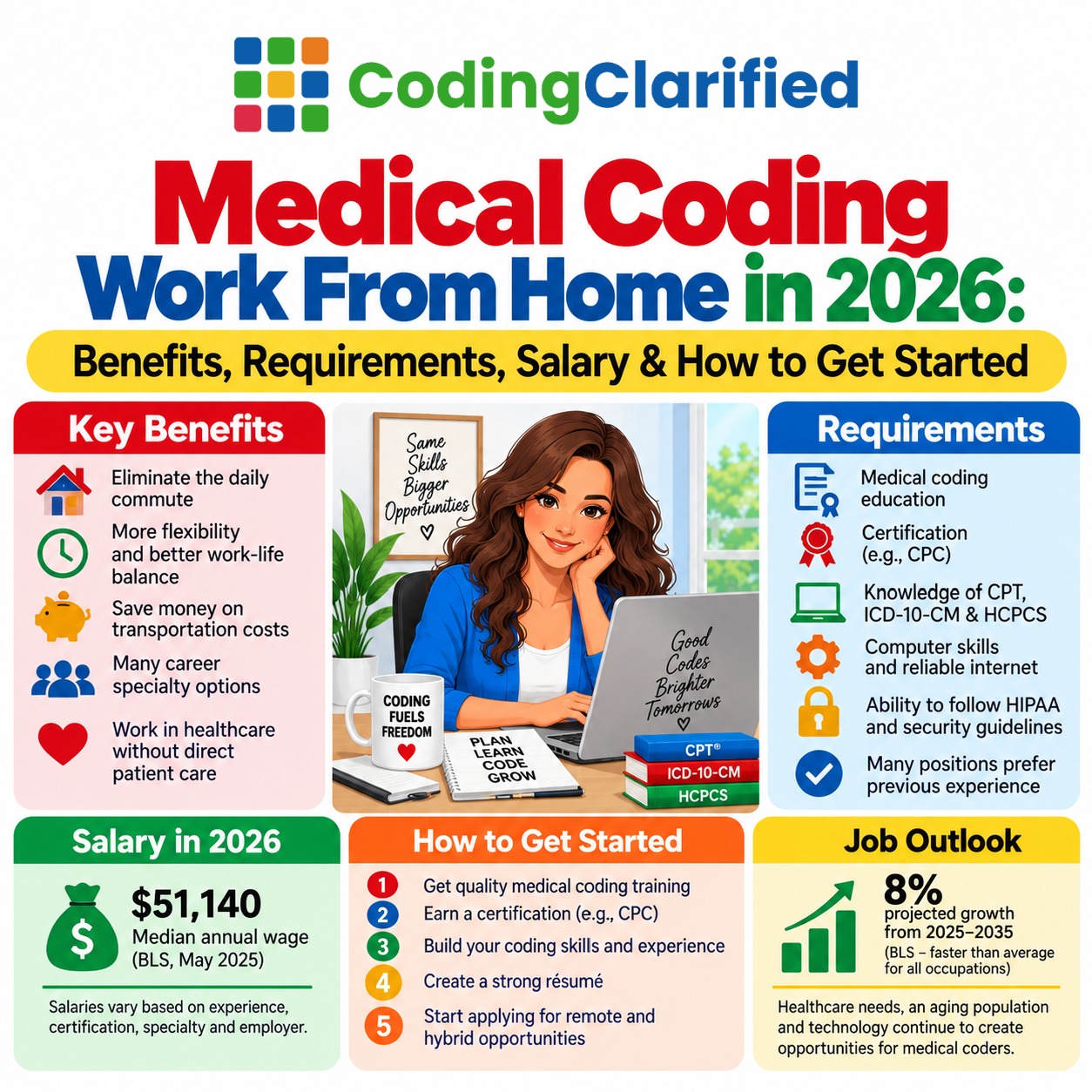
The U.S. Bureau of Labor Statistics (BLS) reports that medical records specialists had a median annual wage of $51,140 in May 2025. Moreover, employment is projected to grow 8% from 2025 through 2035, which is much faster than the 3% average projected for all occupations.
Still, remote medical coding is competitive. Therefore, students need to understand what employers actually want before assuming certification automatically leads to a work-from-home job.
Key Takeaways: Work-From-Home Medical Coding in 2026
- Medical coding can be performed remotely because coders primarily work with electronic health records, coding software, payer policies, and digital healthcare documentation.
- Remote coding jobs may be available through hospitals, physician groups, insurance companies, healthcare systems, consulting firms, and coding vendors.
- Certification, such as the AAPC Certified Professional Coder (CPC) credential, can help demonstrate coding knowledge to employers.
- New coders should understand that many remote employers prefer or require previous coding experience.
- The BLS reports a median annual wage of $51,140 for medical records specialists as of May 2025.
- Employment of medical records specialists is projected to grow 8% between 2025 and 2035.
- Artificial intelligence is changing medical coding workflows; however, coders still need strong skills in documentation review, guidelines, compliance, and code validation.
- Working from home does not always mean choosing your own schedule. Many remote coders work set hours and must meet productivity and accuracy standards.
- CPC students can improve their chances of employment by developing practical coding skills, gaining experience, and learning how to work efficiently in electronic systems.
Why Is Medical Coding a Good Work-From-Home Career in 2026?
Medical coding works particularly well in a remote environment because most of the coder’s job already takes place on a computer.
Coders review medical documentation and translate diagnoses, procedures, services, supplies, and other healthcare information into standardized codes. Depending on the position, they may work with ICD-10-CM, CPT, and HCPCS Level II code sets. In addition, coders frequently review payer guidelines, medical policies, electronic health records, claim information, and provider documentation.
As healthcare organizations have expanded electronic systems, coders no longer need to sit inside a physician’s office or hospital to access every medical record. Instead, secure technology can allow authorized employees to perform coding responsibilities from home.
However, remote access comes with strict privacy and security responsibilities. Coders still must protect patient information and follow HIPAA requirements, employer policies, and other applicable privacy rules.
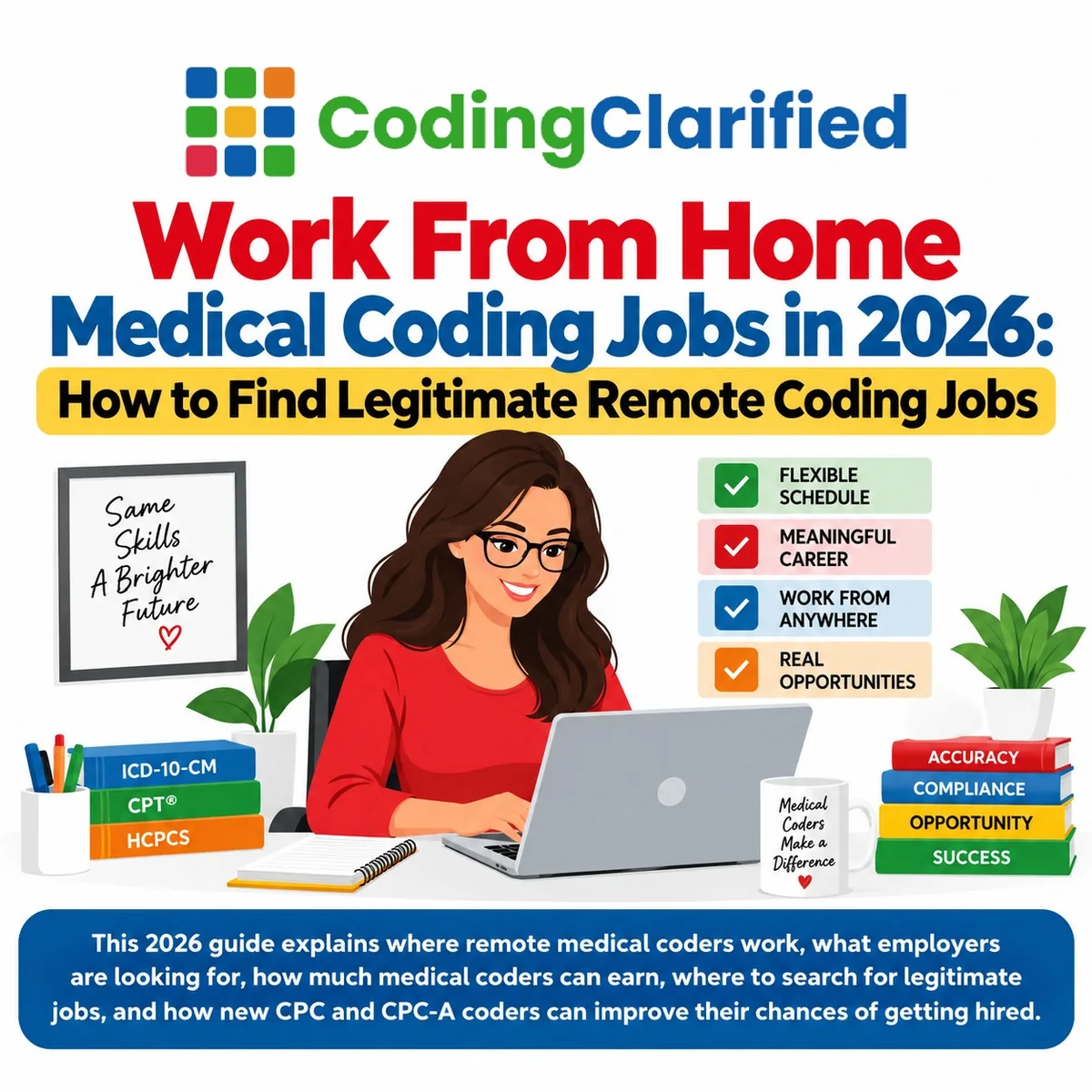
For a deeper look at current remote positions, read our guide to Work From Home Medical Coding Jobs in 2026: How to Find Legitimate Remote Coding Jobs.
7 Benefits of Working From Home as a Medical Coder
1. You Can Eliminate the Daily Commute
One of the clearest benefits of remote medical coding is eliminating the daily drive to an office. As a result, coders may save money on fuel, parking, vehicle maintenance, meals, and work clothing.
Additionally, removing a commute gives employees more time before and after work. That extra time can make a meaningful difference for parents, caregivers, students, and anyone trying to improve work-life balance.
Nevertheless, working from home is still working. Remote coders usually have productivity expectations, scheduled hours, meetings, deadlines, and quality standards.
2. Medical Coding Can Offer More Geographic Flexibility
Remote work can allow coders to apply for jobs outside their immediate community. Consequently, someone living in an area with few local coding employers may have access to a much larger job market.
There is an important limitation, though. A job advertised as “remote” does not always mean an employee can work from anywhere in the United States.
For example, employers may restrict hiring to certain states because of payroll, tax, licensing, security, or operational requirements. Some positions may also require initial on-site training, occasional meetings, or periodic travel.
Therefore, always read the entire job description before applying.
3. Medical Coding Provides Several Career Paths
Medical coding is not one single job. Instead, coders can eventually specialize in areas such as:
- Physician coding
- Hospital outpatient coding
- Inpatient coding
- Surgery coding
- Emergency department coding
- Evaluation and Management coding
- Risk adjustment/HCC coding
- Anesthesia coding
- Radiology coding
- Pathology and laboratory coding
- Auditing
- Compliance
- Coding education
- Clinical documentation
- Revenue cycle management
Furthermore, experience in one specialty can create opportunities to move into more advanced roles.
Coders interested in risk adjustment can also review our HCC Coding in 2026: CMS-HCC V28, Risk Adjustment, RAF Scores, and Documentation Guide.
4. You Can Build a Healthcare Career Without Direct Patient Care
Medical coding appeals to people who want to work in healthcare but do not necessarily want a clinical role.
The BLS notes that medical records specialists typically work at computers and identifies the occupation as one of the few healthcare-related careers without direct hands-on patient care.
Even so, coders have an important role in the healthcare system. Accurate coding supports claims, reimbursement, quality reporting, data collection, compliance, and healthcare analytics.
Therefore, a coder’s work can affect both the financial and administrative sides of healthcare.
5. Certification Can Provide a Clear Career Goal
Medical coding has recognized professional credentials that can help job seekers demonstrate their knowledge.
For example, the Certified Professional Coder (CPC) credential from AAPC focuses heavily on professional-fee coding. Students preparing for the CPC learn CPT, ICD-10-CM, HCPCS Level II, anatomy, medical terminology, coding guidelines, compliance, and other important topics.
Certification does not guarantee a remote job. However, many employers prefer or require professional coding credentials.
Students who are considering this path can read our AAPC CPC Certification Guide 2026: How to Become a Certified Medical Coder for a step-by-step explanation.
6. There Is Room for Continued Learning and Advancement
Medical coding never stays exactly the same.
CPT, ICD-10-CM, and HCPCS Level II code sets receive regular updates. In addition, payer policies, Medicare rules, documentation requirements, technology, and compliance expectations continue to change.
As a result, successful coders become lifelong learners.
Experienced professionals may eventually move into auditing, compliance, education, management, consulting, risk adjustment, or specialty coding. Furthermore, additional credentials may help coders demonstrate advanced knowledge in a specific area.
7. Remote Medical Coding Can Support Better Work-Life Balance
For the right person, remote coding can provide a more comfortable working environment.
Coders may have greater control over their workspace, while also avoiding common office distractions. Additionally, being home can make it easier to manage the time that would otherwise be spent commuting.
Still, remote work requires boundaries. A coder needs a professional workspace, dependable internet access, strong time-management skills, and the ability to stay focused without constant supervision.
How Much Do Medical Coders Make in 2026?
Salary depends on experience, certification, specialty, geographic location, employer, job responsibilities, and the type of coding performed.
According to the U.S. Bureau of Labor Statistics, the median annual wage for medical records specialists was $51,140 in May 2025. The lowest 10% earned less than $37,000, while the highest 10% earned more than $81,150.
Industry also makes a difference. For example, BLS reported a May 2025 median wage of $59,120 for medical records specialists working in hospitals and $60,980 for those working in management of companies and enterprises.
Importantly, these BLS figures cover the broader medical records specialist occupation. Therefore, they should not be interpreted as a guaranteed starting salary for every newly certified medical coder.
Experience matters significantly.
What Is the 2026 Job Outlook for Medical Coding?
The current federal outlook remains positive.
The U.S. Bureau of Labor Statistics projects employment of medical records specialists to grow 8% from 2025 to 2035, compared with 3% for all occupations. Additionally, BLS projects approximately 14,000 openings each year, on average, during the decade.
An aging population and the prevalence of chronic health conditions are among the factors supporting the need for healthcare services and medical records professionals.
However, there is an important 2026 development that medical coding students should understand: artificial intelligence.
BLS specifically notes that increased adoption of AI-powered solutions that make medical coding more efficient may affect demand for medical records specialists.
That does not mean medical coding is disappearing.
Instead, coders should prepare for a career in which technology increasingly assists with code suggestions, documentation analysis, claim review, and workflow automation. Therefore, future-ready coders need to know how to validate information rather than simply accept what software recommends.
Is AI Going to Replace Work-From-Home Medical Coders?
AI is already changing healthcare documentation and coding workflows. However, coding involves more than matching a diagnosis or procedure to a code.
Professional coders must interpret documentation, apply official guidelines, understand code sequencing, identify conflicting information, recognize documentation gaps, evaluate payer requirements, and determine whether the record supports the reported services.
Additionally, computer-assisted coding and AI-generated suggestions still require oversight.
For that reason, CPC students should learn the reasoning behind code selection instead of depending entirely on software. Coders who understand guidelines, documentation, compliance, medical necessity, and auditing may be better positioned as technology evolves.
In other words, the goal in 2026 should not be to compete with AI at simple code lookup. Instead, develop the judgment needed to recognize when an automated recommendation is wrong.
What Do You Need to Work From Home as a Medical Coder?
Requirements vary by employer. However, remote coding jobs commonly look for some combination of:
- Medical coding education
- A recognized coding certification
- Knowledge of ICD-10-CM, CPT, and HCPCS Level II
- Medical terminology knowledge
- Anatomy and physiology knowledge
- Understanding of coding guidelines
- Strong computer skills
- Electronic health record experience
- Attention to detail
- Reliable internet access
- A private, secure workspace
- Strong communication skills
- Ability to meet productivity standards
- Ability to meet coding accuracy requirements
- Previous coding experience for many advanced remote positions
Furthermore, some employers may require specialty experience before allowing a coder to work independently from home.
This is one reason new coders should avoid limiting their first job search to “remote medical coder” positions.
Can a New CPC Get a Remote Medical Coding Job?
Yes, but new coders should have realistic expectations.
Some employers hire entry-level coders into remote or hybrid positions. However, many work-from-home coding jobs prefer candidates who already have coding experience.
Current remote job postings also illustrate this difference. Some experienced-level positions require several years of specialty coding experience, while other jobs may require initial in-person training before the employee transitions to remote work.
Consequently, your first medical coding job does not have to be your forever job.
A local physician practice, billing office, hospital, revenue cycle department, insurance company, or hybrid position may provide the experience needed to become a stronger candidate for remote coding later.
CPC Student Tips for Getting a Work-From-Home Medical Coding Job
If your goal is remote work, start preparing before you finish training.
First, focus on becoming a strong coder rather than simply memorizing enough information to pass an exam. Employers need coders who can read documentation, locate the correct code, apply guidelines, and explain why their answer is correct.
Next, practice navigating CPT, ICD-10-CM, and HCPCS Level II efficiently. Speed matters eventually; however, accuracy should come first while you are learning.
Additionally, become comfortable with medical terminology, anatomy, modifiers, E/M coding, compliance, and documentation requirements. Those foundational skills transfer into many coding specialties.
Students should also consider experience-building opportunities. Practicode, internships, apprenticeships, healthcare office experience, billing roles, and other revenue cycle positions may help strengthen a résumé.
Finally, do not ignore networking. AAPC local chapters, professional groups, instructors, classmates, LinkedIn contacts, and healthcare employers can all become valuable sources of job leads.
If paying for training is a concern, review our Medical Coding Scholarships in 2026: How to Get CPC Training Funded.
Common Mistakes to Avoid When Looking for Remote Medical Coding Jobs
Assuming Certification Guarantees a Remote Job
Passing the CPC exam is an important achievement. However, certification is the beginning of professional development rather than the end.
Employers may still look for experience, accuracy, specialty knowledge, EHR familiarity, productivity, and communication skills.
Applying Only to Jobs With “Remote” in the Title
New coders sometimes overlook excellent entry-level opportunities because they are determined to work from home immediately.
Instead, consider whether an on-site or hybrid position could give you valuable experience. After gaining that foundation, you may qualify for a wider range of remote jobs.
Believing Work From Home Means Work Whenever You Want
Remote employment is not automatically freelance employment.
Many coders have fixed shifts, required online availability, productivity goals, team meetings, quality reviews, and deadlines. Therefore, read the employer’s expectations carefully.
Ignoring Accuracy and Productivity Standards
Coding departments frequently measure both accuracy and productivity.
A coder who moves quickly but makes frequent mistakes can create compliance and reimbursement problems. Conversely, a coder who is accurate but cannot meet reasonable productivity requirements may struggle in a production-based environment.
Develop both skills gradually.
Falling for Work-From-Home Medical Coding Scams
Remote job seekers should be cautious of advertisements promising extremely high income with little training or experience.
Likewise, be suspicious if a supposed employer asks you to pay for a job, requests sensitive financial information too early, communicates only through unusual messaging platforms, or sends a check and tells you to purchase equipment from a particular vendor.
Research the company independently before providing personal information.
How to Make Yourself More Competitive for Remote Coding Jobs
Start by earning a credential that matches the type of coding you want to perform. Then, build practical experience wherever possible.
Additionally, tailor your résumé to each job instead of sending the same generic résumé everywhere. Highlight your certification, coding education, specialty experience, EHR knowledge, compliance knowledge, and measurable accomplishments.
Job seekers should also pay close attention to the requirements listed in each posting. If an employer asks for orthopedic coding experience, for example, emphasize relevant orthopedic knowledge rather than filling the résumé with unrelated information.
Furthermore, keep learning after certification. Annual code changes, payer updates, CMS policies, compliance developments, and new technology mean your education cannot stop after the CPC exam.
Is Working From Home as a Medical Coder Worth It in 2026?
For many people, yes.
Medical coding offers a combination of healthcare career stability, professional certification, specialty options, remote-work potential, and opportunities for continued advancement. Moreover, federal projections continue to show faster-than-average growth for medical records specialists.
At the same time, students should approach the career realistically.
Remote coding is not an instant work-from-home opportunity simply because someone completes a training program. Instead, the strongest candidates combine education, certification, practical coding ability, experience, accuracy, productivity, professionalism, and continued learning.
The rise of AI makes those human skills even more important. Therefore, coders entering the profession in 2026 should focus on becoming skilled coding professionals who know how to use technology while also knowing when technology gets the answer wrong.
For another look at remote work, read Can Medical Coders Work From Home?.
Frequently Asked Questions About Work-From-Home Medical Coding
Quick answers to the questions students ask most about work-from-home medical coding.
Can medical coders really work from home in 2026?
Yes. Hospitals, physician groups, insurance companies, coding vendors, consulting organizations, and other healthcare employers offer remote coding positions. However, the availability and requirements vary by employer, specialty, location, certification, and experience level.
Can I work from home immediately after getting my CPC?
Possibly, but it is not guaranteed. Some entry-level remote opportunities exist; however, many employers prefer coders with previous professional experience. Therefore, new CPCs should consider remote, hybrid, and on-site opportunities when building their first year of experience.
Do I need certification to work as a remote medical coder?
Requirements differ between employers. Nevertheless, many medical coding employers prefer or require a recognized credential such as the CPC. Certification demonstrates that you have met an established standard of coding knowledge, although employers may also require experience and specialty skills.
How much can a work-from-home medical coder make?
Pay varies considerably by employer, experience, certification, specialty, and geographic area. The BLS reports that medical records specialists had a median annual wage of $51,140 in May 2025, with the highest 10% earning more than $81,150. These figures represent the broader occupation and should not be viewed as a guaranteed salary for a new medical coder.
What equipment do I need to work from home as a medical coder?
Employers commonly require a secure computer setup, reliable high-speed internet, access to approved coding resources, and a private workspace. Additionally, organizations may provide computers, monitors, VPN access, software, and other equipment. Never assume you can use a personal device because security requirements vary.
Is medical coding still a good career with AI?
Medical coding continues to have a positive federal employment outlook, although AI is changing how coding work gets performed. BLS projects 8% employment growth for medical records specialists from 2025 through 2035 while also acknowledging that AI-powered coding technology may affect demand. Therefore, coders should strengthen skills in coding guidelines, documentation analysis, auditing, compliance, and validation of automated coding suggestions.
Is work-from-home medical coding flexible?
It can be, but “remote” and “flexible schedule” are not the same thing. Some employers allow flexible schedules, while others require employees to work specific shifts. Additionally, remote coders may have productivity goals, accuracy requirements, meetings, and scheduled availability.
What is the best way for a CPC student to prepare for a remote coding career?
Build strong coding fundamentals first. Then, earn your certification, practice real-world coding scenarios, develop computer and EHR skills, seek practical experience, and continue learning after the exam. Most importantly, do not reject a good first coding opportunity simply because it is not fully remote. Experience can make you significantly more competitive for future work-from-home positions.
Authoritative Resources
For additional career and coding information, visit the U.S. Bureau of Labor Statistics Occupational Outlook Handbook for current medical records specialist employment, wage, and job outlook data.
Medical coders can also use AAPC website for certification, continuing education, coding career resources, and professional development. Learn more about Coding Clarified and our online medical coding training program.
For federal Medicare coding, billing, coverage, compliance, and healthcare program information, visit the Centers for Medicare & Medicaid Services.