Guidelines for Coding and Billing Diabetes in 2026: Complete ICD-10, CPT, and Documentation Guide
Key Takeaways
- Above all, diabetes coding requires accurate identification of the diabetes type, complications, and manifestations.
- ICD-10-CM assumes a causal relationship between diabetes and many documented complications unless stated otherwise by the provider.
- Terms such as “controlled” and “uncontrolled” are no longer the primary determining factors for code selection.
- Hyperglycemia, hypoglycemia, and diabetes-related complications drive code assignment.
- As a result, proper documentation improves reimbursement, risk adjustment accuracy, and compliance.
- In addition, continuous glucose monitoring (CGM), diabetes self-management training (DSMT), and remote patient monitoring services create additional billing opportunities.
- 2026 coding updates continue emphasizing specificity, documentation integrity, and value-based care reporting.
Guidelines for Coding and Billing Diabetes in 2026
Diabetes mellitus remains one of the most commonly reported chronic conditions in healthcare. Consequently, accurate coding and billing are essential for proper reimbursement, quality reporting, risk adjustment, and patient care management.
Because diabetes often affects multiple body systems, medical coders must understand ICD-10-CM diabetes conventions, documentation requirements, and applicable CPT® services. Furthermore, many payer audits continue to focus on diabetes coding due to its impact on reimbursement and quality metrics.
In this comprehensive 2026 guide, we will review diabetes classification, ICD-10 coding rules, common complications, billing considerations, documentation requirements, and frequently used CPT codes.
Understanding Diabetes Classification
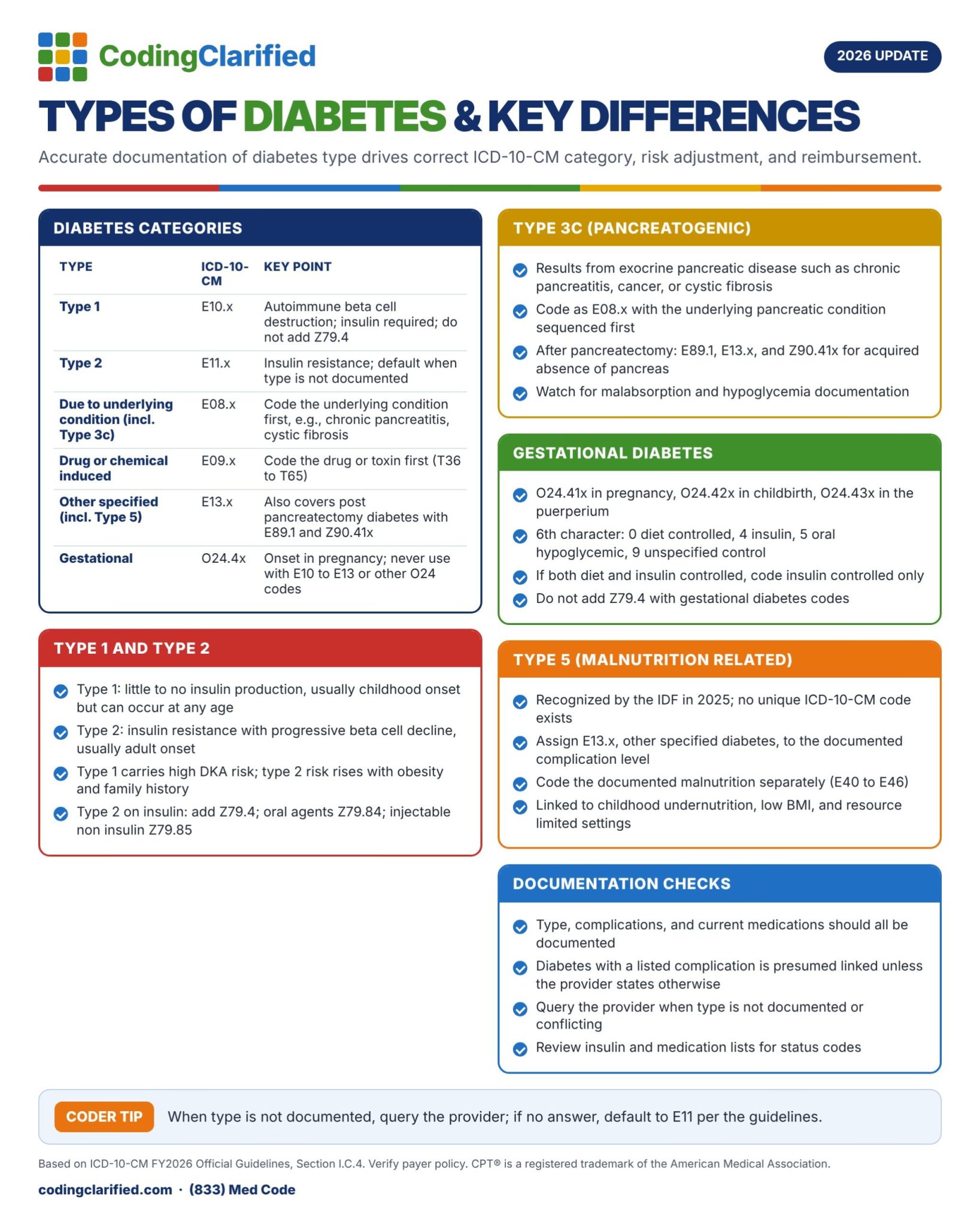
Before assigning ICD-10-CM codes, coders must determine the type of diabetes documented by the provider.
Type 1 Diabetes Mellitus (E10.-)
Type 1 diabetes is an autoimmune disease in which the pancreas produces little or no insulin.
Common characteristics include:
- Usually diagnosed in childhood or early adulthood
- Requires insulin therapy
- Autoimmune destruction of beta cells
For example:
E10.9 – Type 1 diabetes mellitus without complications
Type 2 Diabetes Mellitus (E11.-)
In contrast, Type 2 diabetes involves insulin resistance and relative insulin deficiency.
Common characteristics include:
- Most common diabetes type
- Often associated with obesity
- May be managed through medication, lifestyle changes, or insulin
For example:
E11.9 – Type 2 diabetes mellitus without complications
Diabetes Due to an Underlying Condition (E08.-)
Used when another disease causes diabetes.
For example:
- Chronic pancreatitis
- Pancreatic cancer
- Cushing syndrome
For example:
E08.9 – Diabetes mellitus due to underlying condition without complications
Drug or Chemical-Induced Diabetes (E09.-)
Used when medications or chemicals cause diabetes.
For instance, common examples include:
- Long-term steroid use
- Chemotherapy medications
For example:
E09.9 – Drug or chemical induced diabetes mellitus without complications
Other Specified Diabetes Mellitus (E13.-)
In addition, this category includes less common forms of diabetes.
For example:
- Postpancreatectomy diabetes
- Genetic defects
- Type 5 diabetes (malnutrition-related diabetes mellitus)
For example:
E13.9 – Other specified diabetes mellitus without complications
Type 5 Diabetes: New Recognition in 2026
One of the most discussed diabetes developments is the growing recognition of Type 5 Diabetes, also known as malnutrition-related diabetes.
While ICD-10-CM currently does not provide a dedicated “Type 5” code category, these patients are generally classified under:
E13.- Other Specified Diabetes Mellitus
Therefore, documentation should clearly identify:
- Underlying cause
- Nutritional deficiencies
- Associated manifestations
- Current treatment plan
As awareness continues to grow, coders should therefore monitor future coding guidance and updates.
Controlled vs. Uncontrolled Diabetes: What Coders Need to Know
However, one of the biggest misconceptions in diabetes coding involves the terms “controlled” and “uncontrolled.”
In ICD-10-CM, coders generally do not code based solely on these terms.
Instead, coders should identify documented manifestations such as:
Hyperglycemia
For example:
E11.65 – Type 2 diabetes mellitus with hyperglycemia
In other words, hyperglycemia typically indicates poorly controlled diabetes.
Hypoglycemia
For example:
E11.649 – Type 2 diabetes mellitus with hypoglycemia without coma
Without Complications
For example:
E11.9 – Type 2 diabetes mellitus without complications
Therefore, coding should reflect the documented clinical condition rather than simply the physician’s use of “controlled” or “uncontrolled.”
ICD-10-CM Diabetes Coding Guidelines
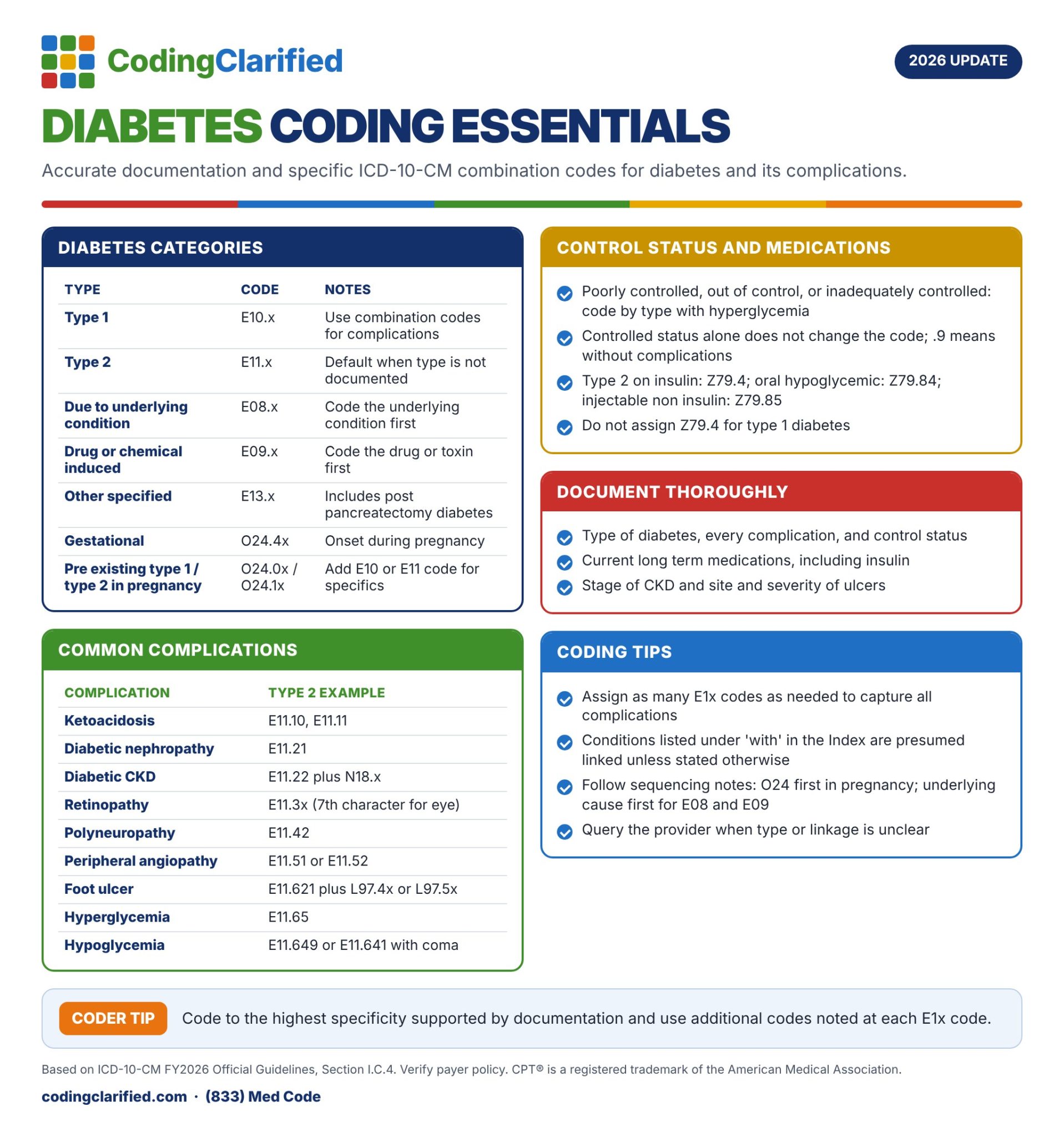
According to the ICD-10-CM Official Guidelines, diabetes codes combine:
- Diabetes type
- Body system affected
- Specific complication
As a result, this combination coding structure reduces the need for multiple diagnosis codes.
Common Diabetes Categories
| Category | Description |
|---|---|
| E08 | Diabetes due to underlying condition |
| E09 | Drug-induced diabetes |
| E10 | Type 1 diabetes |
| E11 | Type 2 diabetes |
| E13 | Other specified diabetes |
Common Diabetes Complications and Coding Examples
For this reason, accurate documentation of complications is critical.
Diabetic Neuropathy
For example:
- E11.40 – Type 2 diabetes with diabetic neuropathy, unspecified
- E10.40 – Type 1 diabetes with diabetic neuropathy, unspecified
Diabetic Retinopathy
For example:
- E11.319 – Type 2 diabetes with unspecified diabetic retinopathy without macular edema
- E10.329 – Type 1 diabetes with mild nonproliferative diabetic retinopathy without macular edema
Diabetic Nephropathy
For example:
- E11.21 – Type 2 diabetes with diabetic nephropathy
- E10.21 – Type 1 diabetes with diabetic nephropathy
Chronic Kidney Disease
Frequently coded together:
- E11.22 – Type 2 diabetes with diabetic chronic kidney disease
- N18.30 – Chronic kidney disease stage 3 unspecified
Diabetic Peripheral Angiopathy
For example:
- E11.51 – Type 2 diabetes with diabetic peripheral angiopathy without gangrene
Diabetic Foot Ulcers
For example:
- E11.621 – Type 2 diabetes with foot ulcer
Additional code required:
- L97.- to identify ulcer location and severity
ICD-10 Assumed Relationships
One of the most important diabetes coding guidelines involves presumed relationships.
Specifically, ICD-10-CM assumes a relationship between diabetes and:
- Kidney disease
- Neuropathy
- Retinopathy
- Cataracts
- Circulatory complications
Therefore, unless the provider specifically documents another cause, coders may report the diabetes combination code.
For official guidance, review the ICD-10-CM guidelines published by the CMS Official ICD-10-CM Guidelines.
CPT Codes Commonly Used for Diabetes Management
In addition to diagnosis coding, coders should understand frequently reported diabetes-related services.
Evaluation and Management (E/M)
For example:
- 99202–99205 New Patient Visits
- 99211–99215 Established Patient Visits
Diabetes Self-Management Training (DSMT)
For example:
- G0108 Individual DSMT
- G0109 Group DSMT
Medical Nutrition Therapy
For example:
- 97802 Initial assessment
- 97803 Reassessment
Continuous Glucose Monitoring (CGM)
In particular, common codes include:
- 95249 Personal CGM setup and training
- 95250 CGM placement and data collection
- 95251 CGM data analysis and interpretation
Remote Patient Monitoring
Similarly, frequently reported codes include:
- 99453 Initial setup and patient education
- 99454 Device supply and data transmission
- 99457 First 20 minutes of treatment management
- 99458 Each additional 20 minutes
- 99091 Collection and interpretation of physiologic data
In fact, these services have become increasingly important as diabetes management shifts toward remote care models.
Documentation Requirements for Diabetes Coding
In general, strong documentation should identify:
- Diabetes type
- Current treatment
- Hyperglycemia or hypoglycemia
- Related complications
- Severity of complications
- Associated chronic conditions
- Current insulin use
- Long-term medication use
For example:
Z79.4 – Long-term current use of insulin
Z79.84 – Long-term current use of oral hypoglycemic drugs
Otherwise, incomplete documentation often leads to undercoding and lost reimbursement opportunities.
Payer-Specific Billing Considerations
Although ICD-10 coding rules remain standardized, payer requirements vary.
Therefore, always verify:
- Medical necessity requirements
- Prior authorization requirements
- Coverage policies for CGM devices
- Documentation requirements for DSMT
- Remote monitoring reimbursement policies
After all, failure to follow payer-specific rules can result in denials and delayed payment.
Quality Assurance and Compliance Best Practices
To that end, healthcare organizations should routinely:
- Audit diabetes diagnosis coding
- Review documentation completeness
- Validate complication coding
- Monitor payer denials
- Educate providers on specificity requirements
In this way, regular auditing helps improve compliance while reducing revenue leakage.
Additional Coding Clarified Resources
Continue your diabetes coding education with these related Coding Clarified articles:
Medical Coding “Clarified” Acute on Chronic Kidney Failure
Medical Coding Chronic Kidney Disease
Medical Coding “Clarified” Acute on Chronic Kidney Failure
Authoritative Resources
For official coding guidance and reimbursement updates, review:
- AAPC website
- Centers for Medicare & Medicaid Services (CMS)
- 2026 ICD-10-CM Guidelines
Frequently Asked Questions About Diabetes Coding
What ICD-10 code is used for Type 2 diabetes without complications?
The most commonly reported code is E11.9, Type 2 diabetes mellitus without complications.
How do you code uncontrolled Type 2 diabetes?
Instead, coders should identify the documented manifestation. For example, code Type 2 diabetes with hyperglycemia as E11.65.
Is Type 5 diabetes recognized in ICD-10-CM?
Clinicians increasingly recognize Type 5 diabetes; however, ICD-10-CM currently does not have a dedicated Type 5 category. Coders report most cases using E13.- Other Specified Diabetes Mellitus when documentation supports the diagnosis.
When should Z79.4 be reported?
Z79.4 applies when a patient uses insulin on a long-term basis and documentation supports ongoing use.
Can diabetic CKD be coded with both E11.22 and N18 codes?
Yes. Report E11.22 to identify diabetic chronic kidney disease, and also assign an additional N18.- code to identify CKD stage.
What CPT codes are used for continuous glucose monitoring?
In particular, frequently reported CGM codes include 95249, 95250, and 95251.
Does ICD-10 assume a relationship between diabetes and chronic kidney disease?
Yes. ICD-10-CM presumes a causal relationship between diabetes and CKD unless documentation clearly states another cause.
What are the most common diabetes coding audit errors?
In particular, common errors include:
- Missing complication codes
- Incorrect diabetes type assignment
- Failure to code insulin use
- Missing CKD stage codes
- Incomplete documentation support
- Incorrect hyperglycemia or hypoglycemia coding
Coding Clarified Final Thoughts
Overall, diabetes coding continues to evolve as healthcare shifts toward chronic disease management, remote monitoring, and value-based reimbursement. Therefore, coders must stay current with ICD-10-CM guidelines, payer requirements, and emerging diabetes classifications.
Most importantly, accurate documentation remains the foundation of proper diabetes coding. By understanding combination coding rules, complication reporting, and CPT service selection, coders can improve compliance, optimize reimbursement, and support better patient outcomes in 2026 and beyond.