Acute on Chronic Kidney Failure: Nephrology Medical Coding Scenario Clarified
Medical Coding for Acute Kidney Failure With Stage III CKD
Acute kidney failure coding requires careful review of provider documentation, laboratory findings, chronic kidney disease staging, and contributing conditions. Additionally, coders must understand the difference between acute kidney injury (AKI), chronic kidney disease (CKD), and acute-on-chronic renal failure. Because nephrology cases frequently involve multiple comorbidities, this type of scenario is commonly tested on the CPC exam.
In this nephrology coding case, the provider documents acute on chronic kidney failure in a patient with stage III CKD, diabetes, hypertension, coronary artery disease, heart failure, and benign prostatic hypertrophy (BPH). Therefore, coders must analyze the assessment carefully and apply ICD-10-CM guidelines correctly.
Scenario Overview
| Section | Details |
|---|---|
| Medical Specialty | Nephrology |
| Chief Complaint | Acute kidney failure |
| Key Conditions | Acute on chronic kidney failure, Stage III CKD, hypertension, diabetes, BPH |
| Significant Findings | Elevated creatinine, hypotension, urinary obstruction concerns |
| Risk Factors | Chinese herbs, dehydration, medications, BPH obstruction |
| Coding Focus | ICD-10-CM diagnosis coding and nephrology evaluation |
Key Clinical Documentation Highlights
Several important documentation elements support accurate coding in this nephrology encounter.
Important Clinical Findings
- Acute on chronic kidney failure
- Stage III chronic kidney disease
- Elevated creatinine from 1.8 to 2.3
- GFR approximately 41 mL/min
- History of diabetes mellitus
- Hypertension
- Coronary artery disease
- Congestive heart failure
- BPH with urinary obstruction symptoms
- Hypotension episodes
- Possible prerenal azotemia
- Use of Chinese herbs potentially causing nephritis
Because the provider specifically documents “acute on chronic kidney failure,” coders should capture both the acute kidney injury and the chronic kidney disease.
ICD-10-CM Coding
Primary Diagnosis Code
Acute Kidney Failure
N17.9N17.9
ICD-10-CM Code: N17.9
Description: Acute kidney failure, unspecified
Rationale
The physician clearly documents:
“Acute on chronic kidney failure.”
However, the provider does not specify:
- Acute tubular necrosis
- Acute cortical necrosis
- Drug-induced AKI
- Specific acute renal pathology
Therefore, N17.9 is appropriate.
Secondary Diagnosis Codes
Stage III Chronic Kidney Disease
N18.30N18.30
ICD-10-CM Code: N18.30
Description: Chronic kidney disease, stage 3 unspecified
Rationale
The documentation states:
- “Stage III CKD”
- GFR approximately 40–41 mL/min
Because the provider does not specify stage 3a or 3b, assign N18.30.
Hypertensive CKD
I12.9I12.9
ICD-10-CM Code: I12.9
Description: Hypertensive chronic kidney disease with stage 1 through stage 4 CKD, or unspecified CKD
Rationale
ICD-10-CM presumes a causal relationship between hypertension and CKD unless documentation states otherwise.
The patient has:
- Longstanding hypertension
- Stage III CKD
Therefore, assign I12.9 along with the CKD stage code.
Type 2 Diabetes Mellitus With Diabetic CKD
E11.22E11.22
ICD-10-CM Code: E11.22
Description: Type 2 diabetes mellitus with diabetic chronic kidney disease
Rationale
The patient has:
- Diabetes mellitus
- CKD
ICD-10-CM guidelines instruct coders to assume a relationship between diabetes and CKD unless documentation states otherwise.
An additional CKD stage code must also be reported.
Benign Prostatic Hyperplasia With Lower Urinary Tract Symptoms
N40.1N40.1
ICD-10-CM Code: N40.1
Description: Benign prostatic hyperplasia with lower urinary tract symptoms
Rationale
The patient has:
- Weak stream
- Dribbling
- Nocturia
- Urinary frequency
These symptoms support BPH with LUTS.
Final ICD-10-CM Code List
| ICD-10-CM Code | Description |
|---|---|
| N17.9 | Acute kidney failure, unspecified |
| N18.30 | Chronic kidney disease, stage 3 unspecified |
| I12.9 | Hypertensive CKD |
| E11.22 | Type 2 diabetes mellitus with diabetic CKD |
| N40.1 | Benign prostatic hyperplasia with LUTS |
CPT® Coding
This encounter represents a nephrology consultation evaluation.
Appropriate CPT® Code
9924499244
CPT® Code: 99244
Description: Office consultation for a new or established patient requiring moderate complexity medical decision making
CPT® Coding Rationale
The nephrologist performed:
- Comprehensive history
- Comprehensive examination
- Moderate complexity medical decision making
Additionally, the provider reviewed:
- Extensive laboratory data
- Chronic illnesses with exacerbation
- Medication risks
- Possible nephrotoxic exposures
- Potential urinary obstruction
- Multiple comorbid conditions
The encounter demonstrates moderate complexity MDM.
HCPCS Level II Coding Considerations
No definitive HCPCS Level II codes are supported by this documentation alone.
However, nephrology cases frequently involve:
- Erythropoietin injections
- Dialysis supplies
- Durable medical equipment
- Medication administration
Since none are documented as administered during this encounter, no HCPCS code is assigned.
CPC Exam Tips for Nephrology Coding
1. Code Both AKI and CKD When Documented
When documentation states:
- “Acute on chronic kidney failure”
- “AKI superimposed on CKD”
Coders should report:
- The acute kidney injury code
- The CKD stage code
Many CPC students incorrectly code only one condition.
2. Watch for Presumed Relationships
ICD-10-CM assumes relationships between:
- Hypertension and CKD
- Diabetes and CKD
Unless the provider specifically states the conditions are unrelated, coders should assign the combination codes.
3. Always Capture CKD Stage
CKD staging is extremely important in nephrology coding.
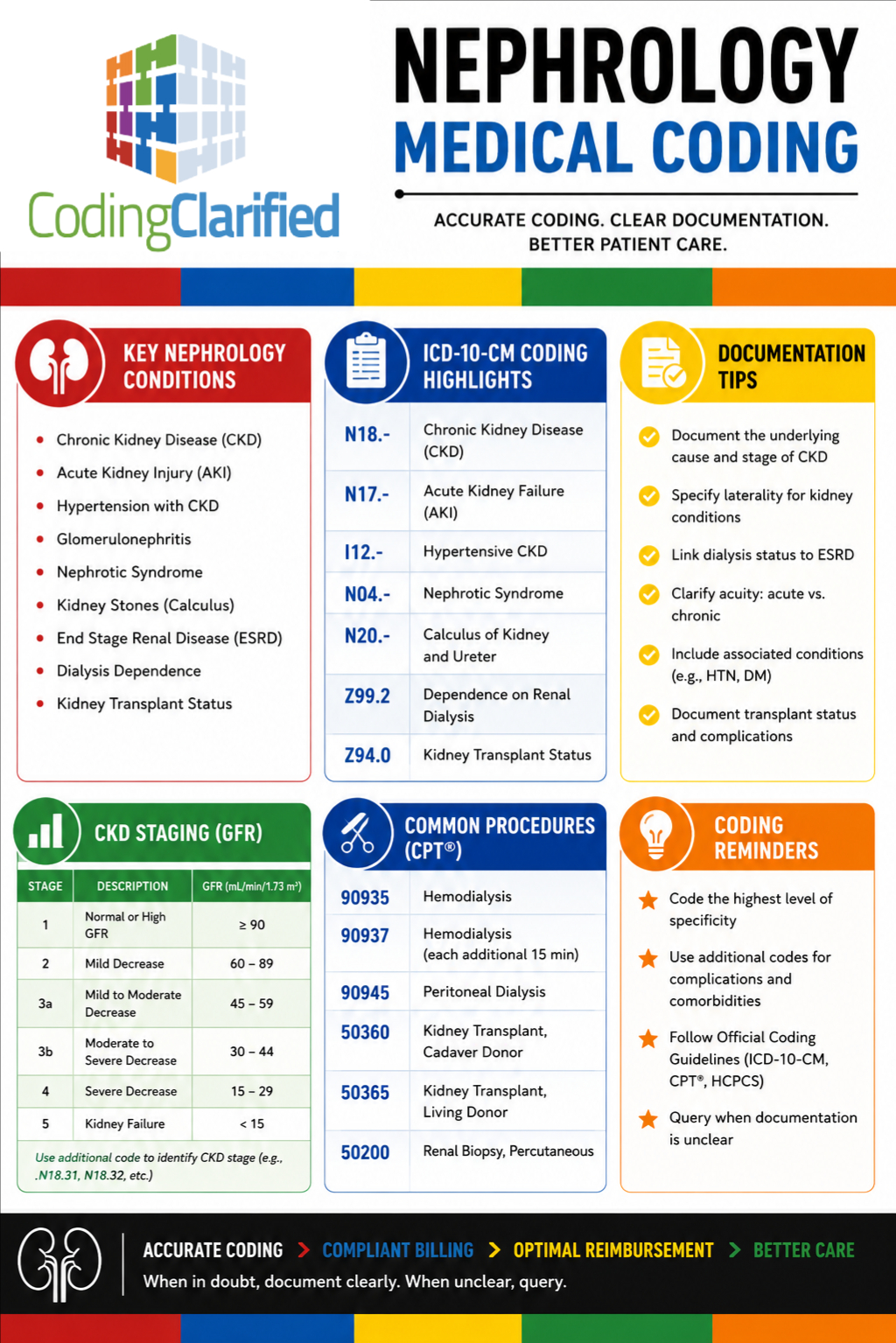
Common CKD stages include:
| Stage | GFR Range |
|---|---|
| Stage 1 | ≥90 |
| Stage 2 | 60–89 |
| Stage 3 | 30–59 |
| Stage 4 | 15–29 |
| Stage 5 | <15 |
The documentation in this case supports Stage III CKD.
4. Review Medication Lists Carefully
Certain medications may contribute to kidney injury.
This scenario mentions:
- TriCor
- Chinese herbs
- Lasix
- ACE inhibitors
Therefore, coders should carefully review documentation for:
- Adverse effects
- Poisoning
- Drug-induced nephropathy
However, this provider did not definitively diagnose drug-induced renal failure.
Nephrology Coding Guidelines
ICD-10-CM Guideline Highlights
Hypertension and CKD
ICD-10-CM guideline:
- Presume a relationship between hypertension and CKD.
Therefore:
- Assign I12 category codes when both conditions are present.
Diabetes and CKD
ICD-10-CM guideline:
- Diabetes with CKD requires combination coding.
Additionally:
- Always assign an additional CKD stage code.
Acute Kidney Failure
Acute kidney failure coding depends on provider specificity.
Examples include:
- Acute tubular necrosis
- Acute cortical necrosis
- Drug-induced AKI
- Acute renal insufficiency
When unspecified:
- Assign N17.9.
Common CPC Exam Mistakes
Mistake #1
Coding only CKD and missing the acute kidney failure.
Mistake #2
Failing to assign the CKD stage code with diabetes or hypertension.
Mistake #3
Assigning unspecified diabetes without linking diabetic CKD.
Mistake #4
Coding symptoms separately when included in confirmed diagnoses.
For example:
- Urinary frequency
- Weak stream
- Dribbling
These are associated with BPH and generally are not separately coded.
Final Coding Summary
| Code Type | Code | Description |
|---|---|---|
| CPT® | 99244 | Office consultation |
| ICD-10-CM | N17.9 | Acute kidney failure |
| ICD-10-CM | N18.30 | Stage III CKD |
| ICD-10-CM | I12.9 | Hypertensive CKD |
| ICD-10-CM | E11.22 | Type 2 diabetes with CKD |
| ICD-10-CM | N40.1 | BPH with LUTS |
Coding Clarified Final Thoughts
Nephrology coding cases often involve multiple chronic conditions, medication interactions, and laboratory interpretation. Consequently, coders must carefully analyze provider documentation, sequencing rules, presumed relationships, and CKD staging requirements.
For CPC students, this type of scenario is an excellent example of:
- Acute vs. chronic condition coding
- Combination coding
- CKD staging
- Nephrology terminology
- Medical decision making analysis
Most importantly, always verify whether the provider documents:
- Acute kidney injury
- CKD stage
- Diabetes relationships
- Hypertension relationships
- Obstructive urinary conditions
Accurate nephrology coding depends on complete documentation review and proper guideline application.