
FY2027 update: This guide reflects the FY2027 ICD-10-CM code set, effective October 1, 2026. The coronary artery disease codes in category I25 did not change for FY2027.
New to medical coding? See how our CPC Training gets you certified.
How do you code coronary artery disease (CAD) in ICD-10-CM for 2027?
Quick answer: The ICD-10-CM code for coronary artery disease (CAD) of a native coronary artery without angina is I25.10. When the provider documents angina, use a combination code from I25.11- instead, such as I25.110 for CAD with unstable angina or I25.119 for CAD with unspecified angina. CAD of a bypass graft is reported from I25.7- when angina is present and I25.810 when it is not.
Coronary Artery Disease (CAD) is one of the most commonly coded cardiovascular conditions in medical coding. Because CAD affects millions of patients each year, medical coders frequently encounter it in physician offices, inpatient facilities, outpatient hospitals, cardiology clinics, and risk adjustment coding.
Therefore, understanding how to correctly assign ICD-10-CM codes for Coronary Artery Disease is essential for accurate reimbursement, compliance, and CPC exam success.
In this comprehensive guide, we will review:
For a closely related topic, see our guide to STEMI and NSTEMI coding.
- What Coronary Artery Disease is
- Common CAD terminology
- ICD-10-CM coding guidelines
- Combination coding rules
- CAD documentation tips
- CPC exam preparation strategies
- Common coding mistakes
- Real-world coding examples
What Is Coronary Artery Disease (CAD)?
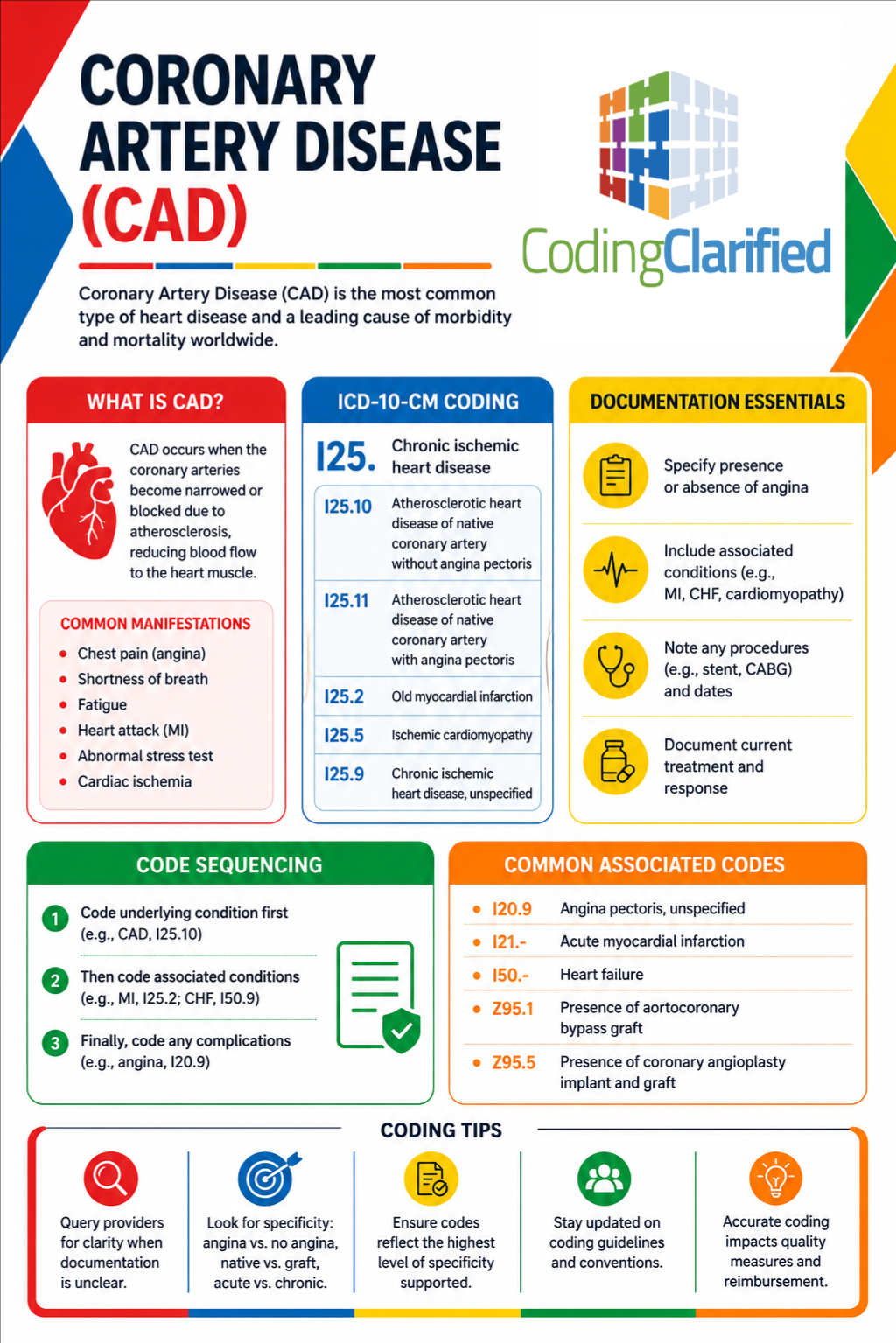
Coronary Artery Disease occurs when plaque builds up inside the coronary arteries, reducing blood flow to the heart muscle. As a result, patients may experience:
- Chest pain (angina)
- Shortness of breath
- Myocardial infarction (heart attack)
- Fatigue
- Cardiac complications
Additionally, CAD may be described using several provider terms, including:
- Coronary atherosclerosis
- Ischemic heart disease
- Arteriosclerotic heart disease (ASHD)
- Coronary heart disease
Because providers often use these terms interchangeably, coders must carefully review documentation before assigning codes.
Which ICD-10-CM category is used for CAD?
Most CAD diagnoses are reported from:
I25: Chronic Ischemic Heart Disease
Common ICD-10-CM CAD codes include:
| ICD-10-CM Code | Description |
|---|---|
| I25.10 | Atherosclerotic heart disease of native coronary artery without angina pectoris |
| I25.11- | Atherosclerotic heart disease of native coronary artery with angina pectoris |
| I25.7- | Atherosclerosis of coronary artery bypass graft(s) and coronary artery of transplanted heart with angina pectoris (for example, I25.709 for an unspecified graft with unspecified angina) |
| I25.81- | Atherosclerosis of other coronary vessels without angina pectoris (I25.810 for bypass graft(s)) |
| I25.2 | Old myocardial infarction |
Is the disease in a native coronary artery or a bypass graft?
One of the most important CAD coding concepts involves identifying whether the disease affects:
- Native coronary arteries
OR - Coronary artery bypass grafts (CABG)
This distinction is critical because ICD-10-CM provides separate code categories.
For example:
- Native artery CAD → I25.1-
- Bypass graft CAD → I25.7- or I25.81-
Therefore, coders should always review the operative history and provider documentation carefully.
How do you code CAD with angina?
ICD-10-CM includes combination codes for CAD with angina.
As a result, coders typically report only ONE code when both conditions are documented.
Examples
| Documentation | ICD-10-CM Code |
|---|---|
| CAD without angina | I25.10 |
| CAD with unstable angina | I25.110 |
| CAD with documented spasm angina | I25.111 |
| CAD with unspecified angina | I25.119 |
| CAD with refractory angina | I25.112 |
| CAD with other forms of angina | I25.118 |
What does the official guideline say about CAD and angina?
According to ICD-10-CM guidelines:
A causal relationship is presumed between coronary artery disease and angina pectoris unless documentation states otherwise.
Therefore, if the provider documents:
- CAD
AND - Angina
Coders should assign the combination code unless the provider specifically states the angina is unrelated.
This is an extremely important CPC exam concept.
What documentation is needed for CAD coding?
Accurate documentation is essential for correct CAD coding. Therefore, coders should look for:
Key Documentation Elements
Type of artery involved
- Native artery
- Bypass graft
- Transplanted heart artery
Presence of angina
- Stable angina
- Unstable angina
- Variant angina
- Unspecified angina
History of procedures
- CABG
- Stents
- Angioplasty
- PTCA
Severity and complications
- Total occlusion
- Ischemia
- Calcification
- Vessel disease
Code also the plaque or lesion type when documented: I25.82 (chronic total occlusion of coronary artery), I25.83 (coronary atherosclerosis due to lipid rich plaque) and I25.84 (coronary atherosclerosis due to calcified coronary lesion) are reported in addition to the I25.1- or I25.7- code. I25.85 reports chronic coronary microvascular dysfunction.
How do you code CAD after a CABG?
Patients with prior coronary artery bypass grafting often continue to have CAD after surgery.
However, coders should not automatically code graft disease unless documentation specifically states the graft is affected.
For example:
Correct Example
“CAD of native coronary arteries status post CABG”
Code:
- I25.10
NOT:
- I25.81-
This distinction is commonly tested on CPC exams.
Does a coronary stent change the CAD code?
A patient may have:
- CAD
- Coronary stents
- Prior angioplasty
However, the presence of a stent alone does not change the CAD code category.
Instead, coders may also assign:
| ICD-10-CM Code | Description |
|---|---|
| Z95.5 | Presence of coronary angioplasty implant and graft |
In stent restenosis: When the provider documents restenosis of a coronary stent, report T82.855- (stenosis of coronary artery stent) with the appropriate 7th character, along with the CAD code.
Therefore, coders should verify whether the provider documents:
- Active CAD
- History of stents
- Complications
- Restenosis
What are the most common CAD coding errors?
Medical coders should avoid several common CAD coding mistakes.
1. Coding Separate Angina Incorrectly
If CAD and angina are linked, use the combination code.
Do not code:
- I25.10
PLUS - Angina code separately
unless documentation states the conditions are unrelated.
2. Confusing Native Artery Disease With Graft Disease
Always determine:
- Native vessel?
OR - CABG graft?
This affects code selection significantly.
3. Assuming CABG Eliminates CAD
Patients may still have CAD after bypass surgery.
Therefore, CAD may still be coded when documented.
4. Missing History Codes
Coders may need additional status codes such as:
- Z95.1: Presence of aortocoronary bypass graft
- Z95.5: Presence of coronary angioplasty implant and graft
How is CAD coded in real scenarios?
Example 1
Documentation
“Atherosclerotic heart disease of native coronary artery with unstable angina.”
Code
- I25.110
Example 2
Documentation
“CAD of native vessels without angina. History of CABG.”
Codes
- I25.10
- Z95.1
Example 3
Documentation
“Atherosclerosis of bypass graft with unspecified angina.”
Code
- I25.709
What CAD concepts are tested on the CPC exam?
CAD coding is heavily tested on the CPC exam. Therefore, students should focus on:
Key CPC Exam Concepts
Combination Codes
Know when CAD and angina combine into one code.
Native Artery vs Graft
This is one of the most commonly tested CAD concepts.
Status Codes
Understand:
- Z95.1
- Z95.5
Documentation Specificity
Watch for:
- Angina type
- Vessel type
- Prior procedures
How should you answer CAD questions on the CPC exam?
When answering CAD coding questions:
Step 1
Identify:
- CAD?
- Angina?
- Both?
Step 2
Determine:
- Native artery?
- Bypass graft?
Step 3
Look for:
- Combination coding opportunities
Step 4
Review:
- Instructional notes
- Includes notes
- Excludes notes
This step-by-step process can help reduce exam mistakes.
How does CAD affect risk adjustment?
Coronary Artery Disease also plays a major role in risk adjustment coding.
Because CAD is a chronic condition, documentation should support:
- Ongoing monitoring
- Evaluation
- Assessment
- Treatment
Additionally, coders should verify that provider documentation supports active management during the encounter.
What are the key CAD coding rules?
Important CAD Coding Rules
- CAD is commonly coded from category I25
- CAD with angina usually requires a combination code
- Native artery disease and graft disease use different code categories
- CABG history does not automatically mean graft disease
- Status codes may be required for prior bypass or stents
- Documentation specificity is essential
Final Tips for Medical Coders
Coronary Artery Disease coding requires careful attention to detail. However, once coders understand the ICD-10-CM structure and documentation requirements, coding CAD becomes much easier.
To improve accuracy:
- Read provider documentation carefully
- Verify artery type
- Identify angina relationships
- Review ICD-10-CM instructional notes
- Practice cardiovascular coding scenarios regularly
Most importantly, CPC students should continue practicing real-world CAD coding examples because cardiovascular coding is commonly tested on certification exams and frequently encountered in daily coding work.
Related guides: Medical Coding Arteries and Veins, EKG/ECG CPT and ICD-10 Coding and the Medical Coding Reference Library.
Summary
Coronary Artery Disease is one of the most important cardiovascular diagnoses in medical coding. Because CAD coding involves combination codes, bypass graft distinctions, angina relationships, and status codes, coders must understand ICD-10-CM guidelines thoroughly.
By mastering these concepts, medical coders can improve coding accuracy, reduce claim denials, strengthen CPC exam performance, and build confidence in cardiology coding.
Frequently Asked Questions About CAD Coding
What is the code for CAD with refractory angina?
I25.112, atherosclerotic heart disease of native coronary artery with refractory angina pectoris.
Do I code calcified plaque or chronic total occlusion with CAD?
Yes, when documented. Code also I25.84 for a calcified coronary lesion, I25.83 for lipid rich plaque or I25.82 for chronic total occlusion, in addition to the CAD code.
What is the ICD-10 code for CAD?
Use I25.10 for atherosclerotic heart disease of a native coronary artery without angina. Choose a more specific I25 code when the provider documents angina or bypass graft disease.
Do I code angina separately with CAD?
No. ICD-10-CM assumes a causal relationship between coronary atherosclerosis and angina, so you report one combination code from I25.11- or I25.7- rather than a separate I20 code, unless the provider states the angina has another cause.
How do I code CAD with a history of a heart attack?
Report the CAD code and add I25.2 for an old myocardial infarction when the MI happened more than 4 weeks ago and the patient has no current symptoms.
Does a coronary stent change the CAD code?
No. Continue to code the documented CAD, and add Z95.5 to show the presence of a coronary angioplasty implant and graft.
Ready to code like this for a living?
Coding Clarified’s AAPC licensed CPC program takes you from beginner to certified, with an internship and a job board for graduates.
You may qualify for WIOA funding in 30+ states. Check your eligibility.