
Author: Janine Mothershed CPC, CPC-I
Quick answer: ICD-10-CM indexes alcohol use disorder by severity. For example, mild alcohol use disorder is coded F10.10 (alcohol abuse, uncomplicated), and moderate or severe alcohol use disorder is coded F10.20 (alcohol dependence, uncomplicated). When the provider documents remission, intoxication, withdrawal, or an alcohol-induced disorder, choose the more specific F10 code instead.
FY2027 update: This guide reflects the FY2027 ICD-10-CM code set, effective October 1, 2026. In addition, the alcohol related codes in category F10 did not change for FY2027.
New to medical coding? See how our CPC Training gets you certified.
What is the key takeaway for alcohol use disorder coding?
Alcohol-related ICD-10-CM diagnosis codes fall under category F10 (Alcohol-Related Disorders). However, selecting the correct code requires understanding the ICD-10 hierarchy rules, remission status, withdrawal symptoms, intoxication, and alcohol-induced conditions.
The most frequently reported codes include:
- F10.10: Alcohol abuse, uncomplicated
- F10.20: Alcohol dependence, uncomplicated
- F10.90: Alcohol use, unspecified, uncomplicated
- F10.13-: Alcohol abuse with withdrawal (requires a 6th character)
- F10.23-: Alcohol dependence with withdrawal (requires a 6th character)
- F10.11: Alcohol abuse, in remission
- F10.21: Alcohol dependence, in remission
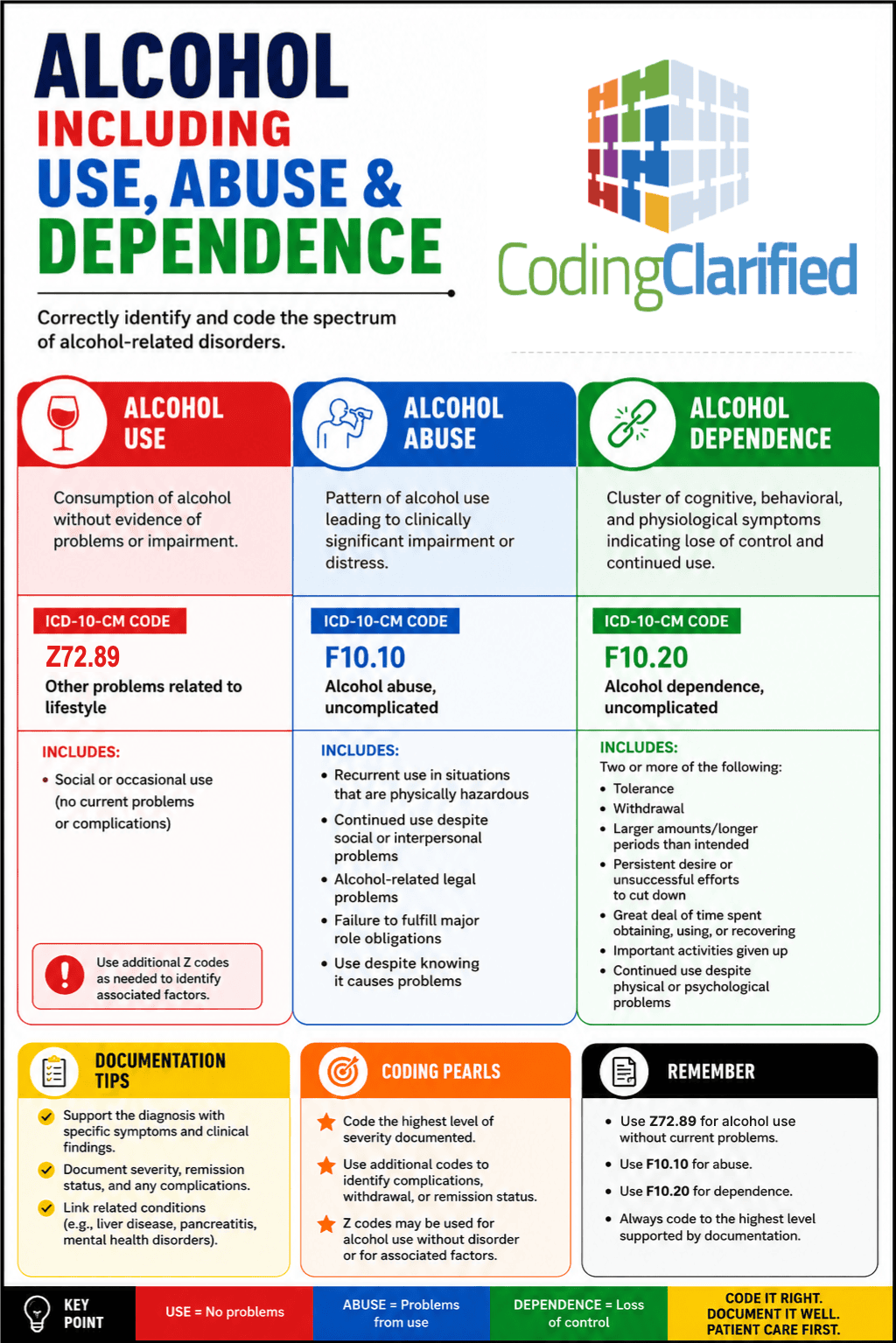
Most importantly, ICD-10-CM requires coders to follow the hierarchy:
Dependence overrides abuse. Abuse overrides use.
As a result, understanding these guidelines is critical for accurate coding, risk adjustment, reimbursement, and CPC exam success.
What Is the ICD-10 Code for Alcohol Use Disorder?
Specifically, coders find the ICD-10-CM codes for alcohol-related disorders in category F10 Alcohol-Related Disorders.
However, the specific code depends on the provider’s documentation regarding severity, complications, remission status, and associated conditions.
For example:
- Alcohol abuse → F10.10
- Alcohol dependence → F10.20
- Alcohol use, unspecified → F10.90
However, many encounters require additional specificity, particularly when intoxication, withdrawal, psychotic disorders, or mood disorders are documented.
What are the ICD-10-CM codes for alcohol use disorder? (FY2027 Reference Table)
For example, the following table includes commonly reported alcohol-related diagnosis codes used in outpatient, inpatient, emergency department, behavioral health, and substance abuse treatment settings.
| Code | Description |
|---|---|
| F10.10 | Alcohol abuse, uncomplicated |
| F10.11 | Alcohol abuse, in remission |
| F10.120, F10.121, F10.129 | Alcohol abuse with intoxication: uncomplicated, delirium, or unspecified |
| F10.130, F10.131, F10.132, F10.139 | Alcohol abuse with withdrawal: uncomplicated, delirium, perceptual disturbance, or unspecified |
| F10.14 | Alcohol abuse with alcohol-induced mood disorder |
| F10.150, F10.151, F10.159 | Alcohol abuse with alcohol-induced psychotic disorder: with delusions, with hallucinations, or unspecified |
| F10.20 | Alcohol dependence, uncomplicated |
| F10.21 | Alcohol dependence, in remission |
| F10.230, F10.231, F10.232, F10.239 | Alcohol dependence with withdrawal: uncomplicated, delirium, perceptual disturbance, or unspecified |
| F10.90 | Alcohol use, unspecified, uncomplicated |
| F10.20 | History of alcoholism or alcohol dependence with no remission documented (code as alcoholism) |
| Z81.1 | Family history of alcohol abuse and dependence |
Important: Always verify final code selection in the ICD-10-CM Tabular List because some categories require additional characters to identify intoxication severity, psychotic manifestations, or other alcohol-induced conditions.
What is the ICD-10 hierarchy rule for alcohol use, abuse and dependence?
One of the most tested ICD-10 concepts on certification exams, and one of the most common coding audit findings, is misuse of the alcohol use hierarchy.
How does the hierarchy work?
When multiple alcohol-related conditions are documented, coders should assign only the highest level of severity documented.
Rule 1
If both alcohol use and alcohol abuse are documented:
Code only alcohol abuse.
Rule 2
If both alcohol abuse and alcohol dependence are documented:
Code only alcohol dependence.
Rule 3
If both alcohol use and alcohol dependence are documented:
Code only alcohol dependence.
Rule 4
If alcohol use, abuse, and dependence are all documented:
Code only alcohol dependence.
Quick Reference
| Documentation | Code Selection |
| Use + Abuse | Abuse |
| Abuse + Dependence | Dependence |
| Use + Abuse + Dependence | Dependence |
| Use + Dependence | Dependence |
Consequently, assigning multiple F10 severity codes together is typically incorrect.
What is the difference between alcohol abuse and alcohol dependence?
Similarly, another area that causes confusion is distinguishing alcohol abuse from alcohol dependence.
Alcohol abuse
First, alcohol abuse generally reflects problematic alcohol consumption that negatively affects health, relationships, employment, or behavior.
Typical coding:
F10.10: Alcohol abuse, uncomplicated
Alcohol dependence
In contrast, alcohol dependence represents a more severe condition involving physical or psychological reliance on alcohol.
Common documentation includes:
- Alcoholism
- Chronic alcohol dependence
- Severe alcohol use disorder
- Alcohol addiction
Typical coding:
F10.20: Alcohol dependence, uncomplicated
Therefore, when dependence is documented, coders should not report an abuse code separately.
How do you code alcohol withdrawal?
Alcohol withdrawal is frequently seen in emergency departments, inpatient facilities, behavioral health units, and detoxification programs.
Common symptoms may include:
- Tremors
- Anxiety
- Sweating
- Hallucinations
- Seizures
- Delirium tremens
Coding options include:
- F10.13-: Alcohol abuse with withdrawal (requires a 6th character)
- F10.23-: Alcohol dependence with withdrawal (requires a 6th character)
Because withdrawal significantly increases clinical risk, these diagnoses often contribute to higher medical decision-making complexity.
How do you code alcohol intoxication and alcohol poisoning?
Providers frequently document acute alcohol intoxication during emergency department encounters.
Examples include:
- Acute alcohol intoxication
- Intoxicated on arrival
- Alcohol poisoning
- Acute ETOH intoxication
Intoxication codes require a 6th character: F10.120, F10.121 or F10.129 with abuse; F10.220, F10.221 or F10.229 with dependence; and F10.920, F10.921 or F10.929 with use. Alcohol poisoning is a different condition: it is coded to the toxic effect of ethanol, T51.0X- (for example, T51.0X1A for accidental poisoning, initial encounter), with an F10 code added when the provider documents abuse or dependence. If a blood alcohol level is documented, add a code from category Y90.
In these situations, coders should review the documentation carefully and select the most specific F10 intoxication code available.
Always verify required additional characters in the Tabular List before assigning a final code.
How do you code alcohol induced mental health conditions?
Alcohol use may contribute to psychiatric and behavioral health disorders.
Examples include:
- Alcohol-induced depression
- Alcohol-induced mood disorder
- Alcohol-induced psychosis
- Alcohol-induced hallucinations
Common categories include:
- F10.14: Alcohol abuse with alcohol-induced mood disorder
- F10.15-: Alcohol abuse with alcohol-induced psychotic disorder (F10.150, F10.151 or F10.159)
These diagnoses are particularly important in behavioral health and psychiatric coding.
How do you code alcohol use disorder in remission?
Remission status is frequently documented in primary care, behavioral health, and addiction medicine encounters.
Alcohol abuse in remission
F10.11: Alcohol abuse, in remission
Alcohol dependence in remission
F10.21: Alcohol dependence, in remission
Importantly, remission does not mean the condition has disappeared from the medical record.
Rather, it indicates that the disorder remains clinically relevant but is currently controlled.
Therefore, remission diagnoses continue to be reported using F10 codes.
How do you code a history of alcoholism?
Providers often document alcohol use disorder as a “history,” for example:
- History of alcoholism
- History of alcohol dependence
- Previous alcohol dependence
History of alcoholism without remission is coded as alcoholism. The Alphabetic Index directs alcoholism to F10.20, alcohol dependence, uncomplicated. Alcohol dependence is not treated as a resolved condition, so do not report a personal history Z code for it.
- No remission documented: F10.20, alcohol dependence, uncomplicated
- Remission documented (early or sustained): F10.21, alcohol dependence, in remission
- Alcohol abuse documented as in remission: F10.11, alcohol abuse, in remission
When the record is unclear about current status or remission, query the provider.
What is the code for a family history of alcohol abuse?
In addition, family history may influence treatment planning, screening, and risk assessment.
Use:
Z81.1: Family history of alcohol abuse and dependence
This code may be reported when a provider documents alcoholism among immediate family members.
How DSM-5 Severity Maps to ICD-10 Coding
Also, providers may document Alcohol Use Disorder (AUD) according to DSM-5 severity levels.
Generally:
| DSM-5 Severity | Typical ICD-10 Interpretation |
| Mild | Alcohol abuse (F10.10) |
| Moderate | Alcohol dependence (F10.20) |
| Severe | Alcohol dependence (F10.20) |
However, coders should never automatically convert DSM-5 terminology into ICD-10 codes without provider documentation supporting the diagnosis.
Therefore, always code directly from the documented diagnosis.
How Alcohol Use Disorder Affects E/M Coding Complexity
Furthermore, alcohol-related disorders frequently impact Evaluation and Management coding.
For example, alcohol dependence may:
- Increase patient risk
- Affect treatment planning
- Require medication management
- Increase monitoring requirements
- Impact social determinants of health
- Require counseling or behavioral interventions
Consequently, documentation of alcohol use disorder often contributes to Medical Decision Making (MDM) complexity.
For additional guidance, review:
Evaluation and Management (E/M) Guidelines for 2026: The Complete Guide
Medical Coding E/M Prolonged Services
Real-World Coding Tips for CPC Students
When coding alcohol-related diagnoses:
First, locate the condition in the Alphabetic Index.
Next, verify the code in the Tabular List.
Then, determine whether abuse, dependence, or use is documented.
Additionally, look for:
- Withdrawal
- Intoxication
- Mood disorders
- Psychotic disorders
- Remission status
Finally, apply the hierarchy rule before assigning the diagnosis code.
As a result, following this process can help prevent denials, audits, and certification exam errors.
What are the most common alcohol coding mistakes?
Many coders accidentally:
- Code abuse and dependence together
- Miss remission documentation
- Code a history of alcoholism to a personal history Z code instead of F10.20 (or F10.21 when remission is documented)
- Fail to identify withdrawal symptoms
- Ignore alcohol-induced psychiatric conditions
- Assign unspecified codes when more specific documentation exists
Therefore, careful documentation review is essential.
Coding Clarified Final Thoughts
Overall, alcohol use disorder coding remains one of the most frequently reported behavioral health diagnosis categories in ICD-10-CM.
By understanding:
- The F10 category
- Severity hierarchy rules
- Withdrawal coding
- Intoxication coding
- Remission coding
- History versus active conditions
You can improve coding accuracy, reimbursement, compliance, and CPC exam performance.
As we move through 2027, behavioral health coding continues to receive increased scrutiny from payers, auditors, and regulatory agencies. Therefore, selecting the most specific alcohol-related diagnosis code supported by provider documentation is more important than ever.
Frequently Asked Questions (FAQ)
Quick answers to the questions coders ask most about alcohol use disorder coding.
What is the ICD-10 code for alcohol use disorder?
Alcohol use disorder is typically reported using codes from category F10. Common examples include F10.10 (alcohol abuse) and F10.20 (alcohol dependence), depending on severity and provider documentation.
What is the difference between alcohol abuse and alcohol dependence in ICD-10?
First, alcohol abuse generally reflects problematic alcohol use, while alcohol dependence indicates a more severe disorder involving physical or psychological dependence. Dependence represents the higher level of severity.
How do you code alcohol use in remission?
Use:
- F10.11 for alcohol abuse in remission
- F10.21 for alcohol dependence in remission
Remission remains an active diagnosis and should not be coded as a history condition.
How do you code a history of alcoholism?
Code a history of alcoholism without documented remission as alcoholism, F10.20 (alcohol dependence, uncomplicated). When the provider documents remission, report F10.21. Do not use a personal history Z code such as Z87.898 for alcohol dependence.
Can you code both alcohol abuse and alcohol dependence at the same time?
No. ICD-10-CM hierarchy rules require coding only the highest documented level of severity. Dependence overrides abuse.
What codes are used for alcohol withdrawal symptoms?
Common codes include:
- F10.130 to F10.139: Alcohol abuse with withdrawal
- F10.230 to F10.239: Alcohol dependence with withdrawal
The correct code depends on the documented severity level.
How is moderate alcohol use disorder coded?
The ICD-10-CM Alphabetic Index directs moderate and severe alcohol use disorder to F10.20 (alcohol dependence), and mild alcohol use disorder to F10.10 (alcohol abuse). In remission, mild is F10.11 and moderate or severe is F10.21.
Is F10.13 a billable code?
No. Withdrawal codes require a 6th character: F10.130 to F10.139 with abuse and F10.230 to F10.239 with dependence.
How do you code alcohol poisoning?
Alcohol poisoning is coded to T51.0X- (toxic effect of ethanol) with the appropriate intent and 7th character, plus an F10 code when abuse or dependence is documented.
How does documented alcohol use disorder affect E/M coding complexity?
Alcohol use disorder may increase risk, treatment complexity, medication management, counseling requirements, and monitoring needs. Consequently, it can contribute to higher Medical Decision Making levels when appropriately documented.
Additional Resources
Authoritative References:
Related Coding Clarified Articles:
Mental Health Coding Medical Coding Reference Library
Medical Coding pain
Medical Decision Making
Ready to Learn Medical Coding?
Our comprehensive medical coding training program teaches:
- ICD-10-CM
- CPT
- HCPCS Level II
- Real-world chart coding
- CPC exam preparation
- Medical decision-making analysis
- Documentation review skills
Learn more at:
Ready to code like this for a living?
Coding Clarified’s AAPC licensed CPC program takes you from beginner to certified, with an internship and a job board for graduates.
You may qualify for WIOA funding in 30+ states. Check your eligibility.