Medical coding is one of today’s fastest-growing healthcare careers, but becoming an excellent medical coder takes much more than memorizing codes. Successful coders develop strong analytical skills, understand medical documentation, stay current with annual coding updates, and continually improve their knowledge.
Whether you’re preparing for the CPC® exam, starting your first coding job, or looking to sharpen your skills, following proven strategies can help you stand out from other coders.
This guide explains practical ways to excel in medical coding in 2026 while avoiding common mistakes that slow career growth.
Key Takeaways for Excelling in Medical Coding
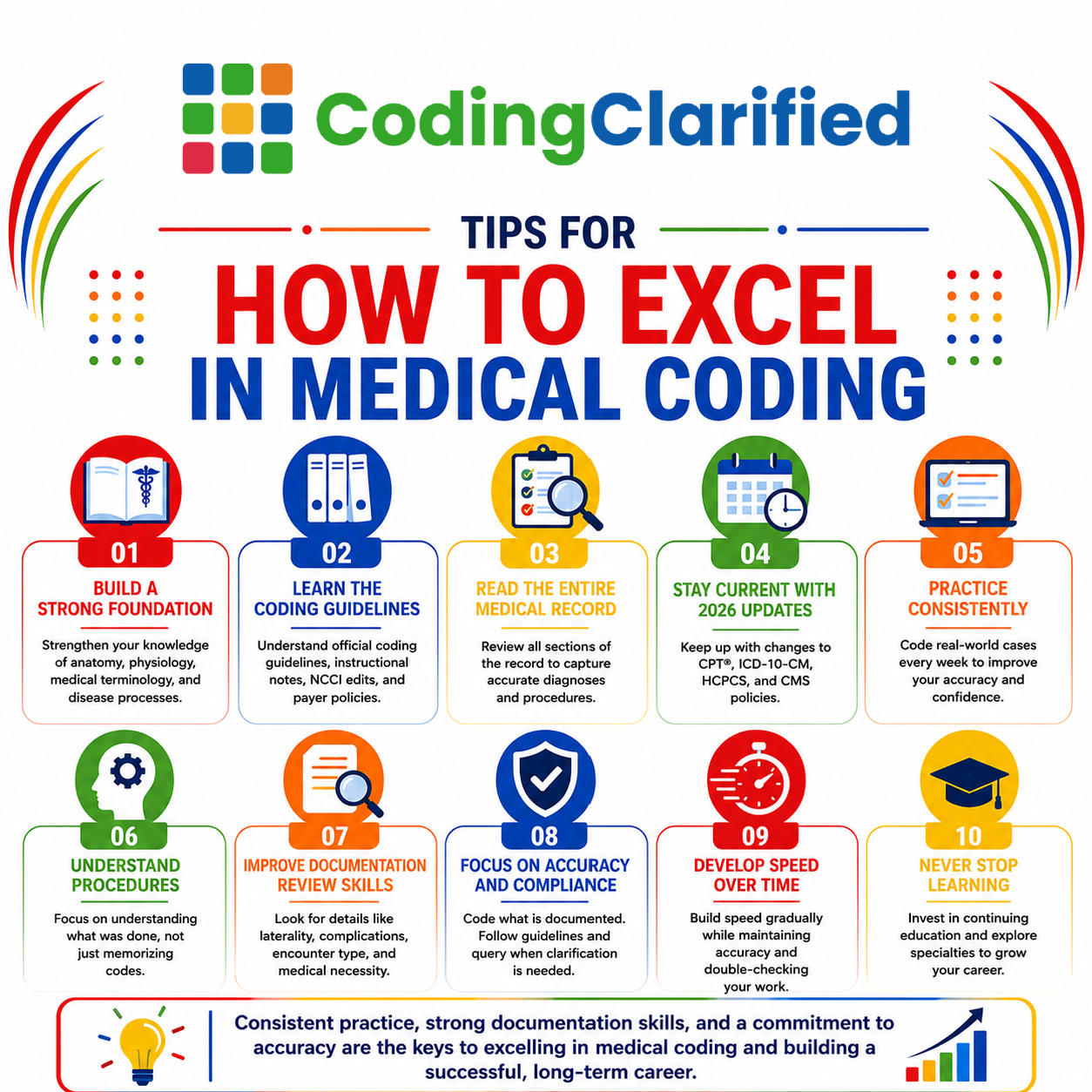
- Build a strong understanding of anatomy, physiology, and medical terminology.
- Learn coding guidelines before memorizing individual codes.
- Read the entire medical record before assigning codes.
- Stay current with the 2026 CPT®, ICD-10-CM, and HCPCS Level II updates.
- Practice coding real-world medical records every week.
- Improve documentation review skills—not just code lookup skills.
- Develop speed and accuracy together.
- Continue learning throughout your medical coding career.
Why Excelling in Medical Coding Matters in 2026
Healthcare continues to rely heavily on accurate medical coding. Every code affects reimbursement, quality reporting, compliance, healthcare analytics, and patient records.
Meanwhile, artificial intelligence has become more common in healthcare. However, AI still cannot replace experienced medical coders who understand physician documentation, payer guidelines, coding conventions, and medical necessity.
As a result, employers increasingly value coders who can think critically rather than simply search for codes.
The most successful coders understand why a code is assigned—not just where to find it.
Build a Strong Foundation in Medical Coding Before Learning Codes
Many new students immediately begin searching the CPT® or ICD-10-CM books for codes. Unfortunately, that approach often creates confusion because coding requires understanding the medical language first.
Instead, begin by strengthening your knowledge in these areas:
- Anatomy and physiology
- Medical terminology
- Disease processes
- Pharmacology basics
- Surgical procedures
- Diagnostic testing
Consequently, coding becomes much easier because you’ll understand what the provider actually performed.
For example, if you recognize the anatomy involved in a laparoscopic cholecystectomy, you’ll locate the correct CPT® code much faster than someone searching blindly through the index.
Learn Medical Coding Guidelines Before Looking Up Codes
One of the biggest differences between beginner coders and experienced professionals is their understanding of official coding guidelines.
The code itself is only one part of correct coding.
You must also understand:
- Official ICD-10-CM Guidelines for Coding and Reporting
- CPT® instructional notes
- HCPCS Level II guidance
- CMS National Correct Coding Initiative (NCCI) edits
- Medicare payment policies
- Payer-specific requirements
Therefore, always read the instructional notes surrounding a code before assigning it.
Skipping those notes often results in coding errors.
Become an Expert at Reading Medical Documentation
Experienced coders spend more time reviewing documentation than searching for codes.
Every chart tells a story.
Before assigning any code, carefully review:
- History
- Physical examination
- Assessment
- Plan
- Operative report
- Imaging reports
- Laboratory findings
- Physician documentation
Additionally, pay close attention to laterality, encounter type, complications, chronic conditions, and medical necessity.
The better you understand documentation, the more accurate your coding becomes.
Practice Coding Every Week
Medical coding is a skill that improves with repetition.
Reading textbooks alone will not prepare you for certification exams or real-world coding.
Instead, practice coding actual case studies regularly.
Good practice includes:
- Office visits
- Emergency department records
- Operative reports
- Hospital inpatient cases
- Radiology reports
- Pathology reports
- Evaluation and Management (E/M) services
Furthermore, review why each answer is correct instead of simply checking whether your code matched the answer key.
Learning from mistakes produces faster improvement than memorizing answers.
Master the CPT® Coding Book
Many new coders become overwhelmed by the CPT® manual.
Fortunately, the book follows a logical structure once you understand how it is organized.
Learn how to efficiently use:
- Index
- Guidelines
- Parenthetical notes
- Symbols
- Add-on codes
- Modifier instructions
- Category I codes
- Category II codes
- Category III codes
Rather than memorizing thousands of codes, focus on understanding how the CPT® manual is organized.
That strategy saves valuable time during both the CPC® exam and daily coding.
Don’t Memorize Codes—Understand Medical Coding Procedures
Excellent coders know what happened during the patient’s visit.
Average coders only know which code was selected.
For example, understanding how a colonoscopy differs from a sigmoidoscopy makes code selection much easier.
Likewise, recognizing the difference between diagnostic and therapeutic procedures improves coding accuracy.
Whenever possible, watch educational procedure videos, study anatomy illustrations, and review surgical descriptions.
Visual learning often makes complex procedures easier to understand.
Stay Current with 2026 Coding Updates
Medical coding changes every year.
Ignoring annual updates can quickly lead to outdated coding practices.
During 2026, continue reviewing changes to:
- CPT® codes
- ICD-10-CM diagnosis codes
- HCPCS Level II codes
- CMS reimbursement policies
- National Correct Coding Initiative edits
- Medicare Physician Fee Schedule updates
Even small revisions may affect code selection or documentation requirements.
Successful coders make continuing education part of their regular routine instead of waiting until certification renewal.
Improve Your Medical Coding Documentation Review Skills
Many coding errors begin long before the code assignment process.
Incomplete documentation often creates uncertainty.
Whenever documentation lacks necessary details, review the entire medical record before assuming information.
Look for clarification regarding:
- Laterality
- Specific diagnosis
- Acute versus chronic conditions
- Initial, subsequent, or sequela encounters
- Procedure approach
- Device placement
- Complications
- Medical necessity
Consequently, your coding accuracy improves while compliance risks decrease.
Learn Medical Coding Compliance
Compliance protects both healthcare providers and medical coders.
Never assign codes simply because they increase reimbursement.
Instead, assign codes that are fully supported by physician documentation.
Remember these basic principles:
- Code what is documented.
- Never code from assumptions.
- Follow official coding guidelines.
- Query providers appropriately when clarification is needed.
- Document coding rationale when necessary.
Ethical coding builds long-term credibility and protects both patients and healthcare organizations.
Develop Speed Without Sacrificing Accuracy
New coders often worry about speed.
However, accuracy should always come first.
As your experience grows, speed naturally improves.
Practice timing yourself while coding complete cases.
Next, review every answer carefully before moving to another record.
Eventually, you’ll develop efficient coding habits that increase productivity without increasing errors.
Use Reliable Medical Coding Resources
Successful coders know where to find trustworthy information.
Instead of relying on social media opinions alone, use authoritative resources whenever possible.
Helpful resources include:
- American Medical Association (AMA) CPT® guidance
- American Academy of Professional Coders (AAPC)
- Centers for Medicare & Medicaid Services (CMS)
- National Correct Coding Initiative (NCCI)
- Medicare Learning Network publications
These organizations publish official guidance that helps coders remain accurate and compliant.
Continue Learning Beyond Certification
Passing the CPC® exam is an important milestone, but it is only the beginning of your career.
Healthcare changes continuously.
New procedures, technologies, regulations, and payer policies appear every year.
Therefore, invest time in continuing education, specialty training, webinars, coding workshops, and professional networking.
The best coders never stop learning.
Common Medical Coding Mistakes to Avoid
Even experienced coders occasionally make mistakes. Fortunately, recognizing these common errors can help you avoid them early in your career.
- Coding directly from the index without verifying the code.
- Skipping CPT® or ICD-10-CM instructional notes.
- Failing to read the complete medical record.
- Assuming diagnoses that are not documented.
- Ignoring annual coding updates.
- Overlooking modifier requirements.
- Coding too quickly without reviewing your work.
- Depending solely on encoder software instead of understanding coding guidelines.
Avoiding these habits will improve both your coding accuracy and your confidence.
CPC Student Tips
If you’re studying for the CPC® exam, focus on building good habits now rather than rushing through practice questions.
Some of the best ways to prepare include:
- Practice coding a variety of real-world cases each week.
- Learn where guidelines are located in your coding books.
- Become familiar with CPT® symbols and instructional notes.
- Time yourself while completing practice exams.
- Review every incorrect answer to understand why it was wrong.
- Strengthen your anatomy and medical terminology knowledge alongside coding.
- Stay organized by creating a weekly study schedule.
Developing these skills before certification will make the transition into your first coding job much smoother.
Build Strong Communication Skills
Medical coding is not just about assigning codes. It also involves communicating clearly with providers, auditors, managers, and other healthcare professionals.
As you gain experience, you’ll likely need to:
- Explain coding decisions.
- Respond to coding audits.
- Submit provider queries.
- Discuss documentation improvement opportunities.
- Collaborate with billing and compliance teams.
Strong communication skills help reduce misunderstandings while supporting accurate reimbursement and compliance.
Explore a Medical Coding Specialty
Although many coders begin as generalists, developing expertise in a specialty can open additional career opportunities.
Popular specialties include:
- Cardiology
- Orthopedics
- Emergency Department
- Surgery
- Anesthesia
- Radiology
- Pathology and Laboratory
- Oncology
- Obstetrics and Gynecology
- Risk Adjustment (HCC)
- Home Health
- Behavioral Health
Specialization often improves your confidence because you become familiar with common diagnoses, procedures, and documentation patterns within a specific field.
Build Professional Confidence
Every experienced coder was once a beginner.
Instead of becoming discouraged by difficult charts, view each one as a learning opportunity.
Keep a notebook or digital file of coding scenarios that challenge you. Then, research the official guidelines and review the rationale behind the correct code assignment.
Over time, you’ll notice patterns that make similar cases easier to code.
Confidence grows through consistent practice—not perfection.
Prepare for Long-Term Career Growth
Medical coding offers many career paths beyond entry-level coding positions.
As your experience grows, you may pursue roles such as:
- Medical Coding Auditor
- Coding Educator
- Compliance Specialist
- Documentation Improvement (CDI) Specialist
- Risk Adjustment (HCC) Coder
- Coding Supervisor
- Revenue Cycle Analyst
- Medical Coding Consultant
Setting long-term goals can help you decide which certifications, specialties, and continuing education opportunities best support your career.
Why Employers Value Skilled Medical Coders
Healthcare employers look for more than certification alone.
They also value professionals who can:
- Think critically.
- Follow official coding guidelines.
- Interpret provider documentation accurately.
- Learn new coding updates quickly.
- Maintain compliance.
- Work independently.
- Communicate professionally.
- Meet productivity goals without sacrificing quality.
Developing these qualities can help you stand out during interviews and throughout your career.
Related Coding Clarified Resources
Continue building your coding knowledge with these helpful guides from Coding Clarified:
- Medical Coding: Outlook for 2026 and Beyond
- How to Get Your First Medical Coding Job in 2026
- Medical Coding Resume Tips for 2026 | Get More Interviews
- What Coding Clarified School Resources Can Help You Become A CPC Medical Coder
- E/M Evaluation and Management (E/M) Guidelines for 2026: The Complete Guide
- About Coding Clarified
These articles provide practical guidance on certification, coding accuracy, specialty coding, and career development.
Authoritative Resources
Stay current with official coding guidance by using trusted industry resources.
- American Academy of Professional Coders (AAPC)
- Centers for Medicare & Medicaid Services (CMS)
- National Correct Coding Initiative (NCCI)
- ICD-10-CM Official Guidelines for Coding and Reporting
- American Medical Association CPT Resources
Frequently Asked Questions About Medical Coding
Here are quick answers to the questions medical coders ask most often about excelling in this career.
How can I become better at medical coding?
Practice consistently, strengthen your anatomy and medical terminology knowledge, read the complete medical record, and follow the official coding guidelines. Additionally, review your mistakes so you understand the reasoning behind the correct answer.
Is the CPC® certification enough to get a medical coding job?
The CPC® certification is highly respected, but employers also look for practical coding skills, documentation review abilities, and familiarity with current coding guidelines. Gaining experience through case studies, internships, apprenticeships, or Practicode can improve your job prospects.
How often do medical coding guidelines change?
Coding updates occur every year. New CPT®, ICD-10-CM, and HCPCS Level II codes typically become effective annually, while CMS and payer guidance may change throughout the year. Successful coders regularly review these updates.
Should I memorize CPT® and ICD-10-CM codes?
No. Instead of memorizing thousands of codes, focus on understanding coding guidelines, medical terminology, anatomy, and documentation. Knowing how to locate and verify codes accurately is much more valuable.
What skills do employers want in medical coders?
Most employers seek coders who demonstrate accuracy, attention to detail, critical thinking, ethical decision-making, communication skills, and a commitment to continuing education.
How can I improve my coding speed?
Start by focusing on accuracy. As you gain experience, you’ll naturally become faster. Practicing complete coding cases while using your coding manuals efficiently can improve both speed and confidence.
What is the biggest mistake new medical coders make?
One of the most common mistakes is assigning codes before reading the entire medical record. Another frequent error is overlooking official coding guidelines and instructional notes that directly affect code selection.
Coding Clarified Final Thoughts
Excelling in medical coding is a journey built on continuous learning, attention to detail, and a commitment to accuracy. While certification is an important milestone, your long-term success depends on how well you interpret medical documentation, apply official coding guidelines, and adapt to annual coding updates.
As healthcare continues to evolve throughout 2026, skilled medical coders remain essential to accurate reimbursement, compliance, and high-quality patient care. By practicing regularly, strengthening your clinical knowledge, and staying current with industry changes, you can build a rewarding and successful career in medical coding.
Whether you’re preparing for the CPC® exam or advancing into a specialty such as HCC, surgery, or emergency department coding, the habits you develop today will shape your success tomorrow. Keep learning, ask questions, and never stop refining your skills—the investment you make in yourself will pay dividends throughout your coding career.