
AHIMA CCA & CCS Exam Tips: The Ultimate 2026 Guide to Passing Your Medical Coding Certification Exam
These CCA and CCS exam tips will help you prepare for AHIMA certification with confidence. Preparing for an AHIMA website certification exam can feel overwhelming at first. However, with the right strategy, study plan, and test-taking techniques, passing the Certified Coding Associate (CCA) or Certified Coding Specialist (CCS) exam becomes much more achievable.
Understanding CCA and CCS Exam Tips
Whether you are just beginning your medical coding journey or advancing toward inpatient coding specialization, understanding how to prepare effectively is critical. Furthermore, learning how the exams are structured can help reduce anxiety and improve confidence on exam day.
In this comprehensive guide, you will learn:
- The differences between the CCA and CCS exams
- The best study methods for AHIMA credentials
- Proven exam-day strategies
- Time management techniques
- Common mistakes to avoid
- Important coding guidelines to review
- How to think like a coder instead of memorizing answers
What Is the Difference Between the AHIMA CCA and CCS Credentials?
Before studying, it is important to understand the purpose of each credential.
AHIMA CCA (Certified Coding Associate)
The American Health Information Management Association CCA credential is considered an entry-level coding certification. Therefore, it is ideal for students and new coders entering the healthcare industry.
The CCA exam focuses on:
- ICD-10-CM diagnosis coding
- CPT procedural coding
- HCPCS Level II coding
- Basic reimbursement concepts
- Medical terminology
- Anatomy and physiology
- Coding compliance and ethics
Additionally, the exam evaluates whether students understand foundational coding concepts and can apply official coding guidelines.
AHIMA CCS (Certified Coding Specialist)
The CCS credential, on the other hand, is considered an advanced-level certification. In contrast to the CCA, the CCS exam emphasizes deeper coding knowledge and more complex inpatient coding scenarios.
The CCS exam focuses heavily on:
- Inpatient hospital coding
- ICD-10-PCS procedure coding
- Complex ICD-10-CM guideline application
- DRG assignment concepts
- Coding sequencing rules
- Clinical documentation interpretation
- Advanced reimbursement methodologies
Because of this, many employers view the CCS credential as a strong indicator of advanced coding proficiency.
CCA Requirements and Cost
| Exam detail | CCA | CCS |
|---|---|---|
| Level | Entry level | Advanced, facility focused |
| Questions | 105 (90 scored, 15 pretest) | 107 (97 scored, 10 pretest) |
| Time | 2 hours | 4 hours |
| Passing score | 300 | 300 |
| Exam fee | $199 members, $299 nonmembers | $299 members, $399 nonmembers |
| Eligibility | High school diploma required; AHIMA recommends six months of coding experience or a coding program | AHIMA recommends coursework plus a year of experience, or two years of experience |
AHIMA sets and changes these details, so confirm them on the AHIMA CCA page and our CCS certification guide before you apply.
CCA vs. CPC vs. CCS
| CCA (AHIMA) | CPC (AAPC) | CCS (AHIMA) | |
|---|---|---|---|
| Who it is for | New coders, mostly hospital settings | New coders, physician and outpatient settings | Experienced facility coders |
| Code sets | ICD-10-CM, CPT, HCPCS Level II | ICD-10-CM, CPT, HCPCS Level II | Adds ICD-10-PCS for inpatient |
| Employer recognition | Known, but less requested | The most requested coding credential | Highly valued for inpatient roles |
Is the CCA Worth Taking First?
The CCA can be a good start if you want to work in a hospital and plan to move up to the CCS. For most new coders, though, the CPC opens more doors, because it is the credential most entry level and remote job postings name. The CCA also has a lower career ceiling. Many employers treat it as a stepping stone and expect you to add the CCS or another credential as you grow.
Our online, instructor-guided program prepares you for the CPC. Compare every option in our medical coding certifications guide.
Why AHIMA Certifications Matter in Medical Coding
Earning an AHIMA credential can significantly improve your career opportunities. In fact, many employers specifically require or prefer nationally recognized certifications when hiring coders.
Moreover, AHIMA certifications demonstrate:
- Coding competency
- Understanding of official guidelines
- Commitment to professional development
- Readiness for healthcare documentation analysis
- Knowledge of reimbursement methodologies
As healthcare regulations continue evolving, certified coders remain highly valuable in hospitals, physician offices, outpatient facilities, and remote coding environments.
The Biggest Mistake Students Make While Studying
One of the most common mistakes students make is attempting to memorize answers instead of understanding coding logic.
Unfortunately, memorization alone usually fails on certification exams because coding scenarios frequently change wording, sequencing, and documentation details.
Instead, successful students:
- Learn how to locate information in coding manuals
- Understand guideline hierarchy
- Practice interpreting provider documentation
- Apply coding rules step-by-step
- Learn why codes are assigned
Consequently, strong critical thinking skills often matter more than pure memorization.
Best Study Tips for the AHIMA CCA & CCS Exams
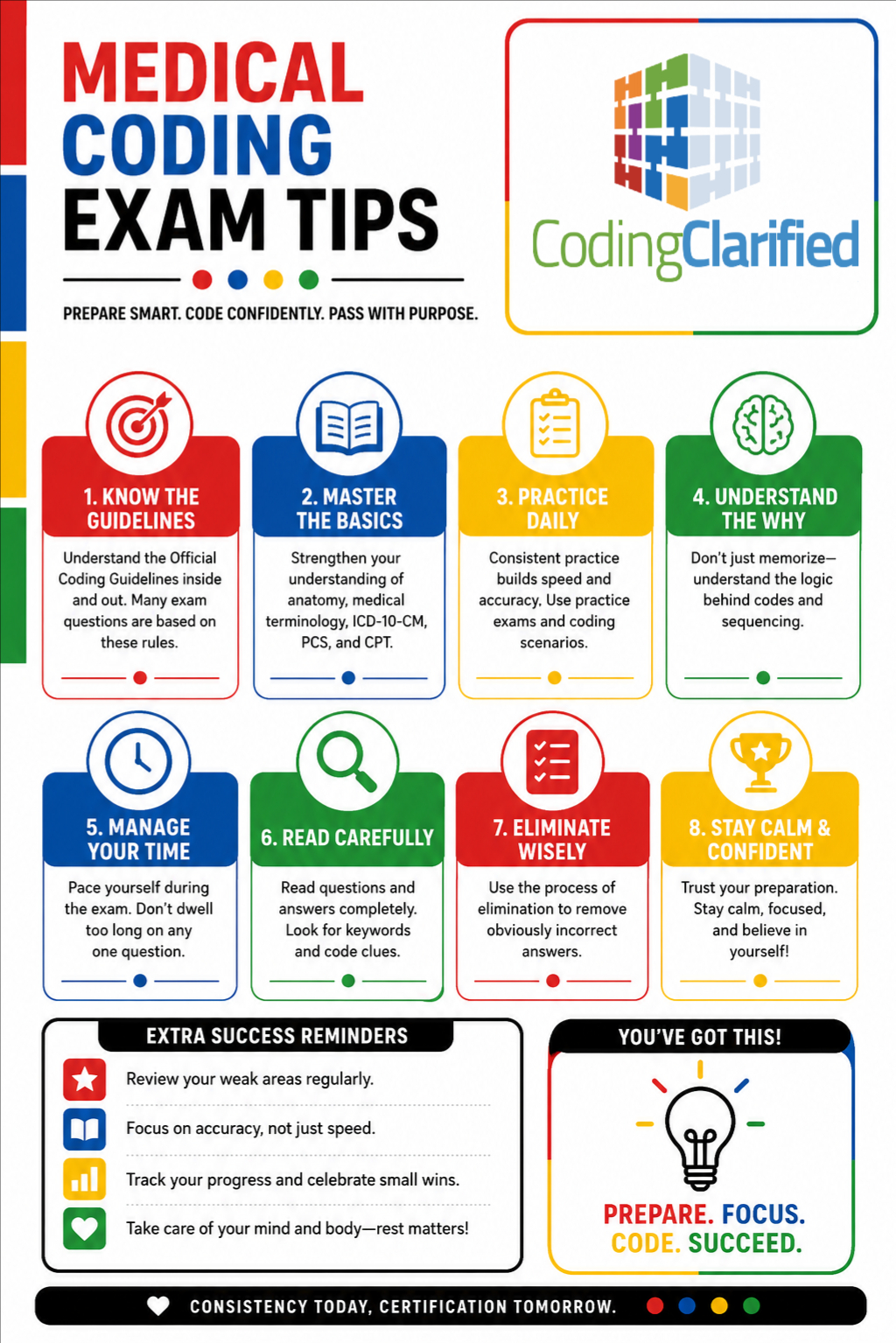
1. Focus on Official Coding Guidelines First
Before memorizing codes, students should thoroughly understand:
- ICD-10-CM Official Guidelines
- ICD-10-PCS conventions
- CPT coding instructions
- HCPCS Level II rules
Additionally, many exam questions test guideline application rather than direct code recall.
Therefore, students who ignore guidelines often struggle with tricky exam questions.
2. Learn How to Use the Coding Manuals Efficiently
Many students waste valuable exam time flipping through coding books inefficiently.
Instead, practice:
- Using the alphabetic index first
- Verifying codes in the tabular section
- Reading instructional notes carefully
- Watching for “code first” and “use additional code” notes
- Identifying Excludes 1 and Excludes 2 notes
Furthermore, becoming faster with manual navigation improves both confidence and time management.
Important ICD-10-CM Areas to Review
Students preparing for either credential should spend additional time reviewing:
- Diabetes coding
- Hypertension guidelines
- Sepsis sequencing
- Obstetric coding
- Injury coding
- Poisoning versus adverse effects
- Neoplasm coding
- Combination codes
- Manifestation coding
Additionally, understanding laterality and documentation specificity is essential for exam success.
CCS Students Must Master ICD-10-PCS
The CCS exam places heavy emphasis on ICD-10-PCS coding. Therefore, students should dedicate significant study time to PCS root operations.
Important root operations include:
- Excision
- Resection
- Drainage
- Replacement
- Bypass
- Fusion
- Revision
- Supplement
Moreover, students should learn:
- Body system values
- Approach values
- Device characters
- Qualifier definitions
Because PCS coding is logic-based, understanding terminology is far more important than memorization.
Time Management Tips for Exam Day
Time management is one of the biggest factors affecting exam performance.
Therefore, consider the following strategies:
Answer Easy Questions First
Rather than spending excessive time on one difficult question, answer easier questions first. Then, return to challenging scenarios later.
As a result, you avoid losing valuable time early in the exam.
Avoid Overthinking
Many students change correct answers because they second-guess themselves.
However, your first instinct is often correct if:
- You followed the guidelines
- You reviewed the documentation carefully
- You verified the code properly
Therefore, avoid changing answers without a strong coding rationale.
Watch the Clock Frequently
Additionally, monitor your pace throughout the exam.
A good strategy includes:
- Checking progress every 20–30 questions
- Flagging lengthy cases
- Returning later to difficult scenarios
Consequently, this prevents running out of time near the end.
How to Improve Coding Speed
Coding speed improves through repetition and consistent practice.
Therefore, students should:
- Complete practice cases daily
- Time themselves regularly
- Practice both inpatient and outpatient scenarios
- Review rationales for incorrect answers
- Analyze documentation carefully
Furthermore, coding speed develops naturally when students truly understand coding logic.
Common AHIMA Exam Traps
Ignoring Key Documentation Words
Words such as:
- “suspected”
- “probable”
- “history of”
- “acute”
- “chronic”
- “initial encounter”
- “subsequent encounter”
can completely change code assignment.
Therefore, reading carefully is critical.
Missing Instructional Notes
Students frequently overlook:
- Includes notes
- Excludes notes
- Code first notes
- Additional code instructions
However, these notes often determine the correct answer.
Coding Directly From Memory
Even experienced coders should verify codes in the tabular section.
Otherwise, students risk:
- Missing laterality
- Selecting invalid codes
- Ignoring instructional notes
- Choosing outdated code options
Consequently, verification is essential.
Best Resources for AHIMA Exam Preparation
Strong exam preparation often includes multiple resources.
Helpful study tools include:
- AHIMA practice exams
- Coding manuals
- Coding workbooks
- Online coding scenarios
- Anatomy and physiology review
- Medical terminology review
- Coding guideline drills
Additionally, practicing real-world coding cases helps students develop stronger critical-thinking skills.
Mental Preparation Is Equally Important
Many students underestimate the mental side of exam preparation. However, confidence and focus matter significantly during long certification exams.
Therefore:
- Sleep well before exam day
- Avoid last-minute cramming
- Eat before the exam
- Arrive early
- Stay calm during difficult questions
Moreover, remember that difficult questions appear challenging for everyone, not just you.
CPC Students Transitioning to AHIMA Exams
Students coming from a CPC-style background often notice differences between AAPC and AHIMA exams.
For example:
- AHIMA exams often emphasize inpatient coding more heavily
- CCS focuses significantly on ICD-10-PCS
- Clinical interpretation is more detailed
- Documentation analysis is deeper
Therefore, students transitioning from CPC preparation should strengthen inpatient coding skills and PCS understanding.
Final Exam-Day Checklist
Before your exam, make sure you:
- Understand official coding guidelines
- Practice coding cases regularly
- Know how to navigate coding manuals quickly
- Review anatomy and medical terminology
- Understand sequencing rules
- Practice time management
- Review ICD-10-PCS root operations for CCS
- Sleep adequately the night before
Most importantly, remember that certification exams are designed to test coding logic and guideline application, not perfect memorization.
Final Thoughts
Passing the AHIMA CCA or CCS exam requires more than simply memorizing codes. Instead, successful students learn how to analyze documentation, apply coding guidelines, and think critically under pressure.
Furthermore, consistent practice, strong manual navigation skills, and understanding coding rationale can dramatically improve exam performance.
Although the exams can be challenging, proper preparation makes success entirely possible. Therefore, focus on understanding the “why” behind coding decisions, continue practicing realistic scenarios, and trust the skills you develop throughout your studies.
With persistence, preparation, and strategic studying, you can successfully earn your AHIMA credential and move forward confidently in your medical coding career.
CCA Certification FAQs
How much does the CCA exam cost?
AHIMA charges $199 for members and $299 for nonmembers. Retakes cost the same as the exam.
How long is the CCA exam?
2 hours for 105 questions, 90 scored and 15 unscored pretest items. The passing score is 300.
Is the CCA or CPC better for a new coder?
For most new coders, the CPC. It is the most requested credential in entry level job postings. The CCA fits best if you plan a hospital career and will add the CCS later.
Do I need experience for the CCA?
You need a high school diploma. AHIMA recommends six months of coding experience or a coding training program, but these are recommendations.