Inpatient Medical Coding Guidelines 2026: ICD-10-CM, ICD-10-PCS, DRGs, Principal Diagnosis & Hospital Coding Guide
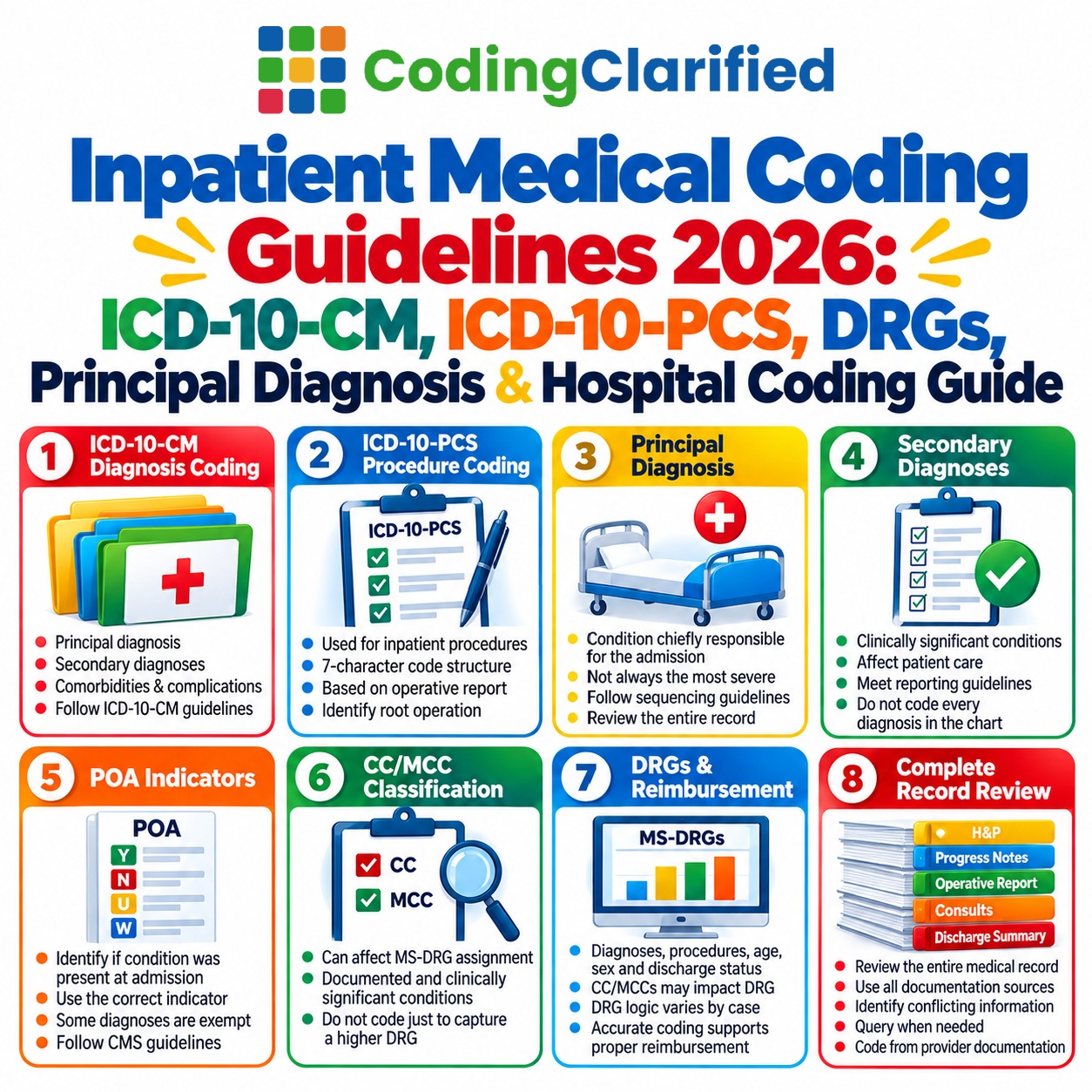
Medical coding for inpatient hospital stays requires a different set of skills than physician-office or outpatient coding. In 2026, inpatient coders must understand ICD-10-CM diagnosis coding, ICD-10-PCS procedure coding, principal diagnosis selection, secondary diagnoses, Present on Admission (POA) indicators, CC/MCC classification, and Medicare Severity Diagnosis Related Groups (MS-DRGs).
Additionally, inpatient coders must review the entire hospital record rather than simply coding from the discharge summary. One missed diagnosis, incorrectly selected principal diagnosis, or wrong ICD-10-PCS root operation can affect the final DRG and hospital reimbursement.
You may also find our article on what an MCC is in medical coding helpful.
This 2026 inpatient medical coding guide explains the process step by step, including important FY 2027 updates taking effect October 1, 2026.
Key Takeaways: Inpatient Medical Coding in 2026
- Inpatient facility coders primarily use ICD-10-CM for diagnoses and ICD-10-PCS for reportable inpatient procedures.
- CPT® is generally not used by hospitals to report inpatient facility procedures under the IPPS. However, physicians and other professionals may separately report their professional services with CPT®/HCPCS codes.
- The principal diagnosis is the condition established after study to be chiefly responsible for the hospital admission.
- Certain uncertain diagnoses documented at discharge, such as “probable,” “suspected,” “likely,” and “possible,” may be coded as if they exist in qualifying inpatient settings.
- Secondary diagnoses should meet applicable reporting criteria; coders should not automatically report every condition appearing anywhere in the chart.
- CCs and MCCs can affect MS-DRG assignment, although the impact depends on the specific DRG logic.
- POA indicators identify whether certain diagnoses were present when the inpatient admission occurred.
- FY 2027 ICD-10-CM, ICD-10-PCS, and MS-DRG updates become effective October 1, 2026.
- Accurate inpatient coding requires complete record review, strong guideline knowledge, and careful ICD-10-PCS analysis.
What Is Inpatient Medical Coding?
Inpatient medical coding is the process of translating diagnoses and procedures from a hospital inpatient stay into standardized medical codes.
Unlike many physician-office encounters, inpatient cases may involve several days or weeks of documentation. Therefore, coders may review emergency department notes, history and physical reports, progress notes, consultations, operative reports, pathology reports, diagnostic studies, medication records, discharge documentation, and other parts of the medical record.
The goal is not simply to find as many diagnoses as possible. Instead, the coder must determine which conditions and procedures meet official reporting requirements and how they affect the inpatient claim.
For Medicare acute-care hospitals paid under the Inpatient Prospective Payment System (IPPS), reported diagnoses, procedures, patient demographics, and other factors help determine the MS-DRG assigned to the stay.
ICD-10-CM vs. ICD-10-PCS in Inpatient Coding
One of the first concepts new inpatient coders must understand is the difference between ICD-10-CM and ICD-10-PCS.
ICD-10-CM for Inpatient Diagnoses
Hospitals use ICD-10-CM to report diagnoses.
These may include:
- Principal diagnosis
- Secondary diagnoses
- Complications
- Comorbidities
- Acute conditions
- Chronic conditions
- Injuries
- Poisonings
- Certain symptoms when reportable
- External causes when applicable
However, finding a diagnosis in the medical record does not automatically mean it should appear on the inpatient claim. Coders must apply the ICD-10-CM Official Guidelines for Coding and Reporting and the Uniform Hospital Discharge Data Set (UHDDS) definitions when appropriate.
For additional diagnosis coding guidance, review our guide to ICD-10-CM coding steps.
ICD-10-PCS for Inpatient Procedures
ICD-10-PCS is used for procedure coding in the hospital inpatient facility setting.
Each ICD-10-PCS code contains seven characters. Depending on the section, those characters identify details such as:
- Section
- Body system
- Root operation
- Body part
- Approach
- Device
- Qualifier
Consequently, coders cannot select an ICD-10-PCS code based only on the procedure name written by the physician. They must analyze what the provider actually performed.
For example, terms such as excision, resection, extraction, drainage, insertion, replacement, and removal have specific meanings within ICD-10-PCS.
Is CPT Used for Inpatient Hospital Coding?
This question causes confusion for many CPC students.
For inpatient facility procedure coding, hospitals generally use ICD-10-PCS rather than CPT® to report procedures under IPPS.
However, that does not mean CPT® disappears simply because a patient has been admitted.
Physicians and other qualified healthcare professionals may separately report their professional services using CPT® and HCPCS Level II codes when applicable. Therefore, the same hospital stay can involve ICD-10-PCS coding on the facility side and CPT® coding on the professional side.
This distinction is especially important for students moving from physician-based coding into inpatient facility coding.
How Do You Select the Principal Diagnosis?
Principal diagnosis selection is one of the most important skills in inpatient coding.
The principal diagnosis is generally the condition established after study to be chiefly responsible for occasioning the patient’s admission to the hospital for care.
Notice that this definition does not simply mean:
- The first diagnosis listed
- The most expensive condition
- The most severe condition
- The condition with the highest-paying DRG
- The first problem mentioned in the emergency department
- The diagnosis that required the most treatment
Instead, coders must review the circumstances of admission and apply the Official Guidelines for Coding and Reporting.
For example, a patient may arrive with shortness of breath, fever, and weakness. After study, the physician may determine that bacterial pneumonia caused the symptoms and required the inpatient admission. Depending on the complete documentation and applicable guidelines, the pneumonia may become the principal diagnosis rather than the presenting symptoms.
Therefore, always determine the condition established after study before assigning the principal diagnosis.
Secondary Diagnoses: Do Not Code Everything in the Chart
Inpatient charts can contain long problem lists. Nevertheless, coders should not automatically report every diagnosis found in the EHR.
Secondary diagnoses generally include clinically significant conditions that affect patient care during the hospitalization through factors such as:
- Clinical evaluation
- Therapeutic treatment
- Diagnostic procedures
- Extended length of stay
- Increased nursing care or monitoring
Additionally, certain conditions may require reporting because of specific coding guidelines.
A historical diagnosis copied into every progress note does not automatically qualify as a reportable secondary diagnosis. Likewise, a condition on the problem list may not qualify when the current admission provides no evidence that it affected care.
This is one reason medical record abstraction skills are so important for hospital coders.
CCs, MCCs, and MS-DRGs Explained
For Medicare inpatient hospital claims under IPPS, the MS-DRG system groups cases with similar clinical characteristics and expected resource use.
The MS-DRG assignment may consider factors including:
- Principal diagnosis
- Secondary diagnoses
- ICD-10-PCS procedures
- Age
- Sex
- Discharge status
- Presence of qualifying complications or comorbidities
Some secondary diagnoses may be classified as a CC, or complication/comorbidity. Others may qualify as an MCC, or major complication/comorbidity.
However, coders should never search the chart simply to “find an MCC.”
Every reported diagnosis must be supported by documentation and meet applicable coding and reporting requirements. Furthermore, a CC or MCC does not automatically change every MS-DRG because grouper logic varies.
Learn more in our guide to medical coding and DRGs.
2026 and FY 2027 Inpatient Coding Updates
Inpatient coders need to pay close attention to the October 1 update cycle.
CMS released the FY 2027 ICD-10-CM and ICD-10-PCS files for use beginning October 1, 2026. Therefore, coders must select the code set based on the applicable date and official reporting rules rather than assuming that “2026” always means one code book.
CMS also updated the Medicare Severity DRG system for FY 2027. Version 44 applies beginning October 1, 2026.
As a result, inpatient coding teams should update:
- ICD-10-CM resources
- ICD-10-PCS resources
- Coding software
- Encoder and grouper systems
- MS-DRG references
- Medicare Code Editor resources
- Facility coding policies
- CDI education
- Internal auditing tools
In addition, coders should review new, revised, and deleted codes before the effective date rather than waiting until October claims reach their work queues.
Present on Admission (POA) Indicators
POA reporting is another major difference between inpatient and many outpatient coding workflows.
The Present on Admission indicator helps identify whether a condition existed at the time the order for inpatient admission occurred.
Depending on the situation, POA reporting may use indicators such as:
- Y — Present at the time of inpatient admission
- N — Not present at the time of inpatient admission
- U — Documentation is insufficient to determine whether the condition was present
- W — Provider cannot clinically determine whether the condition was present at admission
Certain diagnoses are exempt from POA reporting.
Therefore, coders should never guess the POA status. When documentation does not clearly support the correct assignment, review the applicable guidelines and facility query policy.
Coding Uncertain Diagnoses in the Inpatient Setting
One of the biggest differences between inpatient and outpatient diagnosis coding involves uncertain diagnoses.
For qualifying inpatient admissions, diagnoses documented at discharge as probable, suspected, likely, questionable, possible, still to be ruled out, compatible with, consistent with, or similar terms indicating uncertainty may generally be coded as though the condition exists.
However, this guideline does not apply universally to every healthcare setting.
Outpatient coding follows different rules. Therefore, CPC students should learn to identify the setting before deciding how to code uncertain diagnoses.
Also, coders must base the assignment on documentation available at the time of discharge and follow the current Official Guidelines.
Signs and Symptoms in Inpatient Coding
Another common misconception is that signs and symptoms can never be coded when a definitive diagnosis exists.
That rule is too broad.
Signs and symptoms routinely associated with a confirmed diagnosis generally should not be coded separately unless guidelines instruct otherwise. In contrast, signs or symptoms that are not routinely associated with the definitive diagnosis may sometimes be reported separately when they meet reporting requirements.
Therefore, coders should not automatically delete every symptom after identifying a definitive diagnosis.
Instead, determine whether the symptom is integral to the condition and whether official guidelines support separate reporting.
The Importance of Complete Medical Record Review
A discharge summary provides valuable information, but inpatient coding should not rely on that document alone.
Coders may need to review:
- History and physical
- Emergency department documentation
- Progress notes
- Consultation reports
- Operative reports
- Procedure notes
- Pathology reports
- Imaging reports
- Medication records
- Nursing documentation
- Discharge summary
Additionally, conflicting documentation may require further review or a compliant provider query.
Modern EHR systems can make this process harder because copied-forward information, old diagnoses, templates, and automated text may appear throughout the chart.
For more help with this skill, read our Medical Record Abstraction in 2026 guide.
Clinical Documentation Integrity and Provider Queries
Coders should code from provider documentation rather than make independent clinical diagnoses.
For example, a coder may notice laboratory values that appear consistent with a condition. Nevertheless, the coder cannot simply diagnose the patient and assign the corresponding code.
When documentation is unclear, conflicting, incomplete, or clinically inconsistent, a compliant provider query may be appropriate.
Common query opportunities can involve:
- Diagnosis specificity
- Cause-and-effect relationships
- Acute versus chronic conditions
- Postoperative complications
- Conflicting diagnoses
- Procedure details
- ICD-10-PCS root operations
- POA status
- Clinical significance of documented findings
However, queries must remain compliant and should not improperly lead the provider toward a diagnosis solely because it produces a higher-paying DRG.
AI and Computer-Assisted Coding in 2026
Artificial intelligence and computer-assisted coding continue to change hospital coding workflows in 2026.
AI tools may help identify possible diagnoses, procedures, documentation conflicts, missing specificity, or potential codes. Additionally, encoders can make searching large code sets much faster.
Still, technology does not replace coding judgment.
Coders must verify suggestions against:
- Provider documentation
- ICD-10-CM guidelines
- ICD-10-PCS guidelines
- Coding Clinic guidance when applicable
- Payer requirements
- Facility policy
- Official code sets
Therefore, never assume that a suggested code is correct simply because an encoder or AI tool generated it.
Common Inpatient Medical Coding Mistakes to Avoid
1. Confusing Principal Diagnosis With the Most Serious Diagnosis
The most severe condition is not automatically the principal diagnosis. Instead, apply the principal diagnosis definition and sequencing guidelines.
2. Coding Every Diagnosis on the Problem List
Problem lists often contain old or inactive conditions. Therefore, determine whether each secondary diagnosis meets reporting requirements.
3. Using CPT® Instead of ICD-10-PCS for Inpatient Facility Procedures
CPT® and ICD-10-PCS serve different purposes. Consequently, always identify whether you are coding the facility claim or professional services.
4. Selecting an ICD-10-PCS Code From the Procedure Title Alone
Procedure names do not always match PCS definitions. Instead, read the operative report and determine the objective of the procedure.
5. Automatically Coding Every Symptom
Some symptoms are integral to a definitive diagnosis. However, other symptoms may qualify for separate reporting, so apply the guidelines rather than using an all-or-nothing rule.
6. Coding From Lab Results Instead of Provider Documentation
Coders cannot independently diagnose a condition from laboratory or imaging findings. Therefore, query when appropriate rather than making a clinical assumption.
7. Chasing CCs and MCCs
A higher-paying DRG never justifies unsupported coding. Instead, code the record accurately and allow the documented clinical picture to drive the result.
8. Ignoring POA Status
Incorrect POA reporting can create compliance and reimbursement problems. Therefore, review documentation carefully and follow current POA guidance.
CPC Student Tips for Learning Inpatient Coding
CPC students often find inpatient coding challenging because CPC training focuses heavily on physician-based services and CPT®.
First, master ICD-10-CM diagnosis coding. Strong diagnosis coding skills create the foundation for understanding principal diagnosis selection and sequencing.
Next, learn that ICD-10-PCS is not CPT®. Rather than memorizing procedure codes, learn the seven-character structure and become comfortable identifying root operations.
Additionally, practice reading operative reports. Ask yourself:
- What was the objective of the procedure?
- What body part was involved?
- What approach did the physician use?
- Was a device left in place?
- Is a qualifier required?
Finally, do not confuse CPC® and inpatient coding credentials. AAPC’s Certified Professional Coder (CPC®) credential focuses primarily on physician-office coding, while its Certified Inpatient Coder (CIC®) credential focuses on inpatient facility coding.
Students considering a coding career can also review our AAPC CPC Certification Guide for 2026.
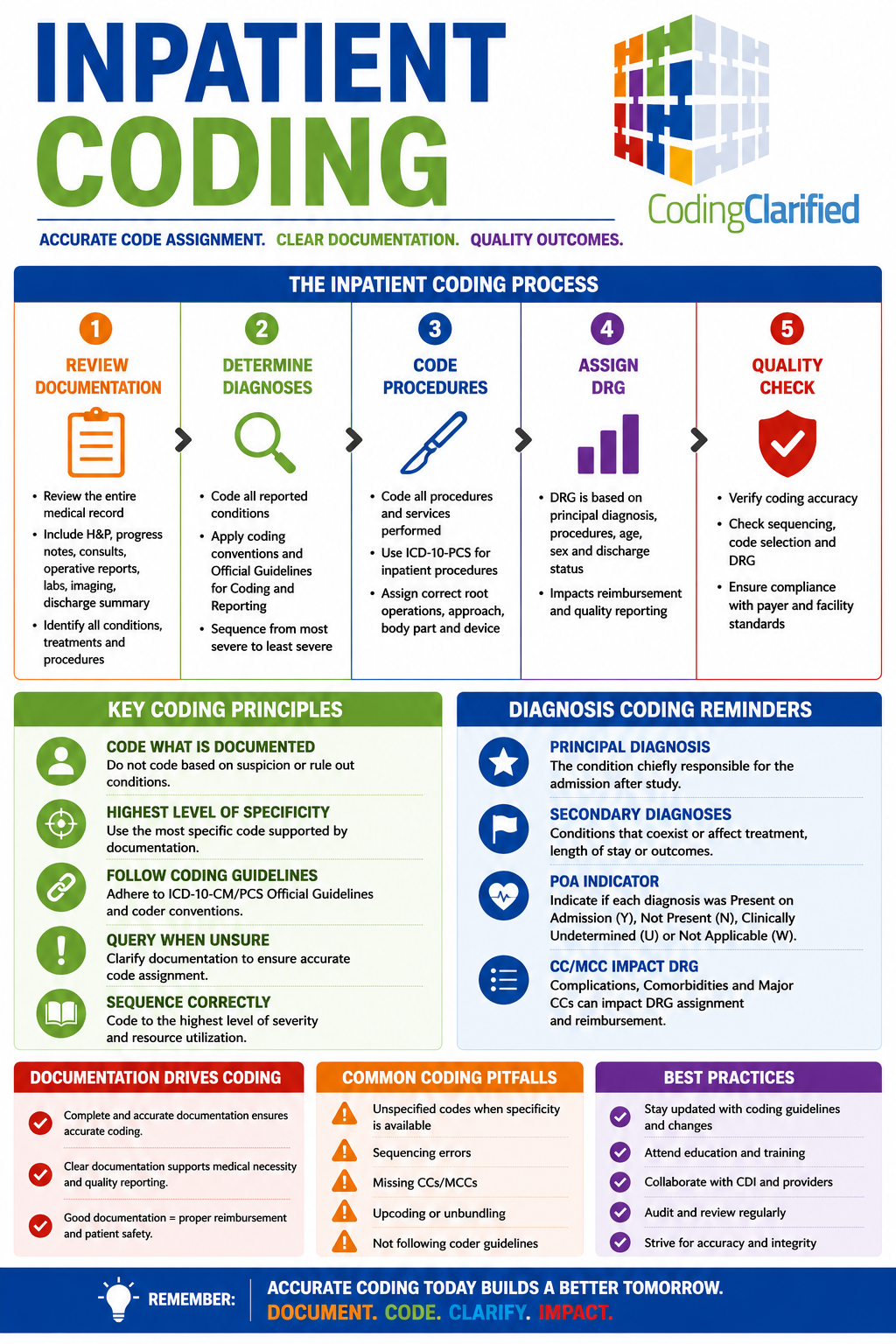
Inpatient Coding Workflow: A Practical Step-by-Step Approach
A consistent workflow can make complex inpatient records easier to manage.
Step 1: Review the reason for admission.
Determine what brought the patient to the hospital and why inpatient care became necessary.
Step 2: Review the entire record.
Look beyond the discharge summary and identify diagnoses, procedures, complications, and relevant clinical events.
Step 3: Determine the principal diagnosis.
Apply the Official Guidelines and identify the condition established after study as chiefly responsible for the admission.
Step 4: Identify reportable secondary diagnoses.
Determine which conditions meet reporting criteria and apply all applicable sequencing rules.
Step 5: Assign ICD-10-CM codes.
Use the Alphabetic Index and confirm every selection in the Tabular List.
Step 6: Review all reportable inpatient procedures.
Analyze operative and procedure documentation before selecting ICD-10-PCS codes.
Step 7: Assign POA indicators when required.
Determine whether each applicable diagnosis was present when the inpatient admission occurred.
Step 8: Review the MS-DRG.
Check the resulting DRG and investigate unexpected results without coding solely for reimbursement.
Step 9: Resolve documentation questions.
Submit a compliant provider query when clarification is needed.
Step 10: Complete a final quality review.
Confirm sequencing, specificity, procedure coding, POA reporting, discharge status, and other claim elements before finalizing the account.
Authoritative Inpatient Coding Resources for 2026
Inpatient coders should regularly use official and authoritative resources.
The Centers for Medicare & Medicaid Services (CMS) publishes the ICD-10-CM and ICD-10-PCS files, Official Guidelines, MS-DRG resources, Medicare Code Editor information, and IPPS updates.
AAPC also provides inpatient coding education and its Certified Inpatient Coder (CIC®) certification pathway.
Coders should also monitor applicable Coding Clinic guidance, payer requirements, facility policies, and annual code-set changes.
Because inpatient coding rules change, never rely solely on an old cheat sheet, blog post, encoder suggestion, or social media answer when official guidance is available.
Frequently Asked Questions About Inpatient Medical Coding in 2026
What coding system is used for inpatient hospital coding?
Inpatient facility coders use ICD-10-CM for diagnoses and ICD-10-PCS for qualifying inpatient procedures. Additionally, Medicare acute-care hospital claims may group into an MS-DRG for payment under IPPS.
Do inpatient coders use CPT codes?
Hospitals generally use ICD-10-PCS rather than CPT® for inpatient facility procedure reporting under IPPS. However, physicians and other professionals may report their professional services with CPT® or HCPCS Level II codes, even when the patient is hospitalized.
What is the principal diagnosis for an inpatient stay?
The principal diagnosis is generally the condition established after study to be chiefly responsible for occasioning the patient’s admission to the hospital for care. Therefore, it is not automatically the most severe or expensive diagnosis.
Can you code a suspected diagnosis for an inpatient patient?
In qualifying inpatient settings, certain diagnoses documented at discharge as probable, suspected, likely, possible, questionable, or similar terms may generally be coded as if established. However, outpatient settings follow different uncertain-diagnosis rules.
What is the difference between ICD-10-CM and ICD-10-PCS?
ICD-10-CM reports diagnoses, while ICD-10-PCS reports procedures in the inpatient hospital facility setting. Additionally, ICD-10-PCS uses a seven-character structure in which each character has a defined meaning.
What is an MCC or CC in inpatient coding?
A CC is a complication or comorbidity, while an MCC is a major complication or comorbidity within the MS-DRG system. Depending on the specific grouper logic, these diagnoses may affect DRG assignment and reimbursement.
What changes for inpatient coding on October 1, 2026?
FY 2027 ICD-10-CM and ICD-10-PCS updates become effective October 1, 2026. Additionally, Medicare’s FY 2027 IPPS and MS-DRG updates take effect for applicable discharges beginning October 1, so inpatient coders should verify that they are using the correct code files, guidelines, grouper, and facility resources.
Is inpatient coding harder than outpatient coding?
Inpatient coding often requires more extensive record review and deeper knowledge of principal diagnosis selection, secondary diagnosis reporting, POA indicators, ICD-10-PCS, and MS-DRGs. However, coders who develop a consistent chart-review process and understand the official guidelines can build these skills with practice.
Final Thoughts: Inpatient Medical Coding in 2026
Inpatient medical coding requires much more than looking up diagnosis codes.
Successful hospital coders must understand the complete story of the admission. Moreover, they must determine the principal diagnosis, identify reportable secondary conditions, analyze procedures using ICD-10-PCS, assign POA indicators, and understand how accurate coding contributes to MS-DRG assignment.
As October 1, 2026 approaches, inpatient coding teams should also prepare for the FY 2027 ICD-10-CM, ICD-10-PCS, IPPS, and MS-DRG updates.
Most importantly, accurate inpatient coding should always begin with the documentation and official coding guidelines—not the desired reimbursement result.
Authoritative Resources
Centers for Medicare & Medicaid Services (CMS) — ICD-10-CM and ICD-10-PCS coding files, guidelines, and annual updates. CMS.gov ICD-10-CM resources
CMS Acute Inpatient Prospective Payment System — Current IPPS regulations, MS-DRG resources, payment updates, and annual final rules. CMS.gov IPPS resources
AAPC — Inpatient coding education and Certified Inpatient Coder (CIC®) certification resources. AAPC ICD10 Resources
Coding Clarified — Medical coding education, certification preparation, coding guidelines, and 2026 coding updates. Coding Clarified Blog