
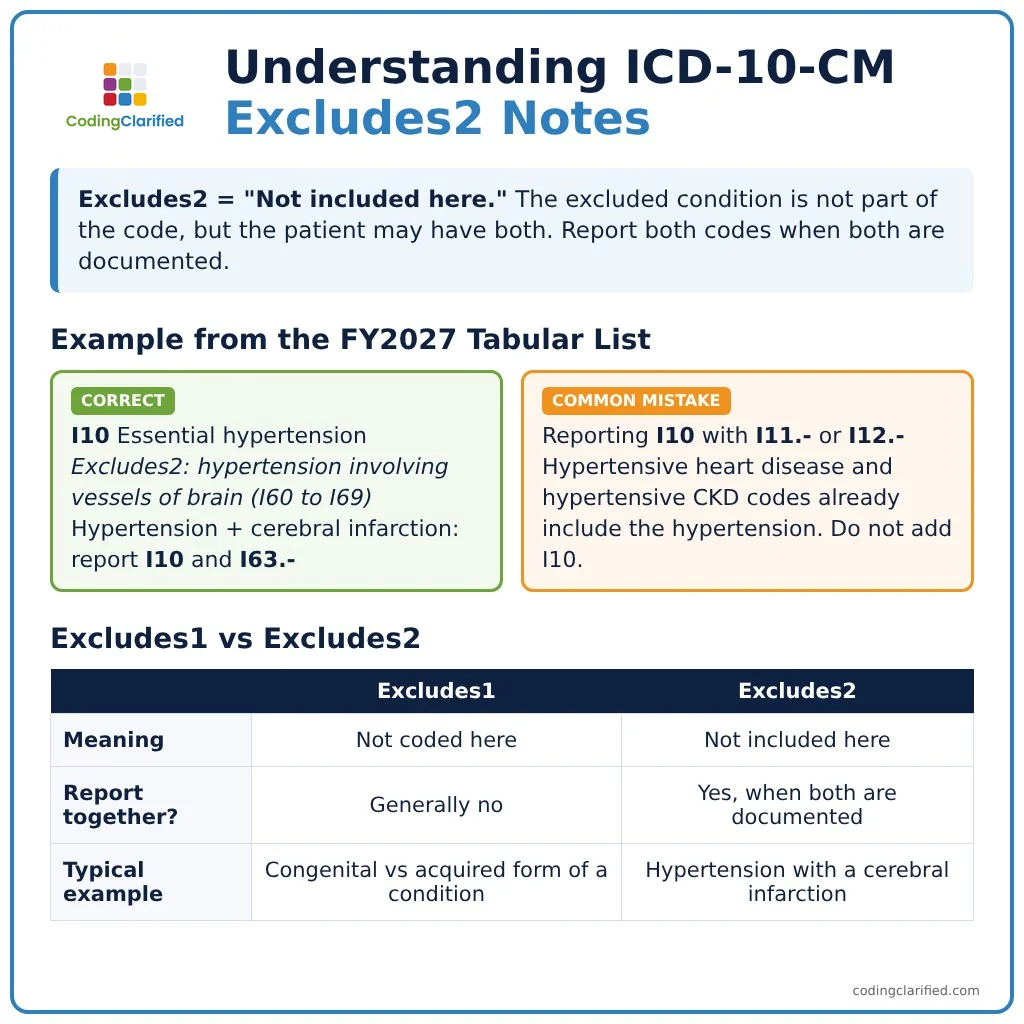
An Excludes2 note in ICD-10-CM means “not included here”: the excluded condition is not part of the code you are looking at, but the patient may have both conditions, so you can report both codes together when the documentation supports them. An Excludes1 note is the opposite. It means “not coded here,” so coders generally do not report the two codes together.
In ICD-10-CM, Excludes Notes play a vital role in helping coders choose the correct diagnosis codes. Excludes 1 notes indicate that you cannot code two conditions together. However, medical coding ICD-10-CM Excludes 2 notes have a completely different meaning, and that difference often confuses new coders. So let’s break it down.
What Is an Excludes 2 Note?
An Excludes 2 note means that the condition listed is not included in the code you’re currently looking at. However, you can code both conditions together if the patient truly has both.
In simpler terms:
“It’s okay to use both codes if the documentation supports both conditions.”
Official ICD-10-CM Definition
Section I.A.12.b of the FY2027 ICD-10-CM Official Guidelines explains that an Excludes2 note represents “not included here.” The excluded condition is not part of the condition the code represents. However, a patient may have both conditions at the same time, so you can report both codes together when appropriate.
Example of an Excludes 2 Note
I10, Essential (primary) hypertension, carries this note in the FY2027 Tabular List:
Excludes2: essential (primary) hypertension involving vessels of brain (I60 through I69); essential (primary) hypertension involving vessels of eye (H35.0-)
What it means: I10 does not include a cerebrovascular condition. If a patient with essential hypertension has a documented cerebral infarction, report both I10 and the appropriate code from I63.
A common mistake: I10 with I11 or I12
However, hypertensive heart disease (I11) and hypertensive chronic kidney disease (I12) are not Excludes2 situations. ICD-10-CM presumes a causal relationship between hypertension and heart disease or chronic kidney disease. Also, the I11, I12, and I13 combination codes already include the hypertension. Therefore, do not report I10 with these codes.
Key Differences Between Excludes 1 and Excludes 2
| Feature | Excludes 1 | Excludes 2 |
|---|---|---|
| Meaning | “Not coded here” | “Not included here” |
| Coding rule | Two conditions cannot be coded together | Both conditions may be coded together |
| Documentation impact | Mutually exclusive conditions | Coexisting conditions allowed |
| Example | Congenital vs. acquired forms of a condition | Hypertension (I10) with a cerebral infarction (I63.-) |
Why Excludes 2 Notes Matter
Understanding Excludes 2 notes prevents undercoding and ensures that all relevant conditions are captured for accurate data reporting and reimbursement. Still, many coders mistakenly omit secondary diagnoses due to misreading these notes.
Coding Tip
Always read the notes beneath every ICD-10-CM code, especially when conditions seem similar. The Excludes 2 list also gives essential clues about what else may need to be coded for full documentation accuracy.
In Summary
-
Excludes 2 = you may use both codes together if documented.
-
However, always verify documentation supports both conditions.
-
Also review Excludes notes for every code to avoid errors.
-
Remember that proper use of Excludes 2 ensures complete coding and compliant claims.
FY2027 ICD-10-CM Official Guidelines
Medical Coding ICD-10-CM Chapters
Excludes 2 FAQs
What does Excludes2 mean in ICD-10-CM?
Not included here. The excluded condition is a separate condition, so you may report both codes if the patient has both.
What is the difference between Excludes1 and Excludes2?
Excludes1 means you cannot report the two conditions together, such as a congenital and an acquired form of the same condition. In contrast, Excludes2 means you may report both when the provider documents both. Read our Excludes 1 guide for examples.
Do I have to code the condition listed in an Excludes2 note?
Only if the provider documents it. The note tells you the condition has a code elsewhere, not that you must add it.
Can I report I10 with I11?
No. I11 hypertensive heart disease already includes the hypertension. Therefore, that pairing is not an Excludes2 situation.
Where do Excludes notes appear?
Under a chapter, block, category, or code in the Tabular List. Also, a note at the category level applies to every code in that category.