Online medical coding training has become one of the most convenient ways to prepare for a career in medical coding. However, not every online medical coding program offers the same level of education, instructor support, certification preparation, or real-world experience.
In 2026, students have more online training choices than ever before. Therefore, choosing a program based only on price or convenience can be a costly mistake. A strong program should not simply teach you how to look up codes. Instead, it should help you understand coding guidelines, prepare for certification, practice real-world coding, and develop the skills employers expect.
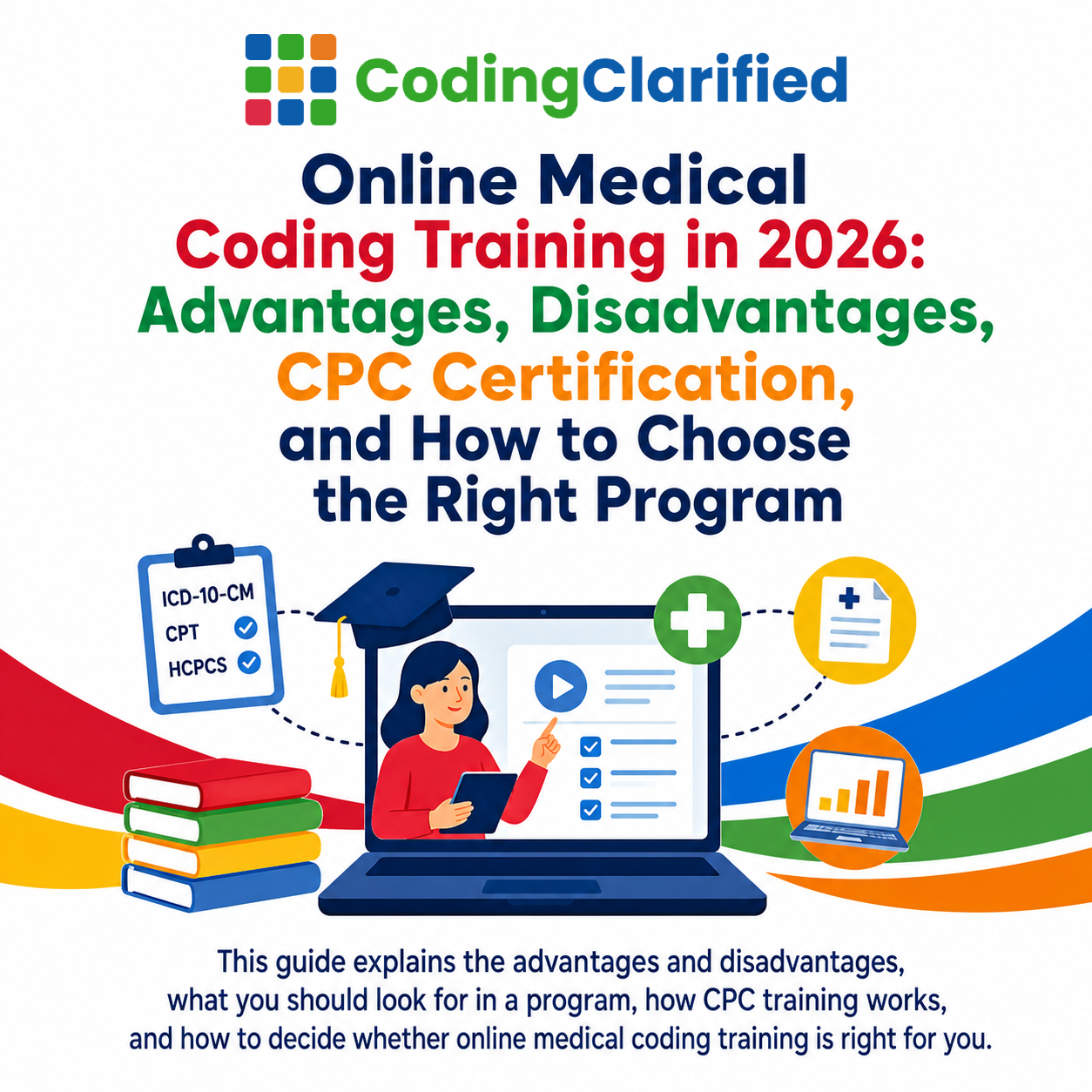
If you are considering online medical coding classes, this guide explains the advantages and disadvantages, what you should look for in a program, how CPC training works, and how to decide whether online medical coding training is right for you.
Key Takeaways on Online Medical Coding Training
- Online medical coding training offers flexibility and allows students to study from home.
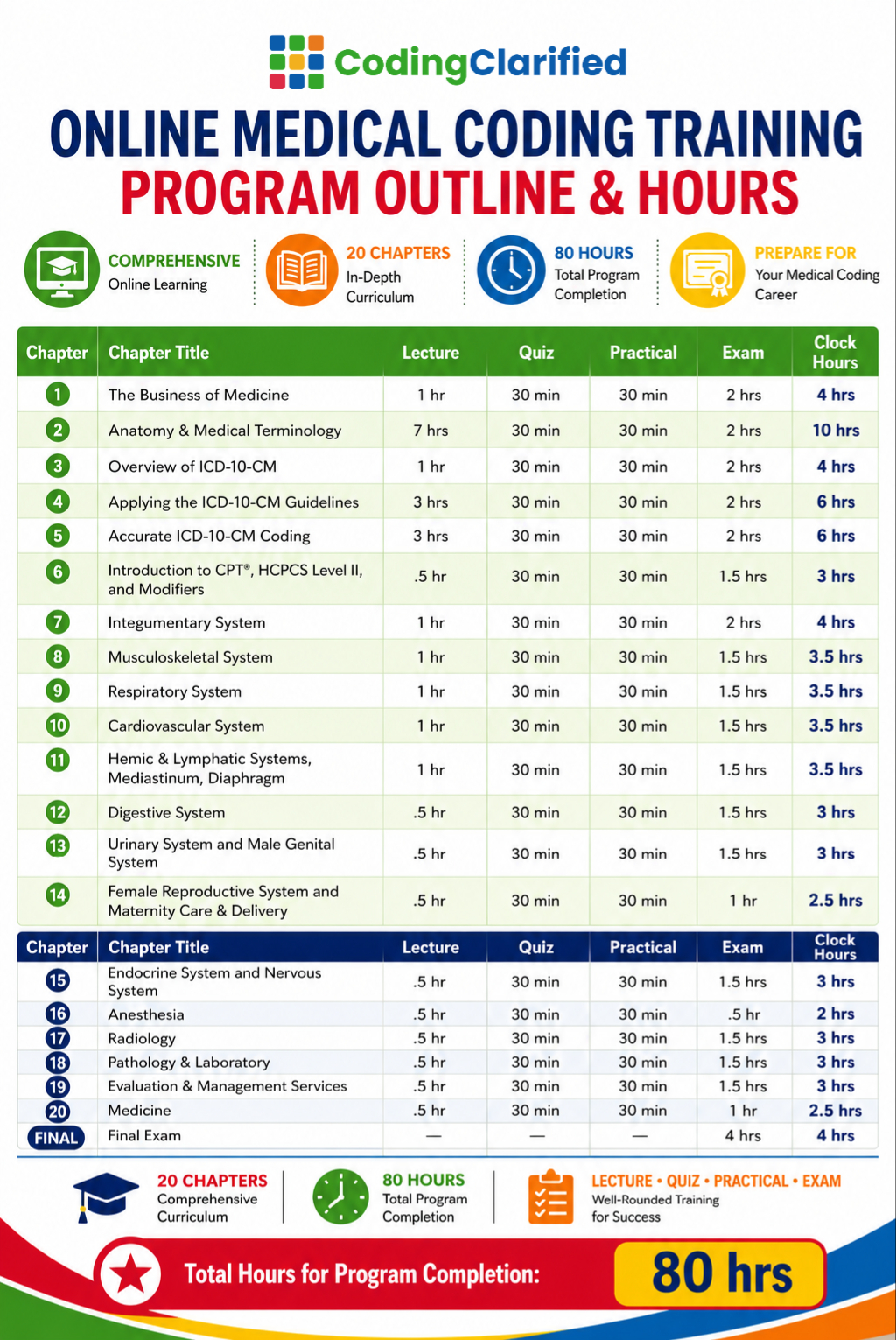
- A quality program should teach CPT, ICD-10-CM, HCPCS Level II, anatomy, medical terminology, and coding guidelines.
- Online programs vary greatly in instructor access, certification preparation, textbooks, practice cases, and career support.
- Students should determine which certification a program prepares them for before enrolling.
- Instructor-led does not mean unsupported. Instructor access can make a major difference when you encounter difficult coding concepts.
- Real-world coding practice can help bridge the gap between passing a certification exam and performing coding work.
- In 2026, students should compare the total program package, not simply the advertised tuition.
- Certification, experience, and continued education remain important parts of building a long-term medical coding career.
What Is Online Medical Coding Training?
Online medical coding training teaches students how to convert diagnoses, procedures, services, supplies, and other healthcare information into standardized medical codes.
For physician-based coding, students commonly learn:
- CPT
- ICD-10-CM
- HCPCS Level II
- Medical terminology
- Anatomy and physiology
- Coding guidelines
- Compliance
- Documentation requirements
- Insurance and reimbursement concepts
Additionally, students preparing for hospital coding may need ICD-10-PCS and more advanced reimbursement training.
Online training can range from independent self-study courses to structured instructor-supported programs. Consequently, two programs described as “online medical coding courses” may provide very different educational experiences.
AAPC currently offers online CPC training in instructor-led and instructor-led formats. Its CPC training focuses on preparing students for the Certified Professional Coder credential and includes foundational coding knowledge. AHIMA also offers online Medical Coding and Reimbursement courses covering areas such as anatomy, medical terminology, ICD-10-CM, ICD-10-PCS, CPT, reimbursement, and career preparation.
Therefore, before enrolling, identify the credential and type of coding career you want to pursue.
Advantages of Online Medical Coding Training
1. Flexible Scheduling
Flexibility remains one of the biggest advantages of online medical coding training in 2026.
Many students entering medical coding already have jobs, children, family responsibilities, or other commitments. Therefore, attending a traditional classroom at the same time several days each week may not work.
Online learning can allow you to study before work, after work, during weekends, or whenever your schedule permits.
However, flexibility still requires discipline. Students should create a weekly study schedule instead of waiting until they “have time.”
2. You Can Study From Home
Online medical coding classes eliminate commuting to a college or training center. As a result, students can save both travel time and transportation costs.
Studying at home can also make medical coding education available to people who live far from a traditional program.
Furthermore, online learning gives students experience working independently with electronic educational resources. That skill can become useful later because many coding positions involve computer-based workflows.
3. You Can Often Learn Within an Instructor-Supported Weekly Schedule
Some online programs allow students to move through material according to their own schedules.
For example, you may understand medical terminology quickly but need additional time to master CPT guidelines. A flexible program lets you spend more time where you need it.
However, students should not confuse instructor-led learning with unlimited time. Every program has its own access period, deadlines, and extension policies.
Before enrolling, ask exactly how long you will have access to the course.
4. Online Training Can Reduce Additional Costs
Traditional education can involve expenses beyond tuition. For example, students may pay for transportation, parking, housing, campus fees, or childcare.
Online medical coding training can reduce some of those expenses.
Nevertheless, always calculate the total cost of becoming certified, rather than looking only at tuition.
Ask whether your program price includes:
- CPT code books
- ICD-10-CM code books
- HCPCS Level II code books
- Certification exam preparation
- Practice exams
- Certification exam voucher
- Professional membership
- Instructor support
- Practicum or internship experience
- Resume assistance
- Career resources
A cheaper course can become more expensive once you purchase everything separately.
For additional information, read Coding Clarified’s guide to how much it costs to learn medical coding.
5. Online Medical Coding Training Can Prepare You for Certification
One of the most important reasons to complete formal training is preparation for a nationally recognized medical coding certification.
For example, AAPC’s Certified Professional Coder (CPC) credential focuses heavily on physician and professional-service coding.
Meanwhile, AHIMA offers certifications such as the CCA, CCS, and CCS-P.
Your career goal should help determine which certification you pursue.
In 2026, AHIMA also requires candidates taking certain certification exams on or after May 1, 2026, including CCA and CCS, to use the appropriate 2026 code books. Therefore, students should always verify current exam requirements before purchasing books or scheduling an exam.
6. Online Learning Can Provide Access to More Training Options
Your medical coding education is no longer limited to schools within driving distance.
Instead, online training lets you compare programs from different locations. As a result, you can focus on curriculum, certification preparation, instructor access, student support, and career preparation rather than geography alone.
That freedom can be valuable. However, more options also mean students must research programs carefully.
Disadvantages of Online Medical Coding Training
Online training offers significant benefits, but it also has potential disadvantages.
1. Online Learning Requires Self-Discipline
Nobody is standing at your door telling you to study.
Therefore, procrastination can quickly become a problem.
Students who succeed in online medical coding programs usually establish a consistent routine. For example, setting aside one or two hours each evening may work better than attempting to complete an entire week of lessons on Sunday.
A calendar, study checklist, and weekly goals can help you stay on track.
2. Some Programs Provide Very Little Instructor Support
Medical coding can become complicated quickly.
A student may understand a chapter until encountering a difficult operative report, modifier question, sequencing issue, or coding guideline. At that point, having access to a knowledgeable instructor becomes extremely valuable.
Unfortunately, some online programs primarily provide prerecorded lessons and automated quizzes.
Before enrolling, therefore, ask:
- Will I have an assigned instructor?
- Can I ask coding questions?
- How do I contact my instructor?
- How quickly are questions answered?
- Does the instructor hold a recognized coding credential?
- Is individual assistance available?
Online does not have to mean learning alone.
3. Home Can Be Full of Distractions
Children, television, household chores, phones, pets, and social media can interfere with studying.
For that reason, create a dedicated study space whenever possible.
Additionally, tell family members when you need uninterrupted study time. Even a consistent one-hour block can help you make progress.
4. Technology Problems Can Interrupt Training
Online education requires dependable technology.
You may need:
- Reliable internet
- A laptop or desktop computer
- Updated web browsers
- PDF or eBook access
- Video capability
- Basic computer skills
Before enrolling, check the program’s technology requirements. Moreover, determine whether you will lose access to lessons or resources after completing the course.
5. Some Programs Do Not Provide Enough Real-World Coding Practice
Learning guidelines and passing quizzes are important. However, coding an actual medical record requires students to combine multiple skills.
Real documentation is rarely written like a textbook question.
Therefore, students benefit from practicing with realistic charts and scenarios whenever possible.
Coding Clarified students can continue building experience through opportunities such as Practicode and HCC internship training after meeting program requirements. This type of experience can help students transition from studying individual coding concepts to reviewing more realistic documentation.
Read more in our guide to medical coding internships and gaining real-world coding experience.
What Should an Online Medical Coding Program Teach in 2026?
For students pursuing physician-based coding and CPC certification, a strong program should build a foundation in several areas.
Students should expect training involving CPT, ICD-10-CM, HCPCS Level II, medical terminology, anatomy, compliance, reimbursement concepts, and documentation.
Additionally, the program should teach students how to apply official coding guidelines, not simply memorize codes.
Codes change. Guidelines change. Technology changes.
Consequently, successful medical coders must learn how to research and verify coding information rather than depend entirely on memorization.
Online Medical Coding Training and the CPC Certification
The Certified Professional Coder credential remains a popular certification for students pursuing professional medical coding.
AAPC describes its CPC course as appropriate for beginners through experienced coders seeking CPC certification. Additionally, its current online training options include instructor-led and instructor-led pathways.
Students should remember that completing a course and earning a certification are separate steps.
Training teaches the material. Certification demonstrates that you passed the credentialing organization’s examination.
For a complete step-by-step overview, read How to Become a Certified Medical Coder in 2026.
How to Choose the Best Online Medical Coding Training Program
Do not choose a school simply because an advertisement promises a fast career.
Instead, compare what you actually receive.
Ask These Questions Before Enrolling
Which certification does the program prepare me for?
A general “medical billing and coding certificate” is not necessarily the same as preparation for a recognized professional certification.
Are the coding books included?
Find out whether CPT, ICD-10-CM, and HCPCS Level II resources are included or must be purchased separately.
Is certification exam preparation included?
A strong program should help students transition from learning concepts to answering certification-style questions.
Do I receive instructor support?
Find out who answers your coding questions and how that process works.
Does tuition include an exam voucher?
Certification exams can add to your total cost. Therefore, determine what tuition includes before comparing programs.
Will I get practical coding experience?
Ask whether the program includes case-based training, Practicode, internships, or other opportunities to practice coding documentation.
What happens after I finish?
Career preparation matters. Ask about resume assistance, job-search resources, internships, networking, and continued support.
For more questions to consider, see Coding Clarified’s article on accreditation and medical coding schools.
CPC Student Tips for Succeeding in Online Medical Coding Training
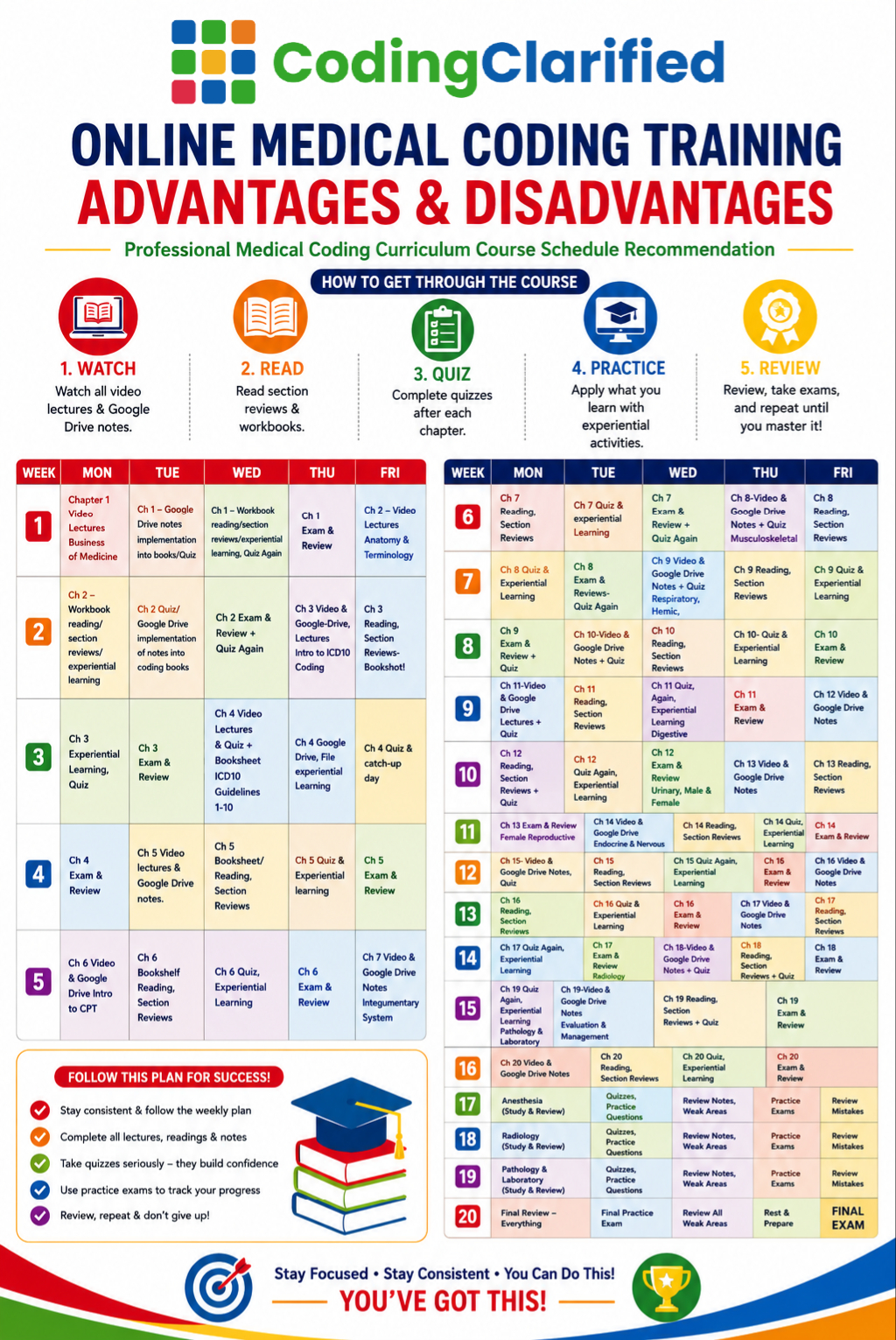
Create a Weekly Study Schedule
Treat your course like an appointment.
Block specific study periods on your calendar and protect that time. Furthermore, divide larger chapters into smaller daily goals.
Learn Guidelines Instead of Memorizing Codes
You do not need to memorize every CPT or ICD-10-CM code.
Instead, learn how the code sets are organized, how guidelines work, and where to find information efficiently.
Practice Using Your Code Books
Your books are working tools.
Therefore, become comfortable navigating indexes, tables, guidelines, notes, symbols, and code ranges. Efficient code-book navigation becomes especially important when preparing for certification exams.
Review Every Wrong Answer
Wrong answers can become excellent study tools.
Instead of simply checking the correct answer, determine why your original answer was incorrect. Then, locate the applicable guideline or rule.
Practice Complete Cases
Individual multiple-choice questions help reinforce concepts. However, full cases teach you to identify relevant information within longer documentation.
This skill becomes increasingly important as you move toward certification and employment.
Ask Questions Early
Do not allow one confusing concept to become five confusing concepts.
Ask your instructor for clarification when you get stuck. Likewise, keep notes about difficult topics so you can review them later.
For additional study strategies, visit Tips on How to Excel in Medical Coding.
Common Mistakes to Avoid When Choosing Online Medical Coding Training
Choosing Based Only on Price
The least expensive course is not automatically the best value.
Compare books, certification preparation, exam vouchers, instructor support, practical experience, and career resources.
Assuming Every Medical Coding Certificate Is the Same
A school’s completion certificate and a professional certification are different.
Before enrolling, understand exactly what credential you are working toward.
Ignoring Instructor Access
Medical coding involves detailed rules. Therefore, having someone qualified to explain difficult concepts can make a major difference.
Not Researching the Certification Exam
Know your goal before you begin.
If you want CPC certification, choose training designed around the skills and knowledge tested for that credential.
Waiting Until Graduation to Think About Experience
Start planning your transition into employment while you are still learning.
Practice cases, certification preparation, Practicode, internships, networking, and resume development can all become part of that strategy.
Assuming Certification Guarantees a Remote Job
Medical coding can offer remote opportunities, but certification does not guarantee immediate remote employment.
New coders still need to build skills, demonstrate accuracy, and compete for available positions. Therefore, focus on becoming employable rather than simply completing a course.
Can You Get Financial Help for Online Medical Coding Training?
Possibly.
Depending on your circumstances and location, workforce development programs, grants, scholarships, military-spouse programs, or other funding sources may help pay for career training.
Coding Clarified works with workforce programs in multiple states to help eligible students pursue medical coding education.
Eligibility varies, however, and the funding agency makes the final determination.
Explore Coding Clarified medical coding scholarships and grants to learn more about available state-based options.
Authoritative Medical Coding Training Resources
Students should verify certification and coding information directly through recognized industry organizations.
- American Medical Association CPT® Resources
- American Academy of Professional Coders (AAPC)
- Centers for Medicare & Medicaid Services (CMS)
- National Correct Coding Initiative (NCCI)
- ICD-10-CM Official Guidelines for Coding and Reporting
- CMS ICD-10 Resources
- About Coding Clarified
Students should always verify current certification requirements with the organization administering the credential because exam rules, code-book requirements, and policies can change. Ready to get started? Explore Coding Clarified’s online medical coding training program.
Is Online Medical Coding Training Worth It in 2026?
For many students, yes.
Online medical coding training can provide the flexibility needed to start a new career without attending a traditional classroom. Furthermore, students can study from home while continuing to manage work and family responsibilities.
However, the quality of the program matters.
Look beyond the words “online medical coding course.” Instead, evaluate the curriculum, instructor access, certification preparation, coding resources, practical experience, student support, and career resources.
Ultimately, the best program is one that does more than help you finish a course. It should help prepare you to understand medical coding, earn a recognized certification, gain practical experience, and compete for medical coding jobs.
Frequently Asked Questions About Online Medical Coding Training
Quick answers to the questions students ask most about online medical coding training.
Can I learn medical coding completely online in 2026?
Yes. Medical coding can be taught online because the work centers heavily on reviewing documentation, applying coding guidelines, researching code sets, and using computer-based resources. However, students should choose a program that includes structured education, instructor support, and practical coding exercises rather than relying only on prerecorded lessons.
How long does online medical coding training take?
The timeline varies by program and student. Some programs use a fixed schedule, while others allow students to progress on an instructor-supported weekly schedule within an established access period. Additionally, previous healthcare knowledge and the number of hours you study each week can affect completion time.
What certification should I get for medical coding?
That depends on your career goal. The AAPC CPC credential is widely used for professional and physician-based coding. Meanwhile, AHIMA offers credentials including the CCA, CCS, and CCS-P. Research job postings in the area of coding you want to pursue and compare credential requirements before selecting your training program.
Is online medical coding difficult to learn?
Medical coding has a learning curve because students must understand anatomy, terminology, documentation, coding guidelines, and multiple code sets. Nevertheless, consistent study and practice can make complex concepts easier over time. Instructor support can also help students work through difficult areas.
Do I need medical experience before taking an online coding course?
Not necessarily. Many people enter medical coding without previous coding experience. However, knowledge of anatomy, medical terminology, and pathophysiology provides an important foundation. Some programs include prerequisite education, while others require or recommend it separately.
Can I work from home after completing online medical coding training?
Remote medical coding jobs exist, but finishing an online course does not guarantee a work-from-home position. Employers may require certification, experience, specific specialties, or demonstrated coding accuracy. Therefore, students should build a broader job-readiness plan that includes certification, practical experience, resume preparation, networking, and consistent job searching.
How do I know if an online medical coding program is legitimate?
Research the curriculum, instructors, certification preparation, total cost, refund policies, books, exam vouchers, and student support. Additionally, verify information about professional certifications directly through organizations such as AAPC or AHIMA. Be cautious of programs that promise guaranteed jobs, unusually high starting salaries, or certification without a recognized credentialing exam.
Should I choose self-paced or instructor-led medical coding training?
The best choice depends on how you learn. Self-paced training may work well if you are disciplined and comfortable learning independently. Conversely, instructor-led training can be valuable if you prefer guidance, accountability, and the ability to ask questions when coding becomes complicated.
Coding Clarified Final Thoughts
Online medical coding training in 2026 can offer a flexible path into the healthcare industry. However, choosing the right program requires more than comparing tuition prices.
Look closely at what the program teaches, which certification it prepares you for, what resources are included, how much instructor support you receive, and whether you will have opportunities to practice real-world coding.
Most importantly, think beyond passing the certification exam. Your long-term goal should be to become a knowledgeable, accurate, confident medical coder who can continue learning as codes, guidelines, payer policies, and healthcare regulations change.
With the right training, consistent study, professional certification, and practical experience, online education can provide a strong foundation for building your medical coding career in 2026 and beyond.