Are medical coders still in demand in 2026?
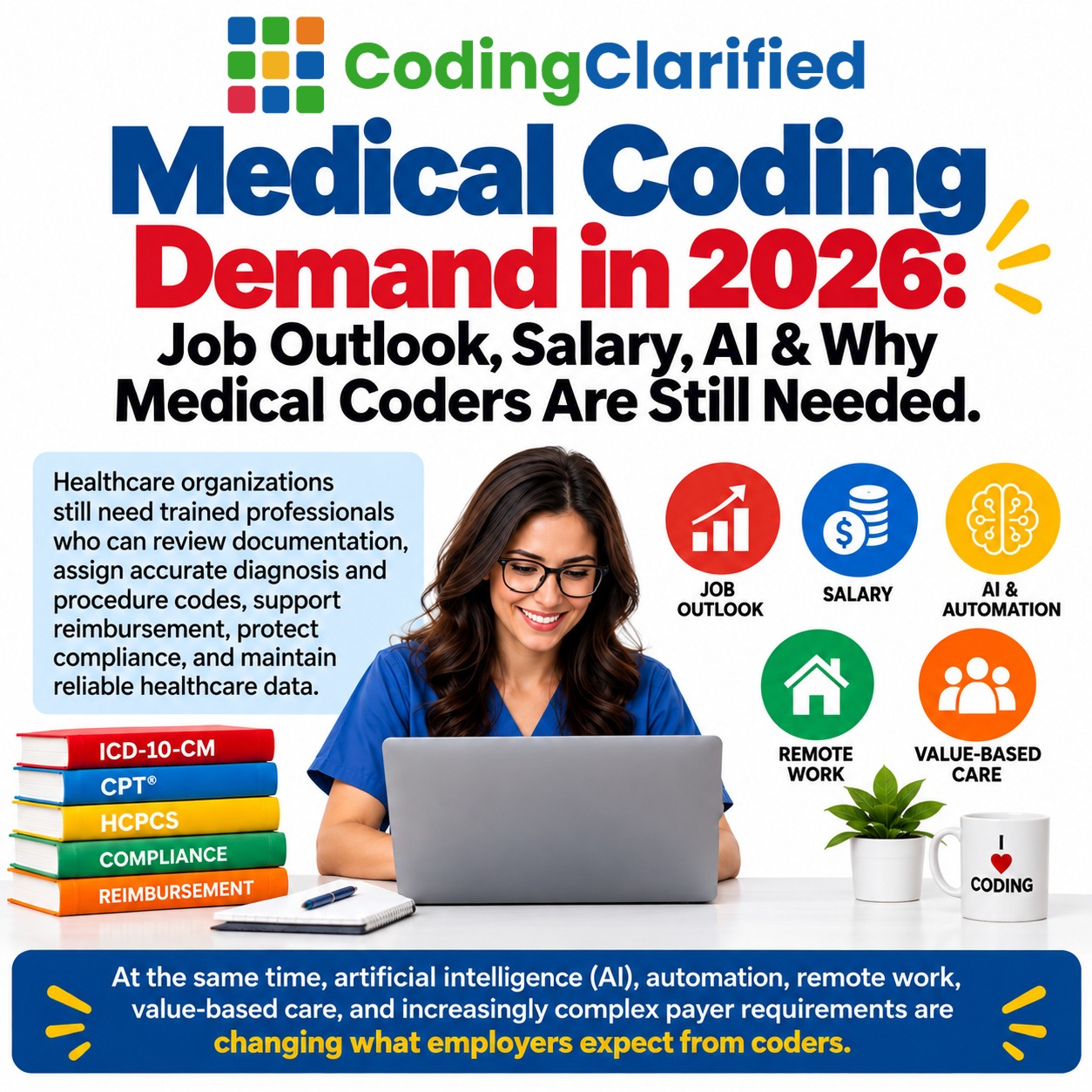
Yes, but the medical coding profession is changing. Healthcare organizations still need trained professionals who can review documentation, assign accurate diagnosis and procedure codes, support reimbursement, protect compliance, and maintain reliable healthcare data. At the same time, artificial intelligence (AI), automation, remote work, value-based care, and increasingly complex payer requirements are changing what employers expect from coders.
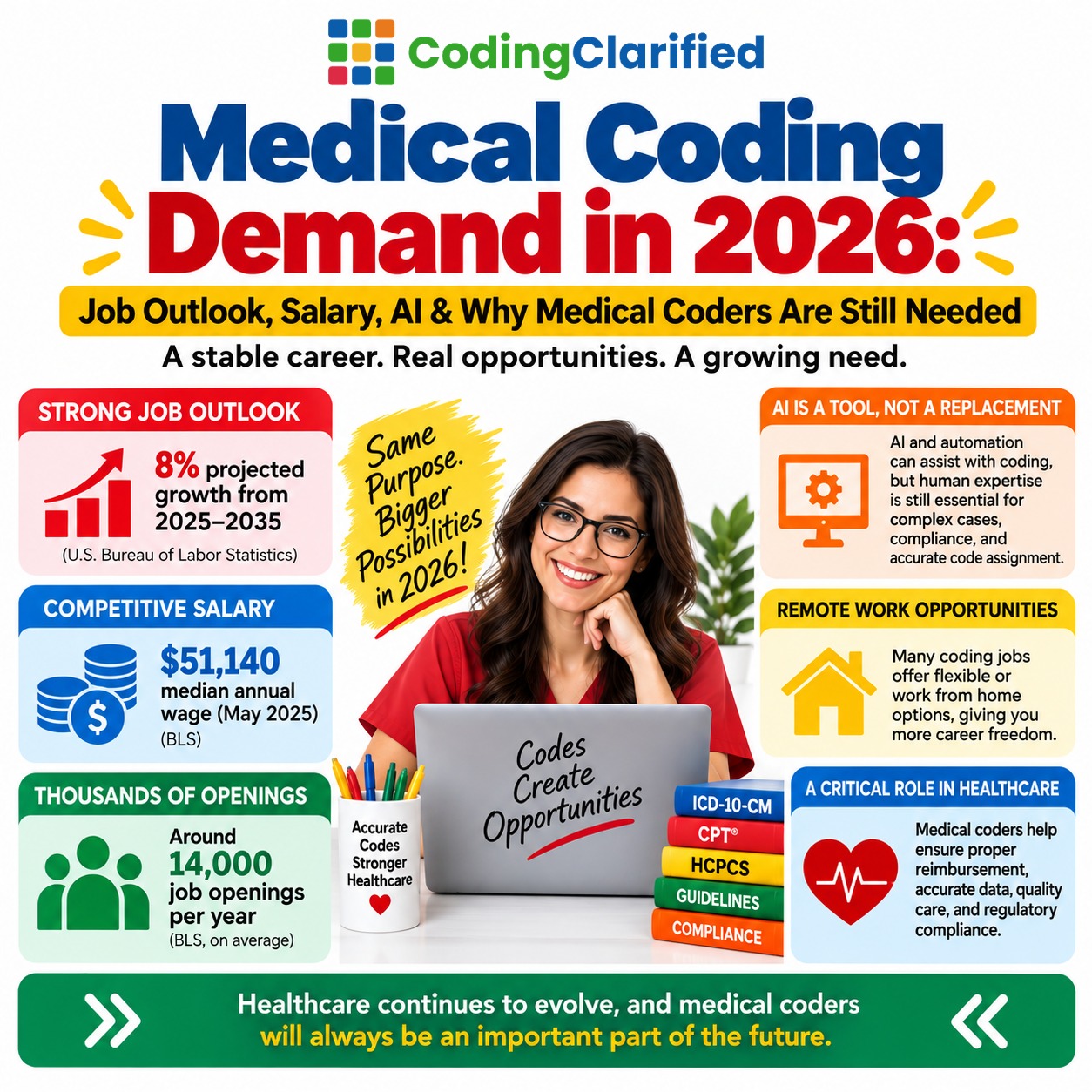
The latest U.S. Bureau of Labor Statistics (BLS) data provides encouraging evidence. Employment of medical records specialists, the occupational category that includes medical coders, is projected to grow 8% from 2025 through 2035, which BLS classifies as much faster than the average for all occupations. In addition, BLS projects approximately 14,000 job openings each year, on average, during that period.
Therefore, medical coding remains a viable healthcare career in 2026. However, certification alone does not guarantee a job. Employers increasingly want coders who combine coding knowledge with accuracy, compliance awareness, technology skills, and practical experience.
Key Takeaways: Medical Coding Demand in 2026
- Medical coders remain an important part of the healthcare revenue cycle in 2026.
- BLS projects 8% employment growth from 2025–2035 for medical records specialists.
- Approximately 14,000 openings per year are projected, on average, over the decade.
- The median annual wage for medical records specialists was $51,140 in May 2025, according to BLS.
- Certification can improve employment opportunities because employers may prefer certified candidates.
- Remote medical coding continues to attract job seekers; however, entry-level remote jobs can be competitive.
- AI is changing coding workflows, but human judgment remains important for complex coding, documentation review, compliance, auditing, and validation.
- Specialty knowledge in areas such as risk adjustment, surgery, cardiology, orthopedics, and auditing can help experienced coders stand out.
- Successful coders must continue learning because ICD-10-CM, CPT®, HCPCS Level II, Medicare policies, and payer requirements change regularly.
Are Medical Coders in Demand in 2026?
Medical coders remain in demand because healthcare organizations generate enormous amounts of clinical and financial information.
Every physician visit, surgery, diagnostic test, hospital admission, therapy session, and other reportable healthcare service creates documentation that may need to be translated into standardized codes. Consequently, those codes affect claims, reimbursement, healthcare statistics, quality reporting, risk adjustment, and compliance.
BLS reports that medical records specialists held approximately 200,700 jobs in 2025. Hospitals employed the largest share at 28%, while physician offices employed another 18%.
Furthermore, medical coders work in many settings beyond hospitals and physician practices. Opportunities can exist with insurance companies, healthcare consulting firms, revenue cycle companies, ambulatory surgery centers, specialty practices, auditing organizations, and other healthcare businesses.
Medical coding also remains one of the relatively few healthcare careers that does not require direct hands-on patient care.
For a broader career analysis, read Is Medical Coding a Good Career in 2026? Salary, Job Outlook, Remote Work & How to Get Started.
Medical Coding Job Outlook: What the Latest BLS Numbers Show
The 2026 job outlook is stronger than many students may realize.
According to the U.S. Bureau of Labor Statistics:
- Medical records specialists had a median annual wage of $51,140 in May 2025.
- Employment is projected to increase 8% from 2025 through 2035.
- BLS expects approximately 14,000 openings each year, on average, during the decade.
- Medical records specialists held approximately 200,700 jobs in 2025.
However, these figures require some context.
BLS tracks the broader occupation of medical records specialists rather than publishing a national employment projection exclusively for Certified Professional Coders (CPCs). Therefore, students should not interpret the 8% figure as a guarantee that every newly certified coder will immediately find employment.
Instead, the numbers show continued demand for professionals who manage, classify, verify, and maintain healthcare information.
Why Does Healthcare Continue to Need Medical Coders?
Several forces continue to support demand for qualified coding professionals.
1. Healthcare Produces More Data Every Year
Healthcare organizations rely heavily on electronic health records and digital claims systems. As a result, enormous amounts of clinical information must be organized and converted into usable healthcare data.
Medical coders help transform provider documentation into standardized codes. Moreover, coded data supports reimbursement, quality reporting, research, public health, and healthcare analytics.
2. Coding Rules Constantly Change
Medical coding is not a static profession.
ICD-10-CM, CPT®, and HCPCS Level II change regularly. Medicare policies, payer rules, National Correct Coding Initiative edits, coverage requirements, and documentation standards can also change throughout the year.
In fact, CMS has already published the ICD-10-CM and ICD-10-PCS files that take effect October 1, 2026 for FY 2027.
Therefore, healthcare organizations need professionals who can interpret current rules rather than simply search for a code.
3. Accurate Coding Affects Reimbursement
Healthcare providers depend on accurate claims to receive appropriate reimbursement.
Incorrect coding can cause denials, delayed payments, underpayments, overpayments, and compliance problems. Consequently, skilled coders provide value by helping organizations submit claims that accurately reflect documented services.
A coder’s job involves much more than entering numbers into software. Instead, coders must understand documentation, anatomy, medical terminology, guidelines, modifiers, sequencing rules, payer requirements, and medical necessity.
4. Compliance Creates an Ongoing Need for Human Expertise
Healthcare organizations face significant compliance responsibilities.
Coding errors can lead to audits, repayments, claim denials, or allegations of improper billing. Therefore, employers need coders, auditors, compliance professionals, and revenue cycle specialists who understand how official rules apply to real medical records.
Automation may identify patterns. However, experienced professionals still need to evaluate unusual situations, research guidelines, communicate documentation problems, and verify whether a coding decision is supported.
Will AI Reduce the Demand for Medical Coders?
AI will change medical coding. Nevertheless, that does not automatically mean medical coders will disappear.
Computer-assisted coding and AI systems can already perform tasks such as:
- suggesting diagnosis codes;
- recommending procedure codes;
- identifying possible documentation gaps;
- highlighting potential coding conflicts;
- organizing information from medical records; and
- automating repetitive workflow tasks.
However, coding often requires context.
For example, software may identify several possible diagnosis codes from a medical record. A trained coder still needs to determine whether the documentation supports the code, whether an instructional note applies, whether the condition should be reported, and how diagnoses should be sequenced.
Similarly, CPT® coding can require careful interpretation of operative reports, bundled services, modifiers, parenthetical instructions, and payer rules.
Therefore, the coder’s role may increasingly shift from simple code assignment toward validation, auditing, compliance, documentation review, denial prevention, and complex coding decisions.
The strongest career strategy is not to compete against AI. Instead, learn how to use technology while developing the judgment needed to recognize when technology gets the answer wrong.
Read more in our guide to Latest Trends and Best Practices in Medical Coding in 2026.
What Skills Are Medical Coding Employers Looking for in 2026?
Employers increasingly want job-ready candidates rather than applicants who simply passed a certification exam.
Strong candidates should understand:
- ICD-10-CM diagnosis coding;
- CPT® procedure coding;
- HCPCS Level II;
- anatomy and physiology;
- medical terminology;
- official coding guidelines;
- modifier use;
- electronic health records;
- compliance and HIPAA;
- payer policies;
- medical necessity; and
- documentation requirements.
Additionally, communication skills matter because coders may need to work with providers, billers, auditors, clinical documentation teams, and revenue cycle staff.
Attention to detail remains especially important. BLS specifically identifies analytical ability and detail orientation as important qualities for medical records specialists.
Does Certification Help With Medical Coding Job Demand?
Certification can make a significant difference.
BLS notes that employers may prefer medical records specialists who have certification or may expect workers to earn certification after being hired.
For professional-fee coding, the Certified Professional Coder (CPC®) credential from AAPC is one of the most widely recognized credentials.
However, students should understand the difference between certification and employability.
Passing an exam demonstrates knowledge. Employers may still want practical coding ability, productivity, specialty experience, EHR familiarity, and the ability to interpret real medical records.
Therefore, your goal should be to become both certified and job ready.
Our AAPC CPC Certification Guide 2026 explains the certification path in greater detail.
Remote Medical Coding Jobs Remain Popular
One reason medical coding attracts career changers is the possibility of working from home.
Because coders work primarily with electronic documentation and computer systems, many coding jobs can be performed remotely. Nevertheless, remote employment should be viewed as a career opportunity rather than a guarantee.
Competition can be strong, particularly for entry-level remote positions. In addition, employers may require previous coding experience, specialty knowledge, minimum accuracy scores, and productivity standards.
Remote coders must also protect patient information, follow HIPAA requirements, maintain a secure workspace, and work independently.
If working from home is your goal, see How to Be a Successful Remote Medical Coder.
Specialty Coding Can Make You More Competitive
General coding skills create the foundation for a career. However, specialty expertise can help experienced coders differentiate themselves.
Areas worth exploring include:
- risk adjustment/HCC coding;
- cardiology;
- orthopedics;
- oncology;
- gastroenterology;
- emergency medicine;
- interventional radiology;
- surgical coding;
- behavioral health;
- home health;
- auditing; and
- compliance.
Specialization takes time. Therefore, new coders should first develop strong core skills rather than immediately collecting multiple credentials.
Once you have a solid foundation, deeper expertise can create opportunities for advancement.
CPC Student Tips: How to Prepare for Medical Coding Jobs in 2026
CPC students should begin preparing for employment before they take the certification exam.
First, learn how to navigate your ICD-10-CM, CPT®, and HCPCS Level II resources efficiently. Speed matters; however, accuracy should always come first.
Next, practice coding complete cases instead of memorizing isolated codes. Real coding requires you to read documentation, identify the services performed, apply guidelines, and determine what information actually supports code assignment.
Additionally, strengthen anatomy and medical terminology. Those skills make difficult operative reports much easier to understand.
Finally, review every practice question you miss. Do not simply memorize the correct answer. Instead, determine why your answer was incorrect and which guideline leads to the correct choice.
Those habits will help you on the CPC exam and, more importantly, in an actual coding position.
Common Mistakes to Avoid When Starting a Medical Coding Career
One common mistake is assuming certification guarantees immediate employment. Although certification can strengthen your résumé, employers may still expect practical skills and experience.
Another mistake involves applying only for remote jobs. Remote positions are attractive; however, new coders may increase their opportunities by considering onsite, hybrid, billing, claims, revenue cycle, or related entry-level positions.
Additionally, avoid collecting certifications without building experience. More credentials do not automatically compensate for weak coding fundamentals.
Some students also ignore annual code changes after finishing school. Coding education never truly ends because the code sets and payer rules continue to evolve.
Finally, do not depend entirely on encoders or AI. Technology can improve efficiency, but you need enough coding knowledge to recognize an incorrect recommendation.
How to Make Yourself More Employable in 2026
The most competitive new coders combine certification with practical preparation.
Build a professional résumé that emphasizes coding training, certification, relevant healthcare experience, software skills, and measurable accomplishments. Furthermore, practice explaining coding concepts during interviews rather than giving memorized definitions.
Look beyond jobs titled simply “Medical Coder.” Search for related roles such as coding specialist, claims analyst, billing specialist, revenue cycle specialist, coding auditor trainee, risk adjustment coder, medical records specialist, and charge entry specialist.
Most importantly, keep learning after certification.
Healthcare organizations need coders who can adapt as technology, documentation, regulations, and reimbursement models change.
The Future of Medical Coding Beyond 2026
Medical coding is becoming more technical, analytical, and connected to the larger revenue cycle.
AI will likely automate more routine work. Meanwhile, experienced coders may spend more time reviewing exceptions, validating automated results, resolving denials, auditing records, identifying documentation problems, and supporting compliance.
Value-based care and risk adjustment also increase the importance of accurate diagnosis coding because coded data can influence quality measures, patient risk profiles, and reimbursement.
Furthermore, the code sets themselves continue to change. CMS and CDC have already released the ICD-10 updates effective October 1, 2026, demonstrating why current knowledge remains essential.
The profession is evolving rather than standing still.
For people willing to learn continuously, strengthen their technical knowledge, and adapt to new tools, medical coding can still offer a meaningful long-term healthcare career.
Authoritative Medical Coding Resources
Medical coders should verify information with primary sources whenever possible.
Use the U.S. Bureau of Labor Statistics Occupational Outlook Handbook for current employment and wage information.
The Centers for Medicare & Medicaid Services publishes official ICD-10 resources, files, and Medicare coding information.
The CDC National Center for Health Statistics maintains ICD-10-CM resources and the official ICD-10-CM browser.
For certification and professional coding education, visit AAPC. Learn more about Coding Clarified.
Frequently Asked Questions About Medical Coding Demand in 2026
Quick answers to the questions job seekers ask most about medical coding demand in 2026.
Are medical coders still in demand in 2026?
Yes. BLS projects employment of medical records specialists to grow 8% from 2025 through 2035, which is much faster than the average for all occupations. Furthermore, approximately 14,000 openings are projected each year, on average. Medical coding is part of this broader occupational category.
What is the medical coding job outlook for the next 10 years?
The current BLS projection covers 2025–2035 and forecasts 8% growth for medical records specialists. However, individual medical coding opportunities vary by certification, experience, specialty, location, employer, and technological changes.
How much do medical coders make in 2026?
BLS reports that the median annual wage for medical records specialists was $51,140 in May 2025, the latest national wage figure currently published in the Occupational Outlook Handbook. Individual coder salaries can differ significantly based on credentials, experience, specialty, location, and employer.
Will AI replace medical coders?
AI will automate some coding tasks, but healthcare organizations still need people who understand coding guidelines, documentation, compliance, sequencing, modifiers, payer requirements, and complex medical records. Therefore, coders should learn to validate and work with AI-generated recommendations rather than depend on them.
Is CPC certification worth it in 2026?
CPC certification can help demonstrate professional coding knowledge, particularly for physician and outpatient professional-fee coding. Additionally, BLS notes that employers may prefer certification. Still, students should combine certification with practical coding skills and job-search preparation.
Can a new medical coder work from home?
Entry-level remote jobs exist, but they can be competitive. Some employers prefer candidates with previous coding experience, demonstrated accuracy, or specialty knowledge. Therefore, new coders should consider onsite, hybrid, and related revenue cycle roles as well as remote positions.
What medical coding specialties are in demand?
Opportunities vary by employer and market. However, useful specialty areas include risk adjustment, surgical coding, cardiology, orthopedics, oncology, emergency medicine, home health, auditing, and compliance. Strong general coding skills should come first.
Is medical coding a good career to start in 2026?
Medical coding can be a good choice for people who enjoy healthcare, research, detailed work, computer-based tasks, and continuous learning. The profession also offers paths into auditing, compliance, risk adjustment, education, revenue cycle management, and specialty coding. However, students should enter the field with realistic expectations about certification, entry-level competition, and the need to keep learning.
Final Thoughts: Medical Coding Demand Remains Strong, but the Job Is Changing
Medical coding remains an important healthcare career in 2026. Current BLS projections show continued growth for medical records specialists, while healthcare organizations continue to depend on accurate coded information for reimbursement, compliance, quality reporting, and data analysis.
However, tomorrow’s successful coder may work differently from yesterday’s coder.
AI and automation will handle more routine tasks. Therefore, human coders can create greater value through complex coding, validation, auditing, compliance, documentation review, specialty expertise, and problem-solving.
Certification provides an important foundation. Nevertheless, practical experience, accuracy, technology skills, and continuous education can make the difference when competing for jobs.
If you are beginning your medical coding career in 2026, focus on becoming more than someone who can look up codes. Learn the guidelines, understand the documentation, practice complete cases, develop strong research skills, and prepare to work alongside new technology.
That combination can help you remain valuable as medical coding continues to evolve.