Key Takeaways on Medical Coding Internships in 2026
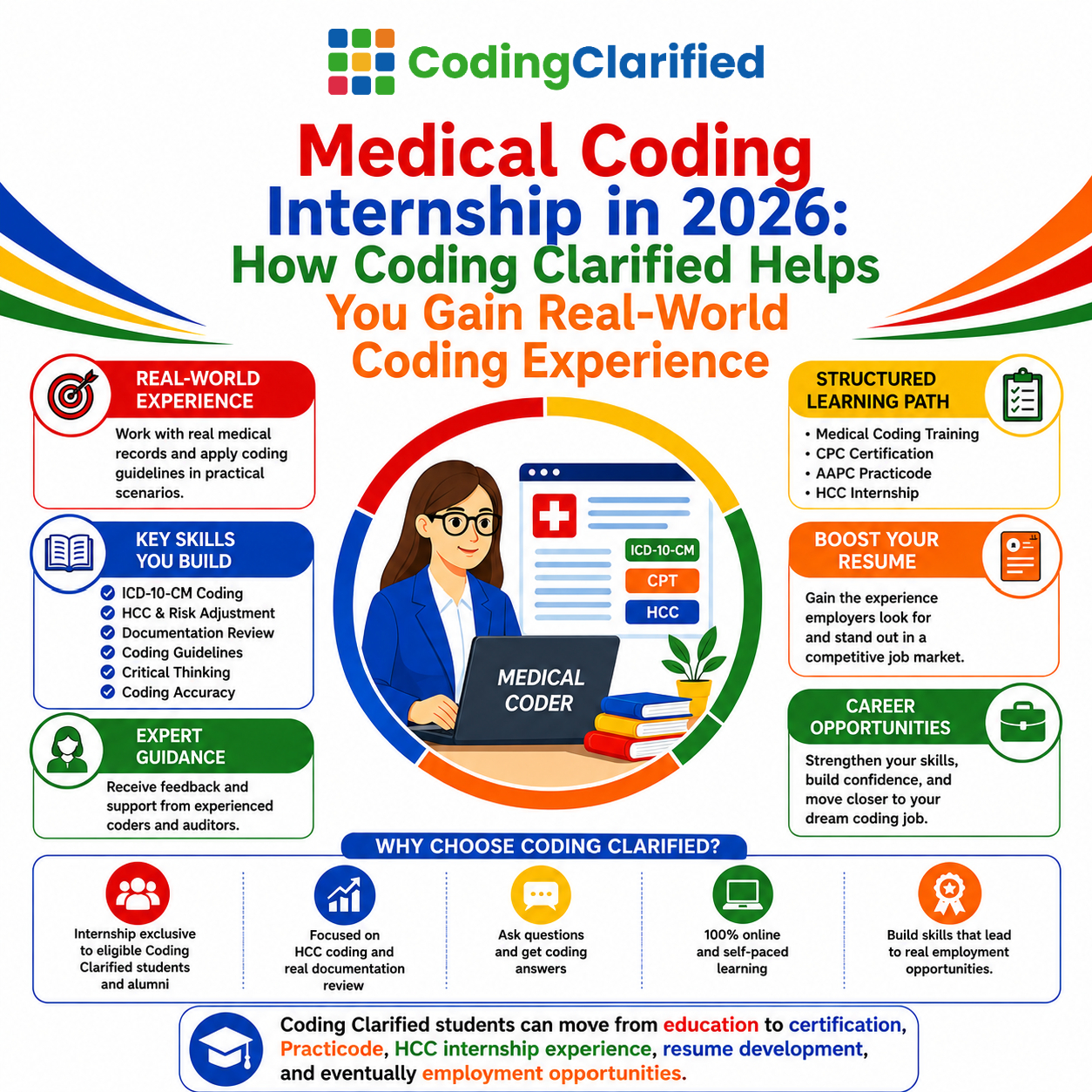
- A medical coding internship can help bridge the gap between earning your certification and landing your first coding job.
- Coding Clarified offers eligible alumni an HCC Medical Coding Internship focused on ICD-10-CM, documentation review, HCC coding, and risk adjustment.
- Students complete Coding Clarified’s training, earn their CPC credential, and complete AAPC Practicode before moving into the Coding Clarified internship pathway.
- AAPC Practicode currently includes 600 cases and can count toward apprentice-removal requirements when AAPC’s current requirements are met.
- Internship experience gives new coders practical skills they can add to their resumes and discuss during job interviews.
- Coding Clarified also offers resume support and a separate Registered Medical Coding Apprenticeship pathway.
- Coders should use current CMS ICD-10-CM guidelines and other authoritative coding resources throughout their training.
- In 2026, employers continue to value certification, accuracy, documentation review, critical thinking, and real-world coding experience.
Why a Medical Coding Internship Matters in 2026
You completed medical coding school, studied hard, passed your certification exam, and started looking for your first job.
Then, you see the same requirement again and again:
Experience required.
However, how can you gain medical coding experience when employers want you to have experience before they hire you?
This continues to be one of the biggest challenges for new medical coders in 2026. Fortunately, a medical coding internship can help bridge the gap between classroom education and professional coding.
Coding Clarified designed its career pathway around this exact problem. Rather than helping students only prepare for the CPC exam, we also focus on giving eligible graduates opportunities to develop practical coding skills after certification.
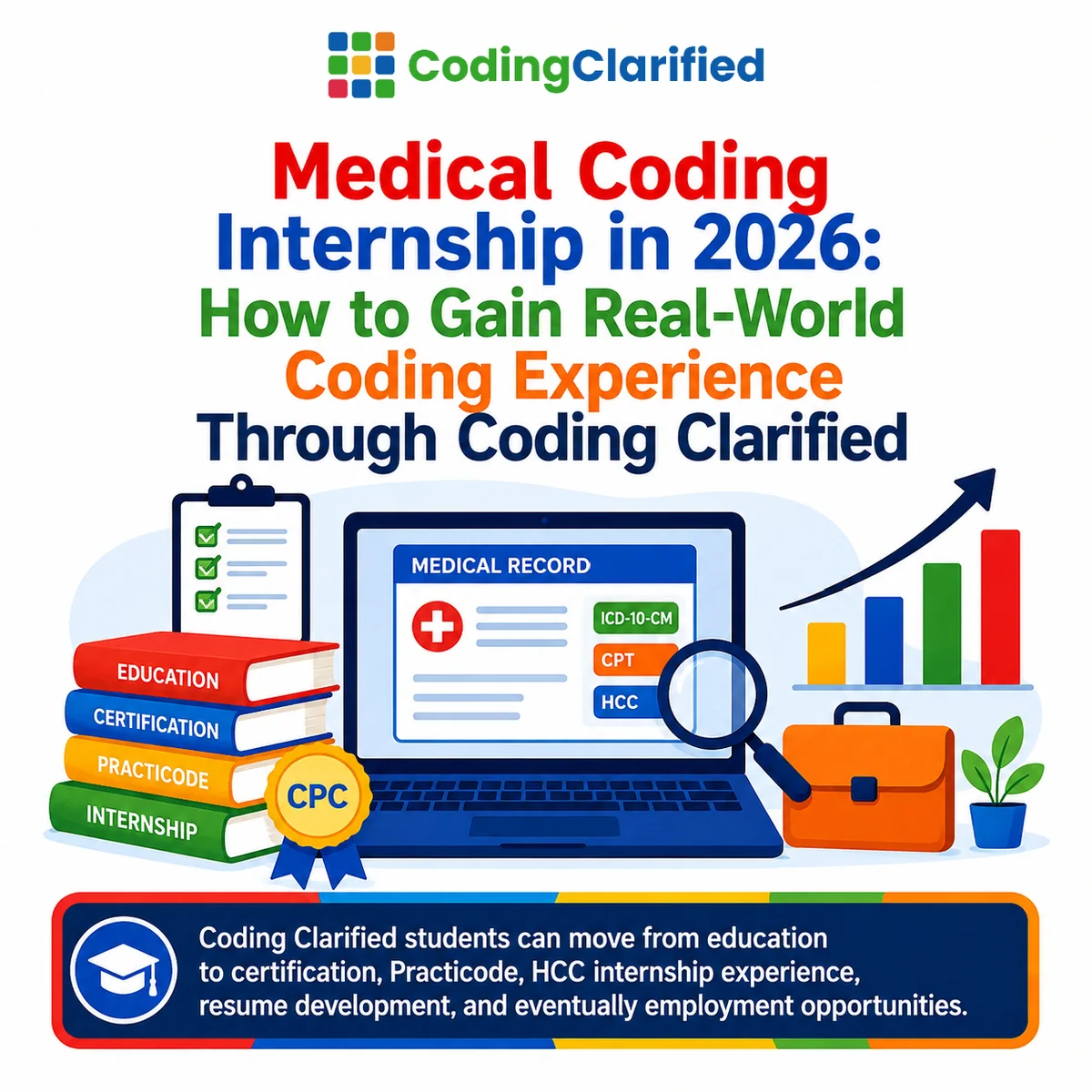
As a result, students can move from education to certification, Practicode, HCC internship experience, resume development, and eventually employment opportunities.
You can learn more about the Coding Clarified HCC Medical Coding Internship.
Why Do Employers Want Medical Coding Experience?
Passing the CPC exam proves that you understand important coding concepts. However, real-world medical records are often more complex than certification questions.
For example, a professional coder may need to review several pages of documentation before identifying the diagnoses and services that should be coded.
Additionally, coders must determine whether the provider’s documentation supports a diagnosis, whether a code is specific enough, and whether coding guidelines affect code selection.
Employers may therefore look for candidates with experience in:
- ICD-10-CM coding
- CPT coding
- HCPCS Level II
- Documentation review
- HCC coding
- Risk adjustment
- Medical terminology
- Anatomy and physiology
- Compliance
- Payer guidelines
- Electronic health records
- Coding research
- Coding accuracy
- Productivity
Furthermore, coding employers want people who understand why a code is correct instead of simply knowing how to search for it.
For another look at what hiring teams expect, read What Medical Coding Recruiters Are Looking for on a Resume in 2026.
What Is the Coding Clarified HCC Medical Coding Internship?
Coding Clarified offers an HCC Medical Coding Internship to eligible Coding Clarified alumni.
Students first complete their medical coding training, earn their certification, and complete Practicode before progressing into the internship.
The internship focuses primarily on:
- ICD-10-CM diagnosis coding
- HCC coding
- Risk adjustment
- Medical record review
- Documentation analysis
- Coding research
- Applying official coding guidelines
- Identifying supported conditions
- Developing coding accuracy
Therefore, students gain experience working through realistic medical documentation rather than relying only on textbook questions.
The goal is to help students begin thinking like working medical coders.
What Do Medical Coding Interns Actually Learn?
Medical coding is not simply a code-lookup job.
Instead, coders must interpret provider documentation and determine what the record supports.
During internship work, a student may need to ask:
- Is this diagnosis currently documented?
- Does the provider support the condition?
- Is a more specific ICD-10-CM code available?
- Does a combination code apply?
- Does an instructional note affect the code?
- Is another diagnosis related to this condition?
- Does the documentation conflict with another part of the chart?
- Should the condition be coded at all?
Consequently, students develop critical-thinking skills alongside code-selection skills.
This becomes particularly important in HCC and risk adjustment coding, where documentation quality and diagnosis specificity can directly affect risk capture.
For additional HCC education, read Medical Coding: Risk Adjustment Model V28.
Why Does Coding Clarified Focus on HCC Coding?
Hierarchical Condition Category coding, commonly called HCC coding, remains an important part of risk adjustment in 2026.
HCC coders review health records and identify supported diagnoses that may affect a patient’s risk profile.
Therefore, HCC coding requires strong ICD-10-CM knowledge as well as careful documentation review.
Students may encounter conditions involving:
- Diabetes
- Chronic kidney disease
- Heart disease
- Cancer
- Neurological disorders
- Vascular disease
- Pulmonary conditions
- Behavioral health conditions
- Other chronic diseases
Furthermore, the CMS-HCC model continues to evolve. Coders working in risk adjustment must stay current with model changes, coding guidance, and documentation requirements.
The Centers for Medicare & Medicaid Services provides official information about ICD-10 coding and annual updates through its CMS ICD-10 resource center.
In addition, coders should review CMS risk-adjustment resources whenever they work with Medicare Advantage HCC coding.
Coding Clarified Internship vs. AAPC Practicode
AAPC Practicode and the Coding Clarified internship both help students develop coding experience, but they serve different purposes.
AAPC describes Practicode as an online practicum that allows coders to apply their skills to real, redacted medical records.
As of 2026, AAPC’s Practicode program includes 600 cases. AAPC requires an overall proficiency of at least 70% for the program to meet its applicable apprentice-removal requirements. AAPC also states that successful CPC-A Practicode completion can earn one year of experience toward removal of the apprentice designation.
You can verify current requirements directly through AAPC’s Practicode information.
Coding Clarified students complete Practicode before moving into our HCC internship.
Consequently, students can receive both structured professional-fee coding practice and additional HCC/risk-adjustment experience.
For practical help getting through Practicode, read our guide AAPC Practicode in 2026: How to Pass Cases, Improve Your Coding Skills, and Complete Practicode Faster.
Can Practicode Help Remove the CPC-A?
Yes, if you meet AAPC’s requirements.
AAPC currently provides several ways to satisfy the experience requirements for removing the apprentice designation.
According to AAPC, Practicode completion requires at least 600 cases with an overall score of 70% or higher when used for the applicable apprentice-removal pathway.
AAPC also recognizes qualifying combinations that can include an 80-hour coding education program and Practicode.
However, students should always verify their individual situation directly with AAPC because policies and documentation requirements can change.
Review the official AAPC Apprentice Removal Requirements before submitting your application.
A Medical Coding Internship Is Different From Certification Training
Certification training teaches you coding concepts.
An internship helps you practice applying those concepts.
For example, CPC training teaches students about CPT, ICD-10-CM, HCPCS Level II, anatomy, terminology, modifiers, guidelines, and coding conventions.
Meanwhile, internship experience forces students to apply that knowledge to medical documentation.
That difference is important.
A textbook may tell you exactly which diagnosis to code. By contrast, a medical record may contain multiple diagnoses, historical conditions, uncertain diagnoses, medications, test results, and conflicting documentation.
Therefore, interns must learn how to decide what actually matters for coding.
The Coding Clarified Career Pathway
Coding Clarified’s goal goes beyond helping students pass the CPC exam.
Instead, we want students to develop the skills needed to move toward employment.
A typical pathway may look like this:
Medical Coding Training → CPC Certification → AAPC Practicode → Coding Clarified HCC Internship → Professional Resume → Job Search → Potential Employer-Based Apprenticeship
Each stage provides something different.
First, training builds your knowledge.
Next, certification demonstrates your understanding of coding concepts.
Practicode provides structured case experience.
Then, the HCC internship provides additional diagnosis-coding and documentation-review experience.
Finally, resume support and job-search guidance help students communicate those skills to employers.
Medical Coding Internship vs. Medical Coding Apprenticeship
Students should also understand the difference between an internship and an apprenticeship.
The Coding Clarified HCC internship is an educational experience intended to build practical coding skills.
A Registered Apprenticeship, however, is employment.
According to the U.S. Department of Labor’s Apprenticeship.gov, Registered Apprenticeship programs combine paid work experience, mentorship, related instruction, and structured skill development.
Registered Apprenticeship programs can also include occupations involving medical records, health information, and medical coding.
Learn more from the official Apprenticeship.gov Healthcare Registered Apprenticeship resources.
Coding Clarified also maintains a separate Registered Medical Coding Apprenticeship pathway for qualified candidates and participating employers.
However, a paid apprenticeship requires an employer to interview and hire the candidate. Therefore, apprenticeship placement cannot be guaranteed.
How a Medical Coding Internship Helps Your Resume
One of the hardest parts of entering medical coding is writing a resume when you have little or no paid coding experience.
An internship gives you relevant experience to discuss.
Depending on the work you actually completed, your resume may include skills such as:
- ICD-10-CM coding
- HCC coding
- Risk adjustment
- Medical documentation review
- Coding guideline application
- Coding research
- Remote coding workflow
- Quality review
- Coding accuracy
- Auditor feedback
Additionally, practical experience can provide examples to discuss during interviews.
Instead of saying, “I learned ICD-10-CM in school,” you may be able to explain how you reviewed documentation, researched coding guidance, and resolved difficult coding situations.
For detailed resume guidance, read Medical Coding Resume Tips for 2026: How to Get More Interviews.
CPC Student Tips for Getting the Most From a Medical Coding Internship
Treat your internship like a professional coding job.
First, create a consistent coding schedule. Completing charts regularly can help build stronger habits than coding once every few weeks.
Additionally, research your questions before immediately asking someone for the answer.
Use your:
- ICD-10-CM code book
- CPT code book
- HCPCS Level II book
- Official guidelines
- CMS resources
- AAPC resources
- Instructor feedback
Furthermore, keep a list of the mistakes you make repeatedly.
For example, you may notice difficulty with:
- Combination codes
- Code specificity
- Excludes notes
- “Code first” instructions
- “Use additional code” instructions
- Causal relationships
- Laterality
- Documentation requirements
- HCC capture
Once you recognize a pattern, study that area more closely.
Most importantly, learn why your answer was wrong.
Correcting the same mistake repeatedly does not build skill. Understanding the rule behind the correction does.
Use the Official ICD-10-CM Guidelines
Internships provide valuable practice, but coders still need authoritative resources.
CMS and the National Center for Health Statistics publish the Official ICD-10-CM Guidelines for Coding and Reporting.
These guidelines explain important concepts involving:
- Code assignment
- Signs and symptoms
- Combination codes
- Laterality
- Sequela
- Acute and chronic conditions
- Uncertain diagnoses
- Chapter-specific rules
- Outpatient coding
- Inpatient coding
Therefore, students should become comfortable using the guidelines instead of relying entirely on internet searches.
The official FY 2026 ICD-10-CM Guidelines apply to the FY 2026 coding year.
CMS has also released new ICD-10-CM codes effective October 1, 2026, for FY 2027. Therefore, coders must always use the code set that applies to the date of service.
Common Mistakes to Avoid During a Medical Coding Internship
Rushing Through Charts
New coders sometimes focus on speed because professional coding jobs have productivity standards.
However, accuracy should come first while you are learning.
Build strong coding habits first. Then, improve your speed as your confidence grows.
Coding From Memory
Do not select a code simply because you remember using it previously.
Instead, verify the code in the Alphabetic Index and Tabular List when appropriate. Additionally, review instructional notes and coding guidelines.
Ignoring the Full Medical Record
A diagnosis may appear in one portion of a chart but require additional context.
Therefore, review all relevant documentation before making a coding decision.
Ignoring Feedback
Corrections are part of the learning process.
When an auditor or instructor changes your answer, determine why.
Furthermore, write down the guideline or documentation issue that led to the correction.
Looking Only for HCCs
Risk-adjustment coders should never force a diagnosis simply because it maps to an HCC.
The medical record must support the code.
Accuracy and compliance always come before risk capture.
Being Afraid to Ask Questions
Good coders ask questions.
However, research the problem first whenever possible.
Then, explain what you reviewed and why you remain unsure. This approach strengthens your critical-thinking skills.
Expecting an Internship to Guarantee Employment
An internship can improve your skills and strengthen your resume.
Nevertheless, no legitimate program can guarantee that every person will immediately receive a coding job.
Employers still make hiring decisions based on qualifications, interviews, staffing needs, experience, specialty requirements, location, and many other factors.
How to Turn Internship Experience Into Your First Medical Coding Job
Once you complete your internship, update your resume immediately.
Highlight the coding systems, specialties, documentation-review skills, and other relevant experience you actually gained.
Next, optimize your resume for Applicant Tracking Systems.
Medical coding job descriptions frequently include keywords such as:
- CPC
- ICD-10-CM
- CPT
- HCPCS
- HCC
- Risk adjustment
- Medical records
- Coding accuracy
- Compliance
- Documentation review
However, only use keywords that accurately describe your qualifications.
Additionally, continue practicing your coding skills while applying for jobs.
Networking can also help.
Attend AAPC local chapter meetings, participate in coding webinars, connect with other professionals, and maintain a professional LinkedIn profile.
Most importantly, do not limit your search to job titles containing only “medical coder.”
Depending on your background, related opportunities may include:
- Risk adjustment coder
- HCC coder
- Coding specialist
- Medical records specialist
- Coding quality specialist
- Revenue cycle specialist
- Claims specialist
- Charge entry specialist
What Is the Job Outlook for Medical Coders?
The U.S. Bureau of Labor Statistics tracks medical coders within the broader Medical Records Specialists occupation.
BLS projects employment of medical records specialists to grow 8% from 2025 through 2035, which is faster than the average for all occupations.
Additionally, BLS projects about 14,000 openings per year, on average, during that period.
Review the current occupational outlook through the U.S. Bureau of Labor Statistics Medical Records Specialists page.
Consequently, medical coding can continue to offer opportunities, although entry-level applicants should expect competition.
Certification combined with practical coding experience can help candidates differentiate themselves.
Does AI Make Medical Coding Internships Less Important?
No.
Artificial intelligence and computer-assisted coding tools continue to change medical coding workflows. However, technology does not eliminate the need to understand coding guidelines, clinical documentation, compliance, payer requirements, and code selection.
In fact, those skills may become even more important.
A coder must be able to recognize when a suggested code is incorrect, unsupported, outdated, or inconsistent with the medical record.
Therefore, students should learn to use technology as a tool while continuing to develop their own coding judgment.
Why Real-World Experience Can Make You a Stronger Coding Candidate
Certification tells an employer that you passed an exam.
Experience helps demonstrate that you can apply what you learned.
An internship also gives students an opportunity to make mistakes in a learning environment, receive feedback, improve their research skills, and become more comfortable reviewing complex records.
Consequently, graduates may enter interviews with more confidence.
They can also discuss actual coding challenges instead of relying entirely on textbook examples.
Final Thoughts: Turning Certification Into a Medical Coding Career
Passing the CPC exam is a major achievement.
However, certification represents the beginning of your medical coding career rather than the end of your education.
Real-world practice helps turn knowledge into skill.
That is why Coding Clarified’s pathway extends beyond certification.
Through CPC training, Practicode, the HCC Medical Coding Internship, professional resume support, job-search resources, and potential Registered Apprenticeship opportunities, eligible students can continue building experience as they move toward employment.
Most importantly, keep learning.
Medical coding changes every year. Coders who continue improving their ICD-10-CM, CPT, HCPCS, documentation, compliance, and research skills give themselves the best opportunity to build long-term careers.
Frequently Asked Questions About Medical Coding Internships in 2026
Quick answers to the questions students ask most about the Coding Clarified medical coding internship.
Does Coding Clarified Offer a Medical Coding Internship?
Yes. Coding Clarified offers an HCC Medical Coding Internship to eligible Coding Clarified alumni.
Students complete the required program steps before entering the internship. The experience focuses primarily on ICD-10-CM, HCC coding, risk adjustment, and medical documentation review.
Do I Need a Medical Coding Internship to Get a Job?
Not every employer requires an internship.
However, practical coding experience may help entry-level applicants demonstrate that they can apply coding knowledge outside a classroom or certification exam.
Furthermore, internships give candidates relevant experience to include on their resumes and discuss during interviews.
Do Coding Clarified Students Complete Practicode Before the Internship?
Yes. Coding Clarified’s current internship pathway requires students to complete their training, become certified, and finish Practicode before moving into the HCC internship.
Practicode provides structured coding practice, while the Coding Clarified internship provides additional HCC and risk-adjustment experience.
Does Practicode Remove the CPC-A?
AAPC currently states that successful Practicode completion can satisfy one year of experience toward apprentice removal.
AAPC’s current requirements include completion of at least 600 cases with an overall score of 70% or higher for the applicable Practicode pathway.
Because policies can change, always review AAPC’s current apprentice-removal requirements.
Is the Coding Clarified Internship the Same as a Paid Apprenticeship?
No.
An internship provides learning and practical coding experience.
A Registered Apprenticeship is an employer-based pathway that includes paid work experience, related instruction, and structured training.
Coding Clarified has a separate Registered Medical Coding Apprenticeship pathway. However, candidates must interview with and be hired by a participating employer before beginning paid apprenticeship employment.
What Coding Skills Can I Gain From an HCC Internship?
Students can strengthen skills involving ICD-10-CM, medical record review, HCC coding, risk adjustment, documentation analysis, guideline research, and coding accuracy.
Furthermore, exposure to different conditions can help students become more comfortable reviewing complex medical records.
Can I Put My Medical Coding Internship on My Resume?
Yes.
Include the internship as relevant experience and accurately describe the work you completed.
For example, you may list ICD-10-CM coding, HCC coding, risk-adjustment review, medical-record analysis, coding research, and other skills that accurately reflect your experience.
For more help, see our 2026 Medical Coding Resume Guide.
What Should I Do After Completing a Medical Coding Internship?
Update your resume and LinkedIn profile, continue practicing your coding skills, network with coding professionals, and apply consistently for positions that match your qualifications.
Additionally, continue reviewing current CMS, AAPC, and official coding resources.
The goal is to keep progressing from:
Education → Certification → Practice → Internship Experience → Job Search → Employment
Related Coding Clarified Articles
Continue building your medical coding career with these resources:
- AAPC Practicode in 2026: How to Pass Cases, Improve Your Coding Skills, and Complete Practicode Faster
- Medical Coding Resume Tips for 2026: How to Get More Interviews
- What Medical Coding Recruiters Are Looking for on a Resume in 2026
- Medical Coding: Risk Adjustment Model V28
- Coding Clarified Medical Coding Blog
- About Coding Clarified
Authoritative Medical Coding Resources
For current coding, certification, internship, and workforce guidance, bookmark these trusted resources:
- AAPC – Apprentice Removal Requirements
- AAPC – CPC-A Practicode
- CMS – ICD-10-CM and ICD-10-PCS Coding Resources
- CMS – FY 2026 ICD-10-CM Official Guidelines for Coding and Reporting
- U.S. Department of Labor – Healthcare Registered Apprenticeships
- U.S. Bureau of Labor Statistics – Medical Records Specialists