
AAPC Practicode in 2026: How to Pass Cases, Improve Your Coding Skills, and Complete Practicode Faster
Key Takeaways
- AAPC Practicode helps new coders apply real-world coding skills before entering the workforce.
- Reading the medical record in the correct order saves time and reduces coding errors.
- Strong documentation review skills matter just as much as knowing CPT®, ICD-10-CM, and HCPCS Level II codes.
- Every Practicode case teaches coding logic, not just code selection.
- Avoid guessing when documentation is incomplete. Instead, code only what the provider documents.
- Following a consistent workflow improves both accuracy and speed.
- Practicing difficult specialties repeatedly builds confidence before taking a coding job.
Learning medical coding is one thing. Applying those skills to actual patient records is another challenge entirely. That is where AAPC Practicode becomes valuable.
Many new CPC students know the coding guidelines but struggle when faced with a complete patient chart. They often wonder where to begin, which documentation matters most, and how to determine the correct diagnosis and procedure codes.
Fortunately, Practicode bridges that gap. It allows future medical coders to practice with realistic patient cases while receiving immediate feedback. As a result, students develop confidence before applying for their first coding position.
This updated 2026 guide explains how AAPC Practicode works, how to approach each case step-by-step, practical tips that improve your scores, and common mistakes to avoid along the way.
What Is AAPC Practicode?
AAPC Practicode is an online medical coding training program that allows students to code simulated patient encounters using actual coding manuals and documentation.
Instead of answering multiple-choice questions, students review complete medical records just like professional coders.
Each case typically includes:
- Provider documentation
- History and physical examination
- Operative reports
- Progress notes
- Laboratory reports
- Imaging reports
- Pathology reports when appropriate
After reviewing the documentation, students assign the correct:
- ICD-10-CM diagnosis codes
- CPT® procedure codes
- HCPCS Level II codes when applicable
- Modifiers when supported by documentation
Because every case mimics real coding situations, Practicode helps students think like professional coders instead of memorizing codes.
Why Practicode Matters in 2026
Healthcare documentation continues to become more detailed every year. Consequently, employers expect new coders to understand both coding guidelines and documentation analysis.
Practicode helps students develop skills employers value, including:
- Medical record review
- Coding guideline application
- Documentation interpretation
- Modifier selection
- Coding confidence
- Productivity improvement
Additionally, many CPC students use Practicode toward removing their CPC-A apprenticeship designation when combined with other qualifying experience according to AAPC requirements.
How to Start Every Practicode Case
One of the biggest mistakes beginners make is immediately searching for procedure codes.
Instead, develop a consistent workflow.
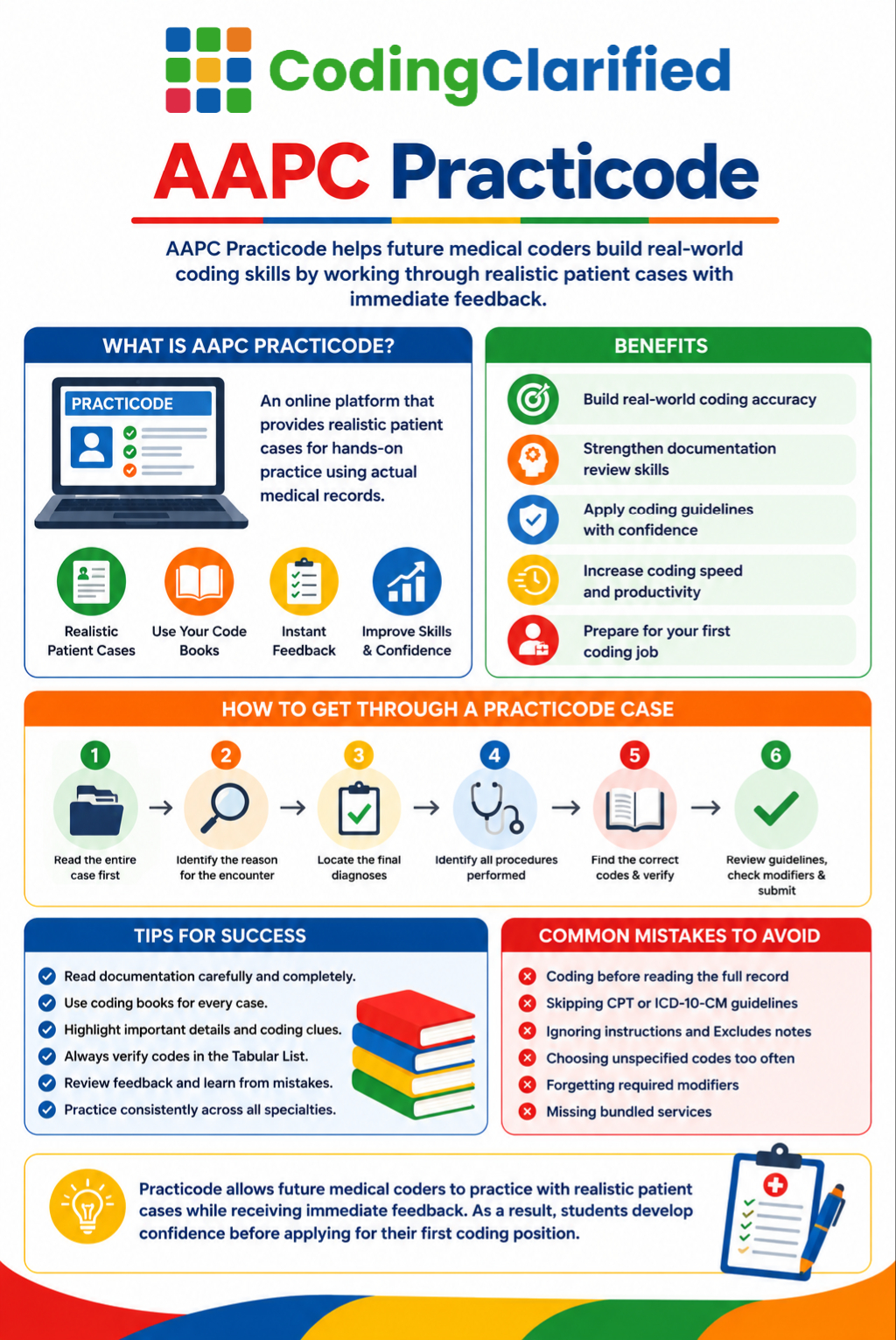
Step 1: Read the Entire Case First
Never code while reading the first paragraph.
Rather, read the complete encounter from beginning to end before opening your code books.
This gives you:
- Clinical context
- Reason for the visit
- Final diagnoses
- Procedures performed
- Medical decision making
Having the full picture makes coding much easier.
Step 2: Identify the Reason for the Encounter
Ask yourself:
Why did this patient receive care today?
Look for documentation describing:
- Chief complaint
- History of present illness
- Assessment
- Final diagnosis
This information guides your diagnosis code selection.
Step 3: Find the Final Diagnoses
Avoid coding suspected conditions unless the documentation supports doing so under outpatient coding rules.
Instead, code confirmed conditions documented by the provider.
Pay close attention to:
- Assessment
- Impression
- Final diagnosis
- Operative diagnosis
- Discharge diagnosis
These sections usually contain the diagnoses you will report.
Step 4: Identify Every Procedure Performed
Next, determine exactly what the provider did.
Look for:
- Surgical procedures
- Office procedures
- Injections
- Imaging
- Laboratory services
- Evaluation and Management (E/M) services
Always verify documentation supports each reported procedure.
Step 5: Highlight Important Details
Many experienced coders annotate documentation while reviewing records.
Highlight items such as:
- Laterality
- Anatomical site
- Number of lesions
- Size measurements
- Surgical approach
- Medical necessity
- Complications
- Supplies
- Follow-up care
These details often determine the correct code selection.
How to Find the Correct Diagnosis Codes
Always begin in the Alphabetic Index.
Next, verify every code in the Tabular List.
Never assign a diagnosis directly from the Alphabetic Index.
Instead, confirm:
- Laterality
- Includes notes
- Excludes1 notes
- Excludes2 notes
- Seventh characters
- Placeholder “X”
- Combination codes
Skipping verification causes many Practicode errors.
How to Find the Correct CPT Codes
Procedure coding requires careful documentation review.
Start by asking:
What service did the provider perform?
Then identify:
- Procedure name
- Anatomical location
- Surgical approach
- Extent of service
- Additional procedures
- Bundled services
- Required modifiers
After locating the code in the CPT Index, verify it within the main CPT section.
Never rely solely on the Index.
Read Every CPT Guideline
Students frequently skip CPT guidelines.
Unfortunately, many Practicode questions test those instructions.
Always review:
- Parenthetical notes
- Inclusion notes
- Exclusion notes
- Modifier instructions
- Add-on code guidance
Those details often determine whether your answer is correct.
Use the Medical Record Like a Professional Coder
Professional coders rarely read charts from top to bottom only once.
Instead, they move through documentation multiple times.
A typical workflow includes:
- Read the entire record.
- Review diagnoses.
- Identify procedures.
- Verify documentation.
- Locate diagnosis codes.
- Locate procedure codes.
- Review coding guidelines.
- Double-check modifiers.
- Confirm medical necessity.
Following a routine reduces missed information.
Watch for Coding Clues
Providers often document valuable coding clues.
For example:
- “Initial encounter”
- “Subsequent encounter”
- “Routine healing”
- “Complicated repair”
- “Excision”
- “Biopsy”
- “Benign”
- “Malignant”
- “Foreign body removed”
Small wording differences frequently change the reported code.
Do Not Rush Through Cases
Many students believe finishing quickly means they are improving.
Actually, coding accurately matters far more than coding rapidly.
Speed naturally increases after consistent practice.
Focus on:
- Documentation
- Guidelines
- Accuracy
- Code verification
Eventually, efficiency follows.
Learn From Every Incorrect Answer
One of Practicode’s greatest strengths is immediate feedback.
After completing a case:
- Review every incorrect answer.
- Compare documentation.
- Read coding guidelines again.
- Understand why another code was selected.
Learning from mistakes builds long-term coding confidence.
Common Practicode Specialties
Students typically encounter cases involving:
- Family medicine
- Internal medicine
- Emergency medicine
- Dermatology
- Orthopedics
- General surgery
- Gastroenterology
- Cardiology
- Obstetrics and gynecology
Practicing multiple specialties develops well-rounded coding skills.
CPC Student Tips for Practicode Success
If you are preparing for the CPC exam or your first coding job, these strategies help tremendously.
Use Your Code Books Every Time
Even if you know the code, verify it.
Professional coders constantly reference coding manuals.
Slow Down During Surgical Cases
Operative reports contain important details.
Read them carefully before selecting any procedure codes.
Review Anatomy Often
Knowing anatomy makes code selection much easier.
Review body systems regularly while completing Practicode cases.
Keep a Coding Notebook
Write down:
- New guidelines
- Difficult cases
- Modifier rules
- Coding reminders
- Common documentation phrases
This becomes an excellent study resource.
Practice Consistently
Completing one or two cases every week slows progress.
Instead, schedule regular practice sessions.
Consistency produces better coding habits.
Common Mistakes to Avoid
Many new coders lose points for the same reasons.
Avoid these common errors:
- Coding before reading the full record
- Skipping CPT guidelines
- Ignoring ICD-10-CM instructional notes
- Choosing unspecified codes when documentation supports greater specificity
- Forgetting required modifiers
- Missing bundled procedures
- Reporting diagnoses not documented by the provider
- Failing to verify codes in the Tabular List
- Rushing through difficult surgical documentation
- Not reviewing incorrect answers after grading
Avoiding these habits greatly improves Practicode performance.
How Practicode Helps Prepare You for Your First Coding Job
Employers want coders who can analyze documentation—not simply memorize code numbers.
Practicode strengthens your ability to:
- Read provider documentation
- Identify billable services
- Apply coding guidelines
- Understand medical terminology
- Improve coding productivity
- Build coding confidence
These practical skills make the transition into your first coding position much smoother.
Coding Clarified Final Thoughts
AAPC Practicode offers much more than coding practice. It teaches students how professional medical coders think through patient documentation from beginning to end.
Rather than chasing codes, successful coders first understand the patient’s story. They review documentation carefully, apply official coding guidelines, verify every code, and learn from each completed case.
Above all, consistency wins. Every Practicode case strengthens your coding judgment and prepares you for both the CPC exam and a future medical coding career.
Frequently Asked Questions About AAPC Practicode
How long does it take to complete AAPC Practicode?
Completion time varies by experience. Most students spend several weeks to a few months working through the cases while improving their coding skills.
Does Practicode remove the CPC-A designation?
Practicode may count toward removing the CPC-A apprenticeship designation when combined with other qualifying experience and requirements established by AAPC. Always review the latest AAPC policies before submitting documentation.
Can beginners complete Practicode?
Yes. However, students should understand medical terminology, anatomy, ICD-10-CM, CPT®, and HCPCS Level II coding before starting.
Should I use my coding books during Practicode?
Absolutely. Practicode is designed to help students practice using official coding manuals just as professional coders do every day.
What types of medical records are included?
Cases may include office visits, surgeries, emergency department encounters, imaging, laboratory reports, and specialty-specific documentation.
What should I do if I get a case wrong?
Review the explanation carefully, compare it with the documentation, reread the applicable coding guidelines, and identify why the correct answer differs from yours. That review process is one of the best ways to improve.
Does Practicode prepare me for a medical coding job?
Yes. Practicode develops documentation review, coding accuracy, critical thinking, and guideline application skills that employers look for in entry-level medical coders.
Related Coding Clarified Articles
Continue building your coding knowledge with these helpful resources:
- Unlock Medical Coder Success with AAPC Practicode
- Using AAPC Codify for Practicode
- Should I Complete the AAPC Medical Coding Practicode Program?
- Abstracting from the EHR
- What Medical Coding Recruiters Are Looking for on a Resume in 2026
- Medical Coding Resume Tips for 2026 | Get More Interviews
- CPC Interview Tips
- The Truth About CPC-A Jobs 2026
- Coding Clarified Apprenticeship FAQs
Authoritative References
- AAPC Job Board
- Medical Coding Mistakes That Could Cost You
- American Academy of Professional Coders (AAPC)
- Centers for Medicare & Medicaid Services (CMS)
- National Correct Coding Initiative (NCCI)
- ICD-10-CM Official Guidelines for Coding and Reporting
This article is part of our CPC exam prep study hub, with everything you need to prepare for and pass the CPC exam.