
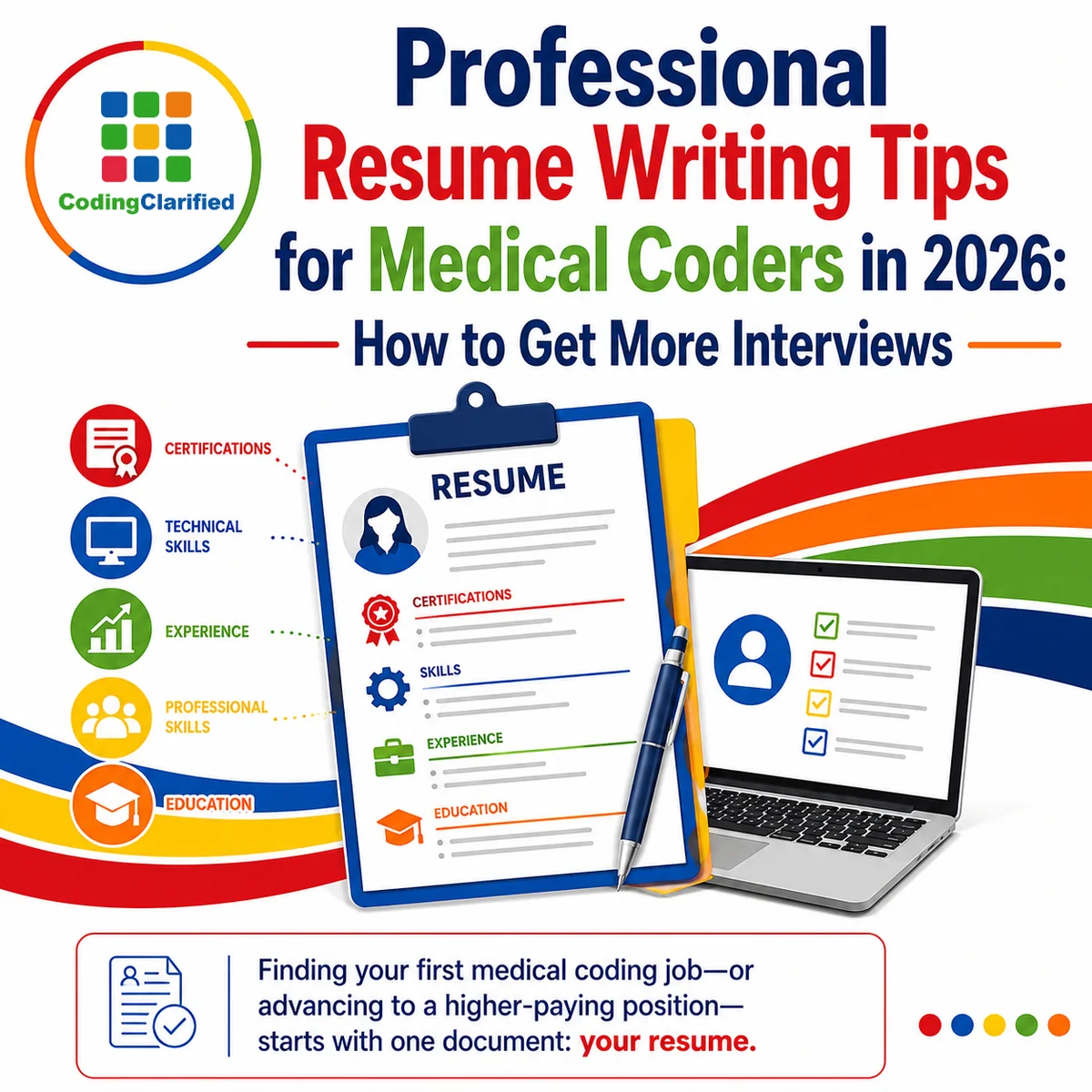
Professional Resume Writing Tips for Medical Coders in 2026: How to Get More Interviews
Key Takeaways
- A strong medical coding resume highlights your coding knowledge, certifications, and measurable achievements.
- Employers in 2026 increasingly use Applicant Tracking Systems (ATS), making keyword optimization essential.
- New CPC students can build competitive resumes even without extensive coding experience.
- Including coding software, healthcare systems, and compliance knowledge helps your resume stand out.
- Tailoring your resume for each position significantly improves your chances of landing an interview.
- Continuing education and annual coding updates demonstrate your commitment to professional growth.
Professional Resume Writing Tips for Medical Coders in 2026
Finding your first medical coding job, or advancing to a higher-paying position, starts with one document: your resume.
Many qualified coders struggle to secure interviews because their resumes fail to showcase the skills employers actually want. A well-written resume not only demonstrates your coding knowledge but also proves that you understand healthcare documentation, compliance, and today’s rapidly evolving medical coding industry.
In 2026, employers expect much more than a list of previous jobs. Healthcare organizations increasingly use Applicant Tracking Systems (ATS) to screen resumes before a hiring manager ever reads them. As a result, resumes must be both recruiter-friendly and ATS-friendly.
Whether you’re preparing for your first CPC position, transitioning from another healthcare career, or seeking a remote coding job, these professional resume writing tips will help you create a resume that gets noticed.
Why Your Medical Coding Resume Matters More Than Ever in 2026
Healthcare hiring continues to evolve as artificial intelligence, automation, and stricter compliance requirements reshape medical coding.
Although AI assists with code suggestions and documentation review, employers still rely on certified medical coders to ensure coding accuracy, apply official coding guidelines correctly, and protect reimbursement integrity.
Today’s employers often look for candidates who demonstrate:
- Medical coding certification
- Strong ICD-10-CM knowledge
- CPT® coding proficiency
- HCPCS Level II familiarity
- Electronic Health Record (EHR) experience
- Knowledge of payer policies
- HIPAA compliance
- Attention to detail
- Communication skills
- Continuous learning
Instead of simply listing responsibilities, your resume should clearly explain how your skills benefit healthcare organizations.
Start with a Strong Professional Summary
Hiring managers frequently spend less than 30 seconds reviewing an initial resume. Consequently, your professional summary should immediately communicate your qualifications.
Rather than writing a vague objective, create a concise summary that highlights your certification, coding strengths, healthcare experience, and career goals.
Example for an Entry-Level CPC
Certified Professional Coder (CPC) with comprehensive training in ICD-10-CM, CPT®, and HCPCS Level II coding. Strong understanding of medical terminology, anatomy, physiology, and healthcare documentation. Detail-oriented professional seeking an opportunity to contribute accurate coding, compliance, and reimbursement support while continuing to expand coding expertise.
Example for an Experienced Medical Coder
Certified Professional Coder (CPC) with over five years of experience assigning accurate ICD-10-CM, CPT®, and HCPCS Level II codes across multiple specialties. Skilled in payer guidelines, auditing, documentation improvement, and revenue cycle management. Recognized for maintaining high coding accuracy and reducing claim denials.
Tailor Every Resume to the Job Description
One of the biggest mistakes applicants make is sending the same resume to every employer.
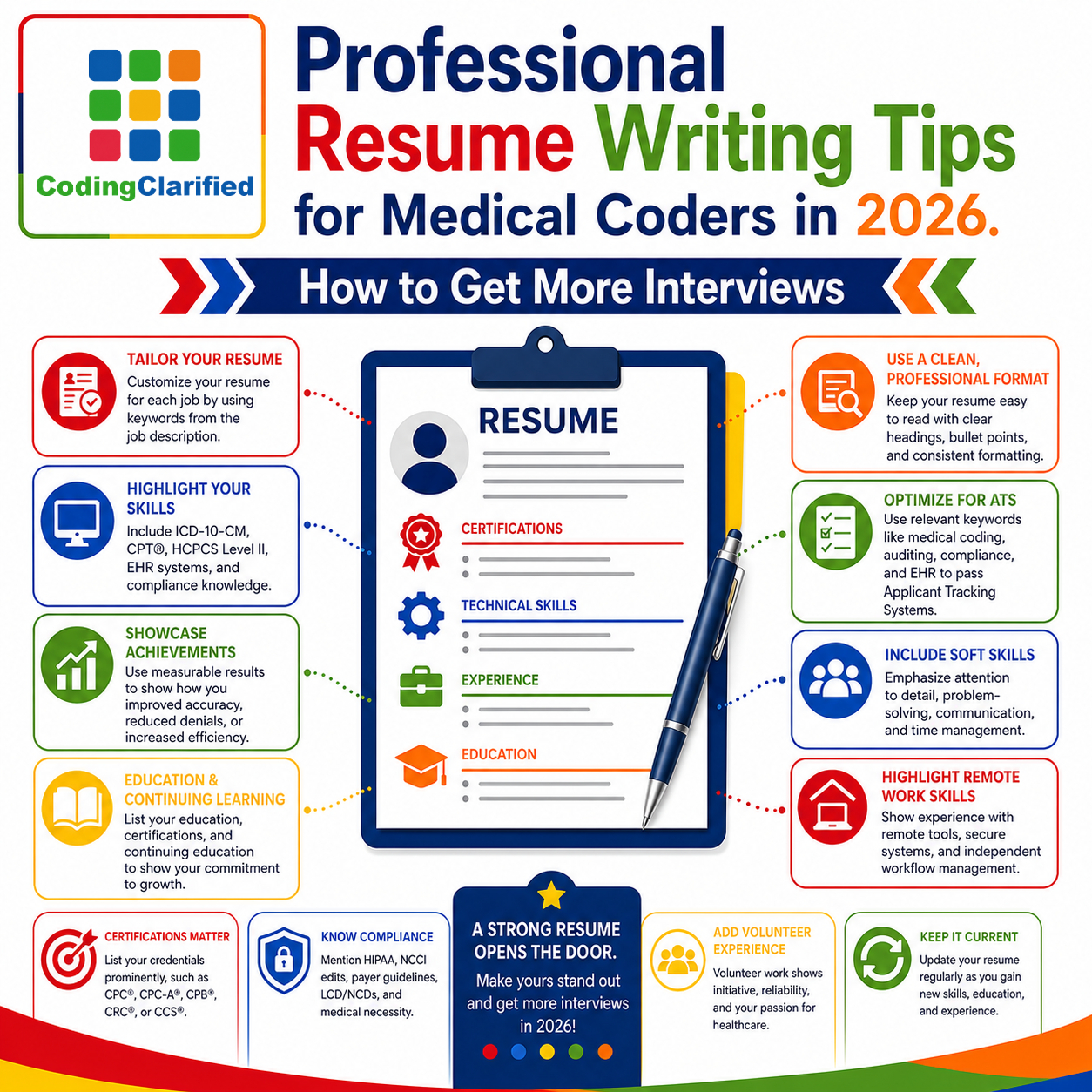
Instead, review each job posting carefully and incorporate relevant keywords throughout your resume whenever they accurately reflect your qualifications.
For example, an employer may emphasize:
- Outpatient coding
- Professional fee coding
- Risk adjustment
- Evaluation and Management (E/M)
- Auditing
- Medical necessity
- Compliance
- Revenue Cycle Management (RCM)
Including these terms naturally throughout your resume improves ATS performance while helping recruiters quickly identify your qualifications.
Highlight Your Medical Coding Certifications
Your certification is often one of the first qualifications employers search for.
Create a dedicated Certifications section near the top of your resume.
Examples include:
- CPC®
- CPC-A®
- CPB®
- CRC®
- COC®
- CCS®
- CCS-P®
If you recently earned your certification, proudly include the completion date.
Example:
Certified Professional Coder (CPC®)
AAPC | Earned 2026
If you’re currently completing additional education, include anticipated completion dates where appropriate.
Showcase Technical Medical Coding Skills
Many resumes focus almost entirely on work history while overlooking technical competencies.
Instead, create a dedicated Skills section that clearly demonstrates your coding knowledge.
Consider including skills such as:
Coding Systems
- ICD-10-CM
- CPT®
- HCPCS Level II
Healthcare Knowledge
- Medical terminology
- Anatomy and physiology
- Pharmacology
- Documentation review
Compliance
- HIPAA
- NCCI edits
- LCD/NCD policies
- Medical necessity
- Coding guidelines
Software
- Epic
- Cerner
- athenahealth
- Meditech
- 3M Encoder
- TruCode Encoder
- Microsoft Excel
- Microsoft Word
Only include software you have actually used or received formal training on.
Demonstrate Results Instead of Listing Duties
Employers want evidence that you can contribute to their organization.
Rather than writing:
- Reviewed patient charts
- Assigned diagnosis codes
- Entered billing information
Show measurable accomplishments whenever possible.
Examples include:
- Maintained 98% coding accuracy during quality audits.
- Reduced coding errors by improving documentation review procedures.
- Processed over 100 patient charts daily while meeting productivity goals.
- Assisted providers with coding clarification to improve claim acceptance.
- Supported revenue cycle initiatives that decreased claim denials.
Even students can demonstrate achievements gained through coursework, internships, Practicode, volunteer experience, or simulated coding exercises.
Include Relevant Healthcare Experience
Not every future medical coder starts with coding experience.
Healthcare employers value transferable skills from positions such as:
- Medical assistant
- Certified nursing assistant
- Patient access representative
- Medical receptionist
- Insurance verification specialist
- Prior authorization specialist
- Medical records clerk
- Billing specialist
These positions demonstrate familiarity with healthcare workflows, patient documentation, insurance requirements, and HIPAA compliance.
When describing previous jobs, emphasize accomplishments that relate directly to medical coding.
For example:
Instead of:
Answered patient phone calls.
Consider:
Coordinated patient scheduling while verifying insurance eligibility and maintaining HIPAA compliance.
Likewise, replace generic responsibilities with accomplishments whenever possible.
Education Still Matters
Even experienced coders should clearly list their education and professional training.
Include:
- Medical coding program
- College degrees
- Coding boot camps
- Certificate programs
- Relevant healthcare coursework
- Continuing education
If you recently completed a coding program, highlight coursework such as:
- ICD-10-CM coding
- CPT® coding
- HCPCS Level II coding
- Medical terminology
- Anatomy and physiology
- Pathophysiology
- Reimbursement methodologies
- Compliance
- Healthcare law
These details help demonstrate your readiness for entry-level coding positions.
Optimize Your Resume for Applicant Tracking Systems (ATS)
Many healthcare employers receive hundreds of applications for a single medical coding position. Before a hiring manager reviews your resume, an Applicant Tracking System (ATS) often scans it for relevant keywords.
An ATS does not determine whether you are a good coder. Instead, it identifies resumes that closely match the job description. Therefore, using appropriate keywords can improve your chances of moving to the next stage of the hiring process.
Common ATS keywords include:
- Medical coding
- ICD-10-CM
- CPT®
- HCPCS Level II
- Revenue Cycle Management (RCM)
- Electronic Health Record (EHR)
- Medical necessity
- Compliance
- Auditing
- Risk adjustment
- Evaluation and Management (E/M)
- Outpatient coding
- Physician coding
- Inpatient coding
- Documentation review
- HIPAA
- Denial management
- Charge capture
- Coding accuracy
- Quality assurance
Use these terms naturally throughout your resume when they accurately reflect your experience. Avoid keyword stuffing, which can make your resume difficult to read and may work against you.
Keep Your Resume Clean and Easy to Read
Even the most qualified candidate can be overlooked if their resume is cluttered or difficult to scan.
Aim for a professional, organized layout that guides the reader through your qualifications.
Resume Formatting Tips
- Use one professional font such as Calibri, Arial, or Aptos.
- Keep font size between 10 and 12 points for body text.
- Use bold headings to separate sections.
- Leave adequate white space throughout the document.
- Keep bullet points concise.
- Save your resume as a PDF unless the employer requests another format.
- Limit your resume to one page if you are a recent graduate. Experienced coders may use two pages when appropriate.
A clean layout allows recruiters to quickly locate the information they need.
Include Keywords from the Job Posting
Every employer has unique priorities. Consequently, you should adjust your resume for each application.
Suppose a job description emphasizes:
- Denial prevention
- Provider education
- Compliance auditing
- Documentation improvement
If you possess these skills, include them within your professional summary, skills section, or work history.
Making these adjustments helps your resume align with the employer’s expectations while improving ATS compatibility.
Build a Resume That Demonstrates Problem-Solving
Medical coders do much more than assign diagnosis and procedure codes.
Healthcare organizations value professionals who help improve coding quality, reduce denials, and support compliance initiatives.
Whenever possible, describe situations where you:
- Improved coding accuracy
- Identified documentation deficiencies
- Assisted providers with coding questions
- Reduced claim denials
- Improved reimbursement
- Participated in internal audits
- Helped educate coworkers
- Supported quality improvement initiatives
These accomplishments show employers that you understand the broader goals of revenue cycle management.
Highlight Remote Work Skills
Remote medical coding positions remain highly competitive in 2026.
Hiring managers often seek candidates who can work independently while maintaining productivity and coding accuracy.
If applicable, mention experience with:
- Remote communication
- Microsoft Teams
- Zoom
- Secure VPN access
- Time management
- Independent workflow
- Productivity monitoring
- Electronic documentation systems
Demonstrating these skills can strengthen your application for work-from-home coding opportunities.
Should You Include AI Skills on Your Resume?
Artificial intelligence continues to reshape healthcare documentation and coding workflows. However, employers still expect certified coders to make the final coding decisions.
Rather than claiming AI expertise, highlight your ability to work alongside technology.
Examples include:
- Reviewed AI-generated coding suggestions for accuracy.
- Validated automated code assignments using official coding guidelines.
- Utilized encoder software to improve coding efficiency.
- Applied clinical judgment when automated recommendations conflicted with documentation.
Employers value coders who understand both technology and coding compliance.
Add Professional Development
Continuing education demonstrates initiative and a commitment to staying current.
Include recent activities such as:
- AAPC webinars
- Local chapter meetings
- Coding conferences
- CMS educational programs
- Specialty coding workshops
- Compliance training
- Continuing Education Units (CEUs)
Keeping your education current shows employers that you stay informed about annual coding changes.
Volunteer Experience Can Strengthen Your Resume
Volunteer work often demonstrates valuable transferable skills, especially for new CPCs.
Examples include:
- Assisting nonprofit healthcare organizations
- Medical office volunteer work
- Community health clinics
- Healthcare outreach programs
- Student leadership positions
- Coding mentorship programs
Relevant volunteer experience can showcase professionalism, teamwork, and leadership.
Don’t Forget Soft Skills
Technical coding knowledge is essential, but employers also evaluate interpersonal skills.
Consider including strengths such as:
- Attention to detail
- Critical thinking
- Time management
- Organization
- Communication
- Problem-solving
- Adaptability
- Team collaboration
- Confidentiality
- Professionalism
Support these skills with examples whenever possible.
Resume Sections Every Medical Coder Should Include
An organized resume typically contains the following sections:
Contact Information
Include:
- Full name
- Professional email address
- Phone number
- LinkedIn profile (if current)
- City and state
Avoid listing your complete street address, date of birth, marital status, or a photo unless specifically requested.
Professional Summary
Provide a brief overview of your qualifications and career goals.
Certifications
List coding certifications prominently near the top of the resume.
Technical Skills
Separate technical competencies from soft skills for easier scanning.
Professional Experience
Focus on measurable accomplishments instead of simply listing responsibilities.
Education
Include coding education, degrees, certificates, and relevant coursework.
Continuing Education
Highlight recent learning activities that demonstrate ongoing professional development.
Professional Memberships
If applicable, include organizations such as:
- AAPC
- AHIMA
- Local coding chapters
Memberships show engagement with the medical coding profession.
How to List a CPC-A Without Undercutting Yourself
List your credential exactly as AAPC issues it, then show what you are doing about the A. For example:
- CPC-A, AAPC (Certified Professional Coder Apprentice), earned [month, year]
- Apprentice removal in progress: 80 hour coding course complete; AAPC Practicode in progress, expected completion [month, year]
This tells the hiring manager you passed the same exam as every CPC and that the A is on its way off. Learn more in our CPC-A guide.
Presenting Your Internship and Practicode as Experience
Put real chart work in your experience section, not buried under education:
- Medical Coding Intern, Coding Clarified HCC Internship [dates]: Reviewed [number] outpatient records for risk adjustment; assigned ICD-10-CM codes to HCC categories; maintained [accuracy]% accuracy on audit.
- AAPC Practicode [dates]: Completed [number] real, redacted cases across E/M, surgery, radiology, pathology, and medicine with immediate feedback.
Numbers make the difference. Track your case counts and accuracy so you can list them. See our HCC internship and Practicode pages.
Transferable Skills From Non-Healthcare Jobs
- Retail and customer service: accuracy under time pressure, following procedures
- Office and administrative work: data entry, confidentiality, software skills
- Military: attention to detail, compliance, working to standards
- Billing or insurance work: payer rules, claims, denials
Coding Clarified students can use the CPC-A Job Board in the Student Portal and get resume help when they mark a job as applied. For the full job search, read how to find a medical coding job.
Common Mistakes to Avoid
Even experienced coders sometimes make resume mistakes that reduce their chances of getting an interview.
Avoid these common errors:
- Using the same resume for every application.
- Including outdated or irrelevant work experience.
- Listing duties instead of accomplishments.
- Forgetting to proofread for spelling and grammar errors.
- Using an unprofessional email address.
- Omitting certifications near the top of the resume.
- Ignoring ATS keywords from the job posting.
- Overloading the resume with graphics, tables, or multiple columns that ATS software may not read correctly.
- Exaggerating coding experience or software proficiency.
- Failing to update the resume after earning new certifications or completing continuing education.
A polished, accurate resume reflects the attention to detail employers expect from professional medical coders.
CPC Student Tips
If you’re preparing for your first coding position, remember that every experienced coder once started where you are today.
To strengthen your resume before applying:
- Complete practice coding cases regularly.
- Finish Practicode or other hands-on coding exercises if available.
- Attend local AAPC chapter meetings to build your professional network.
- Include relevant classroom projects that demonstrate coding proficiency.
- Emphasize transferable healthcare experience, even if it wasn’t a coding role.
- Continue learning about payer policies, documentation requirements, and annual code updates.
- Customize every resume to match the employer’s job description.
Employers understand that entry-level applicants may have limited experience. What often sets candidates apart is their willingness to learn, attention to detail, and commitment to professional growth.
Coding Clarified Final Thoughts
A well-crafted medical coding resume is one of the most valuable tools in your job search. By highlighting your certifications, technical knowledge, measurable accomplishments, and commitment to continuing education, you can present yourself as a strong candidate in today’s competitive healthcare job market.
As healthcare technology continues to evolve in 2026, employers are looking for coders who combine coding expertise with adaptability, professionalism, and a dedication to accuracy. Taking the time to tailor your resume for each opportunity, optimize it for ATS software, and demonstrate real-world value can significantly increase your chances of landing interviews and advancing your medical coding career.
How long should a medical coding resume be?
Most entry-level medical coders should keep their resume to one page. If you have several years of coding experience, multiple certifications, or extensive specialty expertise, a two-page resume is perfectly acceptable. Focus on including relevant accomplishments rather than filling space with unrelated work history.
What should a new CPC include on a resume with no experience?
If you’re a newly certified CPC, emphasize your education, coding certification, technical skills, and any hands-on practice you completed. Include coursework, Practicode experience, internships, volunteer work, or coding projects that demonstrate your ability to apply ICD-10-CM, CPT®, and HCPCS Level II coding principles.
Should I tailor my resume for every medical coding job?
Yes. Tailoring your resume to each position is one of the best ways to improve your chances of getting an interview. Carefully review the job posting and include relevant keywords, software, specialties, and responsibilities that match your experience. This approach also helps your resume perform better in Applicant Tracking Systems (ATS).
Do employers expect medical coders to know AI tools?
Many healthcare organizations now use AI-assisted coding technology, but employers still rely on certified coders to review documentation and apply official coding guidelines correctly. Demonstrating that you understand encoder software, documentation review, and coding compliance can strengthen your resume.
What skills should every medical coding resume include?
Most employers look for a combination of technical and professional skills, including:
- ICD-10-CM
- CPT®
- HCPCS Level II
- Medical terminology
- Anatomy and physiology
- HIPAA compliance
- Electronic Health Records (EHR)
- Attention to detail
- Communication
- Time management
- Problem-solving
- Knowledge of payer guidelines
Include only the skills you genuinely possess and can discuss during an interview.
Should I include continuing education on my resume?
Absolutely. Continuing education demonstrates that you stay current with annual coding updates, payer policies, and industry changes. Employers appreciate candidates who actively participate in AAPC webinars, local chapter meetings, conferences, and specialty training.
Can healthcare experience help if I have never worked as a coder?
Yes. Experience as a medical assistant, patient access representative, insurance verification specialist, prior authorization specialist, medical records clerk, or billing specialist provides valuable knowledge of healthcare workflows and documentation. Highlight transferable skills that relate to medical coding whenever possible.
What is the biggest mistake medical coders make on their resumes?
One of the most common mistakes is submitting the same resume to every employer. Generic resumes often fail to include the keywords and qualifications hiring managers are seeking. Another frequent mistake is listing job duties without explaining measurable accomplishments or results.
Conclusion
Your resume is often your first opportunity to demonstrate your professionalism, coding knowledge, and attention to detail. A well-organized resume that highlights your certifications, technical skills, measurable accomplishments, and commitment to continuing education can significantly improve your chances of securing interviews in today’s competitive healthcare job market.
Medical coding continues to evolve as artificial intelligence, automation, and regulatory changes reshape the industry. Nevertheless, employers still depend on skilled coders who understand official coding guidelines, documentation requirements, compliance standards, and accurate reimbursement practices. By tailoring your resume for each position, optimizing it for ATS software, and showcasing your value through measurable achievements, you can position yourself for long-term career success.
Whether you’re applying for your first CPC role or pursuing an advanced coding position, investing time in creating a polished resume is an investment in your future. Keep learning, update your resume regularly, and continue building the skills employers value most in 2026.
Related Coding Clarified Articles
Continue building your medical coding knowledge with these helpful resources:
- Coding Clarified medical coding apprenticeship
- How to Get hired as a CPC-A
- The Truth About CPC-A Jobs 2026
- What Medical Coding Recruiters Are Looking for on a Resume in 2026
- How To Get Your Resume Past AI in Medical Coding
- Why Your Resume Matters for a Career in Medical Coding
- Resume for a Medical Coding Position Without a Medical Background
Authoritative Resources
Ready to become a certified medical coder? Our online CPC certification training prepares you for the AAPC CPC exam with a credentialed instructor. Many students train at little or no cost through medical coding scholarships and WIOA grants available in 30+ states.