
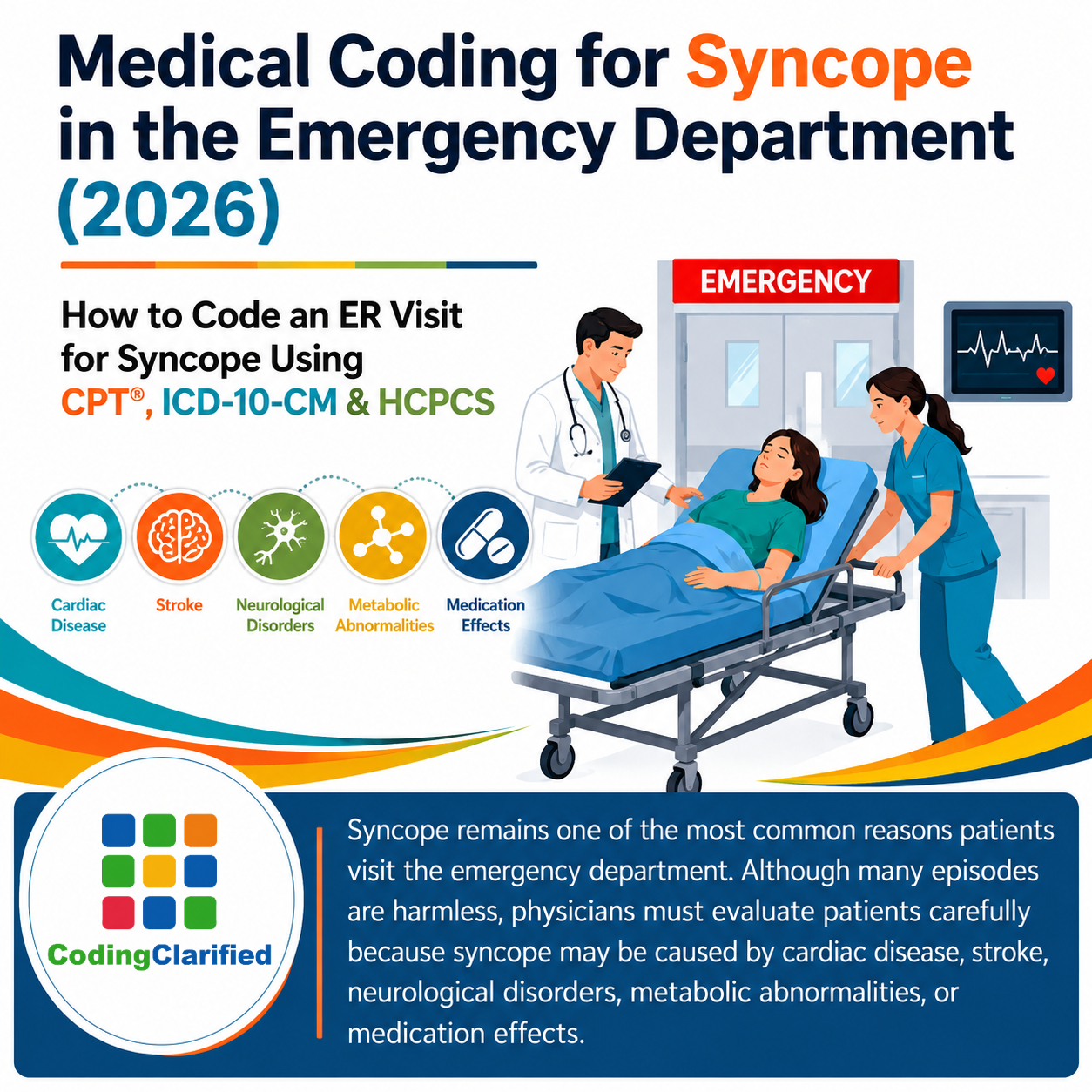
How to Code an ER Visit for Syncope Using CPT®, ICD-10-CM & HCPCS
Key Takeaways
- Syncope is coded to R55 when the provider documents syncope without a more specific underlying cause.
- Emergency department E/M coding depends on medical decision making (MDM) or total physician time under the 2023+ CPT® guidelines.
- A negative CT scan does not change the diagnosis code when no definitive cause is found.
- Diagnostic tests ordered and interpreted increase the complexity of MDM.
- Medical coders should never assign hypertension as a confirmed diagnosis unless the provider documents it.
- Observation, admission, or discharge status can affect code selection.
- Understanding emergency department coding is essential for passing the CPC® exam and working in emergency medicine.
Medical Coding for Syncope in 2026
Syncope remains one of the most common reasons patients visit the emergency department. Although many episodes are harmless, physicians must evaluate patients carefully because syncope may be caused by cardiac disease, stroke, neurological disorders, metabolic abnormalities, or medication effects.
For medical coders, these encounters require careful review of physician documentation, diagnostic testing, and the level of medical decision making before assigning the correct CPT®, ICD-10-CM, and HCPCS Level II codes.
This coding tutorial walks through a real emergency department scenario while explaining why each code is assigned.
Because emergency department coding guidelines continue evolving, this 2026 guide reflects current coding principles and documentation expectations.
Clinical Scenario Summary
A 75-year-old older woman presents to the emergency department after experiencing a brief syncopal episode.
Symptoms
- Brief loss of consciousness
- Headache afterward
- No chest pain
- No palpitations
- No neurological deficit
Physician Evaluation
The emergency physician performs:
- Complete history
- Comprehensive examination
- EKG interpretation
- CT Brain
- Blood pressure monitoring
- Medication management
- Outpatient diagnostic planning
Additionally, the physician ordered diagnostic imaging to rule out intracranial pathology.
The patient is discharged home with outpatient follow-up.
Step 1: Assign the ICD-10-CM Diagnosis Codes
Primary Diagnosis
R55 Syncope and collapse
The physician’s final assessment documents:
Syncope
However, no definitive cause of the syncopal episode was identified.
Therefore, the correct diagnosis is:
R55 Syncope and collapse
According to the ICD-10-CM Official Guidelines, coders should report the condition established after study.
Because the physician did not diagnose stroke, seizure, arrhythmia, dehydration, or another underlying condition, the symptom code remains appropriate.
Should Hypertension Be Coded?
During the visit the patient’s blood pressure reached:
172/91
However, the physician documented:
“First episode of high blood pressure today.”
The assessment states:
Syncope
The provider started Maxzide because of elevated blood pressure.
Should the coder assign hypertension?
Generally, no.
A temporary elevated blood pressure reading does not automatically become hypertension.
Unless the provider documents hypertension as a diagnosis, coders should not report:
I10 Essential hypertension
Instead, code only the documented diagnosis.
Should the Headache Be Coded?
The patient experienced a headache after losing consciousness.
However, headaches commonly occur with syncope and were not separately evaluated or treated.
Since headache was not independently addressed, R51.9 would generally not be assigned.
Final ICD-10-CM Coding
| Diagnosis | Code |
|---|---|
| Syncope and collapse | R55 |
Step 2: Assign the CPT® Emergency Department E/M Code
Beginning in 2023, emergency department E/M services are selected based entirely on Medical Decision Making (MDM).
History and examination remain medically necessary but no longer determine the code level.
Analyze the Medical Decision Making
Problem Addressed
The physician evaluated:
- Acute loss of consciousness
- Unknown cause
- Older person
- Potential cardiac etiology
- Potential neurological etiology
Therefore, this represents:
One acute complicated illness or injury.
Data Reviewed
The physician reviewed and interpreted:
- 93010 Electrocardiogram interpretation (if separately reportable)
- CT Brain
- Previous stress test history
- Echocardiogram history
- Blood pressure trends
DM risk.
Multiple diagnostic studies significantly increase MDM complexity.
Risk of Management
Management included:
- Prescription medication (Maxzide)
- Outpatient Holter monitor
- Carotid Doppler
- Follow-up instructions
Prescription drug management is considered Moderate Risk under CPT guidelines. Furthermore, prescription drug management increased the overall MDM risk.
Correct Emergency Department CPT Code
Based on the documentation, the encounter supports:
99284
Consequently, the emergency department visit supports Moderate MDM rather than Low or High MDM.
Why Not 99283?
99283 generally involves low-complexity MDM.
This encounter includes:
- Older patient
- Syncope
- Diagnostic imaging
- ECG
- Prescription medication
- Additional outpatient cardiac workup
These factors support Moderate MDM.
Could 99285 Be Supported?
Probably not.
Although syncope may become life-threatening, documentation does not indicate:
- Critical instability
- Significant neurological deficit
- Cardiac arrhythmia
- Hospital admission
- High-complexity decision making
Therefore 99284 is the strongest supported code.
Step 3: Diagnostic Procedure Coding
Electrocardiogram
Documentation states:
EKG performed showing sinus rhythm with nonspecific Q waves.
If only the physician interpretation is reported:
93010
If the emergency department owns the equipment and performs the tracing:
93000
If only tracing:
93005
Coding depends on billing circumstances.
CT Scan of the Brain
The physician documents:
Negative CT Brain.
If the hospital bills the technical component, common codes include:
Without contrast:
70450
With contrast:
70460
Without and with contrast:
70470
Documentation should always confirm whether contrast was used before assigning the code.
HCPCS Level II Coding
This encounter contains very little information requiring HCPCS coding.
However, HCPCS could apply if the hospital separately reports:
- Medications administered
- Injectable drugs
- Contrast material
- Supplies
- Ambulance transport
Because none are documented, no HCPCS code can be assigned from the physician note alone.
This illustrates an important CPC exam concept:
Never assume HCPCS codes.
Only code what documentation supports.
Final Coding Summary
ICD-10-CM
- R55 Syncope and collapse
CPT®
- 99284 Emergency Department Evaluation and Management
- 93010 ECG interpretation (if physician interpretation only)
- 70450 CT Head without contrast (if documented and reportable)
HCPCS
None documented.
Coding Rationale
This encounter demonstrates a common emergency department coding principle.
The diagnosis remains a symptom because no definitive condition was identified.
The physician nevertheless performed a moderate-complexity workup that included multiple diagnostic studies and prescription medication management.
Accordingly, the diagnosis coding remains straightforward while the E/M coding reflects the complexity of evaluating a potentially serious condition.
Documentation Tips for Medical Coders
Likewise, review the assessment before assigning ICD-10-CM codes because the final diagnosis determines code selection.
\Always verify:
- Was syncope confirmed?
- Was another diagnosis established?
- Was hypertension officially diagnosed?
- Did the physician prescribe medication?
- Were imaging studies ordered?
- Was an ECG interpreted?
- Was the patient admitted or discharged?
Each answer can affect code selection.
CPC Student Tips
Students frequently miss emergency department questions because they focus only on the diagnosis.
Instead:
- Identify the final diagnosis first.
- Review every diagnostic test.
- Evaluate MDM using CPT guidelines.
- Separate physician coding from hospital coding.
- Never code ruled-out conditions.
- Do not assign hypertension based solely on elevated blood pressure.
- Read the assessment before selecting ICD-10-CM codes.
- Remember that emergency department E/M codes are selected using MDM or total time, not history and exam elements.
Practicing real emergency department cases like this one is one of the best ways to prepare for the CPC exam.
Common Mistakes to Avoid
Medical coders commonly make these errors when coding syncope encounters:
- Coding I10 for elevated blood pressure without a documented hypertension diagnosis.
- Reporting headache separately when it is integral to the syncope evaluation.
- Assigning a higher emergency department E/M level based only on the number of tests ordered.
- Assuming the CT scan included contrast when the documentation does not specify.
- Reporting HCPCS drug codes when no administered medications are documented.
- Coding suspected cardiac or neurological conditions that were not confirmed.
- Forgetting that physician and facility coding requirements differ for diagnostic procedures.
Avoiding these mistakes improves coding accuracy and reduces claim denials.
Why Syncope Coding Matters in 2026
Emergency departments continue seeing high volumes of older adults with unexplained syncope. At the same time, payers increasingly review emergency department claims for medical necessity, appropriate E/M level selection, and accurate diagnosis reporting.
As a result, medical coders who understand emergency department documentation, symptom coding, and modern MDM guidelines are highly valued by hospitals, physician groups, and emergency medicine practices. Staying current with annual coding updates also helps reduce compliance risks and supports accurate reimbursement.
Frequently Asked Questions
What ICD-10-CM code is used for syncope?
The appropriate diagnosis is R55 when the provider documents syncope or collapse without identifying a more specific underlying cause.
Can elevated blood pressure be coded as hypertension?
No. Elevated blood pressure alone does not support I10 unless the provider documents hypertension as the diagnosis.
What emergency department CPT® code is commonly assigned for this scenario?
Based on the documented moderate medical decision making, 99284 is generally supported.
Should the headache be coded separately?
Usually not. When the headache is associated with the syncopal episode and is not independently evaluated or treated, it is considered integral to the encounter.
Is the CT scan coded even if the results are negative?
Yes. Procedure codes report services that were performed, regardless of whether the results are normal or abnormal, provided billing requirements are met.
Are HCPCS codes required for every emergency department visit?
No. HCPCS Level II codes are reported only when separately billable supplies, drugs, ambulance services, or other eligible items are documented.
Why is syncope often coded as a symptom instead of a disease?
When the physician completes the evaluation but does not identify a definitive underlying cause, ICD-10-CM guidelines instruct coders to report the documented symptom, which is R55.
How can CPC students improve emergency department coding skills?
Practice reviewing complete emergency department cases, focus on the final assessment, apply ICD-10-CM guidelines, and determine the E/M level using the current CPT® Medical Decision Making framework.
Conclusion
Coding emergency department visits for syncope requires careful review of provider documentation, diagnostic testing, and medical decision making. In this case, the physician documented syncope without identifying a confirmed underlying cause, so R55 remains the correct ICD-10-CM diagnosis code. Furthermore, the documented evaluation, prescription drug management, and diagnostic workup support reporting 99284 for the emergency department E/M service. Additional CPT® procedure codes depend on how the ECG and CT scan are billed. Finally, by following the ICD-10-CM Official Guidelines, applying current CPT® E/M rules, and avoiding unsupported diagnoses, medical coders can improve coding accuracy, reduce claim denials, and strengthen their emergency department coding skills.
Finally, always verify that the documentation supports every reported code before submitting a claim. This simple habit helps improve coding accuracy, supports compliance, and reduces the risk of claim denials.
Additional Coding Clarified Blog Resources
To strengthen topical authority and improve user engagement, link to these related articles from Coding Clarified:
- Emergency Dept Services
- Medical Coding Signs & Symptoms in Diseases
- Medical Coding Labs
- Medical Coding Alzheimer’s Disease
- Coding Clarified Blog
Authoritative References
- CDC Womens Health
- Healthcare .gov Preventive care benefits for women
- 2026 ICD-10-CM Guidelines
- CMS Place Of Service
