Medical Coding for Home Health in 2026: Complete ICD-10-CM, CPT®, HCPCS, PDGM & OASIS Guide
Home health coding continues to evolve as documentation requirements, payment rules, and quality reporting become more detailed. Accurate coding does far more than determine reimbursement—it reflects the patient’s clinical condition, supports medical necessity, and helps ensure compliance with Medicare guidelines.
Whether you are a new CPC student, an experienced medical coder, or a medical biller transitioning into home health, understanding how diagnoses, procedures, and documentation work together is essential.
This 2026 guide explains the fundamentals of home health coding, including ICD-10-CM, HCPCS Level II, CPT®, PDGM, OASIS, and Medicare documentation requirements. Along the way, you’ll learn practical coding tips, avoid common mistakes, and prepare for coding questions that often appear on certification exams.
Key Takeaways
- Home health services require physician or qualified practitioner certification and documentation supporting medical necessity.
- ICD-10-CM diagnosis coding drives payment under the Patient-Driven Groupings Model (PDGM).
- OASIS assessments significantly affect reimbursement, quality reporting, and patient care planning.
- Home health agencies primarily report diagnosis codes, while HCPCS and CPT® codes may be used in specific situations depending on payer requirements.
- Sequencing the primary diagnosis correctly is one of the most important responsibilities of a home health coder.
- Complete provider documentation reduces denials and improves compliance with Medicare regulations.
- Understanding PDGM is critical for both working coders and CPC exam candidates.
What Is Home Health Coding?
Home health coding is the process of assigning standardized medical diagnosis and procedure codes for patients receiving skilled healthcare services in their homes.
Unlike outpatient physician offices or hospitals, home health agencies focus on patients who require intermittent skilled services while remaining safely at home. These services commonly include:
- Skilled nursing
- Physical therapy
- Occupational therapy
- Speech-language pathology
- Medical social services
- Home health aide services
Coders review documentation from physicians, nurses, therapists, and OASIS assessments before assigning the appropriate diagnosis codes. Those codes directly influence Medicare reimbursement through the Patient-Driven Groupings Model (PDGM).
Consequently, accurate coding affects much more than payment. It also supports quality measures, compliance audits, risk adjustment, and patient outcomes.
What Qualifies a Patient for Home Health Services?
Before Medicare covers home health services, several requirements must be met.
Generally, patients must:
- Be under the care of a physician or other qualified practitioner.
- Require intermittent skilled nursing or therapy services.
- Be certified as homebound.
- Receive services through a Medicare-certified home health agency.
- Have an established plan of care.
- Meet documentation requirements supporting medical necessity.
Additionally, providers must complete a face-to-face encounter within the timeframe required by Medicare regulations.
Without proper documentation, even correctly assigned diagnosis codes may fail to support coverage.
Home Health vs. Home Care vs. Hospice
Many new coders confuse these healthcare settings. However, they use different regulations, documentation standards, and reimbursement methodologies.
| Service | Purpose | Primary Payer | Coding Focus |
|---|---|---|---|
| Home Health | Skilled intermittent medical care | Medicare Part A/B | ICD-10-CM, OASIS, PDGM |
| Home Care | Non-medical assistance | Private pay | Usually no medical coding |
| Hospice | End-of-life care | Medicare Hospice Benefit | Terminal diagnosis sequencing |
Understanding these differences helps prevent coding errors and supports accurate reimbursement.
Why Home Health Coding Is Different
Many coding specialties rely heavily on CPT® procedure reporting. Home health agencies operate differently.
Instead, Medicare reimbursement depends primarily on:
- Correct ICD-10-CM diagnosis coding
- Clinical documentation
- Functional assessments
- OASIS data collection
- Comorbidity reporting
- PDGM classification
As a result, diagnosis coding carries much greater financial importance than procedure coding in the home health environment.
For example, two patients may receive similar nursing visits, yet reimbursement may differ because of differences in diagnosis coding, functional limitations, and comorbid conditions documented during the OASIS assessment.
Understanding the Patient-Driven Groupings Model (PDGM)
Since Medicare implemented PDGM, reimbursement has shifted away from therapy visit volume and toward patient characteristics.
Today, payment depends on multiple factors documented during the start of care.
PDGM evaluates:
- Admission source
- Timing of care
- Clinical grouping
- Functional impairment level
- Comorbidity adjustment
Therefore, precise diagnosis coding has become more important than ever.
A poorly selected primary diagnosis can place a patient into the wrong clinical grouping, resulting in inaccurate reimbursement and potential compliance concerns.
How PDGM Uses Diagnosis Codes
The principal diagnosis assigned by the home health agency determines the patient’s clinical grouping.
Secondary diagnoses may also affect payment when they qualify as comorbid conditions under PDGM.
Examples of common PDGM clinical groupings include:
- Musculoskeletal rehabilitation
- Neuro rehabilitation
- Wound care
- Medication management
- Complex nursing interventions
- Behavioral health
- Cardiopulmonary conditions
Because of this structure, home health coders must carefully review physician documentation before selecting the primary diagnosis.
Common ICD-10-CM Codes Seen in Home Health
Although every patient is unique, certain diagnoses appear frequently in home health settings.
Examples include:
- I10 – Essential (primary) hypertension
- E11.9 – Type 2 diabetes mellitus without complications
- I50.32 – Chronic diastolic (congestive) heart failure
- J44.9 – Chronic obstructive pulmonary disease, unspecified
- N18.32 – Chronic kidney disease, stage 3b
- M62.81 – Muscle weakness (generalized)
- R26.89 – Other abnormalities of gait and mobility
- Z91.81 – History of falling
- Z79.4 – Long-term (current) use of insulin
- Z79.85 – Long-term (current) use of injectable non-insulin antidiabetic drugs
Remember that diagnosis selection must always be supported by provider documentation and follow the ICD-10-CM Official Guidelines for Coding and Reporting.
Documentation Is Everything
Even perfect coding cannot overcome poor documentation.
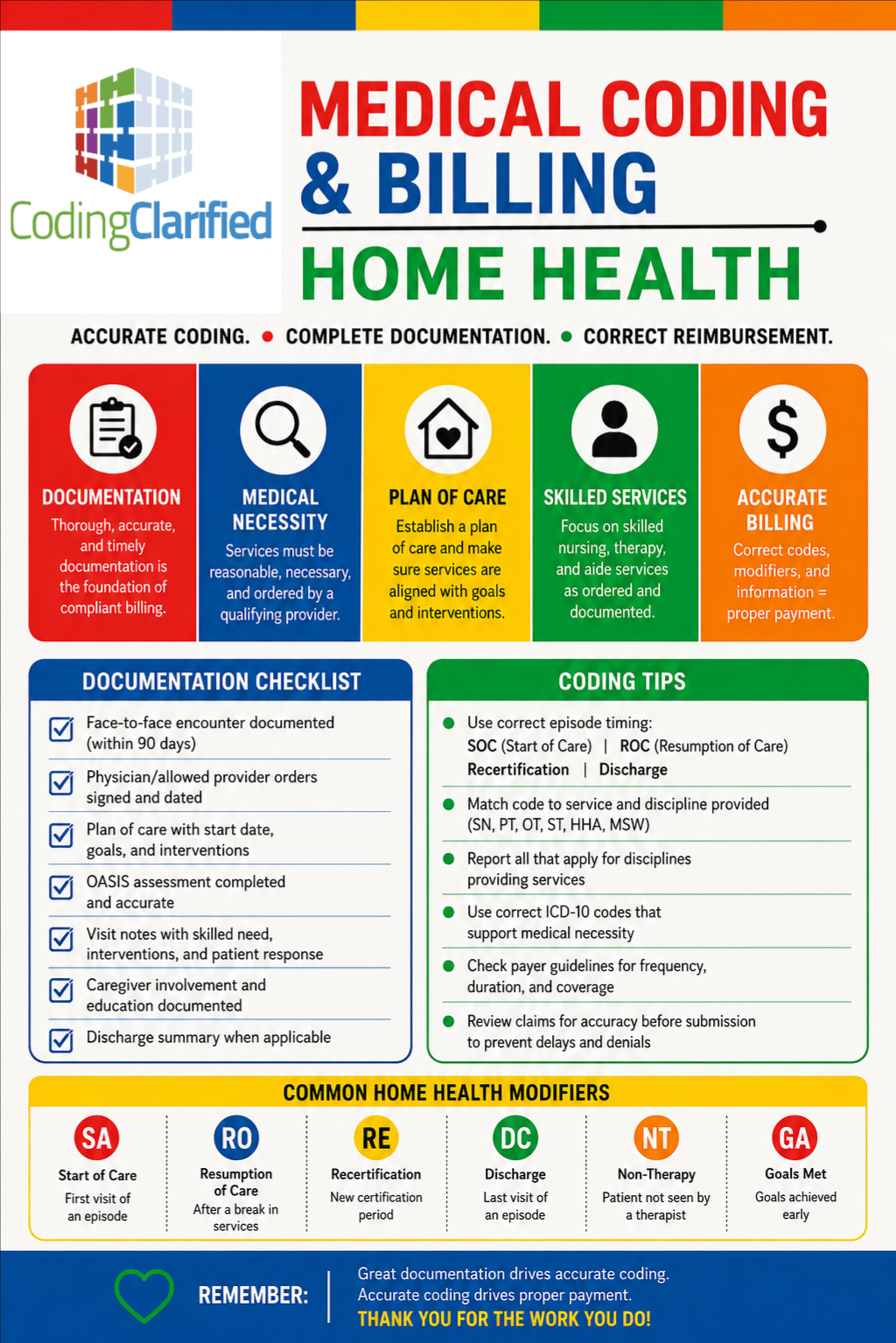
Before assigning any diagnosis, coders should verify that the medical record clearly supports:
- The patient’s current condition
- Medical necessity
- Homebound status
- Skilled services provided
- Physician certification
- Face-to-face encounter documentation
- Plan of care
- Clinical findings
- Response to treatment
Strong documentation reduces claim denials, supports audits, and improves reimbursement accuracy.
OASIS: The Foundation of Home Health Coding
The Outcome and Assessment Information Set (OASIS) is a standardized assessment tool required for most adult Medicare home health patients. While clinicians complete the assessment, medical coders must understand how OASIS information affects coding, reimbursement, and compliance.
OASIS captures clinical, functional, and social information about the patient at key points during the episode of care. Medicare uses this information, along with diagnosis coding, to determine payment under the Patient-Driven Groupings Model (PDGM).
Although coders generally do not complete OASIS assessments, they frequently review them to ensure diagnosis sequencing aligns with the patient’s documented condition.
Common OASIS assessment time points include:
- Start of Care (SOC)
- Resumption of Care (ROC)
- Follow-Up
- Transfer
- Discharge
- Death at Home
Because OASIS data directly impacts reimbursement and publicly reported quality measures, coding accuracy and documentation consistency are essential.
Understanding Homebound Status
One of the most misunderstood Medicare requirements is the definition of “homebound.”
Being homebound does not mean a patient is completely unable to leave home. Instead, Medicare defines homebound status as requiring considerable effort or assistance to leave the home because of illness or injury.
Patients may still leave home for:
- Physician appointments
- Religious services
- Family events
- Adult day care
- Hair appointments (occasionally)
- Short outings that are infrequent or medically appropriate
Documentation should clearly explain why leaving home is difficult rather than simply stating the patient is “homebound.”
Examples include:
- Severe shortness of breath after walking short distances
- Dependence on a walker or wheelchair
- High fall risk
- Recent orthopedic surgery
- Significant weakness following hospitalization
- Cognitive impairment requiring caregiver assistance
Specific documentation supports both medical necessity and compliance during Medicare audits.
Face-to-Face Encounter Requirements
Medicare requires a face-to-face encounter before initiating most home health services.
Generally, the encounter must relate directly to the condition requiring home health care and be documented by the physician or another qualified practitioner.
The medical record should include:
- Date of the encounter
- Reason for the visit
- Clinical findings
- Need for skilled home health services
- Homebound status
- Physician certification
Missing or incomplete face-to-face documentation remains one of the leading causes of payment denials.
Therefore, coders should always verify that supporting documentation exists before claims are submitted.
ICD-10-CM Diagnosis Coding in Home Health
Diagnosis coding drives nearly every aspect of home health reimbursement.
Unlike many physician practices where procedures often determine payment, home health relies heavily on accurate diagnosis selection and sequencing.
When assigning diagnoses, coders should:
- Follow the ICD-10-CM Official Guidelines for Coding and Reporting
- Code conditions receiving active treatment or monitoring
- Report all clinically significant comorbidities
- Sequence the primary diagnosis according to Medicare guidance
- Avoid coding conditions that are resolved or unsupported
Each diagnosis should reflect the patient’s current episode of care.
Choosing the Primary Diagnosis
Selecting the principal diagnosis is one of the most important responsibilities of a home health coder.
The primary diagnosis should represent the chief reason skilled services are being provided during the home health episode.
For example:
Scenario 1
A patient receives skilled nursing after hospitalization for heart failure management.
Primary diagnosis:
- I50.32 – Chronic diastolic (congestive) heart failure
Secondary diagnoses might include:
- I10 – Essential hypertension
- E11.9 – Type 2 diabetes mellitus without complications
- Z79.4 – Long-term (current) use of insulin
These additional diagnoses may qualify for PDGM comorbidity adjustments when appropriately documented.
Reporting Secondary Diagnoses
Secondary diagnoses are equally important because they describe additional conditions requiring monitoring, assessment, medication management, or skilled intervention.
Common examples include:
- N18.32 – Chronic kidney disease stage 3b
- J44.9 – Chronic obstructive pulmonary disease
- F03.90 – Unspecified dementia without behavioral disturbance
- M62.81 – Muscle weakness
- R26.89 – Other abnormalities of gait and mobility
- Z91.81 – History of falling
Every reported diagnosis must affect patient care during the certification period.
Simply listing chronic conditions without clinical relevance can lead to compliance concerns.
CPT® Codes Used in Home Health
Many new coders assume home health agencies bill numerous CPT® procedure codes.
Actually, Medicare-certified home health agencies generally receive payment through the Home Health Prospective Payment System rather than traditional physician procedure coding.
However, coders should still understand commonly encountered CPT® services because physicians, therapists, and other providers may report them outside the agency setting.
Examples include:
- 97110 – Therapeutic exercises
- 97112 – Neuromuscular reeducation
- 97116 – Gait training therapy
- 97530 – Therapeutic activities
- 97535 – Self-care and home management training
- 92507 – Speech-language treatment
- 97165–97168 – Occupational therapy evaluations
- 97161–97163 – Physical therapy evaluations
Knowing these codes helps coders understand physician documentation and interdisciplinary care plans.
HCPCS Level II Codes in Home Health
Home health coders also encounter HCPCS Level II codes for supplies, durable medical equipment (DME), medications, and certain services.
Examples include:
- A4253 – Blood glucose test strips
- E0143 – Folding wheeled walker
- E0260 – Semi-electric hospital bed
- E0601 – Continuous positive airway pressure (CPAP) device
- L0650 – Lumbar-sacral orthosis
- K0001 – Standard wheelchair
Although DME suppliers frequently bill these items separately, coders should recognize these codes when reviewing documentation.
Skilled Services That Support Home Health
Medicare covers only medically necessary skilled services.
Examples include:
Skilled Nursing
- Medication management
- Wound care
- IV therapy
- Catheter care
- Diabetes education
- Disease management
- Postoperative monitoring
Physical Therapy
- Strength training
- Balance improvement
- Fall prevention
- Gait training
- Functional mobility
Occupational Therapy
- Activities of daily living (ADL) training
- Home safety evaluation
- Adaptive equipment instruction
- Upper extremity rehabilitation
Speech-Language Pathology
- Swallowing disorders
- Speech therapy
- Cognitive rehabilitation
- Communication training
Each service must be supported by documentation demonstrating continued medical necessity.
Typical Home Health Coding Workflow
Successful home health coding follows a structured process.
A typical workflow includes:
- Review physician orders.
- Verify certification requirements.
- Confirm face-to-face documentation.
- Review OASIS assessment.
- Analyze nursing and therapy documentation.
- Assign the primary diagnosis.
- Assign appropriate secondary diagnoses.
- Verify sequencing according to ICD-10-CM guidelines.
- Review for PDGM accuracy.
- Submit for quality review before billing.
Following a consistent workflow reduces coding errors and improves compliance.
2026 Home Health Coding Updates
Home health coding continues to evolve as Medicare updates payment policies and quality reporting requirements.
For 2026, coders should pay close attention to:
- Annual ICD-10-CM code additions, revisions, and deletions effective October 1.
- Medicare Home Health Prospective Payment System (HH PPS) updates.
- PDGM payment refinements and case-mix adjustments.
- OASIS data collection revisions.
- Expanded focus on documentation supporting medical necessity.
- Increased scrutiny of diagnosis sequencing during Medicare audits.
- Ongoing quality reporting and value-based purchasing initiatives.
Staying current with these changes helps agencies maintain compliance and reduces the risk of claim denials.
Real-World Home Health Coding Scenario
Applying coding guidelines to real cases is one of the best ways to strengthen your coding skills. Let’s walk through a common home health scenario.
Scenario
A 74-year-old patient is discharged from the hospital following treatment for acute exacerbation of chronic diastolic heart failure. The physician certifies the patient as homebound due to generalized weakness and shortness of breath with minimal exertion.
Home health services include:
- Skilled nursing for medication management and heart failure education
- Physical therapy for gait training and strengthening
- Monitoring of diabetes and hypertension
- Ongoing assessment of chronic kidney disease
Provider Documentation
- Chronic diastolic congestive heart failure
- Type 2 diabetes mellitus without complications
- Essential hypertension
- Chronic kidney disease stage 3b
- Generalized muscle weakness
- Difficulty walking
- Homebound due to weakness and dyspnea
- Skilled nursing and physical therapy medically necessary
Example ICD-10-CM Coding
Primary diagnosis:
- I50.32 – Chronic diastolic (congestive) heart failure
Secondary diagnoses:
- E11.9 – Type 2 diabetes mellitus without complications
- I10 – Essential (primary) hypertension
- N18.32 – Chronic kidney disease, stage 3b
- M62.81 – Muscle weakness (generalized)
- R26.89 – Other abnormalities of gait and mobility
If documented:
- Z79.4 – Long-term (current) use of insulin
- Z79.85 – Long-term (current) use of injectable non-insulin antidiabetic drugs
Notice that every diagnosis affects the patient’s current care. None of the reported conditions are historical or inactive.
Documentation Tips That Improve Coding Accuracy
Strong documentation makes coding easier and significantly reduces denials. Therefore, coders should look for complete clinical details before assigning codes.
A well-documented home health record should clearly identify:
- The reason for skilled services
- The patient’s current diagnoses
- Medical necessity
- Homebound status
- Functional limitations
- Physician certification
- Face-to-face encounter documentation
- Treatment goals
- Response to therapy
- Medication management
- Comorbid conditions affecting care
Additionally, documentation should remain consistent throughout physician notes, nursing documentation, therapy records, and the OASIS assessment.
Common Mistakes to Avoid
Even experienced coders make mistakes in home health coding. Fortunately, most are preventable with careful documentation review.
1. Choosing the Wrong Primary Diagnosis
The primary diagnosis should represent the chief reason for home health services. Selecting a diagnosis simply because it appears first in the medical record can lead to incorrect PDGM classification.
2. Ignoring Clinically Significant Comorbidities
Secondary diagnoses often influence reimbursement. Consequently, failing to report documented comorbid conditions may reduce payment accuracy and fail to reflect the patient’s complexity.
3. Coding Unsupported Conditions
Never assign diagnoses that are not supported by provider documentation. If clarification is needed, follow your organization’s query policy.
4. Forgetting Laterality or Specificity
Whenever possible, assign the most specific ICD-10-CM code available. Review documentation carefully before selecting unspecified diagnoses.
5. Reporting Resolved Conditions
Only report conditions that require evaluation, monitoring, treatment, or affect the current plan of care.
6. Overlooking Documentation Inconsistencies
Compare physician documentation with nursing notes, therapy documentation, and the OASIS assessment. Any conflicting information should be resolved before coding.
CPC Student Tips
Home health coding appears challenging at first because reimbursement depends heavily on diagnosis coding rather than procedure coding. Nevertheless, once you understand the workflow, the process becomes much easier.
Here are several study tips that can improve both coding accuracy and exam performance.
Learn the ICD-10-CM Guidelines
Many CPC exam questions test guideline knowledge more than code memorization. Spend extra time reviewing the Official Guidelines for Coding and Reporting.
Practice Diagnosis Sequencing
Home health relies heavily on sequencing. Practice determining which condition represents the primary reason skilled services are provided.
Review PDGM Concepts
You do not need to memorize every payment calculation. However, understanding how diagnosis coding affects PDGM will help you become a stronger coder.
Understand OASIS
Although coders may not complete OASIS assessments, understanding their purpose helps explain why documentation must remain consistent across the medical record.
Read Every Word
Never assume documentation says what you expect. Instead, read every note carefully before assigning codes.
Stay Current
Coding changes occur every year. Therefore, always use the most current ICD-10-CM, CPT®, and HCPCS Level II code books.
2026 Home Health Coding Best Practices
Successful home health coders combine strong clinical knowledge with attention to detail.
For 2026, focus on these best practices:
- Verify physician documentation before coding.
- Follow the ICD-10-CM Official Guidelines for Coding and Reporting.
- Sequence diagnoses carefully.
- Report all documented comorbidities that affect care.
- Review OASIS documentation for consistency.
- Monitor annual Medicare updates.
- Perform routine internal coding audits.
- Communicate with clinicians when documentation needs clarification.
Following these habits improves compliance, supports accurate reimbursement, and helps agencies deliver high-quality patient care
Conclusion
Home health coding requires much more than assigning diagnosis codes. Coders must understand Medicare regulations, physician documentation, OASIS assessments, and PDGM reimbursement to accurately reflect each patient’s condition.
As Medicare continues refining payment methodologies in 2026, accurate coding and complete documentation remain essential. Moreover, staying current with annual coding updates helps reduce denials, improve compliance, and support better patient outcomes.
Whether you are preparing for the CPC exam or working in a home health agency, mastering these fundamentals will strengthen your coding skills and increase your confidence.
Additional Coding Clarified Resources
Continue building your coding knowledge with these helpful guides on Coding Clarified:
- EKG/ECG CPT & ICD-10 Coding (2026 Update)
- Evaluation and Management (E/M) Guidelines for 2026: The Complete Guide
- Medical Coding Care Plan Oversight
- Medical Coding for Pressure Ulcers
- Medical Coding Dementia
Authoritative References
For the latest guidance, consult these trusted resources:
- CMS Home Health Center
- CMS Home Health Coding and Billing Information
- CMS OASIS Data Sets portal
- AAPC Home Health Coding Course
Frequently Asked Questions
What diagnosis code determines PDGM reimbursement?
The principal ICD-10-CM diagnosis generally determines the patient’s PDGM clinical grouping. Secondary diagnoses may also affect reimbursement when they qualify for comorbidity adjustments.
Does Medicare require patients to be completely confined to their homes?
No. Medicare defines homebound status as leaving home only with considerable effort or assistance. Patients may still leave for medically necessary appointments and limited community activities.
Do home health agencies bill many CPT® procedure codes?
Usually not. Medicare-certified home health agencies primarily receive payment through the Home Health Prospective Payment System. However, coders should still understand common CPT® codes used by physicians and therapists.
What is the purpose of OASIS?
OASIS collects standardized patient assessment data that supports care planning, quality reporting, and Medicare reimbursement.
Why are secondary diagnoses important?
Secondary diagnoses reflect additional conditions requiring assessment or treatment. They may also influence PDGM reimbursement when they meet Medicare requirements.
What coding manual is most important for home health coding?
The ICD-10-CM manual is the primary coding resource because diagnosis coding drives reimbursement. Coders should also understand HCPCS Level II, CPT®, Medicare regulations, and the Official Coding Guidelines.
How can CPC students prepare for home health coding?
Practice sequencing diagnoses, review Medicare documentation requirements, study PDGM concepts, and work through real-world coding scenarios using current coding manuals.
Coding Clarified Final Key Takeaways
- Accurate ICD-10-CM coding drives Medicare reimbursement in home health.
- Proper diagnosis sequencing directly affects PDGM classification.
- OASIS assessments and documentation consistency are essential.
- Medical necessity, homebound status, and physician certification must be supported in the medical record.
- Staying current with 2026 coding updates improves compliance and reduces claim denials.
- Strong documentation remains the foundation of accurate home health coding.
- CPC students should master diagnosis sequencing and Medicare guidelines to build confidence for certification exams and real-world coding.