
Updated October 2026 for 2027. The EKG CPT codes in this guide are unchanged for 2027, and the ICD-10-CM codes reflect the FY2027 code set effective October 1, 2026.
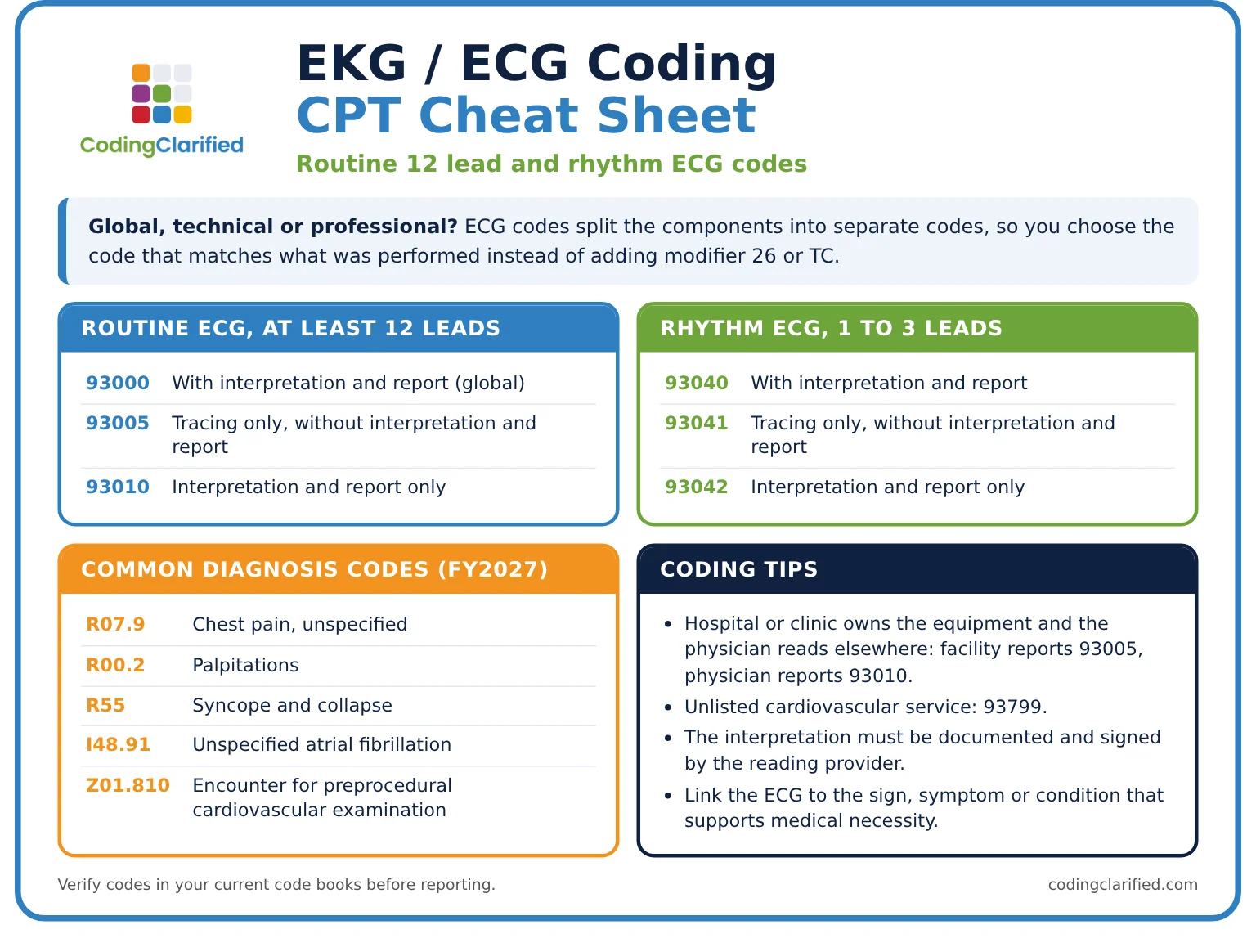
CPT 93000 reports a routine 12 lead EKG with tracing, interpretation, and report. When the work is split, the facility or practice that performs the tracing reports 93005 and the physician who interprets it reports 93010. The ICD-10-CM code shows why the EKG was done: a screening code such as Z13.6, a preprocedural code such as Z01.810, or the symptom or condition that made it medically necessary.
New to medical coding? See how our CPC Training gets you certified.
Medical Coding for EKG/ECG: CPT Procedure Codes and ICD-10 Rules
Electrocardiogram (EKG or ECG) coding is one of the most common areas of cardiology medical coding. However, despite how frequently these procedures are performed, EKG coding errors still occur regularly due to confusion surrounding CPT components, interpretation requirements, and ICD-10-CM diagnosis selection.
Understanding when to use CPT codes 93000, 93005, and 93010 is essential for accurate reimbursement and compliance. Additionally, coders must understand the difference between screening EKGs, symptom-driven diagnostic studies, and pre-operative cardiac evaluations.
This 2027 medical coding guide explains the most commonly used EKG CPT codes, ICD-10-CM diagnosis coding rules, documentation requirements, CPC exam tips, and common billing pitfalls.
You may also find our article on STEMI and NSTEMI coding helpful.
What is the CPT code for an EKG?
The global CPT code for a routine EKG with at least 12 leads is 93000. This code includes the tracing, interpretation, and written report.
If the service is split between providers or facilities:
- Use 93005 for the technical component (tracing only)
- Use 93010 for the professional component (interpretation and report only)
For preventive cardiovascular screenings in asymptomatic patients, ICD-10-CM code Z13.6 is commonly assigned.
How do EKG CPT codes 93000, 93005 and 93010 differ?
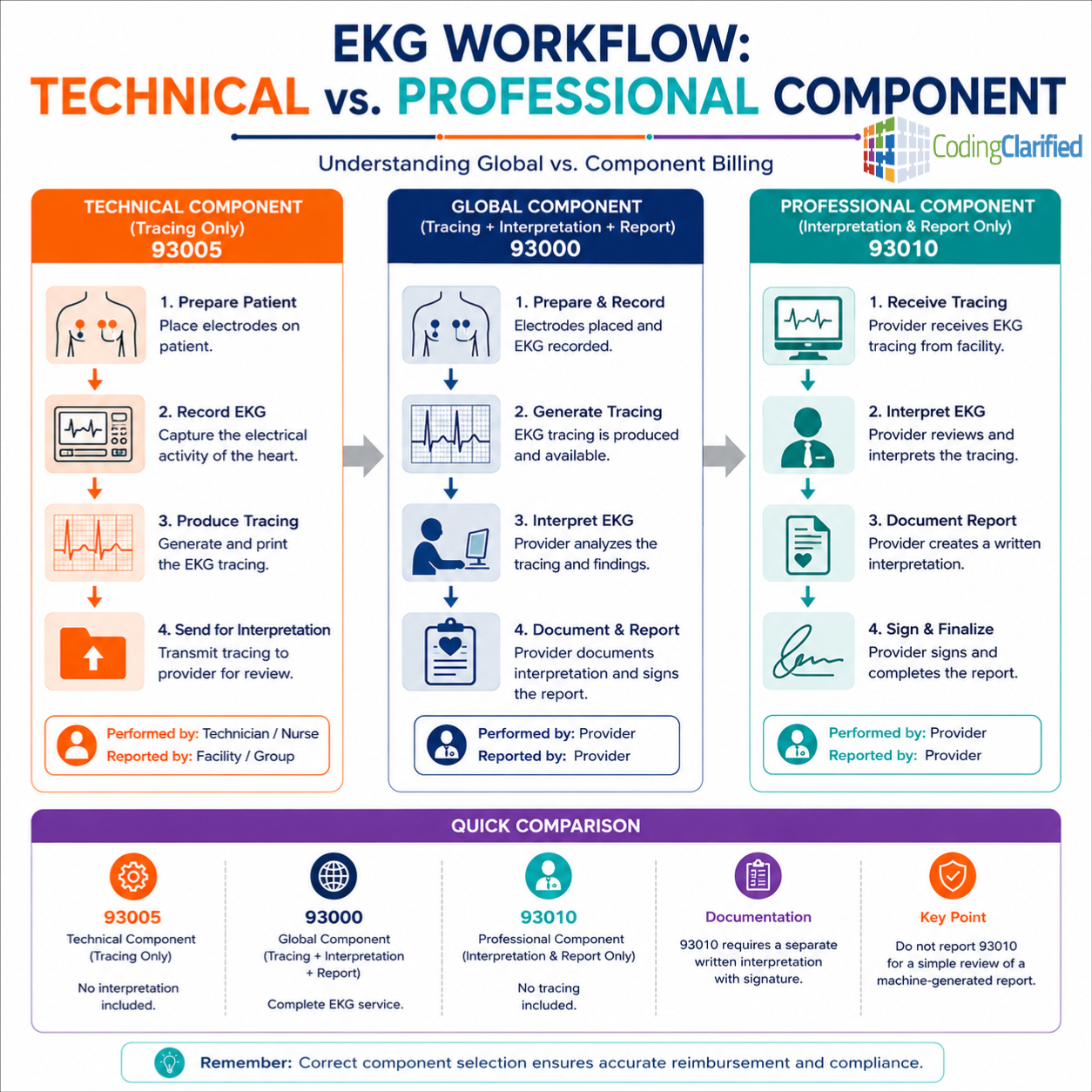
Medical coders must understand the “global versus component” billing structure used for EKG services. The most common EKG CPT codes are 93000, 93005, and 93010.
These codes apply to standard 12-lead electrocardiograms and represent different portions of the service.
CPT Code 93000: Global Service
CPT code 93000 is reported when the provider performs:
- The EKG tracing
- The interpretation
- The written report
This is considered the complete or “global” service.
Example
A physician office performs the EKG, interprets the results, and documents the findings in the patient record.
In this situation, report:
- 93000
This is the most commonly reported EKG procedure code in physician office settings.
CPT Code 93005: Technical Component Only
CPT code 93005 is used when only the technical portion of the EKG is performed.
This includes:
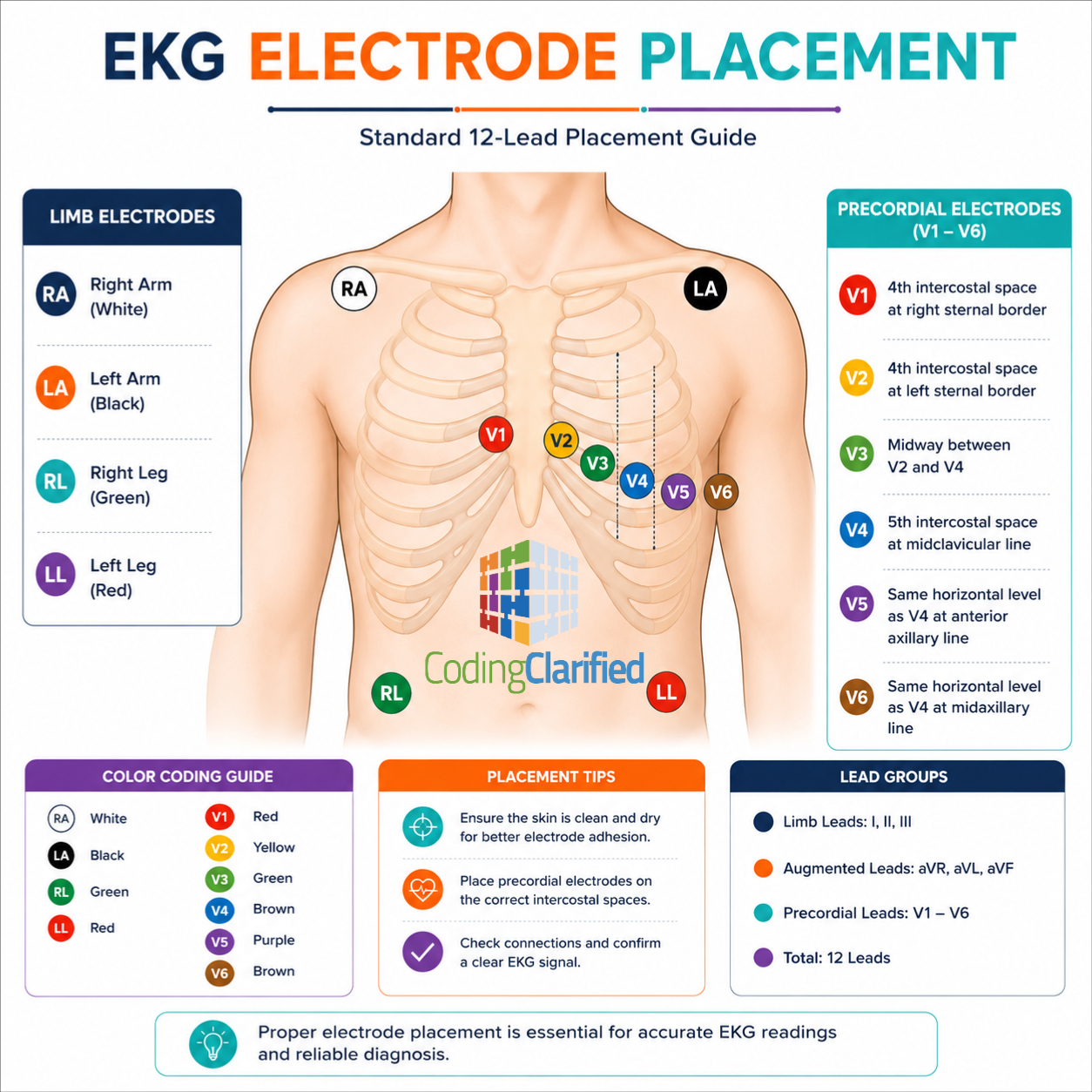
- Electrode placement
- Recording the tracing
- Producing the EKG strip
However, it does not include physician interpretation.
Common Scenario
A hospital outpatient department performs the tracing, but an outside cardiologist interprets the results separately.
In this case, the facility reports:
- 93005
This code is often referred to as the technical component of the EKG.
CPT Code 93010: Interpretation and Report Only
CPT code 93010 is assigned when the physician performs:
- The interpretation
- The written report only
This code does not include the tracing itself.
Common Scenario
A cardiologist reviews a tracing performed by a hospital or clinic and provides a formal interpretation.
The physician reports:
- 93010
This CPT code for EKG interpretation is commonly used in hospital and emergency department settings.
What are the EKG CPT codes? (2027 Quick Reference)
Below is a quick-reference table for commonly used EKG CPT codes.
| Procedure | CPT Code |
|---|---|
| 12-Lead EKG, Global Service | 93000 |
| EKG Tracing Only | 93005 |
| EKG Interpretation & Report Only | 93010 |
| Rhythm EKG, 1 to 3 Leads, with Interpretation and Report | 93040 |
| Rhythm EKG, 1 to 3 Leads, Tracing Only | 93041 |
| Rhythm EKG, 1 to 3 Leads, Interpretation and Report Only | 93042 |
| Medicare IPPE Screening EKG, Complete | G0403 |
| Medicare IPPE Screening EKG, Tracing Only | G0404 |
| Medicare IPPE Screening EKG, Interpretation and Report Only | G0405 |
These EKG CPT codes are among the most frequently tested cardiology codes on the CPC exam and commonly appear in outpatient coding environments.
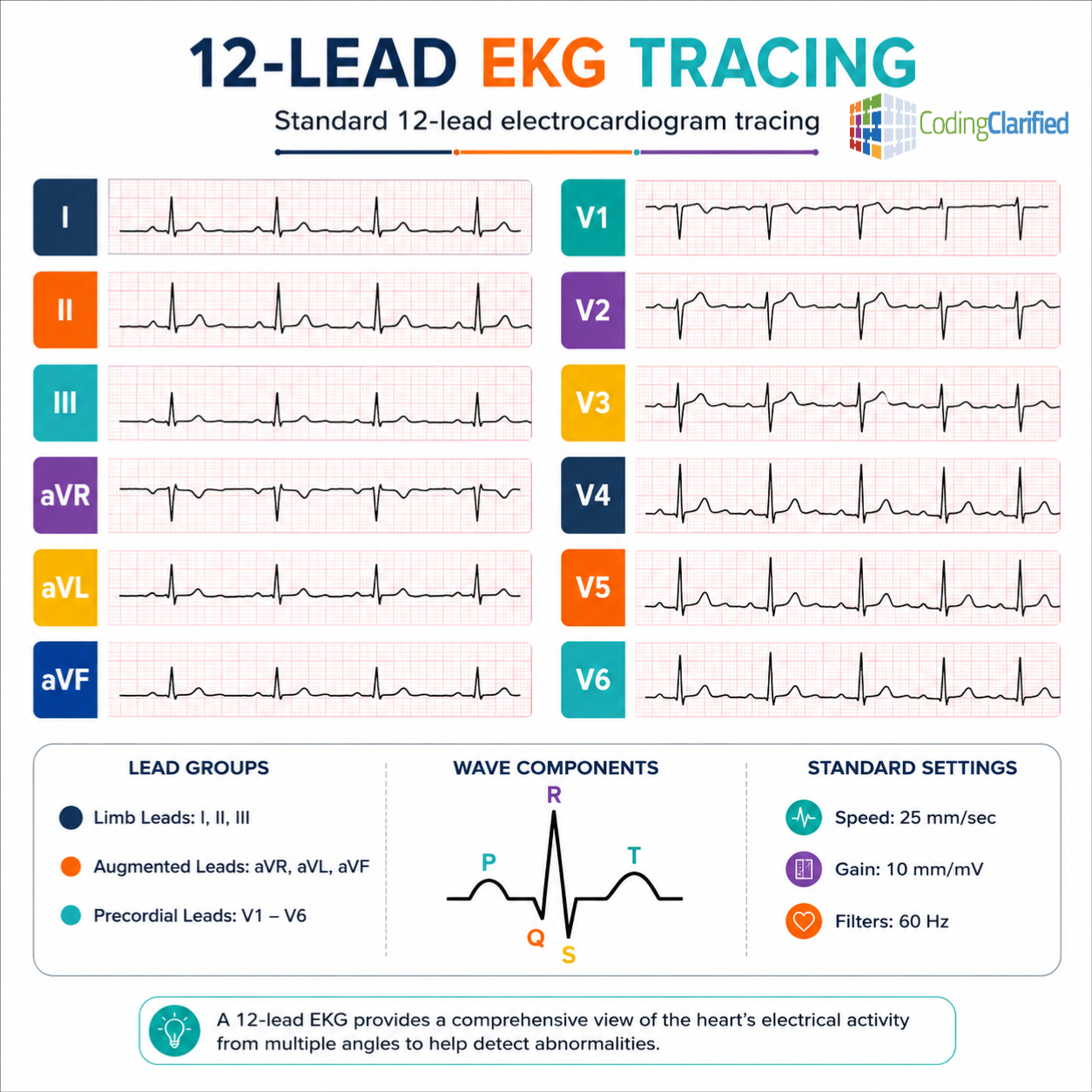
Which ICD-10-CM codes support an EKG?
Correct ICD-10-CM diagnosis coding is necessary to establish medical necessity for EKG services.
Coders must determine whether the encounter involves:
- Preventive screening
- Symptom-based diagnostic testing
- Pre-operative cardiovascular clearance
How do you code a screening EKG?
For asymptomatic cardiovascular screenings, assign:
- Z13.6: Encounter for screening for cardiovascular disorders
This diagnosis code is commonly used when a provider orders an EKG during a preventive visit or wellness examination without symptoms or known cardiac disease.
Example
A patient receives a preventive EKG during an annual wellness exam with no cardiac complaints.
Assign:
- Z13.6
This is one of the most important ICD-10 EKG screening codes coders should understand.
Medicare note: Medicare does not cover a routine screening EKG with the Annual Wellness Visit. A once in a lifetime screening EKG is covered only when it is performed as a result of a referral from the Initial Preventive Physical Examination (IPPE, the “Welcome to Medicare” visit), reported with HCPCS G0403 (complete), G0404 (tracing only) or G0405 (interpretation and report only). Commercial payers set their own rules for screening EKGs.
How do you code a diagnostic EKG for symptoms?
When a patient presents with symptoms, coders should assign the diagnosis code that best explains the medical necessity for the EKG.
Common diagnosis codes include:
| Symptom | ICD-10-CM Code |
|---|---|
| Palpitations | R00.2 |
| Chest pain, unspecified | R07.9 |
| Shortness of breath | R06.02 |
| Cardiac arrhythmia, unspecified | I49.9 |
| Syncope and collapse | R55 |
These diagnosis codes support diagnostic EKG testing rather than preventive screening.
How do you code a preoperative EKG?
For preprocedural cardiovascular examinations, assign:
- Z01.810: Encounter for preprocedural cardiovascular examination
Example
A patient undergoes an EKG before orthopedic surgery for surgical clearance.
Assign:
- Z01.810
This diagnosis code is commonly used before surgical procedures requiring cardiovascular evaluation.
When can 93010 be billed for an EKG interpretation?
One of the most common EKG coding mistakes involves improper reporting of CPT code 93010.
A provider simply reviewing a machine-generated EKG result does not qualify as a billable interpretation.
To report 93010, the documentation must include:
- A separate written interpretation
- Clinical findings
- Physician authentication or signature
What Qualifies as a Billable EKG Interpretation?
A billable interpretation should contain individualized findings and clinical impressions.
Example of Billable Documentation
“Normal sinus rhythm at 74 bpm. No ST elevation. No acute ischemic changes noted.”
This supports reporting:
- 93010
What Does NOT Qualify?
Statements such as:
- “EKG reviewed”
- “Reviewed tracing”
- “Normal EKG”
typically do not support separate reimbursement for 93010.
Coders should verify that a complete written interpretation exists in the medical record.
What documentation is needed for EKG coding?
Accurate EKG coding requires careful review of both CPT documentation and ICD-10-CM diagnosis coding.
Important Coding Tips
- Verify whether the service is global or component billing
- Confirm whether interpretation documentation is separately identifiable
- Link the EKG to a medically necessary diagnosis
- Distinguish screening encounters from symptom-based testing
- Review payer-specific rules for preventive EKG services
- Ensure physician authentication is present for professional interpretations
Failure to properly document the interpretation component may result in denials or audit risk.
What EKG concepts are tested on the CPC exam?
EKG coding is a common topic on the CPC certification exam.
Students should remember:
- 93000 includes both tracing and interpretation
- 93005 represents the technical component only
- 93010 requires a separate written interpretation
- Screening and diagnostic encounters use different ICD-10-CM diagnosis codes
- Medical necessity is essential for reimbursement
CPC exam questions frequently test:
- Global versus component billing
- Proper ICD-10-CM diagnosis selection
- Interpretation documentation requirements
- Cardiology coding guidelines
When answering exam questions, always verify whether the provider performed the tracing, interpretation, or both.
What other cardiology services should coders know?
EKG coding is only one part of cardiology medical coding. Coders working in cardiovascular specialties must also understand:
- Cardiac catheterization coding
- Echocardiography coding
- Stress testing
- Arrhythmia coding
- Cardiac device procedures
For advanced cardiac procedure coding, review our Cardiac Catheterization Coding guide and Angiography Scenario, browse the Medical Coding Reference Library for additional cardiology coding instruction, or learn more About Coding Clarified.
Coding Clarified Final Thoughts
EKG coding may appear straightforward, but understanding component billing, documentation requirements, and ICD-10-CM diagnosis selection is critical for compliant reimbursement.
Correct use of:
- 93000
- 93005
- 93010
- Z13.6
- Z01.810
helps ensure accurate cardiology coding and reduces claim denials.
Whether you are preparing for the CPC exam or working in a cardiology practice, mastering EKG coding fundamentals is an essential part of medical coding success.
EKG Coding FAQs
What is the difference between 93000 and 93010?
93000 is the global service: tracing, interpretation, and report. 93010 is the interpretation and report only, used when someone else performed the tracing.
Do I add modifier 26 to 93010?
No. 93010 already describes the professional component, so modifier 26 is not needed.
What are the CPT codes for a rhythm strip?
Rhythm EKGs with one to three leads use 93040 (with interpretation and report), 93041 (tracing only), and 93042 (interpretation and report only).
Can the EKG interpretation count toward the E/M level?
Not when the same physician reports the interpretation separately. If 93010 or 93000 is billed, that interpretation cannot also be counted as data in medical decision making. Review our E/M coding guidelines.
What ICD-10 code supports a preoperative EKG?
Z01.810, Encounter for preprocedural cardiovascular examination, listed first, followed by the condition requiring surgery and any findings.
What ICD-10 code supports a screening EKG?
Z13.6, Encounter for screening for cardiovascular disorders, when the patient has no symptoms or known cardiac disease. Check payer rules, since many plans limit routine screening EKGs. For Medicare, a screening EKG is covered only as a referral from the IPPE and is reported with G0403, G0404 or G0405.
Does Medicare cover a screening EKG at the Annual Wellness Visit?
No. The Annual Wellness Visit does not include a screening EKG. Medicare covers a once in a lifetime screening EKG only as a result of a referral from the Initial Preventive Physical Examination.
Ready to code like this for a living?
Coding Clarified’s AAPC licensed CPC program takes you from beginner to certified, with an internship and a job board for graduates.
You may qualify for WIOA funding in 30+ states. Check your eligibility.