
FY2027 update: This guide reflects the FY2027 ICD-10-CM code set, effective October 1, 2026. The nicotine dependence codes (F17) and tobacco use codes (Z72.0, Z87.891) did not change for FY2027.
New to medical coding? See how our CPC Training gets you certified.
Medical Coding for Nicotine & Tobacco Use
Quick Summary
Accurate medical coding for nicotine dependence, tobacco use, and tobacco smoke exposure is critical for reimbursement, HCC risk adjustment, preventive counseling services, and overall documentation compliance. In ICD-10-CM, coders must distinguish between tobacco use, dependence, history of use, and environmental exposure to assign the correct diagnosis codes. Additionally, tobacco cessation counseling may support separate CPT code reporting when properly documented.
This comprehensive 2026 guide explains the ICD-10-CM tobacco coding categories, CPT cessation counseling codes, pregnancy-related tobacco coding, documentation requirements, and common coding mistakes that CPC students and medical coders should avoid.
Why Accurate Nicotine & Tobacco Coding Matters
Accurate nicotine and tobacco coding plays a significant role in healthcare reimbursement, quality reporting, and chronic disease tracking. Furthermore, tobacco-related diagnoses directly affect medical necessity, preventive care services, HCC risk adjustment, and payer compliance initiatives.
For a closely related topic, see our guide to coding for vaping and e-cigarette use.
In addition, nicotine and tobacco use impact multiple medical specialties, including:
- Cardiology
- Pulmonology
- Oncology
- Obstetrics
- Behavioral health
- Preventive medicine
Moreover, tobacco use is considered a major contributing factor for many chronic and life-threatening conditions, such as:
- Chronic obstructive pulmonary disease (COPD)
- Coronary artery disease
- Stroke
- Peripheral vascular disease
- Cancer
- Pregnancy complications
Because of these risks, accurate coding helps support:
- Proper HCC and risk adjustment reporting
- Justified medical necessity
- Preventive counseling reimbursement
- Population health reporting
- Chronic disease management
- Compliance with payer guidelines
Additionally, many quality programs now monitor smoking status and tobacco cessation counseling measures. Therefore, incomplete or inaccurate documentation may negatively impact reimbursement and reporting accuracy.
ICD-10-CM Categories for Nicotine & Tobacco Coding
When coding nicotine and tobacco-related conditions, coders must first determine whether the documentation supports dependence, current use, historical use, or environmental exposure. As a result, selecting the correct ICD-10-CM category is essential.
Nicotine and tobacco-related conditions are primarily classified under the following categories:
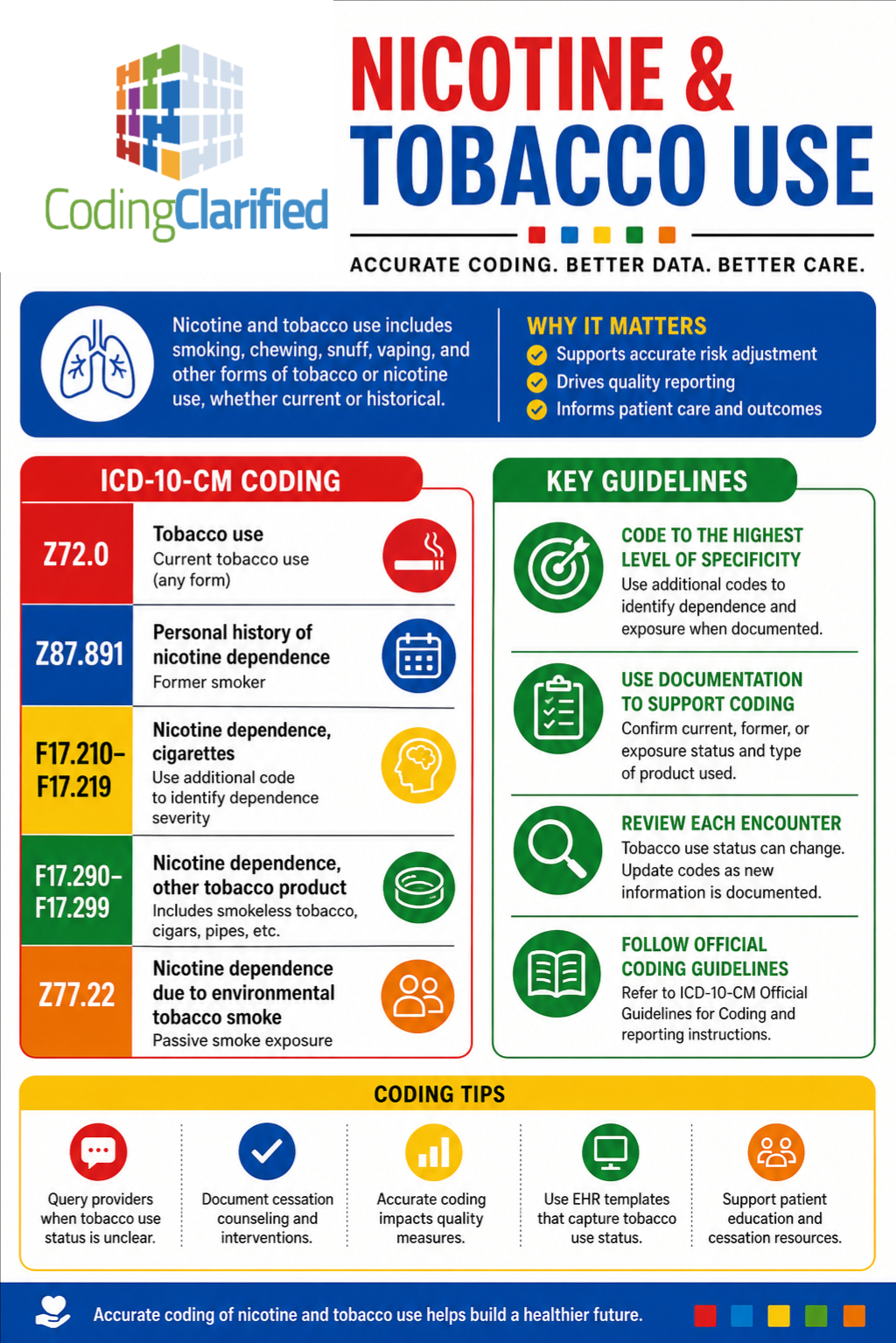
| ICD-10-CM Code | Description |
|---|---|
| F17 | Nicotine dependence |
| Z72.0 | Tobacco use, not otherwise specified |
| Z87.891 | Personal history of nicotine dependence |
| Z77.22 | Exposure to environmental tobacco smoke |
| O99.33- | Smoking complicating pregnancy |
Consequently, coders should carefully review provider documentation before assigning a diagnosis code.
F17 – Nicotine Dependence Codes
Use category F17 when the provider specifically documents nicotine dependence.
Additionally, these codes require coders to identify:
- The specific tobacco product used
- The dependence status
- Any associated nicotine-induced disorders or withdrawal symptoms
Therefore, specificity is extremely important when assigning F17 diagnosis codes.
Tobacco Product Categories
| Code Category | Tobacco Product |
|---|---|
| F17.20- | Unspecified tobacco product |
| F17.21- | Cigarettes |
| F17.22- | Chewing tobacco |
| F17.29- | Other tobacco products (vaping, cigars, pipes, etc.) |
Dependence Status Options
| Status Extension | Meaning |
|---|---|
| .20 | Uncomplicated |
| .21 | In remission |
| .23 | With withdrawal |
| .29 | With other nicotine-induced disorders |
Common F17 Coding Examples
| ICD-10-CM Code | Description |
|---|---|
| F17.210 | Nicotine dependence, cigarettes, uncomplicated |
| F17.221 | Nicotine dependence, chewing tobacco, in remission |
| F17.213 | Nicotine dependence, cigarettes, with withdrawal |
| F17.290 | Nicotine dependence, other tobacco product, uncomplicated |
CPC Coding Tip
Importantly, coders should never assume dependence simply because a patient smokes daily. Instead, the provider must clearly document terms such as:
- Nicotine dependence
- Addiction
- Tobacco dependence
Otherwise, coders should report a tobacco use code rather than a dependence code.
Z72.0 – Tobacco Use Coding
Assign Z72.0 Tobacco use when documentation indicates current tobacco use but does not document dependence.
For example, providers may document:
- Smoker
- Current smoker
- Tobacco user
- Uses chewing tobacco
- Smokes daily
However, if dependence is not specifically documented, coders should not assign an F17 code.
Documentation Examples
| Provider Documentation | Correct ICD-10-CM Code |
|---|---|
| “Patient is a daily smoker.” | Z72.0 |
| “Uses chewing tobacco.” | Z72.0 |
| “Smokes one pack per day.” | Z72.0 |
CPC Coding Tip
Many CPC students mistakenly assign nicotine dependence codes anytime smoking is documented. Nevertheless, ICD-10-CM guidelines require explicit provider documentation of dependence before an F17 code can be reported.
Z87.891 – History of Nicotine Dependence
Use Z87.891 Personal history of nicotine dependence when the patient is a former smoker or has quit tobacco use.
Appropriate Documentation Examples
- “Former smoker”
- “Quit smoking 5 years ago”
- “History of nicotine dependence”
Coding Example
| Documentation | Correct Code |
|---|---|
| “Former smoker, quit in 2021.” | Z87.891 |
Important Coding Reminder
Importantly, history codes should never be assigned for active smokers. Instead, if the patient currently uses tobacco products, coders should assign a current-use or dependence code, depending on the provider documentation.
Z77.22 – Exposure to Environmental Tobacco Smoke
Use Z77.22 when the patient experiences secondhand smoke exposure but does not personally use tobacco products.
For instance, this code may apply in situations involving:
- Passive smoke exposure at home
- Occupational smoke exposure
- Environmental tobacco exposure
Correct Code
| ICD-10-CM Code | Description |
|---|---|
| Z77.22 | Contact with and exposure to environmental tobacco smoke |
Furthermore, this code is frequently reported in pediatric, pulmonary, and preventive medicine settings.
Pregnancy and Tobacco Use Coding
When smoking complicates pregnancy, ICD-10-CM sequencing guidelines become especially important. Therefore, coders must report the pregnancy complication code first.
As a result, coders should assign:
- The appropriate O99.33- code first
- Followed by the applicable nicotine dependence code
Example
Documentation
“Pregnant patient with nicotine dependence, cigarettes.”
Correct Codes
| ICD-10-CM Code | Description |
|---|---|
| O99.331 | Smoking complicating pregnancy, first trimester |
| F17.210 | Nicotine dependence, cigarettes, uncomplicated |
CPC Exam Tip
Because pregnancy chapter codes often contain unique sequencing rules, coders should always review instructional notes and chapter-specific guidelines carefully.
CPT Codes for Tobacco Cessation Counseling
In addition to diagnosis coding, tobacco cessation counseling may also be separately reportable when supported by documentation.
CPT Tobacco Counseling Codes
| CPT Code | Description |
|---|---|
| 99406 | Smoking cessation counseling, 3–10 minutes |
| 99407 | Smoking cessation counseling, greater than 10 minutes |
Documentation Requirements
To support reimbursement successfully, providers should clearly document:
- Counseling provided
- Duration of counseling
- Medical necessity
- Tobacco-related risks discussed
- Treatment recommendations
Important Coding Reminder
Most importantly, cessation counseling codes generally require documented counseling time. Therefore, coders should verify that time requirements are fully supported before assigning CPT codes 99406 or 99407.
Documentation Tips for Medical Coders
Strong provider documentation not only improves coding accuracy but also helps reduce denials and audit risks. Consequently, coders should carefully review records for:
- Tobacco product type
- Smoking frequency
- Duration of use
- Dependence versus use
- Withdrawal symptoms
- Counseling provided
- Attempts to quit
- Associated medical conditions
Additionally, coders should encourage providers to document:
- “Nicotine dependence” instead of simply “smoker”
- The specific tobacco product used
- Current smoking status
- Remission or quit status
As documentation specificity increases, coding accuracy and reimbursement accuracy also improve.
Common Tobacco Coding Mistakes
Even experienced coders occasionally make tobacco coding errors. However, understanding these common mistakes can help improve both coding compliance and claim accuracy.
Frequent Errors Include:
- Coding Z72.0 when dependence is documented
- Using history codes for active smokers
- Missing product specificity
- Incorrect pregnancy code sequencing
- Billing cessation counseling without documented time
- Assuming dependence without provider documentation
Therefore, coders should always verify provider wording carefully before assigning diagnosis codes.
Real-World Tobacco Coding Examples
Example 1
Documentation
“Patient has smoked one pack of cigarettes daily for 20 years.”
Correct Code
- Z72.0 Tobacco use
Because dependence was not documented, an F17 code should not be assigned.
Example 2
Documentation
“Nicotine dependence, vaping daily.”
Correct Code
- F17.290 Nicotine dependence, other tobacco product, uncomplicated
Since vaping falls under “other tobacco products,” coders should assign the F17.29 category when dependence is documented.
Example 3
Documentation
“Former smoker, quit 5 years ago.”
Correct Code
- Z87.891 Personal history of nicotine dependence
Because the patient no longer actively uses tobacco, a history code is appropriate.
Example 4
Documentation
“Pregnant patient with nicotine dependence, cigarettes.”
Correct Codes
- O99.332 Smoking complicating pregnancy, second trimester
- F17.210 Nicotine dependence, cigarettes, uncomplicated
In this scenario, the pregnancy complication code must be sequenced first.
Key Coding Takeaways for CPC Students and Medical Coders
Ultimately, accurate tobacco coding begins with determining whether the documentation supports:
- Current tobacco use
- Nicotine dependence
- Former smoker status
- Environmental exposure
Additionally, coders should always:
- Capture product specificity
- Review sequencing guidelines carefully
- Verify counseling documentation
- Avoid assuming dependence
- Assign pregnancy complication codes correctly
Most importantly, accurate nicotine and tobacco coding supports preventive healthcare initiatives, improves reimbursement accuracy, strengthens risk adjustment reporting, and helps capture the complete clinical picture for patients.
Ready to become a certified medical coder? Our online CPC certification training prepares you for the AAPC CPC exam with a credentialed instructor. Many students train at little or no cost through medical coding scholarships and WIOA grants available in 30+ states.
Ready to code like this for a living?
Coding Clarified’s AAPC licensed CPC program takes you from beginner to certified, with an internship and a job board for graduates.
You may qualify for WIOA funding in 30+ states. Check your eligibility.