
Reviewed October 2026 for 2027. The finger, toe and eyelid modifiers below are unchanged. Confirm against the January 2027 HCPCS Level II update before you bill.
Quick answer: The modifier for the right thumb is F5, and the left thumb is FA. Fingers use FA and F1 to F4 for the left hand and F5 to F9 for the right hand. Toes use TA and T1 to T4 for the left foot and T5 to T9 for the right foot. Eyelids use E1 to E4. When one of these describes the site, use it instead of LT or RT.
Become a Certified Medical Coder
Modifiers are heavily tested on the CPC exam. Master them in our AAPC licensed online CPC training, taught by a CPC-I instructor. Many students train at little or no cost through scholarships and WIOA grants in 30+ states.
Explore online CPC training | See if you qualify for funding
What are the anatomical modifiers? (Quick Reference Chart)
Finger Modifiers (FA to F9)
| Modifier | Description |
|---|---|
| FA | Left hand, thumb |
| F1 | Left hand, second digit (index finger) |
| F2 | Left hand, third digit |
| F3 | Left hand, fourth digit |
| F4 | Left hand, fifth digit |
| F5 | Right hand, thumb |
| F6 | Right hand, second digit (index finger) |
| F7 | Right hand, third digit |
| F8 | Right hand, fourth digit |
| F9 | Right hand, fifth digit |
Toe Modifiers (TA to T9)
| Modifier | Description |
|---|---|
| TA | Left foot, great toe |
| T1 | Left foot, second digit |
| T2 | Left foot, third digit |
| T3 | Left foot, fourth digit |
| T4 | Left foot, fifth digit |
| T5 | Right foot, great toe |
| T6 | Right foot, second digit |
| T7 | Right foot, third digit |
| T8 | Right foot, fourth digit |
| T9 | Right foot, fifth digit |
Eyelid Modifiers (E1 to E4)
| Modifier | Description |
|---|---|
| E1 | Upper left eyelid |
| E2 | Lower left eyelid |
| E3 | Upper right eyelid |
| E4 | Lower right eyelid |
Laterality Modifiers (Quick Comparison)
| Modifier | Description | When to Use |
|---|---|---|
| -LT | Left side | When no specific anatomical modifier exists |
| -RT | Right side | When no specific anatomical modifier exists |
| -50 | Bilateral procedure | When procedure performed on both sides |
If a specific anatomical modifier (F, T, or E) is available, it should be used instead of -LT or -RT.
How do anatomical modifiers work?
What Are Anatomical Modifiers?
Anatomical modifiers are HCPCS Level II modifiers used to identify the exact location on the body where a procedure was performed. These modifiers provide precise anatomical specificity, which Medicare contractors and most payers expect whenever a specific modifier applies.
While -LT (left) and -RT (right) indicate general laterality, anatomical modifiers go further:
- FA = Left hand, thumb
- F6 = Right hand, index finger
- E1 = Upper left eyelid
This level of detail ensures correct claim processing and reduces denials.
What are the rules for using anatomical modifiers?
1. Use the Most Specific Modifier Available
Always choose the most detailed modifier (F, T, or E series) when available.
Using -LT/-RT instead can result in incomplete claim denials.
2. Do Not Default to LT/RT for Digits
Modifiers -LT and -RT should only be used when no specific anatomical modifier exists.
For fingers, toes, and eyelids, always use the correct anatomical modifier.
3. Verify Documentation Carefully
Before assigning modifiers, confirm:
- Exact digit (thumb, index, etc.)
- Left vs. right
- Upper vs. lower eyelid
If documentation is unclear, query the provider.
4. Assign Modifiers Per Line Item
When multiple procedures are performed:
- Use the correct modifier on each line
- Do not combine multiple anatomical sites
This ensures accurate billing.
How anatomical modifiers affect NCCI edits: CMS lists the anatomic modifiers (E1 to E4, FA, F1 to F9, TA, T1 to T9, LT, RT, LC, LD, LM, RC and RI) as NCCI associated modifiers. LC, LD, LM, RC and RI identify coronary arteries. When the same procedure is performed on two different digits, reporting each digit on its own line with its own modifier shows the services were at separate sites, which can bypass an NCCI procedure to procedure edit when the documentation supports it. Use modifier 59 or XS only when no anatomic modifier describes the separate site.
5. Follow Payer-Specific Requirements
Many payers require anatomical modifiers for:
- Surgical procedures
- Dermatology services
- Ophthalmology procedures
Failure to comply may trigger:
- NCCI edits
- Claim rejections
- Payment delays
6. Avoid Common Coding Errors
Common mistakes include:
- Using -LT/-RT instead of F/T/E modifiers
- Selecting the wrong digit (F1 vs. F2)
- Confusing the great toe vs. lesser toes
- Incorrect eyelid selection (E1 to E4)
CPC Exam Tip: The correct answer is usually the most specific anatomical modifier available.
What is the modifier for the right thumb and the other fingers?
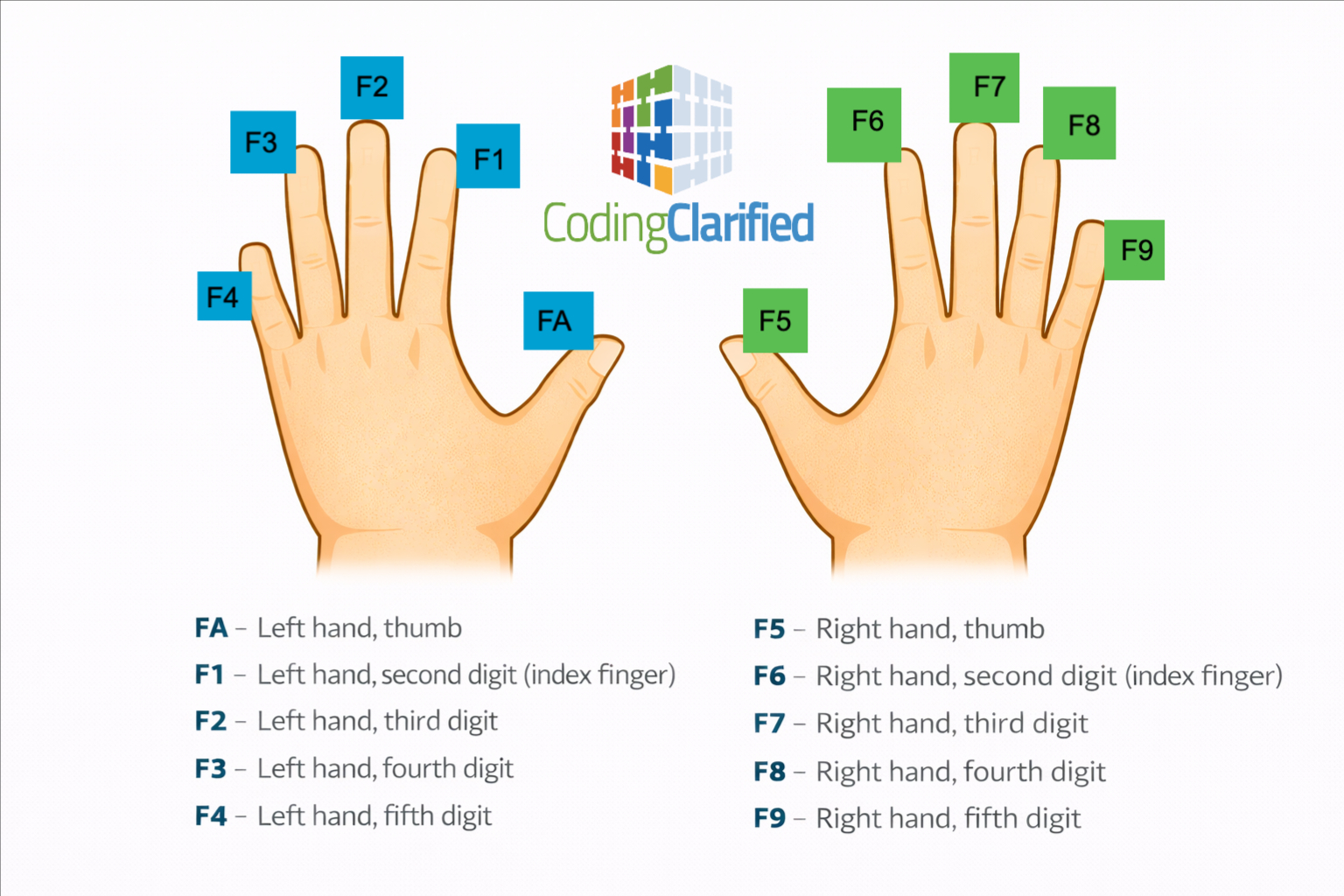
Finger modifiers identify procedures performed on specific digits of the hand. These are required to distinguish procedures from the hand as a whole.
Left Hand
- FA: Left hand, thumb
- F1: Left hand, second digit (index finger)
- F2: Left hand, third digit
- F3: Left hand, fourth digit
- F4: Left hand, fifth digit
Right Hand
- F5: Right hand, thumb
- F6: Right hand, second digit (index finger)
- F7: Right hand, third digit
- F8: Right hand, fourth digit
- F9: Right hand, fifth digit
Important: Always verify the exact finger in documentation before coding.
What are the toe modifiers (TA to T9)?
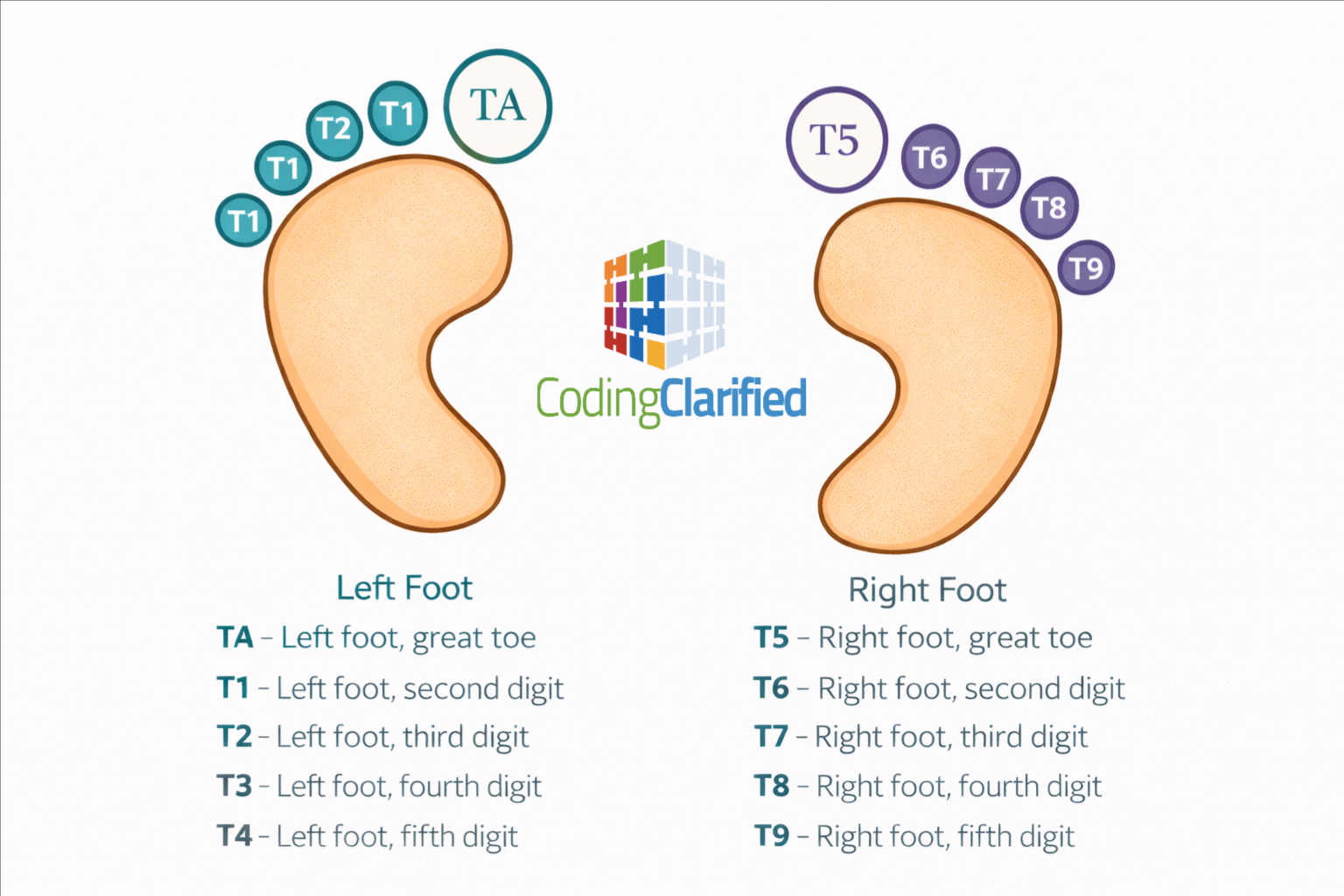
Toe modifiers identify procedures performed on the toes, including the great toe (hallux).
Left Foot
- TA: Left foot, great toe
- T1: Left foot, second digit
- T2: Left foot, third digit
- T3: Left foot, fourth digit
- T4: Left foot, fifth digit
Right Foot
- T5: Right foot, great toe
- T6: Right foot, second digit
- T7: Right foot, third digit
- T8: Right foot, fourth digit
- T9: Right foot, fifth digit
Coding Tip:
Do not confuse the great toe with the lesser toes; this is a common error that impacts reimbursement.
What are the eyelid modifiers (E1 to E4)?
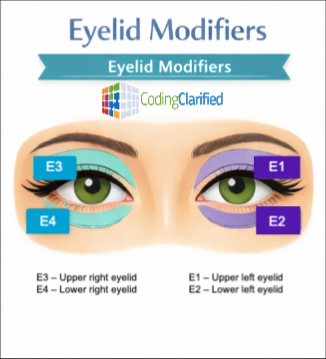
Eyelid modifiers provide precise identification for ophthalmologic procedures.
- E1: Upper left eyelid
- E2: Lower left eyelid
- E3: Upper right eyelid
- E4: Lower right eyelid
Important: Always confirm upper vs. lower eyelid in the documentation.
When do you use LT or RT instead?
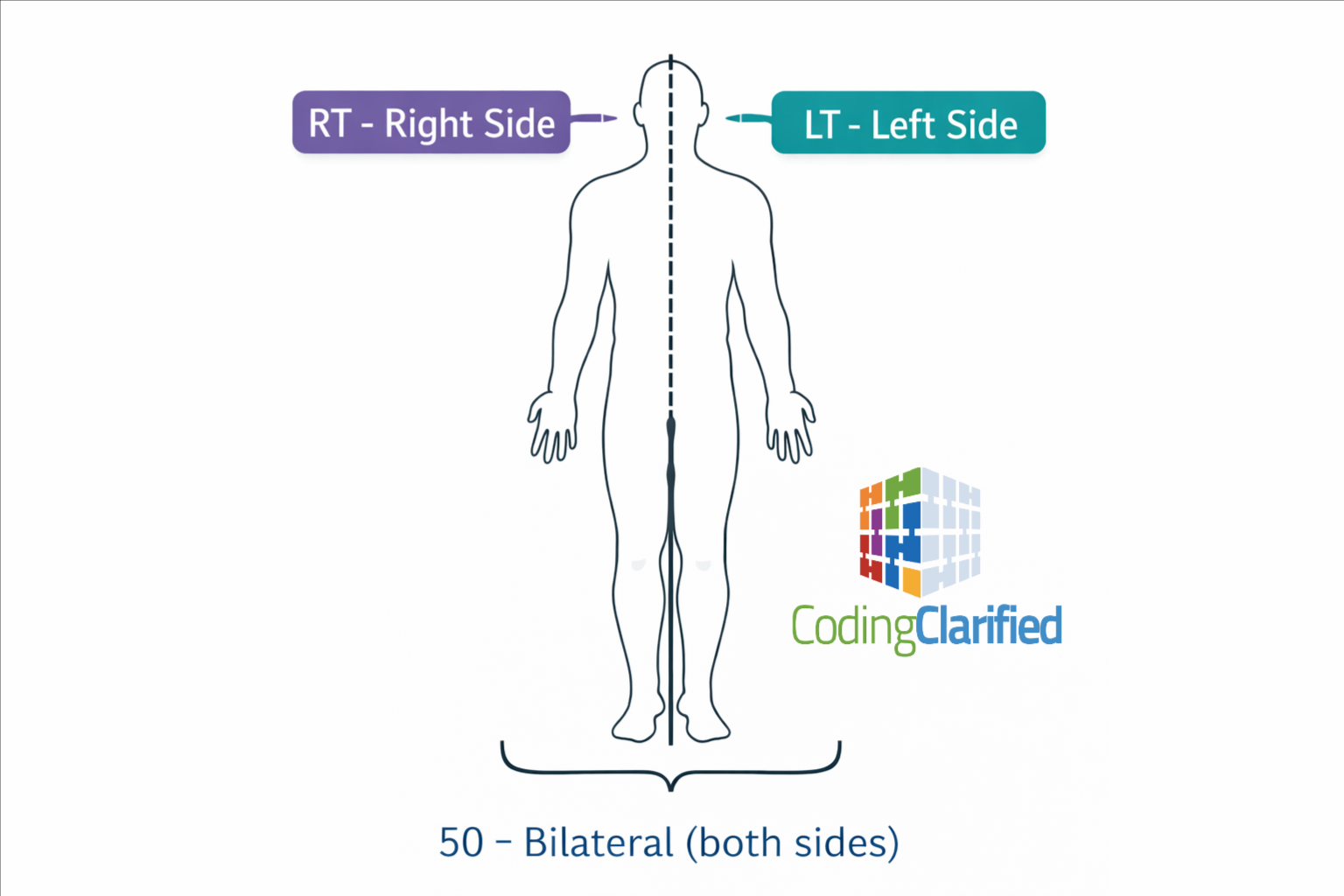
This is long standing Medicare and NCCI practice, not a new rule:
If a specific anatomical modifier exists, it must be used instead of -LT or -RT.
Example:
- Incorrect: Procedure on right index finger with -RT
- Correct: Use F6
Using -LT/-RT instead of F, T, or E modifiers can lead to:
- Claim denials
- Delayed payments
- Payer audits
What do anatomical modifiers look like on a claim?
- 26055-F8: Trigger finger release (incision of the flexor tendon sheath) on the right ring finger. The ring finger is the fourth digit of the right hand, so the modifier is F8.
- 11750-TA: Excision of the nail and nail matrix on the left great toe.
- 67800-E3: Excision of a single chalazion on the right upper eyelid.
Same procedure on two digits: If the provider releases trigger fingers on the right middle and ring fingers, report 26055-F7 and 26055-F8 on separate lines. Check the payer’s unit limits and edits before you submit.
Why do anatomical modifiers matter for medical coders?
Accurate use of anatomical modifiers ensures:
- Proper reimbursement
- Reduced claim denials
- Compliance with CMS guidelines
- Clear and precise documentation
For CPC students, this is a high-yield exam topic and frequently tested concept.
Final Tips for CPC Students and Coders
- Always code to the highest level of specificity
- Never rely on memory; verify in the HCPCS manual
- Pay attention to payer guidelines and edits
- Practice modifier usage with real-world scenarios
Frequently asked questions
What is the modifier for the right thumb?
F5 is the modifier for the right thumb. The left thumb is FA.
What is the modifier for the left great toe?
TA is the modifier for the left great toe. The right great toe is T5.
Can I use RT or LT instead of a finger or toe modifier?
No. When a specific finger, toe or eyelid modifier describes the site, report it instead of LT or RT. Use LT and RT only when no more specific anatomic modifier exists.
Do anatomical modifiers bypass NCCI edits?
They can. CMS lists the anatomic modifiers as NCCI associated modifiers, so they may bypass a procedure to procedure edit when the procedures were performed at different anatomic sites and the documentation supports it.
What are modifiers E1, E2, E3 and E4?
They identify the eyelid: E1 is the upper left eyelid, E2 the lower left, E3 the upper right and E4 the lower right.
Related guides and references
- CMS: Proper Use of Modifiers 59, XE, XP, XS and XU
- Medical Coding Types of Injections
- Medical Coding Reference Library
Take Your Coding Skills Further
To master modifiers (see our HCPCS modifiers guide) and HCPCS coding, explore the HCPCS Level II Mastery module inside the online CPC course. Learn more about Coding Clarified.
Ready to code like this for a living?
Coding Clarified’s AAPC licensed CPC program takes you from beginner to certified, with an internship and a job board for graduates.
You may qualify for WIOA funding in 30+ states. Check your eligibility.