Electronic Remittance Advice (ERA) in Medical Billing for 2026: Complete Guide for Medical Coders and Billers
Key Takeaways
- Electronic Remittance Advice (ERA) is the electronic version of an insurance payment explanation.
- ERA helps medical billers post payments faster while reducing manual errors.
- Most ERAs use the HIPAA-standard ANSI X12 835 transaction.
- ERA works alongside Electronic Funds Transfer (EFT) to automate revenue cycle management.
- Understanding Claim Adjustment Reason Codes (CARCs) and Remittance Advice Remark Codes (RARCs) is essential for proper payment posting.
- Medical coders should understand ERA because coding errors frequently lead to payment denials and reduced reimbursement.
- In 2026, automation, AI-assisted payment posting, and real-time claim reconciliation continue to improve ERA workflows.
Electronic Remittance Advice (ERA): Everything Medical Billers and Coders Need to Know in 2026
Medical billing involves much more than submitting insurance claims. After a payer processes a claim, providers must understand exactly what was paid, denied, adjusted, or transferred to patient responsibility. That information arrives through an Electronic Remittance Advice (ERA).
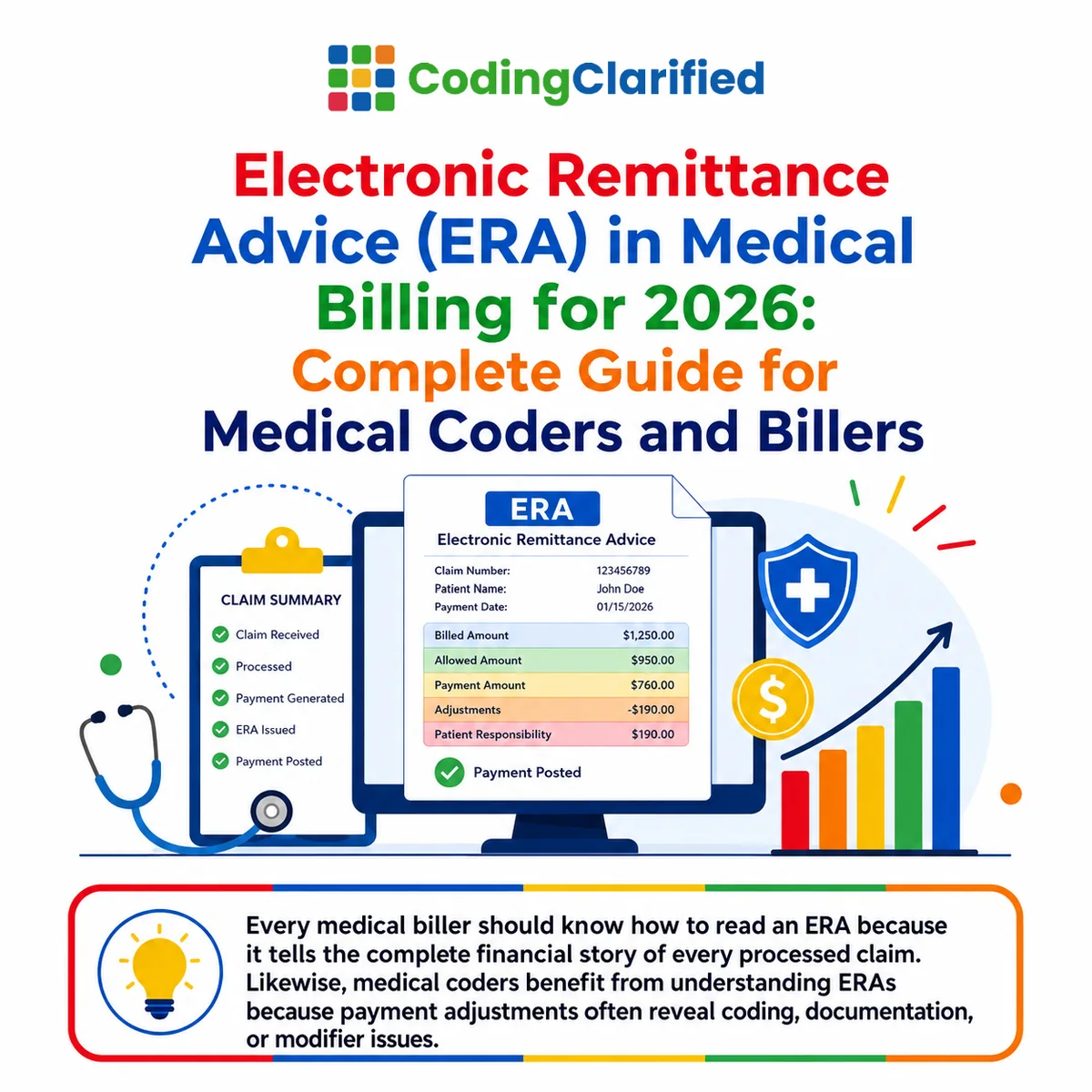
Every medical biller should know how to read an ERA because it tells the complete financial story of every processed claim. Likewise, medical coders benefit from understanding ERAs because payment adjustments often reveal coding, documentation, or modifier issues.
This 2026 guide explains what an ERA is, how it works, why healthcare organizations rely on it, and how medical coders and billers can use ERA information to improve reimbursement.
What Is an Electronic Remittance Advice (ERA)?
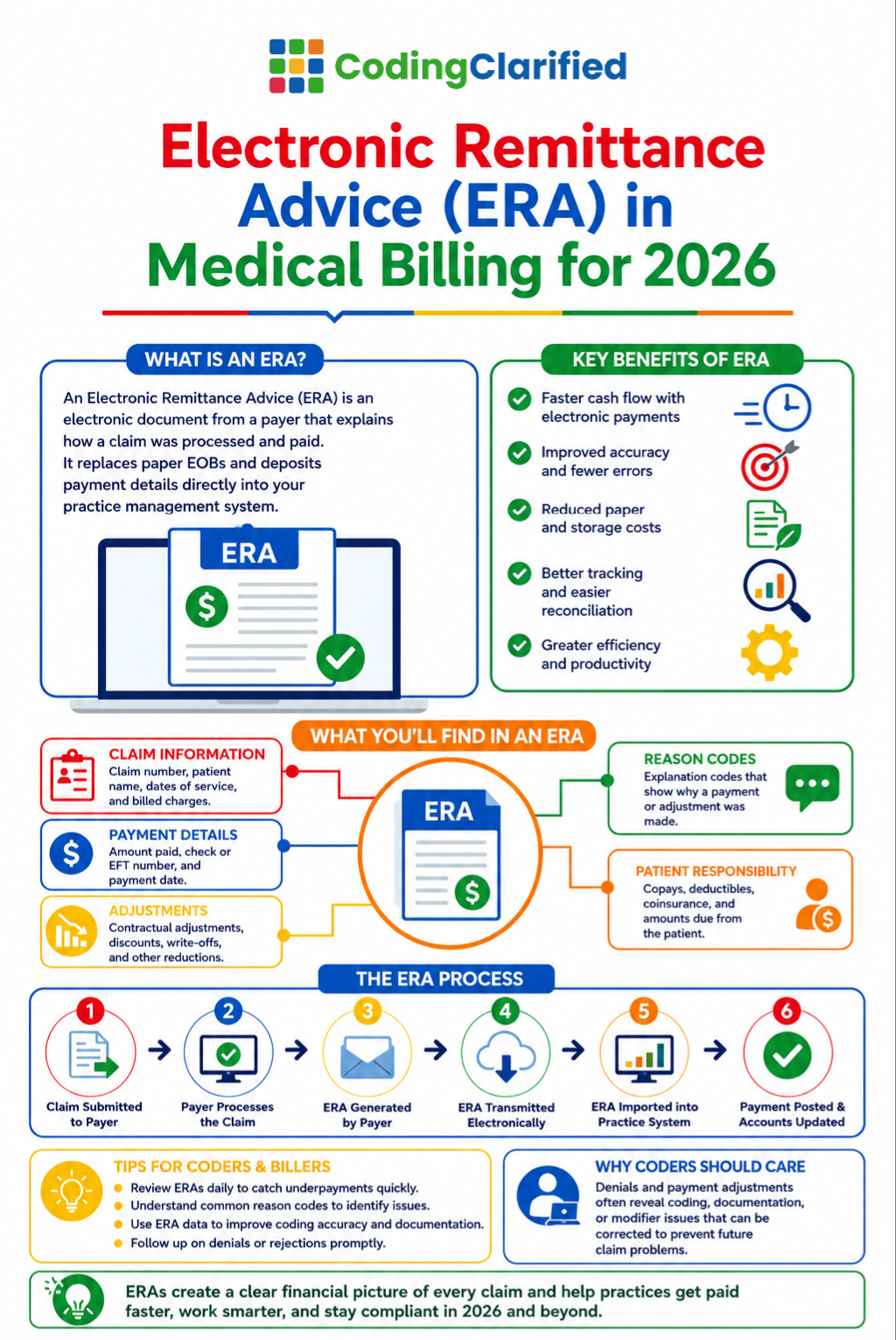
An Electronic Remittance Advice (ERA) is a digital document sent by an insurance company after processing a healthcare claim.
Think of an ERA as the electronic version of an Explanation of Benefits (EOB). Instead of arriving on paper, it comes electronically using a standardized HIPAA transaction.
An ERA explains:
- Amount billed
- Allowed amount
- Amount paid
- Contractual adjustments
- Deductibles
- Coinsurance
- Copayments
- Denied services
- Patient responsibility
- Payment reason codes
- Adjustment codes
Rather than guessing why a claim paid differently than expected, billers use the ERA to identify exactly what occurred.
What Is the ANSI X12 835 Transaction?
Nearly every ERA in the United States uses the ANSI ASC X12N 835 Health Care Claim Payment/Advice transaction.
The 835 transaction is the national HIPAA standard for electronic payment information.
It allows healthcare providers and practice management software to receive standardized payment information regardless of which insurance company processed the claim.
Because every payer follows the same general structure, billing software can automatically read and post many payments.
How Does an ERA Work?
The ERA process begins after a healthcare provider submits a claim.
The workflow generally follows these steps:
Step 1: Claim Submission
The provider submits an electronic claim using the ANSI 837 transaction.
Step 2: Claim Review
The insurance company reviews:
- Medical necessity
- Patient eligibility
- Policy benefits
- Documentation
- Coding accuracy
- Provider contracts
Step 3: Claim Processing
The payer determines:
- Approved services
- Reduced payments
- Denials
- Patient responsibility
Step 4: Payment Issued
The insurance company issues payment through:
- Electronic Funds Transfer (EFT)
- Paper check
Step 5: ERA Sent
The payer sends an ERA explaining every payment decision.
The ERA usually arrives on the same day as the EFT.
Step 6: Payment Posting
Billing software automatically posts many payments using ERA information.
Medical billers review any exceptions before finalizing patient balances.
ERA vs. EOB: What’s the Difference?
Many beginners confuse these two documents.
| ERA | EOB |
|---|---|
| Electronic | Paper or electronic |
| Sent to providers | Sent to patients |
| Used for payment posting | Used for patient information |
| Includes standardized adjustment codes | Written in patient-friendly language |
| HIPAA transaction | Not a HIPAA transaction standard |
Although both explain claim payments, they serve different audiences.
ERA vs. EFT
These terms also work together but represent different functions.
| ERA | EFT |
|---|---|
| Explains payment | Transfers money |
| Contains claim details | Contains funds only |
| Used by billing staff | Used by accounting |
| No money included | Money deposited into bank account |
Many providers enroll in both services because they streamline payment processing.
What Information Is Included on an ERA?
A typical ERA contains several important sections.
Patient Information
- Patient name
- Member ID
- Date of birth
Provider Information
- Billing provider
- Rendering provider
- National Provider Identifier (NPI)
Claim Information
- Claim number
- Dates of service
- Insurance information
- Total charges
Payment Information
- Allowed amount
- Paid amount
- Deductible
- Coinsurance
- Copayment
- Patient responsibility
Adjustment Codes
The ERA identifies why payment changed using standardized adjustment codes.
These include:
- CARCs
- RARCs
- Group Codes
What Are CARCs?
Claim Adjustment Reason Codes (CARCs) explain why a payer reduced, denied, or adjusted payment.
Examples include:
- CO-45 – Contractual obligation
- PR-1 – Deductible
- PR-2 – Coinsurance
- OA-23 – Impact of prior payer
- CO-97 – Service included in another procedure
Every biller should learn the most common CARCs because they explain nearly every payment adjustment.
What Are RARCs?
Remittance Advice Remark Codes (RARCs) provide additional details that support the adjustment reason.
For example, a CARC may indicate the service was denied, while a RARC explains the documentation missing or policy requirement involved.
Together, CARCs and RARCs provide a complete explanation.
Why Are ERAs Important?
Healthcare organizations process thousands of claims every month.
Without ERA automation, staff would spend countless hours posting payments manually.
ERAs help providers:
- Receive payments faster
- Reduce posting errors
- Improve cash flow
- Identify denials quickly
- Reduce administrative costs
- Improve reporting
- Reconcile deposits accurately
- Speed collections
How Medical Coders Benefit from Understanding ERA
Although payment posting belongs primarily to medical billing, coders gain valuable insight from ERAs.
For example, repeated denials may reveal:
- Incorrect modifier usage
- Missing documentation
- Incorrect diagnosis sequencing
- Medical necessity problems
- Bundling issues
- National Correct Coding Initiative (NCCI) edits
Understanding payment outcomes helps coders improve future claim accuracy.
Common ERA Denial Reasons
Some denial reasons appear repeatedly across nearly every specialty.
Common examples include:
- Invalid insurance coverage
- Authorization missing
- Medical necessity not met
- Duplicate claim
- Incorrect modifier
- Coding errors
- Eligibility problems
- Filing deadline exceeded
- Missing documentation
Recognizing these trends helps billing teams reduce repeat mistakes.
ERA and Revenue Cycle Management (RCM)
ERAs play an important role throughout the revenue cycle.
The process generally follows this sequence:
- Patient registration
- Insurance verification
- Medical coding
- Claim submission
- Claim adjudication
- ERA received
- Payment posting
- Patient billing
- Collections
- Revenue reporting
Every step depends on accurate information from the previous step.
ERA Automation in 2026
Technology continues to improve payment posting.
Modern billing software now offers:
- AI-assisted payment posting
- Automated denial routing
- Real-time reconciliation
- Dashboard analytics
- Predictive denial tracking
- Automated secondary claim generation
- Payment variance reporting
These tools reduce manual work while improving payment accuracy.
However, staff members still review exceptions that require human judgment.
How to Read an ERA Efficiently
Experienced billers usually follow the same routine.
First, verify the patient information.
Next, compare billed charges with allowed amounts.
Afterward, review adjustments.
Then, identify patient responsibility.
Finally, investigate unexpected denials before posting the remaining balance.
Following a consistent workflow reduces overlooked payment issues.
Common Mistakes to Avoid
Even experienced billers occasionally make ERA mistakes.
Avoid these common errors:
- Posting payments without reviewing adjustment codes
- Ignoring CARCs and RARCs
- Failing to reconcile EFT deposits
- Writing off balances incorrectly
- Missing secondary insurance claims
- Posting patient responsibility inaccurately
- Overlooking payer policy updates
- Failing to investigate repeated denials
Regular audits help catch these issues before they affect revenue.
CPC Student Tips
Students preparing for the CPC® examination often focus only on diagnosis and procedure coding. However, understanding the payment side of healthcare provides valuable career knowledge.
Keep these tips in mind:
- Learn the difference between ERA, EOB, and EFT.
- Become familiar with the ANSI 835 transaction.
- Understand the purpose of CARCs and RARCs.
- Review common denial reasons.
- Study how coding errors affect reimbursement.
- Practice reading sample remittance advice documents.
- Learn basic revenue cycle management terminology.
Employers appreciate coders who understand both coding and billing workflows.
Why ERA Knowledge Matters in 2026
Healthcare reimbursement continues to become more automated.
Insurance companies increasingly rely on electronic transactions, artificial intelligence, and standardized payment systems. As a result, professionals who understand ERA processing can troubleshoot payment issues faster and improve reimbursement accuracy.
Whether you plan to become a medical coder, medical biller, or revenue cycle specialist, learning how ERAs work will strengthen your understanding of the complete claims process and make you a more valuable member of any healthcare organization.
Frequently Asked Questions (FAQ)
What does ERA stand for in medical billing?
ERA stands for Electronic Remittance Advice, which is the electronic explanation of how an insurance company processed and paid a healthcare claim.
Is an ERA the same as an EOB?
No. An ERA is sent electronically to healthcare providers for payment posting, while an Explanation of Benefits (EOB) is typically sent to patients to explain how their insurance processed the claim.
What is the difference between ERA and EFT?
An ERA explains the payment details, adjustments, and patient responsibility. An Electronic Funds Transfer (EFT) moves the actual payment into the provider’s bank account. They often arrive together but serve different purposes.
What are CARCs and RARCs?
Claim Adjustment Reason Codes (CARCs) explain why a payment was adjusted or denied. Remittance Advice Remark Codes (RARCs) provide additional information about the adjustment or denial.
Why do medical coders need to understand ERAs?
ERAs help coders identify recurring coding errors, documentation deficiencies, modifier issues, and medical necessity problems that can lead to denials or reduced reimbursement.
Can ERAs be posted automatically?
Yes. Most modern billing software uses the ANSI X12 835 transaction to automatically post payments. Staff members then review exceptions, denials, or unusual adjustments.
Are ERAs required by HIPAA?
HIPAA designates the ANSI ASC X12N 835 transaction as the standard format for electronic healthcare payment and remittance advice, promoting consistent electronic communication between payers and providers.
Coding Clarified Final Thoughts
Electronic Remittance Advice is one of the most important tools in modern medical billing. It provides detailed payment information, supports accurate payment posting, and helps healthcare organizations manage revenue efficiently. When medical billers understand ERAs and medical coders recognize how coding affects reimbursement, organizations reduce denials, improve cash flow, and strengthen the entire revenue cycle. As electronic claims processing continues to evolve in 2026, ERA knowledge remains an essential skill for every healthcare revenue cycle professional.
Suggested Internal Links (Coding Clarified)
Link to 3–5 relevant articles from your blog, such as:
- How To Become A Medical Biller In 2026
- Medical Coder vs Medical Biller
- Pediatric Medical Coding and Billing in 2026
- Medical Coding and Billing Guidelines for Infusion Services in 2026
- CPB Exam Tips
Authoritative References
- CMS – Electronic Remittance Advice (ERA)
- CMS – HIPAA Administrative Simplification
- AAPC
- CAQH CORE – ERA & EFT Resources
- X12 Standards Organization