Pediatric Medical Coding and Billing in 2026: Guidelines, CPT Updates, Billing Tips, and CPC Exam Strategies
Pediatric medical coding and billing require careful attention to age-specific documentation, preventive medicine guidelines, vaccine administration rules, growth and development services, and payer-specific requirements. Furthermore, because pediatric practices often provide preventive care, immunizations, developmental screenings, and acute illness management during the same encounter, coders must understand how to correctly report multiple services while remaining compliant with CPT®, ICD-10-CM, and payer guidelines.
Additionally, pediatric coding continues to evolve in 2026 as healthcare organizations focus more heavily on preventive medicine, behavioral health integration, telehealth, social determinants of health (SDOH), and documentation accuracy. Therefore, medical coders, billers, auditors, and CPC students must stay current on pediatric coding rules to reduce denials and improve reimbursement accuracy.
Key Takeaway: Pediatric Coding in 2026
Pediatric coding involves far more than assigning diagnosis and procedure codes. Instead, coders must evaluate preventive medicine services, immunization administration, modifier usage, developmental screenings, behavioral assessments, telehealth documentation, and medical necessity requirements. Moreover, accurate pediatric billing depends heavily on documentation specificity, age-based coding selection, and proper sequencing of CPT® and ICD-10-CM codes.
Learn more in our guide to newborn coding.
What Is Pediatric Medical Coding?
Pediatric medical coding is the process of translating healthcare services provided to infants, children, adolescents, and teenagers into standardized CPT®, HCPCS Level II, and ICD-10-CM codes for billing and reimbursement purposes.
Typically, pediatric coding includes:
Learn more in our guide to dehydration coding.
- Well-child visits
- Preventive medicine services
- Immunizations
- Developmental screenings
- Behavioral health screenings
- Acute illnesses
- Chronic condition management
- Newborn services
- Telehealth services
- Care coordination
- Vaccine counseling
- Minor procedures
Because pediatric encounters often include multiple components during one visit, coders must review documentation carefully to determine whether additional services are separately reportable.
Common Pediatric CPT® Codes in 2026
Preventive Medicine Services
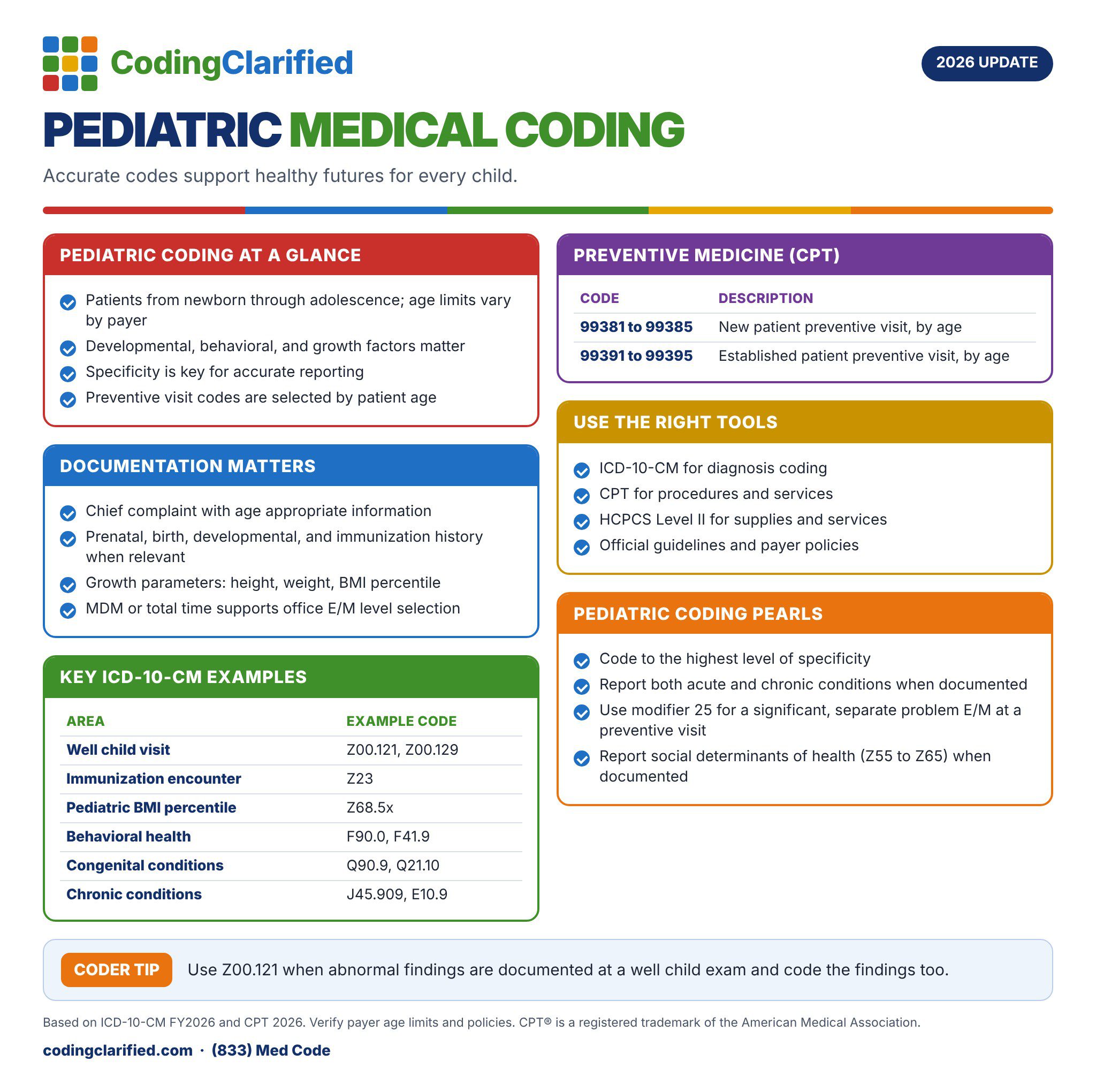
Preventive medicine visits remain some of the most frequently billed pediatric services.
New Patient Preventive Medicine Codes
| Age Range | CPT® Code |
|---|---|
| Under 1 year | 99381 |
| 1–4 years | 99382 |
| 5–11 years | 99383 |
| 12–17 years | 99384 |
Established Patient Preventive Medicine Codes
| Age Range | CPT® Code |
|---|---|
| Under 1 year | 99391 |
| 1–4 years | 99392 |
| 5–11 years | 99393 |
| 12–17 years | 99394 |
Importantly, preventive medicine visits are age-based rather than time-based. Therefore, coders must verify the patient’s exact age on the date of service.
Sick Visits Performed on the Same Day as Well Visits
One of the most common pediatric billing situations involves reporting a sick visit during a preventive medicine encounter.
For example, a child may present for a routine wellness exam but also receive evaluation and treatment for:
- Ear infection
- Asthma flare
- Fever
- ADHD medication management
- Rash
- Bronchitis
In these situations, an additional E/M code may be reported if the physician documents a significant and separately identifiable service.
Common office visit E/M codes include:
| CPT® Code | Description |
|---|---|
| 99202–99205 | New patient office visits |
| 99211–99215 | Established patient office visits |
Additionally, modifier 25 is often required when billing the problem-oriented E/M service with the preventive medicine service.
Pediatric Modifier 25 Tip
Modifier 25 indicates that the provider performed a significant, separately identifiable E/M service on the same date as another procedure or preventive service.
However, documentation must clearly support the additional work performed.
Documentation Should Include:
- Separate complaint
- Additional history
- Separate assessment
- Additional medical decision making
- Treatment plan
Consequently, weak documentation frequently results in payer denials.
Immunization Coding and Billing in 2026
Immunization coding remains one of the most complex areas of pediatric billing. Nevertheless, accurate vaccine coding is essential for reimbursement compliance.
Vaccine Product Codes
Coders must report the vaccine product CPT® code.
Examples include:
| Vaccine | CPT® Code |
|---|---|
| Influenza vaccine | 90686 |
| MMR vaccine | 90707 |
| Varicella vaccine | 90716 |
| HPV vaccine | 90651 |
Vaccine Administration Codes
In addition to the vaccine product, coders must also report administration codes.
Common Administration Codes
| CPT® Code | Description |
|---|---|
| 90460 | First vaccine/toxoid component with counseling |
| 90461 | Each additional component |
| 90471 | Administration without counseling |
| 90472 | Additional vaccine administration |
Importantly, codes 90460–90461 are used only when physician or qualified healthcare professional counseling is documented.
Therefore, if counseling is not documented, coders may need to use 90471–90474 instead.
Developmental and Behavioral Screening Codes
Developmental and behavioral screenings are increasingly important in pediatric practices. Furthermore, many payers now emphasize early identification of developmental disorders and mental health concerns.
Common Screening Codes
| CPT® Code | Description |
|---|---|
| 96110 | Developmental screening |
| 96127 | Brief emotional/behavioral assessment |
Examples include:
- ADHD screening
- Autism screening
- Depression screening
- Anxiety screening
- Behavioral assessment questionnaires
Additionally, documentation should include:
- Screening tool used
- Results
- Interpretation
- Provider review
Without proper documentation, these services may not be reimbursed.
Telehealth Pediatric Coding in 2026
Telehealth continues to play a major role in pediatric medicine, especially for behavioral health, follow-up visits, and chronic condition management.
However, telehealth rules remain payer dependent in 2026. Therefore, coders must verify:
- Audio-only coverage
- POS requirements
- Modifier requirements
- State Medicaid policies
- Commercial payer guidelines
Common Telehealth Modifiers
| Modifier | Description |
|---|---|
| 95 | Synchronous telemedicine service |
| GT | Via interactive audio and video; largely replaced by 95, use only when a payer requires it |
| FQ | Audio-only communication |
Additionally, many payers still require documentation of:
- Patient consent
- Provider location
- Patient location
- Technology used
ICD-10-CM Coding in Pediatrics
Pediatric diagnosis coding often includes:
- Upper respiratory infections
- Otitis media
- Asthma
- ADHD
- Developmental disorders
- Newborn conditions
- Well-child examinations
Common Pediatric ICD-10-CM Codes
| ICD-10-CM Code | Description |
|---|---|
| Z00.121 | Child health exam with abnormal findings |
| Z00.129 | Child health exam without abnormal findings |
| J06.9 | Acute upper respiratory infection |
| H66.90 | Otitis media |
| F90.9 | ADHD |
| J45.909 | Asthma |
Importantly, coders must sequence abnormal findings appropriately when reporting preventive medicine visits with illnesses or abnormalities.
Pediatric Billing Guidelines for 2026
1. Verify Vaccine Eligibility Programs
Many pediatric practices participate in Vaccines for Children (VFC) programs. Therefore, billing staff must understand:
- State Medicaid rules
- Vaccine eligibility
- Administration billing limitations
- Inventory tracking requirements
2. Watch Age Restrictions
Certain CPT® and vaccine codes are age dependent.
Consequently, using the wrong age-based code may trigger automatic denials.
Always verify:
- Patient age
- Vaccine schedule
- FDA-approved age ranges
- CPT® age guidelines
3. Use Correct Diagnosis Linkage
Payers frequently deny pediatric claims because diagnosis codes are not linked properly to procedures.
For example:
- Vaccines should link to immunization diagnoses
- Sick visits should link to illness diagnoses
- Screenings should link to preventive or screening diagnoses
4. Monitor NCCI Edits
National Correct Coding Initiative (NCCI) edits remain extremely important in pediatric coding.
Coders should monitor:
- Preventive + E/M combinations
- Vaccine administration bundling
- Procedure edit conflicts
- Modifier requirements
Pediatric Coding Updates for 2026
Increased Focus on Behavioral Health
In 2026, pediatric practices continue integrating behavioral and mental health screenings into routine care.
Consequently, payers increasingly review documentation for:
- ADHD evaluations
- Anxiety screenings
- Depression screenings
- Autism screenings
Furthermore, many Medicaid programs now encourage preventive behavioral assessments during wellness visits.
Continued Telehealth Monitoring
Telehealth policies continue changing throughout 2026.
Therefore, coders should monitor:
- Medicare policy updates
- Medicaid state changes
- Commercial payer telehealth rules
- Audio-only coverage limitations
Greater Documentation Audits
Pediatric audits are increasing in areas such as:
- Modifier 25 usage
- Vaccine counseling
- Preventive medicine services
- Developmental screenings
- Medical necessity
As a result, strong documentation is more important than ever.
Pediatric Medical Billing Tips
Always Verify Insurance Before Visits
Because pediatric patients often have changing insurance coverage, front-end eligibility verification is critical.
Verify:
- Active coverage
- Vaccine benefits
- Copays
- Deductibles
- Medicaid eligibility
Track Vaccine Inventory Carefully
Improper vaccine inventory management can lead to:
- Billing errors
- Revenue loss
- Compliance issues
Therefore, practices should reconcile:
- Vaccine purchases
- Administration logs
- Lot numbers
- Expiration dates
Document Counseling Thoroughly
Counseling documentation is especially important for:
- Immunizations
- Nutrition counseling
- Obesity counseling
- Behavioral health discussions
Without documentation, payers may deny services.
CPC Exam Tips for Pediatric Coding
Pediatric coding topics appear frequently on the CPC® exam. Therefore, students should pay close attention to:
- Preventive medicine code age ranges
- Immunization administration rules
- Modifier 25 usage
- E/M guidelines
- ICD-10-CM sequencing
- Vaccine counseling documentation
CPC Strategy Tip
When answering pediatric coding questions:
- Identify whether the encounter is preventive or problem-oriented.
- Determine whether both services are separately reportable.
- Verify modifier requirements.
- Review age ranges carefully.
- Check immunization counseling documentation.
Additionally, always read CPT® parenthetical notes because pediatric vaccine coding often includes instructional guidance.
Common Pediatric Coding Mistakes
Billing Preventive and Sick Visits Incorrectly
One of the most common mistakes involves billing an additional E/M service without sufficient documentation.
Missing Vaccine Administration Codes
Some coders report only the vaccine product while forgetting the administration code.
Consequently, reimbursement may be incomplete.
Incorrect Use of Modifier 25
Modifier 25 misuse remains a major audit target.
Therefore, coders should avoid automatically appending modifier 25 to every preventive medicine visit.
Incorrect Developmental Screening Billing
Developmental screenings require documentation of:
- Tool used
- Results
- Interpretation
- Provider review
Without these elements, reimbursement may fail.
Final Thoughts on Pediatric Coding and Billing in 2026
Pediatric medical coding and billing continue to evolve rapidly in 2026. Moreover, preventive medicine services, immunizations, behavioral health screenings, and telehealth services all require careful documentation and coding accuracy.
Additionally, because pediatric encounters often involve multiple services during one visit, coders must understand modifier usage, CPT® guidelines, payer rules, and ICD-10-CM sequencing requirements.
Most importantly, strong documentation remains the foundation of compliant pediatric billing. Therefore, pediatric coders, billers, auditors, and CPC students should continue reviewing CPT® updates, payer policies, NCCI edits, and vaccine administration guidelines throughout 2026 to maintain coding accuracy and reduce denials.