How to Become a Medical Biller in 2026: Skills, Training, and AAPC CPB Exam Tips for Students
By Janine Mothershed CPC, CPC-I
Medical billing is one of the best entry points into the healthcare revenue cycle. It gives students a path into healthcare without direct patient care, and it can open the door to roles in physician offices, hospitals, specialty clinics, remote billing companies, and revenue cycle departments. However, becoming a successful medical biller takes more than learning how to “send claims.” Students need to understand insurance rules, medical terminology, coding basics, compliance, payer policies, and the full claim lifecycle from registration to payment posting and appeals.
If you want to become a medical biller in 2026, this guide walks you through what the job actually involves, what students need to learn, how to prepare for the AAPC Certified Professional Biller (CPB) exam, and what habits separate struggling students from job-ready billers.
Key Takeaways
- Medical billers manage claims, payments, denials, patient balances, and payer communication across the revenue cycle.
- Students who want to become medical billers should learn insurance basics, CPT, HCPCS Level II, ICD-10-CM, claim forms, modifiers, compliance, and denial management.
- A strong biller does not just enter charges. Instead, they understand medical necessity, payer edits, coverage rules, prior authorization, and documentation support.
- The AAPC CPB exam is a stand-alone billing credential, but AAPC recommends real-world experience because the exam covers advanced billing concepts and payer rules.
- In 2026, students should be comfortable with Medicare enrollment concepts, electronic claim submission, eligibility verification, coordination of benefits, and appeals.
- The fastest way to improve CPB exam readiness is to combine structured study, payer-rule review, practice questions, and hands-on claim examples.
What Is a Medical Biller?
A medical biller is the revenue cycle professional who turns healthcare services into clean claims, submits those claims to insurance payers, follows up on unpaid balances, posts payments, resolves denials, and helps ensure the provider gets paid correctly and compliantly.
In many offices, billing and coding overlap. However, they are not the same role.
Medical coders translate provider documentation into diagnosis and procedure codes such as 99213, 93000, J1100, or M54.50.
Medical billers use those codes, payer rules, patient insurance information, and claim data to submit claims, correct rejections, appeal denials, collect patient balances, and reconcile payments.
Because of that, a biller needs coding knowledge, but also needs a strong understanding of the business side of healthcare.
What Does a Medical Biller Do Every Day?
A medical biller’s daily tasks may include:
- Verifying insurance eligibility and benefits
- Reviewing patient demographics and policy information
- Checking whether prior authorization or referrals are required
- Creating and submitting professional claims on the CMS-1500
- Working with institutional billing concepts and UB-04 data when relevant
- Posting insurance and patient payments
- Reviewing explanation of benefits (EOBs) and electronic remittance advice (ERAs)
- Correcting claim edits and front-end rejections
- Appealing denials and underpayments
- Following up on accounts receivable (A/R)
- Understanding payer rules for Medicare, Medicaid, and commercial insurance
- Coordinating benefits when multiple insurance plans exist
- Communicating with providers, coders, front-desk staff, and patients
Therefore, medical billing is part insurance, part compliance, part problem-solving, and part finance.
Why Medical Billing Is a Strong Career Path in 2026
Medical billing remains a practical career choice because healthcare organizations still need trained professionals who understand payer rules, reimbursement, and compliance. While software can automate parts of claim submission, software does not replace the human judgment needed for denials, medical necessity issues, prior authorization problems, coordination of benefits, modifier questions, or payer-specific billing rules.
Additionally, healthcare employers need staff who can help protect revenue while reducing claim errors and avoidable write-offs. That makes billing knowledge valuable in:
- Physician offices
- Specialty clinics
- Ambulatory surgery centers
- Hospital revenue cycle departments
- Remote billing services
- Durable medical equipment and supplier settings
- Consulting and compliance support roles
If a student also learns coding, that combination becomes even more marketable because employers often want team members who understand the full revenue cycle.
How to Become a Medical Biller: Step-by-Step
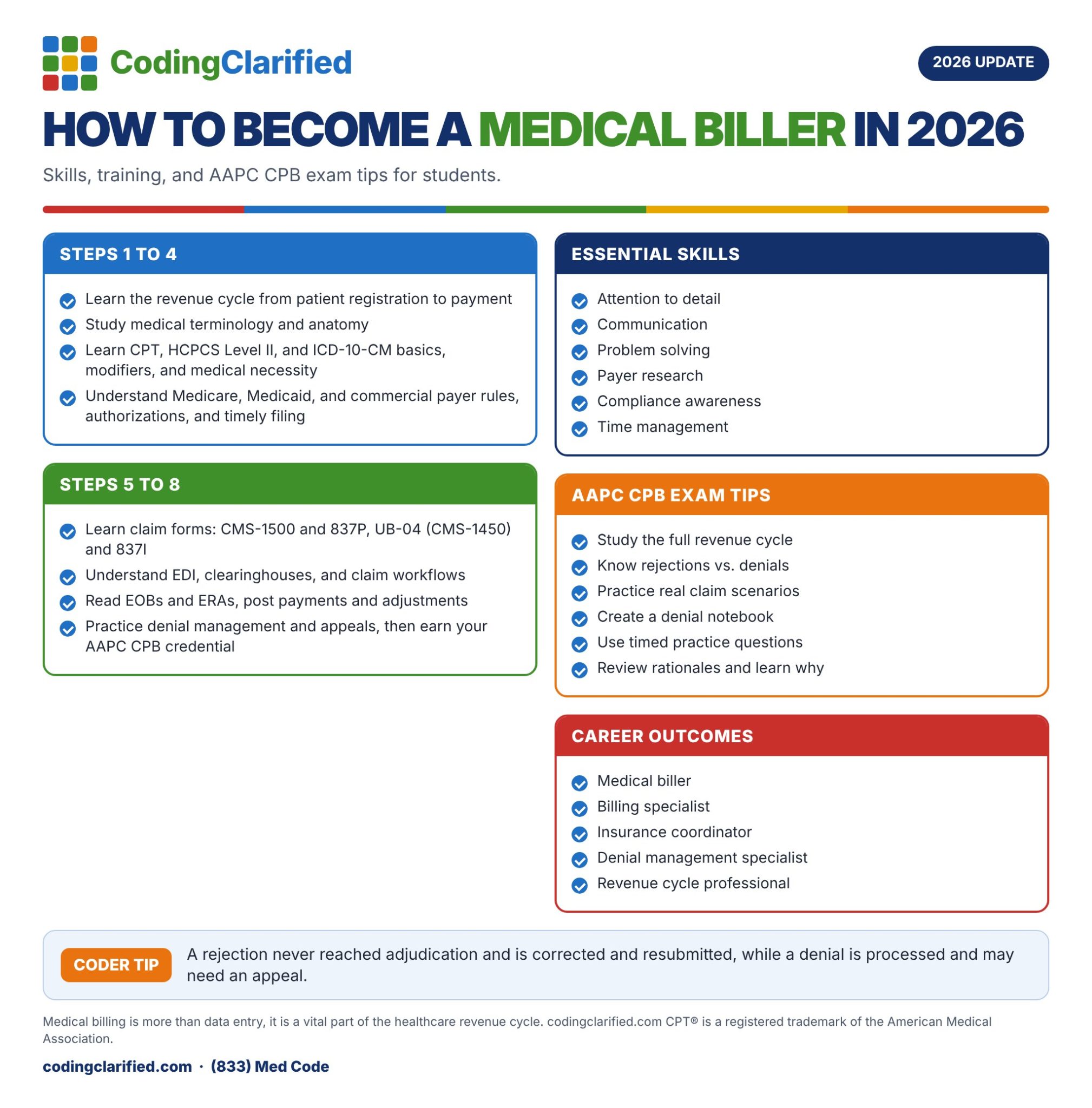
1) Learn the Basics of the Revenue Cycle
Before a student worries about certification, they need to understand the healthcare revenue cycle from beginning to end. That includes:
- Patient registration
- Insurance verification
- Charge capture
- Coding and claim creation
- Claim submission
- Payment posting
- Denial management
- Patient billing and collections
- Reporting and compliance review
This matters because a billing mistake can happen long before the claim is submitted. For example, if registration enters the wrong insurance, the claim may deny. If the provider is not enrolled correctly, the claim may reject. If prior authorization is missing, payment may be denied even when the code itself is correct.
So, students should study billing as a workflow, not as a single task.
2) Build a Foundation in Medical Terminology, Anatomy, and Pathophysiology
Medical billers do not code every chart like a full-time coder, but they still need to understand the language of medicine. Otherwise, it becomes very difficult to review claims, interpret diagnoses, understand procedures, or recognize when something on a claim does not make sense.
Students should learn:
- Body systems and common conditions
- Common surgeries and procedures
- Diagnostic testing terminology
- Drug administration terms
- Common abbreviations used in healthcare documentation
- The difference between acute, chronic, follow-up, screening, and preventive services
For example, a biller should know the difference between a screening mammogram and a diagnostic mammogram, or between a routine physical and a problem-oriented E/M visit.
3) Learn the Core Code Sets Used in Billing
Even if your goal is billing rather than coding, you still need to understand the main code sets because claims are built around them.
Students should learn:
- CPT procedure and service codes
- HCPCS Level II codes for supplies, drugs, and certain services
- ICD-10-CM diagnosis codes
- Modifiers and when they affect reimbursement
A biller does not need to code every operative note from scratch. Still, a biller should know enough to spot common problems such as:
- Diagnosis does not support the procedure
- Modifier is missing or incorrect
- Drug units look wrong
- A preventive service is being billed with a problem-focused diagnosis only
- A payer requires a specific modifier or place of service
That is one reason the CPB exam expects billing professionals to understand coding principles, not just claim submission.
4) Learn Insurance and Payer Rules
This is one of the biggest differences between coding students and billing students. Medical billers must understand how insurance actually works.
Students should study:
- Medicare Part A, Part B, Part C, and Part D basics
- Medicaid basics
- Commercial insurance plans
- HMO, PPO, POS, EPO, and high-deductible plan concepts
- Copays, deductibles, coinsurance, and out-of-pocket maximums
- Coordination of benefits (COB)
- Primary vs. secondary insurance
- Medical necessity
- Prior authorization
- Referrals
- Timely filing limits
- Claim appeals and reconsiderations
For example, a biller must know that a clean claim can still deny if the patient’s primary insurance was not billed first or if the provider failed to meet a payer’s authorization requirement.
5) Understand the Claim Forms and Electronic Claims Process
Students should become comfortable with the structure and purpose of claim submission. In physician and outpatient billing, the CMS-1500 is the standard paper professional claim form, while electronic professional claims are sent using the 837P format. Institutional billing uses the UB-04/CMS-1450 and electronic 837I concepts in applicable settings. CMS also requires providers and suppliers to complete enrollment and EDI steps to bill Medicare electronically. In addition, billers should understand how clearinghouses and front-end edits affect claim acceptance. CMS continues to emphasize electronic enrollment, electronic claims, and EDI workflows in 2026.
Students should learn:
- Claim flow from practice management system to clearinghouse to payer
- Basic CMS-1500 fields and what they represent
- Rendering, billing, and referring provider information
- NPI use and provider enrollment basics
- Place of service, diagnosis pointers, units, and modifiers
- Rejections vs. denials
- Clearinghouse edits vs. payer adjudication
When students understand where claims break down, they become much better at troubleshooting.
6) Learn Payment Posting, EOBs, and ERAs
A good biller does not stop once a claim is submitted. They also need to understand what happens after the payer responds.
Students should learn how to read:
- Explanation of Benefits (EOB)
- Electronic Remittance Advice (ERA)
- Adjustment reason codes
- Remark codes
- Patient responsibility amounts
- Contractual adjustments
- Overpayment and underpayment scenarios
This knowledge helps students understand why a claim was paid, denied, bundled, reduced, or transferred to patient responsibility.
7) Learn Denial Management and Appeals
Denials are a huge part of medical billing. In fact, some students do well in class until they hit denial management, because denials require both technical knowledge and persistence.
Students should know how to work denials related to:
- Eligibility
- Prior authorization
- Timely filing
- Medical necessity
- Coordination of benefits
- Noncovered services
- Missing or invalid modifiers
- Incorrect provider information
- Duplicate claims
- Bundling edits
- Diagnosis inconsistency
They should also learn how to document an appeal clearly, attach supporting records when appropriate, and track follow-up.
8) Study Compliance and HIPAA
Medical billing is not just about getting paid. It is also about billing correctly and compliantly.
Students need a working understanding of:
- HIPAA privacy and security basics
- Fraud, waste, and abuse concepts
- Medical necessity
- Documentation support for billed services
- Refunds and overpayments
- Modifier misuse risks
- Accurate patient and insurance information
- Basic audit awareness
This is especially important because billers often see claim patterns that could create compliance issues if left uncorrected.
9) Earn a Medical Billing Credential if It Fits Your Goals
For students who want an employer-recognized billing credential, the AAPC Certified Professional Biller (CPB) is one of the best-known options. AAPC treats the CPB as a stand-alone certification. It does not require a CPC first, but AAPC notes that CPB is not intended as a simple beginner exam and recommends relevant experience. That recommendation matters because the exam tests billing rules, payer concepts, claim processing, reimbursement, compliance, and revenue cycle knowledge—not just vocabulary.
If your goal is physician-based medical billing, the CPB is a strong option because it validates knowledge of insurance, reimbursement, billing regulations, and the claim lifecycle.
What Students Need to Learn to Be Successful as Medical Billers
1) Accuracy With Details
Medical billing is detail-heavy work. One missing digit in an ID number, one incorrect modifier, or one wrong date can delay payment.
Students need to practice:
- Reading carefully
- Double-checking data entry
- Comparing documentation to claim details
- Tracking payer responses
- Noticing patterns in denials
2) Comfort With Rules and Exceptions
Billing is full of “it depends” situations. Medicare may handle a service one way, while a commercial payer handles it another way. One payer may require a modifier, while another may want a different edit corrected first.
Students should get comfortable asking:
- What payer is involved?
- Is this service covered?
- Was authorization required?
- Is there a policy or LCD/NCD issue?
- Was the claim filed under the correct provider?
- Does the diagnosis support medical necessity?
3) Basic Coding Knowledge
Even if billing is the main goal, students should still know how diagnosis and procedure coding affects reimbursement. A biller who understands ICD-10-CM, CPT, and HCPCS Level II can catch more errors and communicate better with coders and providers.
4) Strong Communication Skills
Billers communicate with providers, coders, front-desk teams, patients, insurance representatives, and managers. Because of that, students need to learn how to:
- Explain balances clearly
- Ask providers for missing information professionally
- Write appeal letters
- Document payer calls
- Escalate issues without sounding confrontational
5) Persistence and Problem-Solving
Some claims pay quickly. Others do not. Students who become strong billers learn how to investigate issues rather than giving up after the first denial.
That means asking:
- Was the claim actually received?
- Was the claim rejected before adjudication?
- Is there a COB issue?
- Is the NPI or taxonomy wrong?
- Did the payer apply a policy edit?
- Is there a documentation or coding mismatch?
What Is the AAPC CPB Exam?
The AAPC Certified Professional Biller (CPB) credential focuses on physician-based billing and reimbursement knowledge. It is designed to validate a professional’s understanding of the business side of healthcare, including insurance rules, billing regulations, claims, compliance, collections, and reimbursement processes.
AAPC’s certification information and exam support materials emphasize that CPB is a stand-alone credential, but also note that these specialty and billing credentials are not meant for people with little or no relevant experience. AAPC recommends experience because students must apply billing rules, payer concepts, and revenue cycle logic—not just memorize terms.
What Does the CPB Exam Test?
Although AAPC can update exam outlines, CPB preparation generally includes topics such as:
- Medical billing regulations and compliance
- Insurance guidelines and payer policies
- Revenue cycle management
- Claim forms and claim submission
- HIPAA and billing rules
- Payment posting and reimbursement concepts
- Denial management and collections
- Coding knowledge related to billing workflows
- Medicare, Medicaid, and commercial payer concepts
Before studying, students should always review AAPC’s current CPB exam information, prerequisites, and exam materials on the official AAPC website.
Best Study Plan for Students Who Want to Pass the AAPC CPB Exam
Step 1: Start With the Big Picture of Billing
Do not start by memorizing random payer facts. Instead, learn the full revenue cycle first. When you understand how a claim moves from registration to reimbursement, everything else makes more sense.
A smart study order looks like this:
- Revenue cycle overview
- Insurance basics
- Medical terminology and anatomy
- Coding basics for ICD-10-CM, CPT, and HCPCS
- Claim forms and claim flow
- Medicare and Medicaid billing rules
- Payment posting and EOB/ERA review
- Denials and appeals
- Compliance and HIPAA
- Timed CPB practice questions
Step 2: Learn Medicare First, Then Compare Other Payers
Medicare is a good foundation because many billing rules and claim concepts are easier to organize once you understand Medicare basics. Students should know:
- Provider enrollment concepts
- NPI and PECOS basics
- Electronic claim submission and EDI basics
- Primary vs. secondary payer rules
- Patient responsibility concepts
- Claims filing responsibilities
- Coverage and documentation support concepts
Once that foundation is clear, commercial payer rules become easier to compare.
Step 3: Make a “Denial Notebook”
One of the best ways to study billing is to track common denials and how to fix them.
Create a notebook or spreadsheet with columns for:
- Denial reason
- What it means
- Common cause
- How to fix it
- Whether it is appealable
- What documents are usually needed
For example:
- Authorization missing
- Invalid subscriber ID
- Timely filing exceeded
- Diagnosis inconsistent with procedure
- Provider not credentialed with plan
- Coordination of benefits issue
- Duplicate claim denial
This study method builds real-world thinking, which is exactly what billers need.
Step 4: Practice Reading EOBs and ERAs
Students often focus heavily on claim submission but spend too little time on payment interpretation. That is a mistake. If you cannot read a remittance correctly, you will miss underpayments, adjustment issues, or denial trends.
Practice identifying:
- Allowed amount
- Patient responsibility
- Contractual adjustment
- Coinsurance and deductible
- Denial code
- Remark code
- Whether a corrected claim or appeal is needed
Step 5: Review Modifiers and Medical Necessity Basics
Even though the CPB is a billing credential, students still need to understand how modifiers and diagnoses affect payment.
Study:
- Common modifier use in physician billing
- Why modifiers affect reimbursement
- How diagnosis coding supports medical necessity
- When a claim might need corrected coding before rebilling
- How payer edits can block payment even when a code is valid on its own
Step 6: Use Timed Practice Questions
Once your foundation is solid, start answering timed practice questions. Do not just read the answer explanation and move on. Instead, ask:
- Why was the correct answer correct?
- Why were the wrong answers wrong?
- What rule or concept did I miss?
- Was this an insurance question, coding question, compliance question, or workflow question?
That extra step improves retention much faster than passive review.
CPB Exam Tips for Students
1) Do Not Treat Billing Like “Easy Coding”
Billing is not the easy version of coding. It is a separate skill set. Students who underestimate the CPB exam often struggle because they focus only on definitions and ignore payer application.
Instead, study billing as a decision-making process.
2) Know the Difference Between a Rejection and a Denial
This is a high-yield concept.
- Rejection: The claim failed before full adjudication, often because of missing or invalid claim information.
- Denial: The payer processed the claim and refused payment for a specific reason.
That distinction affects what happens next. A rejected claim is often corrected and resubmitted. A denied claim may require appeal, corrected claim review, or documentation support.
3) Study Real Claim Scenarios
A question becomes easier when you can picture the claim.
Practice scenarios such as:
- Medicare patient with secondary commercial insurance
- New patient office visit denied for eligibility
- Injection claim denied for diagnosis mismatch
- Surgery claim denied for missing authorization
- Preventive service processed as diagnostic
- Provider not enrolled with payer
- Claim filed under wrong rendering provider
4) Learn Common Billing Vocabulary Cold
Students should be able to define and apply terms like:
- Allowed amount
- Assignment
- Clean claim
- COB
- ERA
- EOB
- Capitation
- Write-off
- Deductible
- Coinsurance
- Prior authorization
- Appeal
- Medical necessity
- Timely filing
- NPI
- Participating vs. nonparticipating provider
5) Mark Up Your Resources During Study
If your course or exam materials allow reference use, organize your resources before exam day. Add tabs, quick notes, and cross-references for topics you keep missing.
For example, create quick sections for:
- Medicare basics
- COB
- appeals
- denials
- claim forms
- modifier reminders
- HIPAA/compliance
6) Do Not Memorize Without Context
Memorization helps, but it is not enough. Students should understand why a claim denied, why a payer needs certain information, and why an appeal would or would not succeed.
That deeper understanding improves both test scores and job performance
Student Success Tips for Becoming a Strong Medical Biller
Build a Weekly Routine
Set a predictable weekly plan. For example:
- 2 days: billing concepts and insurance rules
- 2 days: coding basics and modifier review
- 1 day: claim scenarios and denials
- 1 day: practice questions
- 1 day: review weak areas
Consistency matters more than marathon study sessions.
Practice With Realistic Workflows
When possible, work through a claim from start to finish:
- Review demographics
- Check insurance
- Review diagnosis and procedure codes
- Identify claim fields needed
- Submit the claim mentally or on paper
- Read a mock denial or remittance
- Decide next action
That process builds job-ready confidence.
Learn to Read Payer Policies Without Panicking
Students do not need to memorize every payer rule. However, they do need to get comfortable reading policy language, checking requirements, and finding the part that answers the question.
Track Your Weak Areas
If you keep missing COB questions, denial questions, or Medicare enrollment questions, stop rereading everything. Spend targeted time on the weak topic instead.
Join Billing and Coding Communities
AAPC chapters, study groups, and online communities can help students hear real denial stories, ask questions, and learn from working professionals.
CPC Student Tips That Also Help Future Billers
Even though this article focuses on billing, many students in your audience are CPC students or future coders who may also handle billing. These habits help both groups.
CPC Student Tip #1: Never Separate Coding From Reimbursement
When you learn a CPT code, also ask how it gets billed, whether modifiers commonly apply, and what documentation supports it.
CPC Student Tip #2: Watch Diagnosis-to-Procedure Relationships
A code can be valid but still fail payment if the diagnosis does not support medical necessity.
CPC Student Tip #3: Learn Place of Service and Provider Type Logic
Billing problems often start when the place of service, rendering provider, or payer setup is wrong.
CPC Student Tip #4: Study Denials as Learning Tools
A denial teaches coding, billing, payer policy, and documentation all at once. Keep those examples.
CPC Student Tip #5: Think Like an Auditor
Ask whether the claim tells a clean, supported story:
- Was the service documented?
- Was the diagnosis appropriate?
- Was the provider enrolled correctly?
- Was the claim filed to the correct payer?
- Was the modifier justified?
Common Mistakes to Avoid When Training to Become a Medical Biller
1) Focusing Only on Data Entry
Medical billing is not just entering charges into software. Students need to understand payer rules, denials, reimbursement, and compliance.
2) Ignoring Coding Basics
A biller does not need to be the office’s lead coder. Still, ignoring coding makes it much harder to understand claims and catch errors.
3) Memorizing Terms Without Practicing Scenarios
Students often know definitions but freeze when they see a denial or coordination-of-benefits problem. Scenario practice fixes that.
4) Skipping Medicare Concepts
Medicare rules influence many billing workflows. Students should not wait until the end of their studies to learn them.
5) Not Reviewing Remittances
Payment posting and remittance review are core billing skills. If you skip them, you miss half the revenue cycle.
6) Studying the CPB Exam Too Late
Do not wait until the last week to start timed practice questions. Build exam practice into your plan early enough to identify weak areas.
7) Forgetting Soft Skills
Accuracy matters, but communication matters too. Billers talk to patients, payers, coders, and providers every day.
Helpful Resources for Future Medical Billers
As you build your training plan, use authoritative resources alongside your course materials. These are especially helpful for 2026 learning and blog linking:
- AAPC CPB certification information and exam prep resources
- AAPC certification prerequisites and exam policies
- Provider Enrollment, Chain, and Ownership System (PECOS)
- Electronic Data Interchange (EDI) Support
- CMS provider billing responsibilities and Medicare secondary payer resources
Coding Clarified related blogs:
- Coding Clarified Blog
- Coding Clarified Resource Library
- Medical coding and medical billing
- Place Of Service
- Medical Coding and Billing Denials
- AAPC CPB Exam Tips
Coding Clarified Final Thoughts: Is Medical Billing a Good Career for Students?
Yes—especially for students who enjoy problem-solving, details, insurance rules, and the business side of healthcare. Medical billing can be a smart career path for people who want remote-friendly healthcare work, a strong foundation in the revenue cycle, and a role that directly affects reimbursement.
The key is to train beyond the basics. Students who learn medical terminology, coding fundamentals, insurance concepts, claim forms, denials, appeals, and compliance will be much more prepared for both the AAPC CPB exam and real billing work.
If your long-term goal includes coding as well, medical billing can be an excellent bridge into the full revenue cycle. In fact, students who understand both coding and billing often become stronger problem-solvers because they can see the entire story behind a claim—from documentation to payment.
Frequently Asked Questions About Becoming a Medical Biller
Do you need certification to become a medical biller?
Not every employer requires certification, but certification can strengthen your resume and show employers that you understand billing, compliance, and reimbursement concepts. For physician-based billing, the AAPC CPB is a strong option.
Is medical billing hard to learn?
Medical billing is learnable, but it is detail-heavy. Students need to understand insurance, coding basics, claims, denials, and compliance. Therefore, it is easier when you study the full revenue cycle instead of isolated terms.
What should I learn first if I want to become a medical biller?
Start with medical terminology, anatomy, revenue cycle basics, insurance concepts, and introductory coding knowledge. After that, move into claim forms, payment posting, denials, and appeals.
Can a beginner take the AAPC CPB exam?
AAPC treats the CPB as a stand-alone certification, but it also notes that these types of exams are not intended for people with little or no relevant experience. Beginners can still prepare for it, but they should build a solid foundation first and use plenty of scenario-based practice.
Do medical billers need to know CPT and ICD-10-CM?
Yes. A biller should understand CPT, HCPCS Level II, and ICD-10-CM well enough to recognize common claim issues, modifier problems, diagnosis support concerns, and reimbursement risks.
What is the difference between medical billing and medical coding?
Medical coding focuses on translating documentation into diagnosis and procedure codes. Medical billing focuses on claim submission, reimbursement, denials, payment posting, appeals, and patient balances. In many workplaces, the roles overlap.
How long does it take to become a medical biller?
That depends on the training program and the student’s schedule. Some students build entry-level billing skills in a few months, while others take longer if they are also learning coding, anatomy, and insurance from scratch.
Is medical billing a good remote job?
It can be. Many employers offer remote or hybrid billing roles, especially once a biller has proven they can work denials, follow payer rules, and manage A/R accurately.