Dental Coding vs. Medical Coding: What’s the Difference? A Complete 2026 Guide
Dental coding and medical coding may appear similar because both involve translating healthcare services into standardized codes for insurance reimbursement. However, they are two very different coding systems with different code sets, documentation requirements, insurance rules, and reimbursement processes.
As more dental offices provide medically necessary services and more medical practices perform oral procedures, understanding the differences between dental and medical coding has become increasingly important. In 2026, many employers value coders who understand both systems because it helps reduce denials and maximize reimbursement.
Whether you’re a new CPC student, an experienced medical coder, or simply curious about dental billing, this guide explains how dental coding differs from medical coding and when the two systems overlap.
Key Takeaways
- Dental coding primarily uses CDT codes, while medical coding uses CPT, HCPCS Level II, and ICD-10-CM.
- Dental claims are generally submitted on dental claim forms, while medical claims use the CMS-1500 or UB-04.
- Medical necessity plays a much larger role in medical coding.
- Some dental procedures may be billed to medical insurance when they meet medical necessity requirements.
- Documentation requirements differ significantly between dental and medical practices.
- Understanding both systems can increase career opportunities for healthcare coders in 2026.
What Is Dental Coding?
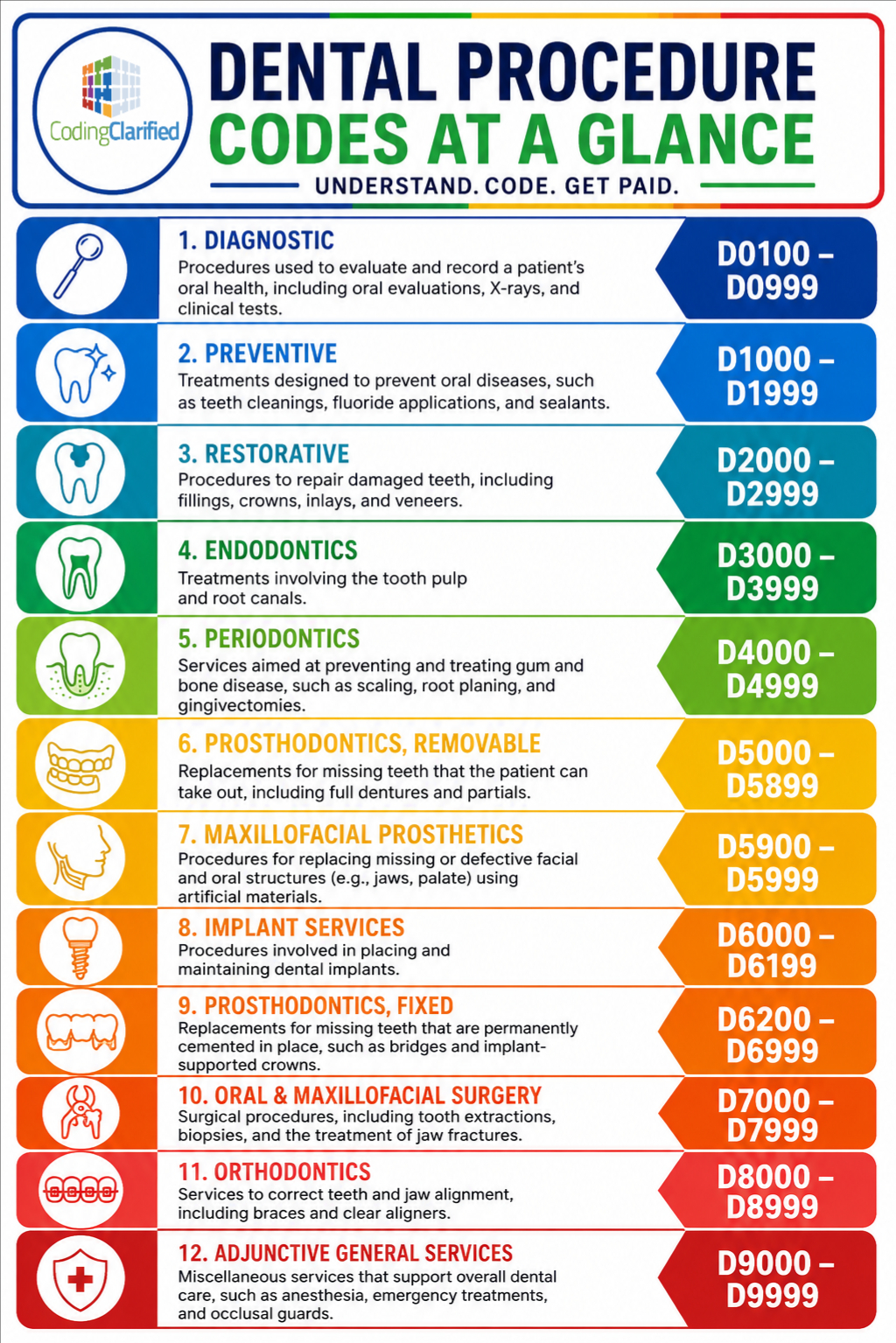
Dental coding is the process of assigning standardized procedure codes to dental services performed by dentists, oral surgeons, orthodontists, periodontists, pediatric dentists, prosthodontists, and other dental specialists.
Unlike medical coding, dental coding primarily uses the Current Dental Terminology (CDT) code set.
The American Dental Association (ADA) updates CDT codes annually to reflect advances in dental treatment, technology, and documentation. Consequently, dental offices must stay current with yearly revisions to avoid claim denials.
Dental coders typically report procedures such as:
- Dental examinations
- Teeth cleanings
- Fillings
- Crowns
- Bridges
- Root canals
- Tooth extractions
- Dentures
- Dental implants
- Orthodontic services
- Periodontal procedures
What Is Medical Coding?
Medical coding involves assigning diagnosis and procedure codes for physician services, hospital care, outpatient treatment, surgery, imaging, laboratory testing, and many other healthcare services.
Medical coders commonly work with:
- CPT
- HCPCS Level II
- ICD-10-CM
Unlike dental coding, every medical claim generally requires both:
- A diagnosis code
- A procedure code
The diagnosis must support the medical necessity of the procedure being performed.
For example:
Diagnosis:
- K08.89 Other specified disorders of teeth and supporting structures
Procedure:
- 41899 Unlisted procedure, dentoalveolar structures
Medical coders must ensure that documentation supports the reported diagnosis and procedure before submitting a claim.
Dental Coding Uses CDT Codes Instead of CPT
One of the largest differences is the procedure code set.
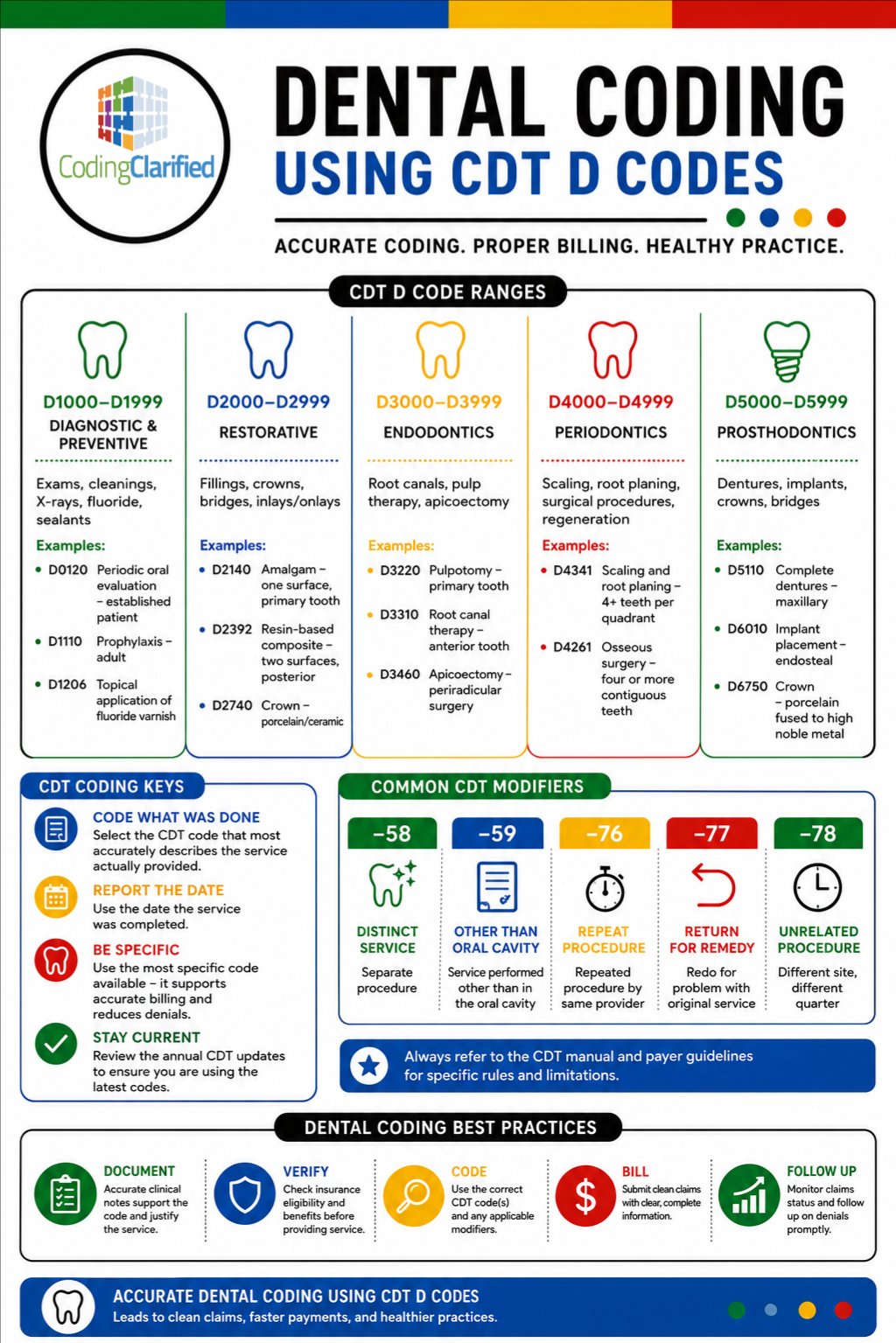
Dental coding uses CDT codes that begin with the letter “D.”
Examples include:
- D0120 Periodic oral evaluation
- D1110 Adult prophylaxis
- D2391 Resin-based composite
- D2740 Crown
- D7140 Extraction
- D7210 Surgical extraction
Medical coding instead uses CPT codes such as:
- 41899 Oral surgery
- 21025 Excision of bone
- 40812 Excision of oral lesion
- 41874 Excision of odontogenic cyst
Because the code sets are entirely different, coders cannot substitute CDT codes for CPT codes.
Dental Coding Focuses on Teeth While Medical Coding Focuses on Disease
Another major difference involves the purpose of the claim.
Dental insurance generally covers:
- Preventive care
- Restorative treatment
- Oral health maintenance
Medical insurance covers:
- Disease
- Injury
- Trauma
- Congenital abnormalities
- Medically necessary procedures
For example, a routine dental cleaning would almost always be billed to dental insurance.
However, treatment following facial trauma may be billed to medical insurance because the injury affects overall health rather than routine dental care.
Dental Claims Often Do Not Require ICD-10-CM Diagnosis Codes
Many routine dental claims rely only on CDT procedure codes.
Medical claims almost always require diagnosis codes such as:
- K02.9 Dental caries
- K04.7 Periapical abscess without sinus
- K05.30 Chronic periodontitis, unspecified
- K08.89 Other specified disorders of teeth and supporting structures
- S02.5XXA Fracture of tooth, initial encounter
Although some dental claims now include diagnosis information, medical insurance requires ICD-10-CM coding to establish medical necessity.
Medical Necessity Is the Biggest Difference
Medical coding revolves around medical necessity.
Dental coding focuses more on the dental procedure itself.
For example, removing wisdom teeth because they are impacted may qualify for medical coverage when documentation demonstrates:
- Infection
- Pain
- Facial swelling
- Trauma
- Osteomyelitis
- Cyst formation
Without adequate documentation, medical insurance may deny the claim.
Therefore, documentation quality becomes extremely important whenever dental procedures are submitted to medical insurance.
Dental Specialists May Bill Both Dental and Medical Insurance
Some providers regularly bill both insurance types.
Examples include:
- Oral surgeons
- Oral pathologists
- Hospital dentists
- Craniofacial specialists
- Maxillofacial surgeons
These providers frequently perform medically necessary procedures involving:
- Facial fractures
- Jaw reconstruction
- Oral cancers
- Sleep apnea surgery
- Biopsies
- Trauma repair
In these situations, coders must understand both dental and medical coding rules.
Documentation Requirements Differ
Medical documentation is generally much more detailed.
Typical medical documentation includes:
- Chief complaint
- History of present illness
- Review of systems
- Physical examination
- Assessment
- Plan
- Diagnostic findings
- Medical necessity
Dental documentation often focuses on:
- Tooth numbers
- Surfaces treated
- Radiographs
- Existing restorations
- Periodontal measurements
- Occlusion
- Treatment planning
Because the documentation differs, coders must understand which information each payer expects.
Can Dental Procedures Be Billed to Medical Insurance?
Yes—but only under certain circumstances.
Medical insurance may cover dental procedures involving:
- Accidents
- Trauma
- Tumors
- Jaw fractures
- Oral pathology
- Congenital abnormalities
- Severe infections
- Medically necessary oral surgery
Examples include:
- Biopsy of an oral lesion
- Treatment of facial fractures
- Jaw reconstruction
- Surgical removal of cysts
- Repair following motor vehicle accidents
Routine cleanings, fillings, and cosmetic dentistry generally remain dental benefits.
Careers in Dental Coding
Dental coders work in many settings, including:
- Dental practices
- Oral surgery centers
- Hospital dental departments
- Insurance companies
- Dental support organizations (DSOs)
- Revenue cycle companies
- Remote coding positions
Individuals who understand both dental and medical coding are becoming increasingly valuable because many organizations process claims through both insurance systems.
CPC Student Tips
If you’re preparing for the CPC exam, remember these points:
- Know that the CPC exam primarily tests medical coding—not CDT coding.
- Become comfortable with oral surgery CPT codes because they appear in the Surgery section.
- Review anatomy of the oral cavity, jaw, facial bones, and salivary glands.
- Practice assigning accurate ICD-10-CM diagnosis codes for oral conditions.
- Never assume every dental procedure belongs on a dental claim. Medical necessity determines whether medical insurance may apply.
Developing a basic understanding of dental coding can also expand your future career opportunities.
Common Mistakes to Avoid
Many coding errors occur because coders assume dental and medical coding follow identical rules.
Avoid these common mistakes:
- Using CDT codes on medical claims.
- Using CPT codes on routine dental claims.
- Forgetting required ICD-10-CM diagnosis codes for medical insurance.
- Failing to document medical necessity.
- Billing cosmetic procedures as medically necessary.
- Ignoring payer-specific dental versus medical policies.
- Assuming every oral surgery belongs on a medical claim.
- Overlooking documentation supporting trauma or disease.
Taking time to verify payer guidelines before claim submission can prevent unnecessary denials.
Why Learning Both Systems Is Beneficial in 2026
Healthcare continues to become more integrated.
As a result, many employers seek coders who understand both dental and medical reimbursement.
Cross-training allows coders to:
- Increase job opportunities.
- Improve reimbursement accuracy.
- Reduce claim denials.
- Support oral surgery practices.
- Assist multidisciplinary healthcare organizations.
- Build specialized coding expertise.
Learning the similarities and differences between both coding systems can make you a stronger coding professional.
Frequently Asked Questions
Is dental coding the same as medical coding?
No. Dental coding primarily uses CDT procedure codes, while medical coding uses CPT, HCPCS Level II, and ICD-10-CM. Documentation requirements, reimbursement rules, and insurance policies also differ.
Can dental procedures be billed to medical insurance?
Yes. Certain procedures involving trauma, tumors, infections, congenital abnormalities, or medically necessary oral surgery may qualify for medical insurance coverage when documentation supports medical necessity.
Do dental claims use ICD-10-CM codes?
Some do, especially when billed to medical insurance. Routine dental claims often rely primarily on CDT procedure codes.
Does the CPC exam include dental coding?
The CPC exam focuses on medical coding. However, candidates should understand oral surgery anatomy, CPT coding, and diagnosis coding related to oral conditions.
What coding system do dentists use?
Dentists primarily use Current Dental Terminology (CDT) codes developed by the American Dental Association.
Can medical coders work in dental offices?
Yes. Medical coders often work in oral surgery, hospital dentistry, and practices that submit claims to both dental and medical insurance.
Is oral surgery billed using CPT or CDT?
It depends on the payer and the procedure. Routine dental services typically use CDT codes, while medically necessary oral surgery submitted to medical insurance generally uses CPT codes along with appropriate ICD-10-CM diagnosis codes.
Related Coding Clarified Articles
Continue learning with these related guides:
- Coding Clarified Blog
- Coding Clarified Resource Library
- Coding Clarified Facebook
- Coding Clarified YouTube
- Coding Clarified Instagram
- Coding Clarified TikTok
- CPT Modifiers
Related Coding Resources