Medical Coding for a Weight Loss Evaluation in 2026: CPT®, ICD-10-CM, HCPCS, and Bariatric Surgery Documentation
Weight loss evaluations are common in primary care, obesity medicine, and bariatric surgery practices. However, selecting the correct medical codes requires more than simply identifying obesity. Coders must review the physician’s documentation, determine the appropriate Evaluation and Management (E/M) level, assign the correct obesity and BMI diagnoses, and identify any additional history codes that affect medical decision-making.
This case study walks through a real-world weight loss evaluation and explains how to assign the correct CPT®, ICD-10-CM, and HCPCS codes using 2026 coding guidelines. Along the way, you’ll also learn why certain codes should not be reported and how proper documentation supports medical necessity.
Key Takeaways
- Weight loss evaluations often require only an E/M service unless another separately billable procedure is performed.
- Documentation drives code selection. Never assign diagnoses that are not documented.
- BMI codes should always accompany the obesity diagnosis when supported by documentation.
- Previous medical conditions, such as a history of pulmonary embolism or prior lung surgery, may significantly affect medical decision-making.
- Careful documentation of surgical planning and risk factors often supports a higher E/M level.
- Understanding obesity coding is essential for both CPC students and experienced medical coders.
Clinical Scenario
A 34-year-old established female patient presents for a follow-up weight loss evaluation. She has documented morbid obesity and has attempted multiple nonsurgical weight loss methods without lasting success. She follows a lean-and-green diet, plans to begin Medifast, and intends to quit smoking.
The provider also documents:
- BMI of 45.5
- Weight loss of 5.6 pounds
- History of pulmonary embolism
- Previous right lower lobe lobectomy
- Planned gastric bypass surgery
- Planned temporary IVC filter placement
- Referral to pulmonology for surgical clearance
- Continued counseling regarding diet and weight reduction
No procedures are performed during today’s visit.
Step 1: Determine the CPT® Code
The first step is selecting the appropriate office E/M service.
Because this patient is already established with the practice, only established patient office visit codes should be considered.
Possible code range:
- 99212
- 99213
- 99214
- 99215
Why 99214 Is Appropriate
Under the 2026 E/M guidelines, code selection depends primarily on Medical Decision Making (MDM) or total physician time.
This encounter supports moderate MDM because the physician manages several significant conditions during the visit.
Those include:
- Morbid obesity
- Bariatric surgery planning
- History of pulmonary embolism
- Previous right lower lobe lobectomy
- Referral for pulmonary evaluation
- Diet counseling
- Weight-loss progress assessment
- Smoking cessation discussion
- Review of preoperative testing
Additionally, the physician discusses future treatment options, reviews upcoming surgery, evaluates operative risk, and coordinates additional specialty care.
Correct CPT® Code
99214 – Established patient office or outpatient visit with moderate medical decision making.
Why 99213 Would Not Be Correct
Many beginning coders choose 99213 because no procedure occurred.
However, the complexity of the visit—not the absence of a procedure—determines the E/M level.
This encounter includes:
- Multiple chronic conditions
- Surgical planning
- Increased operative risk
- Multiple management decisions
- Coordination with specialists
Therefore, 99214 better reflects the documented work.
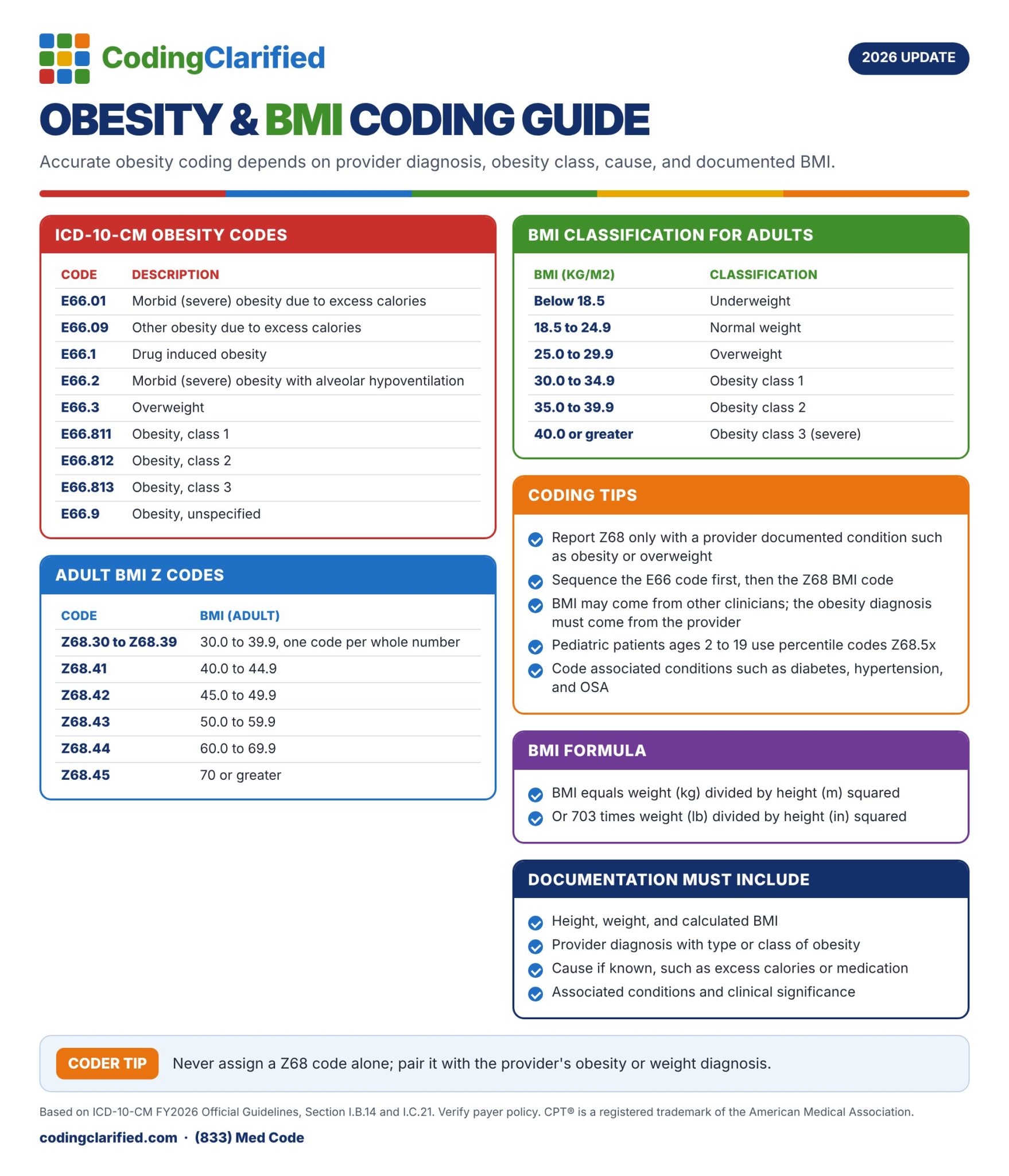
Step 2: Assign the ICD-10-CM Diagnosis Codes
After selecting the E/M code, review every documented diagnosis.
Primary Diagnosis
The physician documents morbid obesity.
Correct diagnosis:
E66.01 – Morbid (severe) obesity due to excess calories
This diagnosis should be listed first because it represents the primary reason for today’s encounter.
BMI Code
Documentation states:
BMI = 45.5
The correct BMI diagnosis is:
Z68.42 – Body mass index (BMI) 45.0–49.9, adult
BMI codes should be assigned only when the BMI is documented by the provider or derived from documentation according to ICD-10-CM guidelines.
Although BMI codes usually are secondary diagnoses, they provide important clinical information and often support medical necessity for bariatric surgery.
History of Pulmonary Embolism
The physician documents a previous pulmonary embolism.
Correct diagnosis:
Z86.711 – Personal history of pulmonary embolism
This condition is no longer active. Therefore, history coding is appropriate.
History of Lobectomy
The patient previously underwent removal of the right lower lobe of the lung.
Correct diagnosis:
Z90.2 – Acquired absence of lung
This diagnosis explains why pulmonary clearance is necessary before surgery.
Tobacco Coding Considerations
The physician notes that the patient plans to begin nicotine patches.
However, the documentation does not clearly state whether she currently smokes.
Because smoking status is unclear, coders should not assign:
- Nicotine dependence
- Tobacco use
- History of tobacco use
Instead, providers should document one of the following:
- Current smoker
- Former smoker
- Never smoked
Clear documentation ensures accurate diagnosis coding.
HCPCS Coding
No HCPCS Level II codes are reported.
Although dietary counseling occurs, it is included within the E/M service.
Likewise, no injectable medications, durable medical equipment, or separately billable supplies are documented.
Final Code Selection
| Code Set | Code | Description |
|---|---|---|
| CPT® | 99214 | Established patient office visit |
| ICD-10-CM | E66.01 | Morbid obesity due to excess calories |
| ICD-10-CM | Z68.42 | BMI 45.0–49.9 |
| ICD-10-CM | Z86.711 | Personal history of pulmonary embolism |
| ICD-10-CM | Z90.2 | Acquired absence of lung |
| HCPCS | None | No separately reportable HCPCS code |
Coding Rationale
Every reported diagnosis affects today’s medical decision-making.
The patient’s obesity drives the visit.
The elevated BMI supports medical necessity.
Meanwhile, her pulmonary embolism history and prior lobectomy significantly increase surgical risk.
Additionally, pulmonary consultation and testing are necessary before bariatric surgery proceeds.
Altogether, these documented factors support moderate medical decision-making.
Documentation Tips for Providers
Strong documentation improves coding accuracy and reduces claim denials.
Providers should document:
- Current BMI
- Current weight
- Weight change since the previous visit
- Previous weight loss attempts
- Current diet
- Exercise recommendations
- Surgical planning
- Smoking status
- Comorbid conditions
- Specialist referrals
- Medical necessity for surgery
The more complete the documentation, the easier accurate code assignment becomes.
Common Mistakes to Avoid
One common mistake is assigning obesity without the documented severity.
Another frequent error involves forgetting to report the BMI diagnosis.
Some coders incorrectly report active pulmonary embolism instead of the history diagnosis.
Others assign tobacco dependence when the documentation does not confirm current smoking.
Finally, selecting 99213 simply because no procedure occurred overlooks the moderate complexity documented during this encounter.
Avoiding these errors improves coding accuracy and reimbursement.
CPC Student Tips
Weight loss evaluation questions appear frequently on certification exams because they test multiple coding concepts simultaneously.
When reviewing obesity encounters:
- Read the assessment before coding.
- Identify the documented obesity diagnosis first.
- Look for BMI documentation.
- Determine whether medical history affects today’s treatment.
- Review referrals and surgical planning.
- Evaluate medical decision-making before choosing the E/M level.
- Never assume diagnoses that are not documented.
Following these steps makes coding much easier during both certification exams and real-world practice.
Why This Documentation Supports Medical Necessity
Medical necessity extends beyond documenting obesity.
In this case, the physician records failed conservative weight-loss attempts, continued dietary counseling, exercise recommendations, surgical planning, pulmonary risk assessment, and coordination of specialty care.
Furthermore, the patient’s history of pulmonary embolism and previous lobectomy increases operative complexity.
Consequently, the documentation clearly supports continued medical management before bariatric surgery.
2026 Coding Update
For 2026, obesity remains a significant healthcare focus because of its association with diabetes, cardiovascular disease, sleep apnea, hypertension, and numerous other chronic conditions.
Additionally, documentation supporting bariatric surgery continues to receive close payer scrutiny.
Practices should ensure providers clearly document BMI, previous weight-loss attempts, medical necessity, and associated comorbidities to support accurate coding and reimbursement.
Related Coding Clarified Articles
For additional coding guidance, readers may also enjoy:
- Medical Coding Obesity & BMI
- Coding Clarified Blog
- Medical Coding for Pressure Ulcers
- Medical Coding GLP-1 Medications
- Coding Clarified Resource Library
Authoritative Coding Resources
For official coding guidance, review:
Frequently Asked Questions
What CPT® code is typically reported for a weight loss evaluation?
Most established patient weight loss evaluations are reported with 99213 or 99214, depending on the documented medical decision-making or total physician time.
Is a BMI code reported separately?
Yes. When documented, BMI should be reported using the appropriate Z68 code in addition to the obesity diagnosis.
Should coders assign a tobacco diagnosis if the patient plans to quit smoking?
No. Providers must clearly document whether the patient currently smokes, formerly smoked, or has never smoked before assigning a tobacco-related diagnosis.
Does planning bariatric surgery automatically change the E/M level?
No. The E/M level depends on documented medical decision-making or total physician time. Surgical planning alone does not determine code selection.
Why is Z86.711 reported instead of an active pulmonary embolism code?
The pulmonary embolism occurred in the past and is no longer active. Therefore, the correct diagnosis is the personal history code.
Is there a separately billable HCPCS code for today’s counseling?
No. The counseling documented in this encounter is included within the E/M service.
Why is Z90.2 important?
This diagnosis explains the patient’s previous lung surgery and supports the physician’s decision to obtain pulmonary clearance before bariatric surgery.
What is the biggest coding mistake in obesity visits?
The most common mistake is assigning diagnosis codes that are not fully supported by provider documentation. Always code only what the medical record clearly documents.