Medical Coder vs Medical Biller in 2026: Differences, Duties, Skills, Certification & Career Guide
If you are considering a career in healthcare without becoming a nurse, physician, or other clinical professional, medical billing and medical coding may both be worth exploring. However, although people often use the terms together, medical billing and medical coding are not the same job.
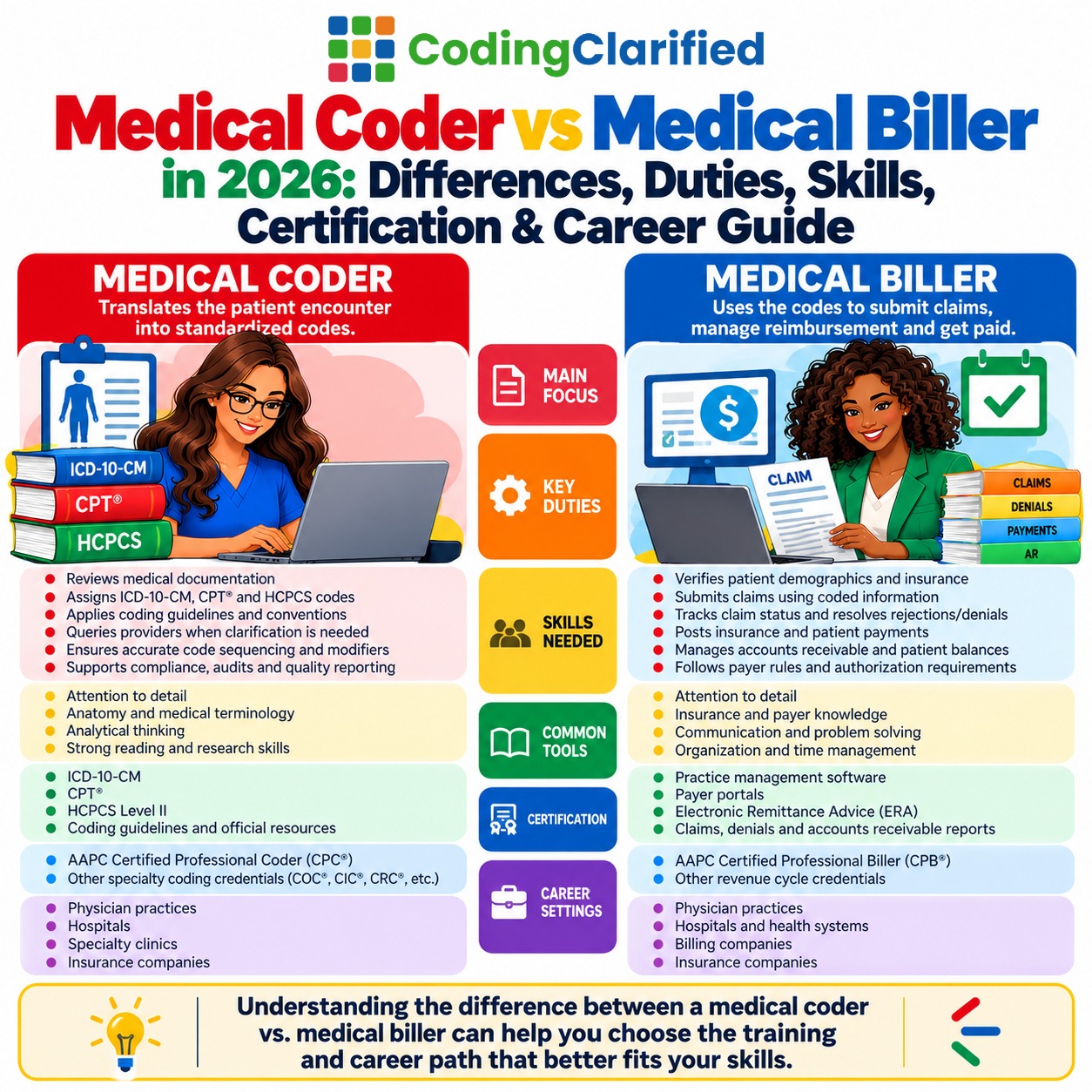
A medical coder reviews clinical documentation and translates diagnoses, procedures, services, and supplies into standardized medical codes. A medical biller, on the other hand, uses those codes and other claim information to submit claims, track reimbursement, work denials, post payments, and help collect money owed to a healthcare organization.
Therefore, understanding the difference between a medical coder vs. medical biller can help you choose the training and career path that better fits your skills.
Key Takeaways: Medical Coder vs Medical Biller
- Medical coders review health records and assign ICD-10-CM, CPT®, and HCPCS Level II codes.
- Medical billers use coded information to prepare and submit claims and manage reimbursement.
- Coders generally need stronger knowledge of anatomy, medical terminology, documentation, and coding guidelines.
- Billers generally need stronger knowledge of insurance, payer rules, claims, denials, accounts receivable, and reimbursement.
- Coding usually occurs before claim submission; however, coders and billers often work together when claims contain errors or are denied.
- Some smaller medical practices combine billing and coding duties into one position.
- AAPC offers separate credentials for the two career paths, including the Certified Professional Coder (CPC®) and Certified Professional Biller (CPB®).
- In 2026, both careers increasingly require comfort with electronic health records, payer portals, automation, and AI-assisted healthcare technology.
- Medical billing knowledge can make a coder stronger, while coding knowledge can help a biller understand why claims deny or reimburse differently.
What Is the Difference Between Medical Billing and Medical Coding?
The easiest way to understand medical billing vs. medical coding is to look at where each role fits into the healthcare revenue cycle.
Medical coding converts the patient encounter into standardized codes. Medical billing uses those codes to seek payment.
For example, a patient visits a physician because of knee pain. The provider evaluates the patient, documents the encounter, orders an X-ray, and creates a treatment plan. Next, a medical coder reviews that documentation and determines which diagnosis and procedure codes the record supports.
After coding is complete, billing staff use the codes and other required information to prepare the insurance claim. Then, the biller submits the claim, tracks its status, reviews the payer response, posts payments, and follows up when the payer denies or underpays the claim.
Consequently, coding and billing are separate functions, but they depend heavily on one another.
CMS explains that standardized code sets allow healthcare claims to be processed consistently. HIPAA-adopted code sets include ICD-10, HCPCS, CPT, CDT, and NDC.
What Does a Medical Coder Do?
Medical coders turn healthcare documentation into standardized codes that describe the patient’s diagnoses, services, procedures, supplies, and other reportable information.
Depending on the healthcare setting and coding specialty, a coder may review:
- Office visit notes
- Operative reports
- Emergency department records
- Hospital records
- Radiology reports
- Pathology reports
- Laboratory documentation
- Therapy notes
- Procedure notes
- Discharge summaries
First, the coder identifies the services and conditions supported by the medical record. Then, the coder applies the appropriate coding guidelines, conventions, sequencing rules, modifiers, and payer requirements.
Common coding systems include ICD-10-CM for diagnoses, CPT® for many professional services and procedures, and HCPCS Level II for certain supplies, equipment, drugs, and services.
CMS explains that HCPCS Level I consists of CPT®, which the American Medical Association maintains. Meanwhile, CMS maintains HCPCS Level II, which identifies many products, supplies, and services that CPT does not describe.
Common Medical Coder Responsibilities
A medical coder may:
- Review medical documentation
- Abstract diagnoses and procedures
- Assign ICD-10-CM codes
- Assign CPT® and HCPCS Level II codes
- Apply modifiers when supported
- Follow official coding guidelines
- Review National Correct Coding Initiative edits when applicable
- Identify missing or conflicting documentation
- Query providers when clarification is necessary
- Check medical necessity requirements
- Correct coding-related claim edits
- Assist with denials and appeals
- Support coding audits and compliance reviews
- Monitor annual and quarterly code changes
Accuracy matters because a code can affect reimbursement, quality data, risk adjustment, reporting, and compliance.
If you are new to coding, our What Is Medical Coding and How Do I Get Certified? guide explains the career and certification process in greater detail.
What Does a Medical Biller Do?
Medical billers focus more heavily on the financial side of healthcare.
Once coding and charge information are available, billers help turn that information into a clean claim. However, their job does not end when they click “submit.”
Instead, medical billing can continue until the claim has been processed correctly and the remaining balance has been resolved.
Common Medical Biller Responsibilities
Depending on the employer, medical billers may:
- Verify patient demographics
- Verify insurance information
- Check eligibility and benefits
- Obtain or verify authorizations
- Enter charges
- Review claims for missing information
- Submit electronic or paper claims
- Monitor claim status
- Correct rejected claims
- Work insurance denials
- Prepare appeals
- Post insurance payments
- Post patient payments
- Review Electronic Remittance Advice (ERA)
- Work accounts receivable
- Contact insurance companies
- Manage patient balances
- Send patient statements
- Follow payer-specific billing requirements
Therefore, successful medical billers need to understand much more than data entry. They must understand how insurance claims move through the reimbursement process and what to do when something goes wrong.
For example, an ERA can show what the payer allowed, paid, denied, adjusted, or transferred to patient responsibility. Our Electronic Remittance Advice (ERA) in Medical Billing for 2026 guide explains this part of the billing process in more detail.
Medical Coder vs Medical Biller: Side-by-Side Comparison
| Medical Coder | Medical Biller |
|---|---|
| Reviews clinical documentation | Reviews claims and reimbursement information |
| Assigns diagnosis and procedure codes | Submits claims using coded information |
| Uses ICD-10-CM, CPT®, and HCPCS Level II | Uses claims, payer portals, ERAs, and billing systems |
| Focuses heavily on documentation accuracy | Focuses heavily on reimbursement |
| Needs strong anatomy and terminology knowledge | Needs strong insurance and payer knowledge |
| Applies coding guidelines and conventions | Applies payer billing requirements |
| May query providers | May contact payers and patients |
| Helps correct coding-related denials | Works claim rejections, denials, and unpaid balances |
| Often pursues CPC®, COC®, CIC®, CRC®, or similar coding credentials | May pursue CPB® or another billing/revenue-cycle credential |
The biggest difference, therefore, is what happens to the information.
The coder translates the medical record into codes. The biller uses those codes as part of the claim and reimbursement process.
Do Medical Coders and Billers Work Together?
Yes. In fact, strong communication between coding and billing departments can help reduce preventable denials and reimbursement delays.
Suppose an insurance company denies a procedure because the diagnosis does not support medical necessity. A biller may identify the denial first because the payer response appears in the billing system. However, the biller should not simply replace the diagnosis with another code to obtain payment.
Instead, coding staff may need to review the original medical record. If documentation supports a different or more specific code, the coder can correct the coding according to applicable rules. If documentation does not support the requested change, the organization must handle the denial appropriately.
Consequently, coding must come from documentation—not from the desire to get a claim paid.
That distinction is essential for both reimbursement and compliance.
Can One Person Be Both a Medical Coder and a Medical Biller?
Yes. Smaller physician practices and healthcare organizations sometimes hire one person to perform both functions.
In addition, some job listings use broad titles such as:
- Medical billing and coding specialist
- Revenue cycle specialist
- Coding and billing specialist
- Physician billing specialist
- Claims specialist
However, larger healthcare organizations often separate the roles. A large hospital system, for example, may employ dedicated coders, coding auditors, billing specialists, denial specialists, payment posters, accounts receivable representatives, and other revenue-cycle professionals.
AAPC also offers a combined CPC + CPB education and certification pathway. Its current training information separates physician coding skills from billing and reimbursement skills while showing how the two areas work together.
Medical Coder vs Medical Biller: Which Skills Do You Need?
People who enjoy detailed clinical information may find coding appealing. In contrast, people who enjoy insurance, claims, problem-solving, and reimbursement workflows may prefer billing.
Skills That Help Medical Coders
Medical coders benefit from:
- Attention to detail
- Anatomy knowledge
- Medical terminology
- Pathophysiology knowledge
- Analytical thinking
- Strong reading comprehension
- Research skills
- Understanding coding guidelines
- Ability to interpret clinical documentation
- Comfort working independently
- Willingness to keep learning
Skills That Help Medical Billers
Medical billers benefit from:
- Attention to detail
- Insurance knowledge
- Communication skills
- Problem-solving ability
- Organization
- Claims-processing knowledge
- Accounts receivable knowledge
- Denial-management skills
- Comfort speaking with payers and patients
- Ability to learn billing software and payer portals
Neither job is simply “typing codes into a computer.” Moreover, both require accuracy, compliance awareness, and continuous learning.
Medical Billing and Coding Changes to Know in 2026
Medical billing and coding never stay completely static.
For example, CMS currently lists FY 2027 ICD-10-CM files for encounters and discharges beginning October 1, 2026. Therefore, coders working across the September-to-October transition must use the code set that applies to the date of service or discharge, as appropriate.
In addition, HCPCS Level II receives ongoing updates, while CPT® changes annually. CMS also notes that standardized coding systems remain essential because U.S. healthcare insurers process billions of claims each year.
Technology continues to change the daily workflow as well. Coders and billers increasingly work with electronic health records, computer-assisted coding, claim-editing tools, payer portals, automation, and AI-supported systems.
Nevertheless, technology does not eliminate the need to understand documentation, coding rules, reimbursement, and compliance. Instead, professionals must know how to review system-generated suggestions and identify errors before they affect the claim.
Medical Coder vs Medical Biller Salary and Job Outlook
Salary varies by certification, experience, specialty, employer, location, and job responsibilities. Additionally, the federal occupational data do not neatly separate every medical coder and medical biller position into individual salary categories.
The U.S. Bureau of Labor Statistics reports that medical records specialists had a median annual wage of $51,140 in May 2025. The BLS also projects employment for medical records specialists to grow 8% from 2025 through 2035, compared with 3% for all occupations.
Therefore, use broad national salary figures as a starting point rather than a guarantee of what an individual coder or biller will earn.
Experience, credentials, specialty expertise, and advanced responsibilities can all affect compensation.
Do You Need Certification for Medical Billing or Coding?
Certification requirements vary by employer. However, professional certification can demonstrate that you have learned the skills needed for the role.
For professional medical coding, one common credential is the Certified Professional Coder (CPC®) from AAPC.
AAPC states that CPC certification requires knowledge of coding guidelines, anatomy, medical terminology, and coding across areas such as E/M, anesthesia, surgery, radiology, pathology, and medicine.
For billing, AAPC offers the Certified Professional Biller (CPB®) credential.
If your goal is coding, read our AAPC CPC Certification Guide 2026 for a complete explanation of training, the CPC exam, certification, and gaining experience.
Students concerned about training costs can also review our Medical Coding Scholarships in 2026 guide for information about possible workforce funding and training assistance.
CPC Student Tips: Understanding Billing Makes You a Better Coder
CPC students naturally spend a great deal of time learning ICD-10-CM, CPT®, HCPCS Level II, anatomy, terminology, and coding guidelines. However, do not completely ignore the billing side of the revenue cycle.
Understanding what happens after you assign a code helps put coding rules into context.
For example, learn basic terms such as clean claim, claim rejection, denial, deductible, copayment, coinsurance, medical necessity, prior authorization, ERA, EOB, accounts receivable, and appeal.
Additionally, practice reading actual documentation instead of memorizing isolated codes. CPC students should become comfortable locating the diagnosis, procedure, approach, anatomical site, laterality, and other details that affect code selection.
Most importantly, learn to verify codes in your code books rather than relying only on memory. The goal is not simply to recognize a code—it is to understand why that code is correct.
Common Mistakes to Avoid in Medical Billing and Coding
1. Thinking billing and coding are the same job
They work together, but they involve different responsibilities. Therefore, research the actual duties before choosing a training program or applying for a position.
2. Coding only to get a claim paid
Never select a diagnosis or procedure code simply because it results in reimbursement. Instead, codes must reflect the documentation and applicable coding rules.
3. Assuming software will catch every error
Technology can help identify potential problems; however, software cannot replace a trained professional’s understanding of documentation, coding, and payer requirements.
4. Using outdated code information
Code sets change. Consequently, coders and billers need current resources and must pay attention to annual and quarterly updates.
5. Ignoring the other side of the revenue cycle
Coders benefit from understanding billing, while billers benefit from understanding basic coding. Better cross-training can also make it easier to investigate denials and communicate with coworkers.
6. Choosing training based only on the words “billing and coding”
Look closely at what a program actually teaches. Some programs focus mainly on coding, while others teach both coding and reimbursement. Furthermore, determine which certification the training prepares you to take.
Medical Coder or Medical Biller: How Do You Choose?
Consider the type of work you enjoy.
If you like anatomy, medical terminology, clinical documentation, research, and detailed rule-based problem solving, medical coding may be a good career path to investigate.
If you prefer insurance, reimbursement, claims, payment posting, denials, accounts receivable, and communication with payers, medical billing may deserve a closer look.
Alternatively, learning both can give you a broader understanding of the revenue cycle.
AAPC currently offers separate CPC and CPB pathways as well as combined coding and billing training. Therefore, students do not necessarily have to treat the two areas as completely separate career tracks.
For students planning to pursue coding, our How to Find a Medical Coding Job in 2026 guide can also help you understand how to approach the job market after training.
Frequently Asked Questions About Medical Coding vs Medical Billing
What is the main difference between a medical coder and a medical biller?
A medical coder reviews healthcare documentation and assigns standardized diagnosis, procedure, and service codes. A medical biller uses coded and demographic information to prepare claims, submit them to payers, track reimbursement, work denials, post payments, and manage outstanding balances.
Is medical coding harder than medical billing?
The answer depends on your strengths. Medical coding requires detailed knowledge of anatomy, terminology, documentation, and coding guidelines. Meanwhile, medical billing requires detailed knowledge of insurance, reimbursement, claims processing, denials, and payer rules. Therefore, each career has its own learning curve.
Can I become both a medical coder and a medical biller?
Yes. Some professionals learn both areas, and some employers hire staff members who perform both functions. Additionally, AAPC offers both CPC® and CPB® credentials for professionals who want to demonstrate coding and billing knowledge.
Should I learn medical billing before medical coding?
Not necessarily. If your goal is to become a medical coder, you can begin with medical terminology, anatomy, pathophysiology, and coding education. However, understanding basic medical billing can help you see how your coding decisions affect the rest of the revenue cycle.
Do medical coders talk to patients?
Many coding positions involve little or no direct patient contact. Instead, coders typically work with medical records and may communicate with providers, clinical documentation staff, auditors, billers, and other revenue-cycle professionals. Medical billers may have more patient communication, particularly when handling balances or billing questions.
Can medical coders and billers work from home?
Yes, remote positions exist in both medical coding and medical billing. However, employers may require certification, experience, productivity standards, secure technology, and knowledge of specific specialties or software. New professionals should not assume that their first job will automatically be remote.
Is medical coding still a good career with AI in 2026?
AI and automation are changing medical coding workflows, but healthcare organizations still need people who understand documentation, coding rules, compliance, payer requirements, and how to identify errors. Therefore, students should learn both core coding skills and how to work effectively with modern healthcare technology.
Final Thoughts: Medical Billing vs Medical Coding in 2026
Medical coding and medical billing are closely connected, but each serves a different purpose within the healthcare revenue cycle.
Coders translate the clinical story into standardized codes. Billers help turn properly coded services into claims and reimbursement.
Moreover, neither role works effectively in isolation. Accurate coding helps create cleaner claims, while billing feedback can uncover documentation, coding, and payer problems that require further review.
If you are choosing between the two careers in 2026, focus on the daily work rather than the job title alone. Consider whether you prefer clinical documentation and coding rules or insurance claims and reimbursement. Then, choose training that directly supports the role and certification you want to pursue.
Authoritative Resources
For current coding, billing, certification, and career information, use:
- Centers for Medicare & Medicaid Services — ICD-10
- CMS — Healthcare Common Procedure Coding System (HCPCS)
- CMS — Code Sets Overview
- AAPC — How to Get CPC Certified
- AAPC — Medical Billing and Coding Training Information
- U.S. Bureau of Labor Statistics — Medical Records Specialists