Normal Spontaneous Vaginal Delivery Coding in 2026: CPT, ICD-10-CM, Placenta Delivery, and Documentation Guide
Coding a normal spontaneous vaginal delivery may look simple at first. However, medical coders must review the entire delivery note before choosing CPT and ICD-10-CM codes. Details about the type of delivery, placenta, lacerations, blood loss, complications, and newborn outcome can all affect final code selection.
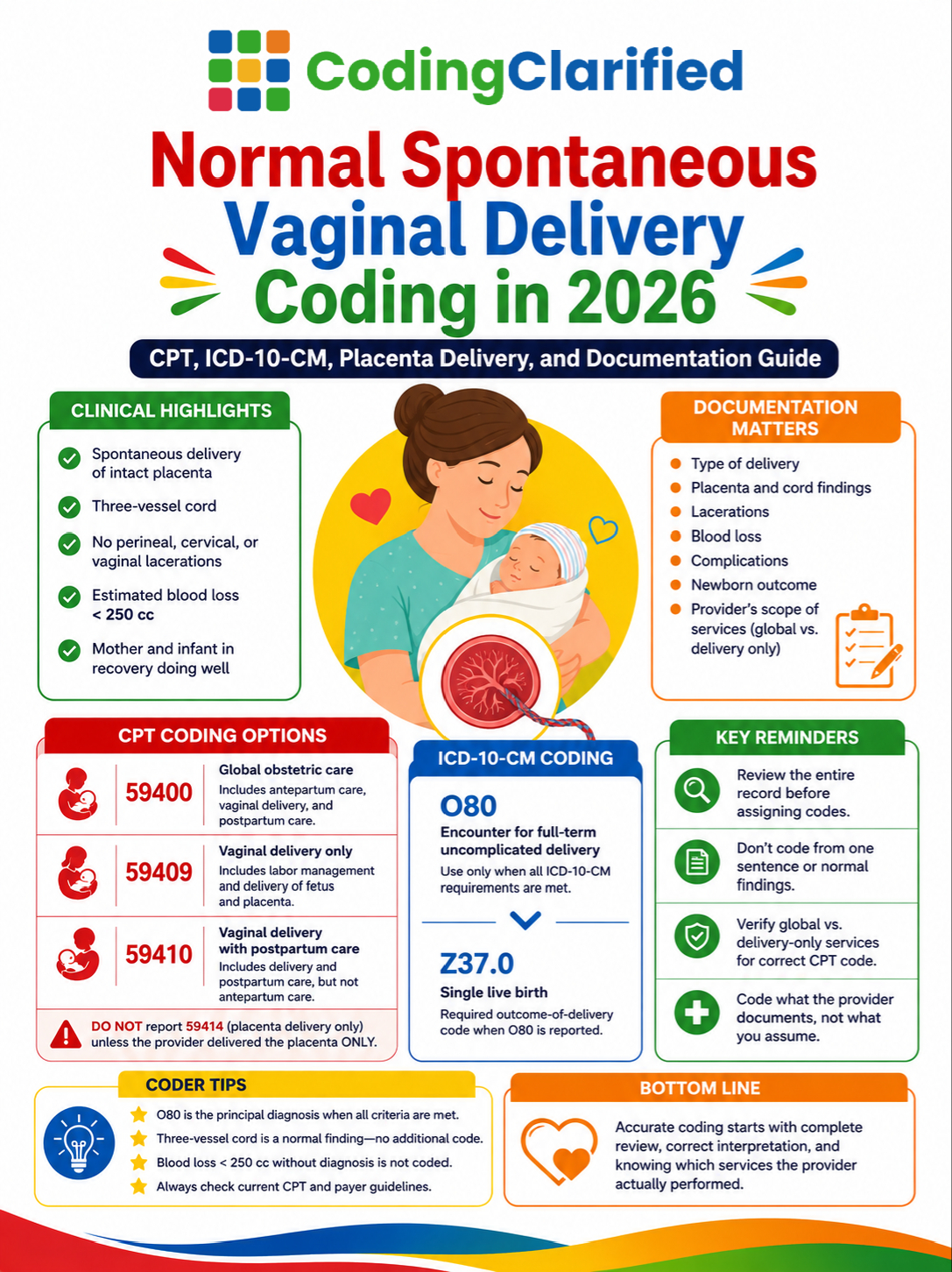
In this 2026 medical coding guide, we will break down a delivery note that documents a spontaneous delivery of an intact placenta with a three-vessel cord, no maternal lacerations, minimal blood loss, and a stable mother and infant.
You may also find our article on newborn coding helpful.
Although this documentation suggests an uncomplicated delivery, coders should never select a code from one sentence alone. Instead, they must determine who performed the delivery, whether the physician provided global obstetric care, whether postpartum care is included, and whether any complication occurred during labor or delivery.
Key Takeaways: Coding a Normal Vaginal Delivery in 2026
For the scenario discussed in this article:
- The documentation describes an uncomplicated postpartum examination following vaginal delivery.
- An intact placenta with a three-vessel cord supports routine placental delivery.
- No perineal, cervical, or vaginal lacerations were documented.
- Estimated blood loss was less than 250 cc, with no documented postpartum hemorrhage.
- Both mother and infant were recovering well.
- O80 may be appropriate for a full-term uncomplicated delivery when all ICD-10-CM requirements are met.
- Z37.0 is used with O80 to identify the outcome as a single live birth.
- CPT selection may involve 59400, 59409, or 59410, depending on which portions of obstetric care the provider performed.
- 59414 represents delivery of the placenta only and should not automatically be reported simply because the note mentions placental delivery.
- Coders must review the complete medical record before assigning final codes.
Most importantly, never assume that a delivery is uncomplicated simply because the final delivery note looks normal. Review the labor record, admission diagnoses, delivery documentation, and postpartum notes first.
Medical Coding Scenario: Spontaneous Delivery of an Intact Placenta
Consider the following documentation:
Spontaneous delivery of an intact placenta with a three-vessel cord was noted at 11:45. On examination, there were no noted perineal abrasions or lacerations. On vaginal exam, there were no noted cervical or vaginal sidewall lacerations. Estimated blood loss was less than 250 cc. Mother and infant are in recovery doing well at this time.
Several important coding clues appear in this short note.
First, the placenta delivered spontaneously and remained intact. Additionally, the provider documented a three-vessel umbilical cord. No lacerations appeared on examination, and blood loss remained low.
Finally, the mother and infant were stable in recovery.
Together, these details support a routine postpartum course at that point in the encounter. Nevertheless, the coder still needs the complete delivery record before finalizing CPT and ICD-10-CM codes.
What Does “Spontaneous Delivery” Mean for Medical Coding?
A spontaneous vaginal delivery generally means the infant delivers vaginally without cesarean delivery or major operative intervention.
However, the word “spontaneous” alone does not determine the CPT code.
Instead, CPT selection depends heavily on the services performed by the reporting physician or qualified healthcare professional. For example, a physician may provide the entire global obstetric package, perform only the delivery, or perform the delivery plus postpartum care.
Therefore, coders must understand the maternity care package before choosing a CPT code.
For more background on obstetric coding, review Coding Clarified’s guide to Medical Coding Pregnancy and Childbirth.
CPT Coding for a Normal Vaginal Delivery
Several CPT codes may come into consideration when coding vaginal delivery services.
CPT 59400: Global Obstetric Care
CPT 59400 represents routine obstetric care that includes antepartum care, vaginal delivery, and postpartum care.
AAPC’s coding information explains that the global service includes antepartum care, hospital admission for delivery, labor management, vaginal delivery of the fetus and placenta, and postpartum care.
Consequently, 59400 may be appropriate when the same physician or physician group provides the required global obstetric services.
Coders should not automatically report separate routine prenatal, delivery, and postpartum services when those services belong to the global package.
CPT 59409: Vaginal Delivery Only
CPT 59409 applies when the reporting provider performs the vaginal delivery but does not provide the complete global maternity package.
AAPC describes 59409 as a vaginal delivery service that includes labor management and delivery of the fetus and placenta.
For example, a covering physician from another practice may perform the delivery while the patient’s regular OB provider handled the antepartum care.
In that situation, the billing structure can differ significantly from a traditional global maternity claim.
CPT 59410: Vaginal Delivery Including Postpartum Care
Another possible code is 59410 when the provider performs the vaginal delivery and provides postpartum care but does not report the complete antepartum global package.
Again, coders should identify exactly which portions of obstetric care the provider performed before selecting the final code.
AAPC lists 59400, 59409, 59410, 59412, 59414, 59425, 59426, and 59430 within the vaginal delivery, antepartum, and postpartum care CPT family.
Does Delivery of the Placenta Get Coded Separately?
This scenario specifically states:
“Spontaneous delivery of an intact placenta with a three-vessel cord.”
That sentence can easily cause confusion for new coders.
CPT 59414 represents delivery of the placenta only. However, that does not mean coders should report 59414 every time a delivery note mentions the placenta.
Routine delivery of the placenta forms part of the vaginal delivery service when the same provider performs the vaginal delivery. For example, AAPC’s description of 59409 specifically includes delivery of the fetus and placenta.
Therefore, reporting 59414 in addition to the routine vaginal delivery code could result in incorrect unbundling.
When Could CPT 59414 Apply?
CPT 59414 becomes relevant when a provider performs placenta delivery only rather than the complete vaginal delivery service.
For instance, a patient could deliver the infant before the physician arrives. The physician might subsequently manage and deliver the placenta. In that situation, the documentation and circumstances could support placenta-only coding.
The key phrase is “placenta only.”
As a result, CPC students should not choose 59414 simply because they see the word “placenta” in the medical record.
ICD-10-CM Coding for an Uncomplicated Vaginal Delivery
When the complete record supports a full-term, uncomplicated delivery, ICD-10-CM code O80 may apply.
The FY 2026 ICD-10-CM Official Guidelines contain very specific instructions for using O80. CMS states that O80 should be used when a patient has a full-term normal delivery of a single healthy infant without complications during the delivery episode. Furthermore, O80 is always the principal diagnosis when properly reported.
This rule makes reviewing the entire chart essential.
A coder cannot assign O80 merely because the placenta was intact, blood loss was low, and no lacerations occurred.
Instead, the entire delivery episode must qualify as uncomplicated.
Outcome of Delivery: ICD-10-CM Z37.0
When O80 applies, coders also need to report the outcome of delivery.
For a single live birth, the appropriate outcome code is:
Z37.0 — Single live birth
The FY 2026 ICD-10-CM Official Guidelines specifically state that Z37.0 is the only outcome-of-delivery code appropriate for use with O80.
Outcome-of-delivery codes provide additional information about the result of the pregnancy.
Therefore, coders should not overlook the Z37 category when reviewing inpatient maternal delivery records.
Does the Three-Vessel Cord Affect Coding?
The delivery note states that the placenta had a three-vessel cord.
A normal umbilical cord usually contains two arteries and one vein. Therefore, documentation of a three-vessel cord generally confirms a normal cord structure.
In this scenario, the provider does not document an umbilical cord abnormality.
Consequently, coders should not assign a diagnosis simply because the provider documented “three-vessel cord.”
Remember an important coding principle: normal findings generally do not require diagnosis coding.
Does Blood Loss Under 250 cc Mean Postpartum Hemorrhage?
No.
The provider documented estimated blood loss of less than 250 cc and did not diagnose postpartum hemorrhage.
Therefore, coders should not assign a hemorrhage diagnosis based on this documentation.
Clinical measurements can help providers establish diagnoses, but coders generally code the provider’s documented diagnosis rather than independently interpreting clinical values.
For this reason, do not turn a routine amount of blood loss into a complication that the provider never documented.
Why the Absence of Lacerations Matters
The provider carefully documented:
- No perineal abrasions or lacerations
- No cervical lacerations
- No vaginal sidewall lacerations
These negative findings help establish that the postpartum examination did not identify birth-related trauma.
However, they do not create additional diagnosis codes.
Instead, they help support the overall picture of an uncomplicated delivery.
Coders should always review delivery documentation for perineal lacerations because first-, second-, third-, and fourth-degree tears can significantly change diagnosis coding.
Step-by-Step Coding Process for This Delivery Scenario
A consistent coding workflow can reduce mistakes.
Step 1: Determine What Actually Happened
Start by identifying the delivery method.
Was the delivery vaginal or cesarean? Did the provider use forceps or vacuum assistance? Was an episiotomy performed?
Next, determine whether any complications occurred.
Step 2: Review the Entire Delivery Episode
Do not code from the placenta note alone.
Instead, review:
- Admission documentation
- Labor notes
- Delivery note
- Maternal diagnoses
- Procedures
- Placental findings
- Blood loss
- Laceration documentation
- Postpartum notes
- Infant outcome
This broader review helps determine whether O80 truly applies.
Step 3: Identify the Provider’s Services
Ask whether the reporting provider supplied:
- Antepartum care
- Labor management
- Vaginal delivery
- Postpartum care
If the same practice provided the full routine package, 59400 may apply.
However, delivery-only circumstances could point toward 59409, while delivery with postpartum care may support 59410.
Step 4: Select the ICD-10-CM Diagnosis
If the entire record confirms a full-term uncomplicated single delivery, consider O80.
Then, report Z37.0 for a single live birth when appropriate.
Step 5: Check for Complications
Before finalizing O80, look for conditions such as:
- Preeclampsia
- Gestational hypertension
- Gestational diabetes affecting the delivery encounter
- Preterm labor
- Abnormal fetal presentation
- Cord complications
- Maternal infection
- Obstetric hemorrhage
- Significant perineal laceration
- Other delivery complications
A current pregnancy or delivery complication may prevent the use of O80.
Step 6: Verify the Codes
Finally, confirm every diagnosis in the current ICD-10-CM Index and Tabular List.
Coding Clarified’s Medical Coding Correctly Using CPT, ICD-10 & HCPCS guide explains why coders should locate codes in the Index and then validate them in the Tabular List.
2026 Coding Example
Assume the complete chart confirms the following:
- Full-term pregnancy
- Single infant
- Spontaneous vaginal delivery
- Live birth
- No current maternal or fetal complications affecting delivery
- Intact placenta
- Three-vessel cord
- No lacerations
- Estimated blood loss less than 250 cc
- Routine postpartum recovery
Potential diagnosis coding could include:
O80 — Encounter for full-term uncomplicated delivery
Z37.0 — Single live birth
For professional CPT coding, the correct delivery code depends on the services performed.
Potential CPT choices include:
59400 — Global routine obstetric care including antepartum care, vaginal delivery, and postpartum care
59409 — Vaginal delivery only
59410 — Vaginal delivery with postpartum care
Do not automatically add 59414 for the placenta when placental delivery forms part of the provider’s vaginal delivery service.
Always verify current CPT descriptors, payer rules, bundling requirements, and documentation before submitting the claim.
Global Obstetric Coding Matters
One of the biggest challenges for new OB coders involves understanding global maternity billing.
Unlike many services, maternity care may combine months of care into one global code.
Therefore, a coder cannot look at a delivery note and assume 59409 simply because the physician performed a vaginal delivery.
The coder must first determine whether the physician or group also provided the patient’s routine antepartum and postpartum care.
For additional information, see Coding Clarified’s Medical Coding OBGYN guide, which covers global obstetric packages, high-risk pregnancy coding, and common OB/GYN coding considerations.
Common Mistakes to Avoid
Mistake #1: Coding 59414 Every Time the Placenta Is Mentioned
Routine placental delivery is part of vaginal delivery services such as 59409. Therefore, do not separately code placenta delivery unless the circumstances actually support placenta-only services.
Mistake #2: Automatically Assigning O80
A normal-looking delivery note does not automatically support O80.
Review the entire delivery episode first. If another Chapter 15 code is required to describe a current complication, O80 generally cannot be reported.
Mistake #3: Ignoring the Outcome-of-Delivery Code
When O80 applies to a single live birth, remember Z37.0.
Missing the outcome code can leave the maternal delivery record incomplete.
Mistake #4: Coding Normal Findings as Diagnoses
An intact placenta and three-vessel cord are normal findings in this scenario.
Do not create diagnoses from normal documentation.
Mistake #5: Assuming Low Blood Loss Needs a Diagnosis
The documentation states blood loss was less than 250 cc and does not diagnose hemorrhage.
Never create a hemorrhage diagnosis from blood-loss documentation alone.
Mistake #6: Ignoring Who Provided the Care
The difference between 59400, 59409, and 59410 depends largely on the scope of services the provider performed.
Always determine who provided antepartum, delivery, and postpartum care.
CPC Student Tips for Coding Vaginal Deliveries
For CPC students, maternity coding questions often test your ability to distinguish between global care and individual components.
When you see a vaginal delivery question, ask yourself three questions:
Who provided the antepartum care?
Who performed the delivery?
Who will provide the postpartum care?
Those answers can quickly narrow your CPT choices.
Additionally, watch for wording such as “delivery only,” “postpartum care,” “global OB care,” and “placenta only.” Each phrase can point toward a different code.
For diagnosis coding, remember that O80 represents a very specific uncomplicated situation. Do not treat it as the default diagnosis for every vaginal delivery.
Finally, never let one dramatic-looking word distract you. “Placenta,” “blood loss,” and “cord” may sound important, but normal findings do not necessarily generate additional codes.
For more help strengthening your coding workflow, review What Is the Process of Medical Coding?.
Documentation Tips for Accurate Vaginal Delivery Coding
Strong documentation makes accurate coding much easier.
A complete delivery record should clearly identify the type of delivery, infant outcome, placental status, cord findings, blood loss, maternal complications, lacerations, repairs, procedures, and postpartum condition.
Furthermore, documentation should clearly establish which provider performed the delivery and other separately reportable services.
Coders should query the provider when clinically important information remains unclear rather than assuming details that are not documented.
In 2026, documentation accuracy remains especially important as payers continue to use automated claim edits and data analysis to identify inconsistent diagnosis and procedure combinations.
Related Coding Clarified Medical Coding Articles
Continue building your obstetric, ICD-10-CM, and CPT coding knowledge with these related Coding Clarified resources:
- Medical Coding for Pregnancy and Childbirth — Review important pregnancy, childbirth, and obstetric coding concepts, including ICD-10-CM Chapter 15 guidelines.
- OB/GYN Medical Coding Guide — Learn more about OB/GYN coding, global maternity services, pregnancy diagnoses, and common coding challenges.
- How to Correctly Use CPT, ICD-10-CM, and HCPCS Codes — Strengthen your process for selecting and verifying diagnosis and procedure codes.
- What Is the Process of Medical Coding? — Follow the medical coding process step by step, from reviewing documentation through final code assignment.
Authoritative Resources for 2026 OB Coding
Coders should always verify obstetric coding against current official resources.
The FY 2026 ICD-10-CM Official Guidelines for Coding and Reporting from CMS provide the official rules for pregnancy, childbirth, puerperium, normal delivery, and outcome-of-delivery coding.
AAPC also provides information about the CPT vaginal delivery code range and individual codes such as 59400 and 59409.
Because CPT coding can change and payer policies vary, always confirm the current year’s CPT manual and individual payer requirements before submitting claims.
Frequently Asked Questions About Normal Vaginal Delivery Coding
What ICD-10-CM code is used for a normal vaginal delivery in 2026?
When the patient has a full-term uncomplicated delivery of a single healthy infant and meets all ICD-10-CM requirements, O80 may be appropriate.
However, coders must review the complete delivery episode before assigning it.
What outcome code is reported with O80?
For a single live birth, report Z37.0.
The FY 2026 ICD-10-CM Official Guidelines identify Z37.0 as the appropriate outcome-of-delivery code with O80.
What CPT code is used for a vaginal delivery only?
CPT 59409 may apply when the provider performs the vaginal delivery without providing the complete global maternity package.
Always confirm the provider’s scope of services before selecting the code.
What CPT code represents global vaginal delivery care?
CPT 59400 represents routine obstetric care that includes antepartum care, vaginal delivery, and postpartum care when the requirements for global reporting are met.
Should CPT 59414 be billed for routine delivery of the placenta?
Generally, no. When the provider performs the vaginal delivery, routine placental delivery is included in the delivery service.
CPT 59414 applies to placenta-only delivery circumstances rather than routine separate reporting after the same provider delivers the infant.
Does a three-vessel cord require an ICD-10-CM diagnosis?
Not by itself.
A three-vessel cord represents a normal finding unless the provider documents another condition or abnormality requiring coding.
Should blood loss under 250 cc be coded as postpartum hemorrhage?
No. The documentation in this scenario does not diagnose postpartum hemorrhage.
Coders should not independently create a hemorrhage diagnosis from the documented blood-loss amount.
Can O80 be reported if the patient had a pregnancy complication?
Possibly, but only under specific circumstances.
The FY 2026 ICD-10-CM guidelines state that O80 may still apply when a patient had a complication earlier in pregnancy that is no longer present at the time of admission for delivery. However, if another Chapter 15 code is needed to describe a current complication during the delivery episode, O80 should not be used.
Final Coding Takeaway
This spontaneous vaginal delivery scenario demonstrates why even a straightforward delivery requires careful medical coding review.
The documentation of an intact placenta, three-vessel cord, no perineal or vaginal lacerations, blood loss under 250 cc, and a stable mother and infant supports an uncomplicated clinical picture. However, coders must still review the entire delivery record before selecting final codes.
When all requirements for a full-term uncomplicated single delivery are met, O80 with Z37.0 may be appropriate.
For CPT coding, determine whether the provider performed global obstetric care, delivery only, or delivery with postpartum care before choosing between 59400, 59409, and 59410.
Most importantly, do not separately report 59414 simply because the documentation states that the placenta delivered spontaneously. Placental delivery is already part of the vaginal delivery service when the same provider performs the delivery.
By following a consistent review process, verifying current 2026 guidelines, and coding only what the documentation supports, medical coders can handle vaginal delivery claims with greater accuracy and confidence.