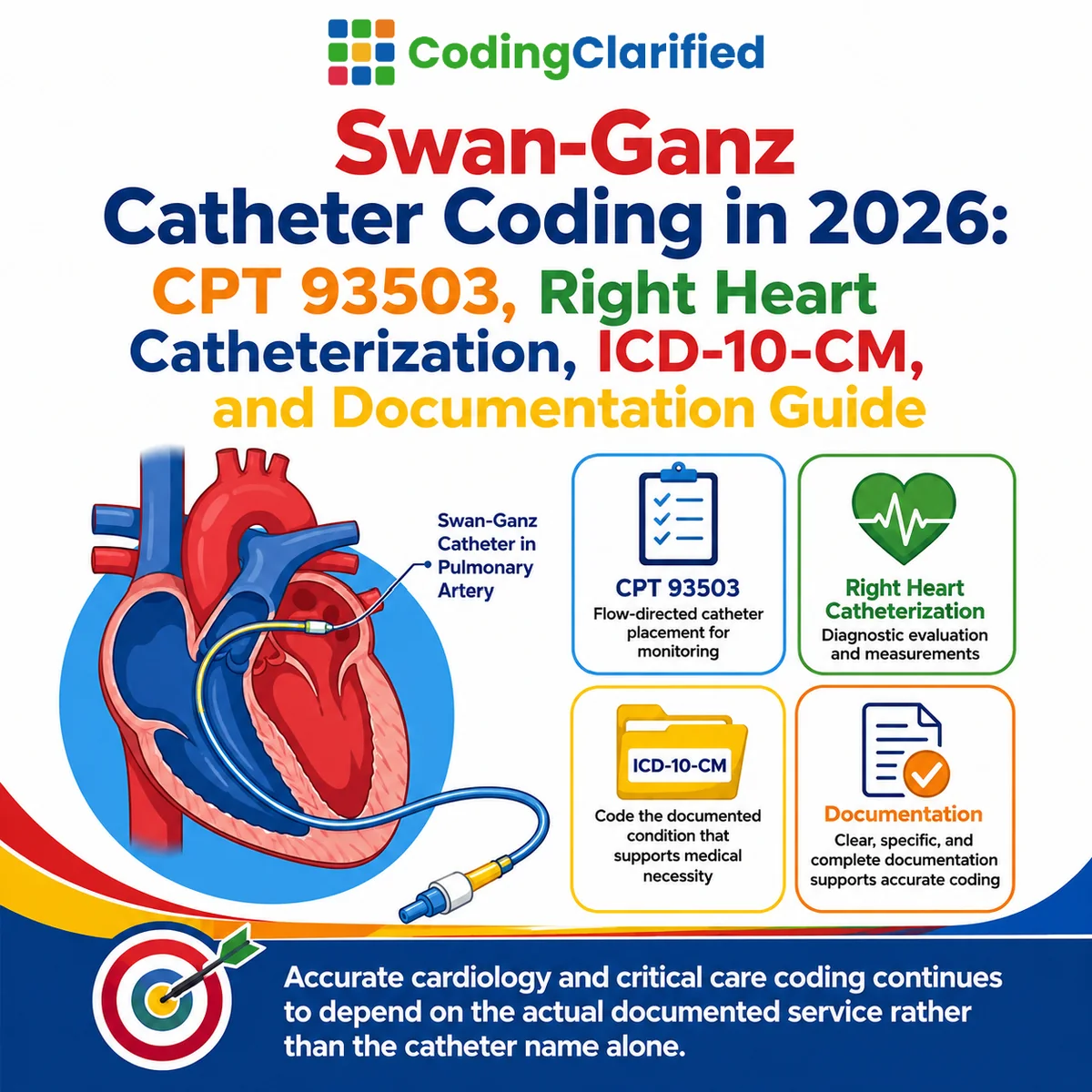
Swan-Ganz Catheter Coding in 2026: CPT 93503, Right Heart Catheterization, ICD-10-CM, and Documentation Guide
Swan-Ganz Catheter Coding in 2026
A Swan-Ganz catheter, also called a pulmonary artery catheter or PA catheter, allows clinicians to obtain detailed hemodynamic information in critically ill and cardiac patients. Although the clinical purpose may seem straightforward, Swan-Ganz catheter coding can become complicated quickly.
For example, coders must determine whether the physician simply inserted and positioned a pulmonary artery catheter or performed a complete diagnostic right heart catheterization. Additionally, another cardiac catheterization service performed during the same encounter can affect whether the Swan-Ganz placement is separately reportable.
In 2026, accurate cardiology and critical care coding continues to depend on the actual documented service rather than the catheter name alone. Therefore, coders should review the entire procedure note, indication, measurements, and other services before assigning a CPT® code.
Key Takeaways
- A Swan-Ganz catheter is a pulmonary artery catheter used for hemodynamic monitoring.
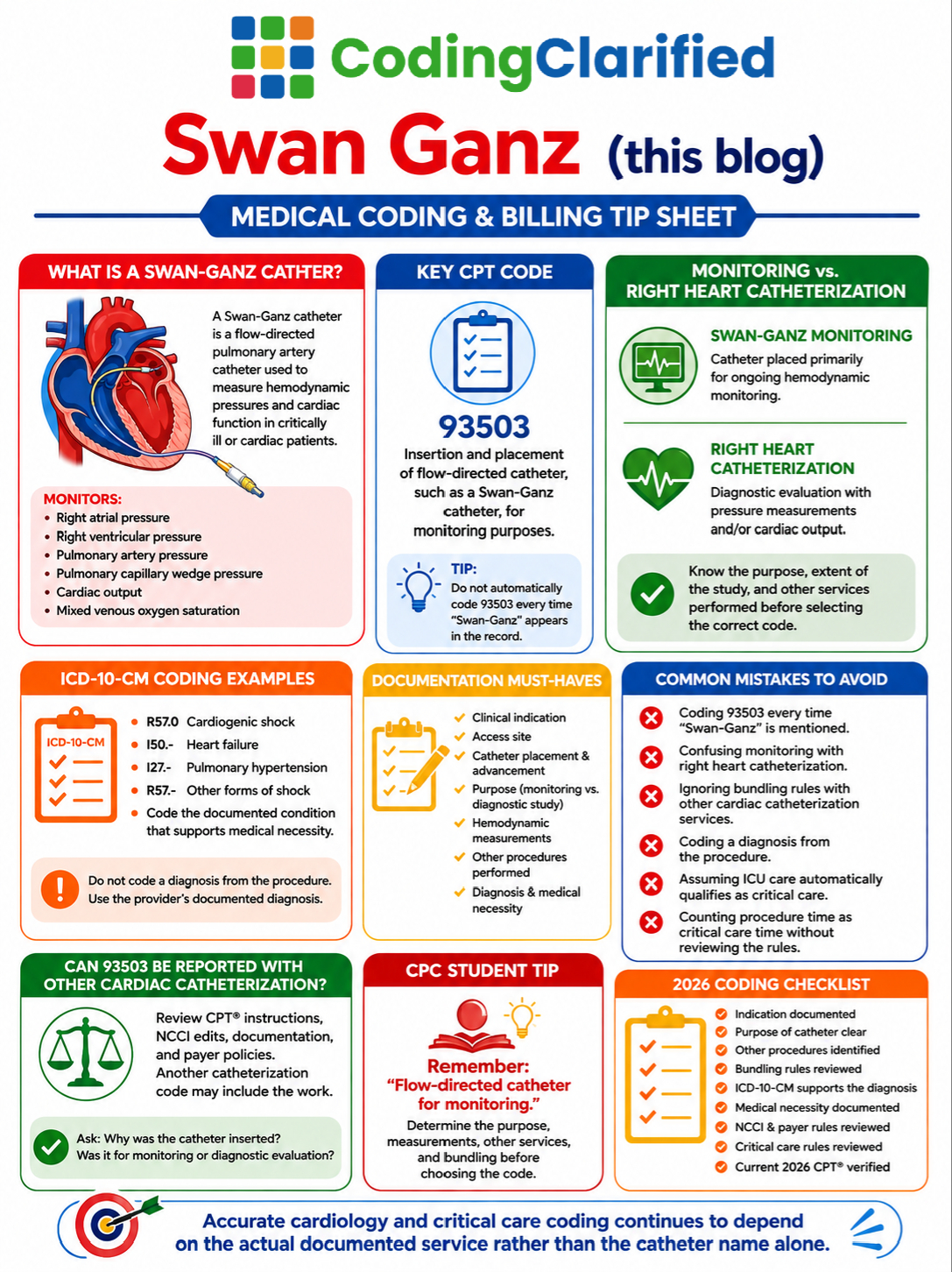
- CPT® 93503 describes insertion and placement of a flow-directed catheter, such as a Swan-Ganz catheter, for monitoring purposes.
- Do not automatically assign 93503 every time the words “Swan-Ganz” appear in the medical record.
- A diagnostic right heart catheterization is different from placement of a pulmonary artery catheter for ongoing monitoring.
- When another cardiac catheterization is performed, coders must check CPT® bundling and reporting rules before separately reporting 93503.
- ICD-10-CM diagnosis coding should represent the patient’s documented condition or reason for the procedure rather than the catheter itself.
- Common clinical indications may include shock, heart failure, pulmonary hypertension, severe hemodynamic instability, or other documented conditions.
- Critical care services may also occur during the same encounter; however, coders must review the rules for separately reportable procedures and critical care time.
- In 2026, always verify the current CPT®, ICD-10-CM, CMS, payer, and NCCI rules before submitting a claim.
What Is a Swan-Ganz Catheter?
A Swan-Ganz catheter is a specialized catheter advanced through the venous system, through the right side of the heart, and into the pulmonary artery. Clinicians also call it a pulmonary artery catheter (PAC).
Unlike a routine central venous catheter, the Swan-Ganz catheter can provide detailed information about cardiovascular function. For instance, clinicians may obtain measurements such as:
- Right atrial pressure
- Right ventricular pressure
- Pulmonary artery pressure
- Pulmonary capillary wedge pressure
- Cardiac output
- Mixed venous oxygen saturation, when applicable
Consequently, the catheter can help the medical team evaluate how well the heart pumps and how blood moves through the pulmonary circulation.
Swan-Ganz monitoring may appear in cardiology, intensive care, anesthesia, cardiovascular surgery, and other high-acuity settings. However, the presence of a critically ill patient does not automatically determine the correct procedure code.
Why Is a Swan-Ganz Catheter Used?
Physicians may use pulmonary artery catheterization when detailed hemodynamic measurements could affect treatment decisions. Therefore, the medical record should clearly identify the clinical reason for the procedure.
Depending on the patient’s condition, the provider may use a Swan-Ganz catheter while evaluating or managing:
- Cardiogenic shock
- Severe or complicated heart failure
- Pulmonary hypertension
- Hemodynamic instability
- Pulmonary edema
- Complicated cardiac disease
- Certain valvular conditions
- Severe critical illness
- Perioperative cardiovascular management
- Other conditions requiring advanced hemodynamic monitoring
Importantly, coders should never assume a diagnosis merely because a Swan-Ganz catheter was inserted. Instead, report the diagnosis established and documented by the treating provider.
What Is the CPT Code for Swan-Ganz Catheter Placement in 2026?
The CPT® code most closely associated with Swan-Ganz catheter placement for monitoring is:
CPT 93503
CPT® 93503 — Insertion and placement of flow-directed catheter, such as a Swan-Ganz catheter, for monitoring purposes.
The code falls within the cardiac catheterization and associated procedure family.
In practical terms, 93503 describes placement of the flow-directed pulmonary artery catheter for monitoring. Nevertheless, seeing “Swan-Ganz” in a procedure note does not mean a coder should automatically assign 93503.
First, determine what the physician actually performed. Then, identify whether another catheterization code already represents or includes the work.
AAPC maintains current information about CPT® 93503 in its Codify code reference.
Swan-Ganz Placement vs. Right Heart Catheterization
One of the most important coding concepts involves distinguishing monitoring catheter placement from diagnostic right heart catheterization.
These services may involve similar anatomy. However, their purposes can differ significantly.
Swan-Ganz catheter placement
A Swan-Ganz catheter may be inserted primarily to provide ongoing hemodynamic monitoring.
The catheter can remain in place while the medical team follows pressures and cardiac function over time. Therefore, the procedure’s primary purpose centers on monitoring the patient’s clinical status.
Diagnostic right heart catheterization
A diagnostic right heart catheterization evaluates cardiovascular function through a formal catheterization study.
For example, the physician may obtain pressure measurements from multiple right-sided cardiac structures and the pulmonary circulation to investigate a suspected cardiac or pulmonary vascular disorder.
CPT® 93451 represents right heart catheterization, including measurement(s) of oxygen saturation and cardiac output, when performed.
As a result, coders should not decide between 93503 and 93451 based only on the type of catheter used. Instead, determine the purpose, extent, and documented service.
Can CPT 93503 Be Reported With Cardiac Catheterization?
This question requires careful review.
Cardiac catheterization coding includes extensive bundling rules. Therefore, coders should never assume that every catheter placed during the encounter generates an additional CPT® code.
For example, if the physician performs a complete diagnostic cardiac catheterization and uses a Swan-Ganz catheter as part of that service, the catheter itself does not automatically support separate reporting of 93503.
Likewise, if a combined right and left heart catheterization service already represents the work, adding another catheter code could create an unbundling issue.
Coding Clarified discusses this concept in our Angiography & Cardiac Catheterization Coding Clarified Scenario, where Swan-Ganz placement and right-sided pressure measurements occur during a broader cardiac catheterization procedure.
Review that scenario here: Angiography & Cardiac Catheterization Coding Clarified
You can also review our broader guide to Medical Coding Cardiac Catheterization
Consequently, always ask:
- Why was the Swan-Ganz catheter inserted?
- Was it inserted primarily for ongoing monitoring?
- Was a formal right heart catheterization performed?
- Was left heart catheterization also performed?
- Was coronary angiography performed?
- Which hemodynamic measurements did the physician obtain?
- Does another reported CPT® code include the work?
- Do current NCCI or payer edits affect separate reporting?
These questions help prevent both overcoding and undercoding.
Swan-Ganz Catheter Coding and Critical Care
Many patients receiving pulmonary artery monitoring are critically ill. Therefore, coders may encounter Swan-Ganz placement and critical care services during the same encounter.
Common critical care CPT® codes include:
- 99291 — Critical care, first 30–74 minutes
- 99292 — Additional critical care time, reported according to current CPT® time requirements
However, a procedure does not become critical care simply because it occurs in the ICU.
The physician or qualified healthcare professional must separately meet the requirements for critical care. Additionally, the documentation must support the patient’s critical illness or injury and the provider’s qualifying critical care work.
Procedure time can also affect critical care time reporting. Consequently, coders must determine whether time spent performing a separately reportable procedure can count toward reported critical care time under current CPT® and payer rules.
For additional guidance, review ourMedical Coding Critical Care article.
ICD-10-CM Coding for Swan-Ganz Catheter Encounters
There is no single ICD-10-CM diagnosis code that should automatically accompany CPT® 93503.
Instead, ICD-10-CM coding depends on why the patient required the procedure.
Potential diagnosis categories may include the following when supported by provider documentation:
Heart failure
Codes within category I50.- identify heart failure. However, coders should report the highest level of specificity supported by the medical record.
For instance, documentation may distinguish systolic, diastolic, or combined heart failure as well as acute, chronic, or acute-on-chronic disease.
Cardiogenic shock
R57.0 identifies cardiogenic shock.
A Swan-Ganz catheter may help guide management of a patient experiencing severe hemodynamic compromise. Nevertheless, coders should report R57.0 only when the provider documents cardiogenic shock.
Pulmonary hypertension
Pulmonary hypertension falls within category I27.-.
Again, code selection depends on the documented type and cause. Therefore, review the provider’s final diagnostic statement rather than assigning an unspecified code automatically.
Other forms of shock
Other documented shock conditions may fall within category R57.- or another appropriate ICD-10-CM category.
Because diagnosis selection affects medical necessity, precise provider documentation remains essential.
Documentation Needed for Swan-Ganz Catheter Coding
Strong documentation helps coders determine whether 93503, a diagnostic catheterization code, or another service applies.
Ideally, the procedure note should identify:
Clinical indication
The record should explain why advanced hemodynamic monitoring or catheterization was medically necessary.
Access site
Documentation may identify the venous access route used for catheter insertion.
Catheter advancement
The physician should describe placement of the catheter and its advancement into the pulmonary artery when applicable.
Purpose of the catheter
This detail is particularly important.
Was the catheter placed for ongoing monitoring, or was the physician conducting a formal diagnostic right heart catheterization?
That distinction can change CPT® code selection.
Hemodynamic measurements
The procedure report may document right atrial pressure, right ventricular pressure, pulmonary artery pressure, wedge pressure, cardiac output, or other measurements.
Other procedures performed
Coders must identify additional procedures performed during the same session. For example, the physician might also perform left heart catheterization, coronary angiography, ventriculography, or another cardiovascular procedure.
Finally, the documentation should support the diagnosis and medical necessity reported on the claim.
Example: Swan-Ganz Catheter Placement for Monitoring
Consider this simplified coding scenario.
A critically ill patient develops severe cardiogenic shock. The physician places a flow-directed Swan-Ganz catheter through a central venous access site and advances it into the pulmonary artery for continuous hemodynamic monitoring.
The provider documents the catheter placement, pulmonary artery positioning, monitoring purpose, and cardiogenic shock.
Potential coding may include:
- CPT® 93503 for qualifying Swan-Ganz catheter placement
- ICD-10-CM R57.0 for documented cardiogenic shock
However, the coder should still review the complete record for other procedures, bundling rules, payer requirements, and applicable edits.
In contrast, suppose the physician performs a formal right heart catheterization as part of a diagnostic cardiac catheterization study. In that case, coders must review the applicable cardiac catheterization code rather than automatically adding 93503 simply because the physician used a Swan-Ganz catheter.
Common Mistakes to Avoid When Coding Swan-Ganz Catheters
Mistake 1: Coding 93503 Every Time “Swan-Ganz” Appears
This approach can lead to incorrect coding.
The catheter name alone does not establish the reportable procedure. Instead, determine why the catheter was placed and what other services occurred.
Mistake 2: Confusing Monitoring With Diagnostic Right Heart Catheterization
Although both procedures involve the right heart and pulmonary circulation, their purposes can differ.
Therefore, review the complete procedure report before selecting 93503 or a right heart catheterization code such as 93451.
Mistake 3: Ignoring Bundling Rules
Cardiac catheterization code families include many bundled components.
Consequently, separately reporting every step described in the operative report can result in unbundling.
Mistake 4: Coding a Diagnosis From the Procedure
Never assume heart failure, shock, or pulmonary hypertension simply because the physician placed a Swan-Ganz catheter.
Instead, assign ICD-10-CM codes from the provider’s documented diagnoses.
Mistake 5: Assuming ICU Care Automatically Qualifies as Critical Care
Location alone does not establish critical care.
A patient may be in an ICU without meeting the requirements for CPT® 99291 or 99292. Conversely, qualifying critical care can occur outside a traditional ICU.
Mistake 6: Counting Procedure Time as Critical Care Time Without Reviewing the Rules
Critical care time has specific reporting requirements.
Therefore, coders should carefully separate qualifying critical care time from time associated with separately reported procedures when required.
CPC Student Tips for Swan-Ganz Catheter Coding
CPC students should associate Swan-Ganz with pulmonary artery catheter and hemodynamic monitoring.
For exam questions, however, do not stop at recognizing the device.
Instead, look for clues about the procedure’s purpose.
If the question describes insertion of a flow-directed Swan-Ganz catheter specifically for monitoring, think about CPT® 93503.
If the scenario describes a complete diagnostic right heart catheterization, review the right heart catheterization family, including 93451.
Additionally, pay close attention when a question includes multiple cardiac procedures. CPT® questions often test whether students understand when one service includes another.
A useful CPC exam strategy is:
Purpose → Procedure → Measurements → Other Services → Bundling → Code
Following that order can prevent you from choosing a code simply because one familiar term appears in the operative report.
For more cardiology practice, review our Medical Coding EKG/ECG guide.
2026 Swan-Ganz Coding Checklist
Before submitting a claim involving a Swan-Ganz catheter in 2026, confirm:
- The physician documented the reason for catheter placement.
- The record identifies whether the purpose was monitoring or diagnostic catheterization.
- The documentation supports pulmonary artery catheter placement.
- You reviewed any right heart catheterization performed during the encounter.
- You identified other cardiac catheterization or angiography services.
- You checked whether another CPT® code includes the catheter work.
- The ICD-10-CM diagnosis comes from provider documentation.
- Medical necessity supports the reported service.
- Critical care time excludes non-countable procedural time when applicable.
- Current CPT®, NCCI, CMS, and payer-specific guidance supports the final claim.
Because code sets and payer edits can change, this final verification remains especially important in 2026.
Authoritative Resources for Swan-Ganz and Cardiac Catheter Coding
Coders should verify current coding and billing requirements using authoritative resources.
Use the CMS Physician Fee Schedule resources and Medicare billing guidance to research Medicare coverage, reimbursement, and current policy.
NCCI resources are particularly important when determining whether services may be separately reported during the same encounter.
Because the AMA maintains CPT®, coders should use the current CPT® code set and official guidance when making final code decisions.American Medical Association CPT® Resources
Frequently Asked Questions About Swan-Ganz Catheter Coding
What CPT code is used for Swan-Ganz catheter placement?
CPT® 93503 describes insertion and placement of a flow-directed catheter, such as a Swan-Ganz catheter, for monitoring purposes. However, coders must review the full procedure because another cardiac catheterization service may affect separate reporting.
Is a Swan-Ganz catheter the same as a pulmonary artery catheter?
Yes. Swan-Ganz is a commonly recognized name for a type of flow-directed pulmonary artery catheter. Clinicians use these catheters for advanced hemodynamic monitoring.
Is CPT 93503 the same as right heart catheterization?
No. CPT® 93503 describes placement of a flow-directed catheter for monitoring purposes, whereas CPT® 93451 describes right heart catheterization with its included measurements when performed.
Therefore, coders should determine the purpose and extent of the documented procedure.
Can CPT 93503 and 93451 be billed together?
Do not automatically report 93503 with 93451 merely because a Swan-Ganz catheter was used during the right heart catheterization. Review current CPT® instructions, NCCI edits, documentation, and payer policies to determine whether separate reporting is appropriate for the specific encounter.
What ICD-10-CM code should be used with Swan-Ganz catheter placement?
There is no universal ICD-10-CM diagnosis code for Swan-Ganz placement.
Instead, code the documented condition that supports medical necessity. Examples may include R57.0 for cardiogenic shock, a specific code from I50.- for heart failure, or an appropriate I27.- code for pulmonary hypertension when documented.
Can critical care be billed with Swan-Ganz catheter placement?
Potentially, yes, when the patient’s condition and provider services independently meet critical care requirements.
However, coders must review whether procedure time can be included in reported critical care time. Documentation should clearly support both services when they are separately reported.
What documentation is most important for CPT 93503?
The record should clearly document the indication, catheter insertion and placement, monitoring purpose, relevant hemodynamic information, and other procedures performed during the encounter.
Most importantly, the note should allow the coder to distinguish placement for monitoring from a diagnostic right heart catheterization.
What should CPC students remember about Swan-Ganz coding?
Remember the phrase “flow-directed catheter for monitoring” when reviewing CPT® 93503.
At the same time, never code from the device name alone. Determine whether the scenario describes monitoring, diagnostic right heart catheterization, or a larger cardiac catheterization procedure.
Coding Clarified Final Thoughts: Swan-Ganz Catheter Coding in 2026
Swan-Ganz catheter coding requires more than finding the words “Swan-Ganz” in the procedure note. Instead, medical coders must understand why the catheter was placed, what the physician performed, which measurements were obtained, and whether another cardiac catheterization code includes the work.
CPT® 93503 remains an important code for insertion and placement of a flow-directed catheter for monitoring purposes. However, right heart catheterization, combined cardiac catheterization, critical care services, and other cardiovascular procedures can change the coding picture.
Therefore, carefully review the complete medical record before finalizing the claim. Additionally, verify current 2026 CPT®, ICD-10-CM, CMS, NCCI, and payer requirements.
For medical coding students, mastering the distinction between Swan-Ganz monitoring and diagnostic right heart catheterization provides a strong foundation for more advanced cardiology coding.
Related Coding Clarified Articles
- Angiography & Cardiac Catheterization Coding “Clarified” Scenario
- Medical Coding Cardiac Catheterization
- Medical Coding Critical Care
- Medical Coding EKG/ECG
These related guides can help coders strengthen their understanding of cardiovascular procedures, critical care, bundling, and documentation.