Critical Care Medical Coding and Billing Guidelines 2026: CPT 99291, 99292, Time & Documentation
Critical care medical coding requires more than seeing “ICU” in the medical record. Instead, coders must determine whether the patient was critically ill or critically injured, whether the provider delivered qualifying critical care, and whether the documented time supports the CPT code reported.
In 2026, the primary critical care CPT codes remain 99291 and 99292. However, correct reporting requires careful review of time, medical necessity, bundled services, separately reportable procedures, practitioner involvement, and payer-specific rules.
This guide explains how to code critical care services in 2026, including CPT 99291, CPT 99292, documentation requirements, Medicare considerations, common mistakes, and practical tips for CPC students.
Key Takeaways: Critical Care Coding in 2026
- Critical care is based on the patient’s condition and the services provided, not simply the patient’s location.
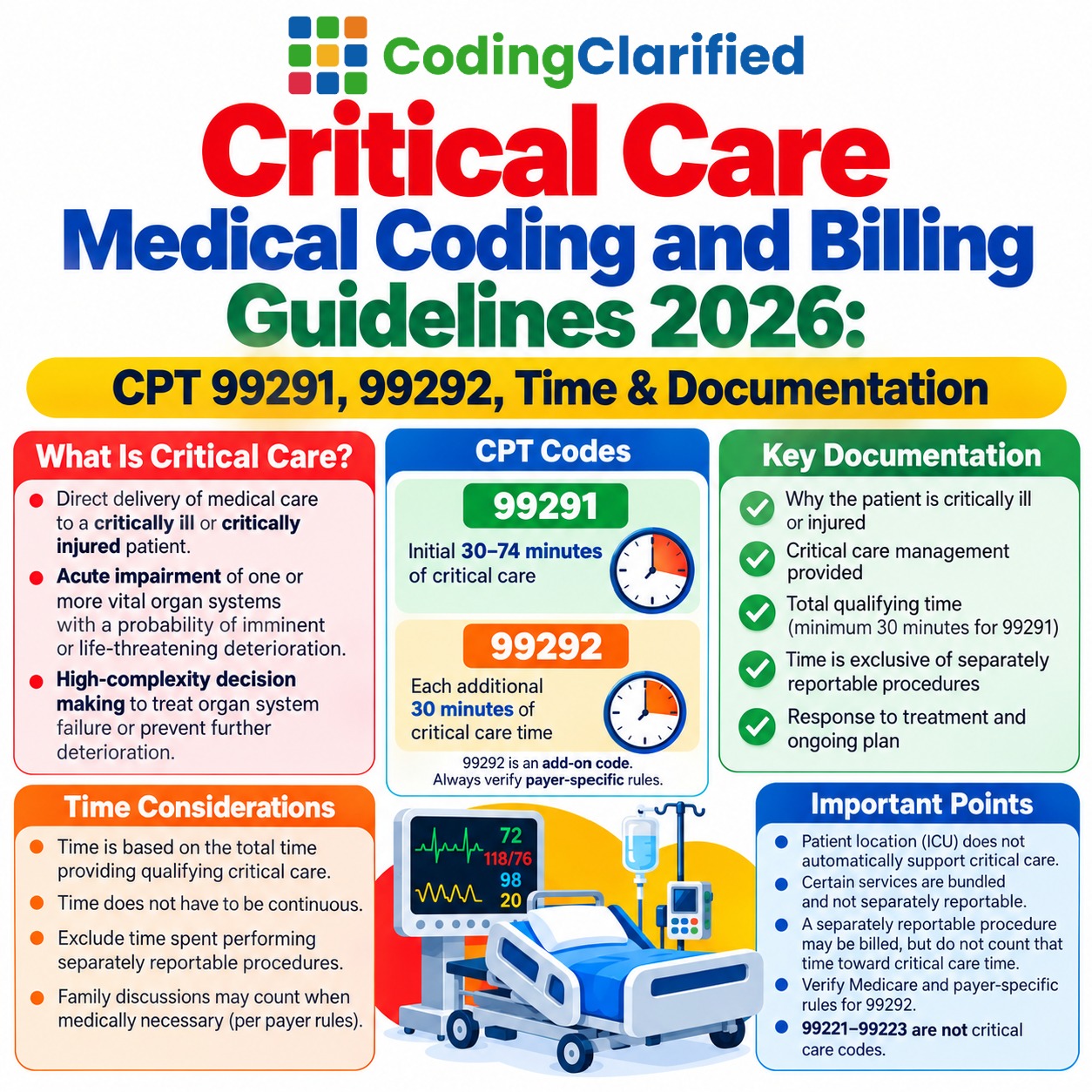
- CPT 99291 reports the initial 30–74 minutes of qualifying critical care on a calendar date.
- CPT 99292 is an add-on code used for additional qualifying critical care time.
- Critical care time does not have to be continuous.
- Time spent performing separately reportable procedures cannot also be counted toward critical care time.
- Certain services are bundled into physician/QHP critical care and cannot be separately reported.
- Documentation should clearly establish the critical condition, critical care management, and total qualifying time.
- Medicare and CPT reporting rules are not identical in every situation. Therefore, coders should always verify payer-specific guidance.
- Being in the ICU does not automatically make a service critical care.
- Critical care lasting fewer than 30 minutes does not support 99291.
What Is Critical Care in Medical Coding?
Critical care involves the direct delivery of medical care to a critically ill or critically injured patient.
According to current CMS guidance, critical care involves a patient with acute impairment of one or more vital organ systems when there is a probability of imminent or life-threatening deterioration. In addition, the practitioner makes high-complexity decisions to treat organ-system failure or prevent further life-threatening deterioration.
Therefore, two basic concepts must be present:
1. The patient’s condition is critical.
The patient has acute impairment or a significant risk of life-threatening deterioration.
2. The provider delivers qualifying critical care.
The provider must actively evaluate, manage, and treat the critical illness or injury.
For current Medicare guidance, review the CMS Evaluation and Management Services guide.
Does the Patient Have to Be in the ICU?
No.
Location alone does not determine whether critical care can be reported. For example, qualifying critical care may occur in:
- An intensive care unit
- An emergency department
- An inpatient hospital unit
- Another hospital area where qualifying critical care is provided
Likewise, simply being admitted to an ICU does not automatically support 99291 or 99292.
A stable patient receiving routine management in the ICU may instead require another appropriate E/M service. Conversely, a patient experiencing life-threatening deterioration in the emergency department may qualify for critical care.
This distinction is important because coders should code the documented service rather than the hospital unit name.
For additional E/M guidance, see our Evaluation and Management Coding Explained Simply 2026.
CPT 99291: Initial Critical Care
CPT 99291 represents the first 30–74 minutes of critical care provided on a given date.
The service is time-based. Therefore, documentation must support at least 30 minutes of qualifying critical care before 99291 can be reported.
For example:
28 minutes of qualifying critical care
Do not report 99291. Instead, consider the appropriate E/M code based on the setting, documentation, payer requirements, and services performed.
52 minutes of qualifying critical care
Report:
- 99291 × 1
74 minutes of qualifying critical care
Report:
- 99291 × 1
Additionally, 99291 is generally reported only once by the applicable practitioner or reporting group for the date under the relevant payer rules.
CPT 99292: Additional Critical Care Time
CPT 99292 is an add-on code for additional critical care time beyond the initial service.
However, this is an area where coders must pay close attention to payer rules.
General CPT methodology and Medicare payment policy may produce different thresholds for reporting additional critical care time in certain circumstances. Consequently, coders should never assume that every payer applies the same threshold.
CMS also provides specific Medicare rules for critical care furnished by practitioners in the same group and specialty, as well as split/shared services.
Therefore, before assigning 99292, verify:
- Total qualifying critical care time
- The payer
- Which practitioner or practitioners provided the service
- Whether the practitioners belong to the same group and specialty
- Whether split/shared rules apply
- Whether the payer follows Medicare or CPT methodology
For Medicare claims, always check the current CMS Evaluation and Management Services guidance and the Medicare Claims Processing Manual.
Critical Care Time Does Not Have to Be Continuous
Critical care time may be cumulative during the calendar date.
For example, a provider might deliver qualifying critical care:
- 20 minutes in the morning
- 18 minutes later in the day
- 22 minutes during another episode of deterioration
If all 60 minutes qualify under the applicable rules, the qualifying time may be added together.
Therefore, the provider does not necessarily need to remain at the bedside for one uninterrupted block.
However, each counted period must meet the requirements for critical care.
What Time Can Count Toward Critical Care?
Qualifying time may include medically necessary work directly related to managing the critically ill or injured patient when allowed under current CPT and payer rules.
For example, qualifying activities may include:
- Evaluating the patient’s critical condition
- Developing or changing a treatment plan
- Reviewing relevant test results
- Managing life-threatening organ-system impairment
- Coordinating urgent treatment
- Documenting qualifying critical care
- Discussing treatment with other healthcare professionals when directly related to the patient’s critical management
However, coders should not simply count every minute associated with the patient.
The record must show that the time represents qualifying critical care.
Can Family Discussion Count Toward Critical Care Time?
In certain situations, yes.
However, talking with family members does not automatically qualify.
For Medicare, family or surrogate discussions may count when specific requirements are met, such as when the patient cannot participate and the discussion is necessary for treatment decisions.
Therefore, documentation should explain why the discussion was necessary and how it affected the patient’s treatment.
Routine updates, general conversations, or discussions unrelated to immediate medical decision-making should not simply be added to critical care time.
Separately Reportable Procedures and Critical Care Time
This is one of the most important critical care coding rules.
Time spent performing a separately reportable procedure cannot also be counted toward critical care time.
Suppose a physician documents 80 total minutes with a critically ill patient. During that period, however, 20 minutes were spent performing a separately reportable procedure.
Those 20 minutes cannot simply be counted again as critical care time.
Instead:
80 total minutes − 20 procedure minutes = 60 minutes of potentially qualifying critical care time.
As a result, the remaining documented critical care time may support 99291, assuming all other requirements are met.
This rule prevents double counting.
Services Bundled Into Critical Care
CMS identifies several practitioner services that are included in critical care when performed during the critical care period. Therefore, they are not separately payable by the practitioner reporting 99291 or 99292.
Examples include certain:
- Cardiac output interpretations
- Chest X-ray interpretations
- Pulse oximetry services
- Blood gas interpretation
- Physiologic data interpretation
- Gastric intubation services
- Temporary transcutaneous pacing
- Ventilator management
- Vascular access procedures
However, facility reporting rules may differ from professional reporting rules.
Additionally, Medicare’s 2026 NCCI Policy Manual contains current bundling guidance. Coders should review the CMS National Correct Coding Initiative when determining whether another service may be separately reported.
Can Critical Care and a Procedure Be Reported on the Same Day?
Yes, in some circumstances.
A separately reportable procedure may be billed when the documentation and applicable coding rules support separate reporting.
However, the procedure time must be excluded from critical care time.
For example, imagine the provider documents:
- 65 minutes of qualifying critical care
- 20 minutes performing a separately reportable procedure
The 20 procedure minutes should not be added to the 65 minutes of critical care.
Instead, 99291 may be supported by the 65 qualifying critical care minutes, while the procedure may be separately reported when allowed.
For a related example involving critically ill patients and invasive monitoring, review our Swan-Ganz Catheter Coding in 2026: CPT 93503 Guide.
Critical Care and Emergency Department E/M Services
A patient may initially receive an emergency department E/M service and later deteriorate enough to require critical care.
In certain circumstances, both services may be reportable when the documentation demonstrates a meaningful clinical change and each service is separately supported.
However, coders should not automatically assign both an emergency department E/M code and critical care simply because both appear in the documentation.
Instead, carefully review:
- Timing
- Clinical change
- Medical necessity
- Provider documentation
- Payer rules
- NCCI edits
For broader E/M concepts, see our What Is Evaluation and Management in Medical Coding?.
Critical Care and Initial Hospital Care
CPT 99221–99223 describe initial hospital inpatient or observation care. They are not critical care codes.
This is an important correction because older coding resources sometimes blur the distinction.
When the patient’s condition and provider services meet critical care requirements, coders should evaluate 99291 and 99292 instead of assuming that a high-level hospital E/M code represents critical care.
Likewise, if the critical care requirements are not met, the appropriate hospital E/M service may be reported when supported.
Split/Shared Critical Care Services
Medicare permits split/shared critical care services under specific requirements.
In a split/shared encounter, a physician and qualified nonphysician practitioner in the same group may both contribute qualifying critical care time.
However, Medicare applies rules for determining which practitioner performs the substantive portion and bills the service.
Additionally, modifier FS is used for Medicare split/shared E/M services when applicable.
Do not count overlapping practitioner time twice. For example, if the physician and NPP jointly discuss the patient for 10 minutes, that same 10-minute period cannot be counted once for each practitioner.
Because these rules can change, verify the current CMS requirements before submitting a claim.
Critical Care Documentation Requirements
Strong documentation should answer three basic questions:
Why was the patient critically ill or injured?
Document the acute condition and threat to life or vital organ function.
What critical care did the provider perform?
The note should describe the evaluation, management, interventions, decisions, and response to treatment.
How much qualifying critical care time was provided?
Document the total qualifying critical care time clearly.
A statement such as:
“Total critical care time: 48 minutes, exclusive of separately billable procedures.”
is much clearer than vague wording such as:
“Spent significant time caring for the patient.”
Documentation should also identify separately performed procedures when needed so their time can be removed from critical care calculations.
ICD-10-CM Diagnosis Coding for Critical Care
There is no single ICD-10-CM diagnosis code that means “critical care.”
Instead, code the patient’s documented conditions according to ICD-10-CM guidelines.
Examples might include:
- A41.9 – Sepsis, unspecified organism
- R65.21 – Severe sepsis with septic shock
- J96.01 – Acute respiratory failure with hypoxia
- I46.9 – Cardiac arrest, cause unspecified
- R57.0 – Cardiogenic shock
However, coders must assign diagnoses from the actual provider documentation rather than selecting a serious diagnosis simply to support 99291.
Furthermore, diagnosis sequencing depends on the setting and circumstances of the encounter.
Critical Care Coding Example
A patient arrives in the emergency department with severe respiratory distress. The physician diagnoses acute respiratory failure with hypoxia and provides 58 minutes of qualifying critical care.
The physician documents active management of the respiratory failure, frequent reassessment, review of diagnostic results, and treatment decisions.
Possible coding:
CPT:
- 99291
ICD-10-CM:
- J96.01
The documentation supports both the critical nature of the patient’s condition and the qualifying critical care time.
Common Mistakes to Avoid
Coding Critical Care Just Because the Patient Is in the ICU
An ICU bed does not establish critical care.
Instead, confirm the patient’s clinical condition and the provider’s qualifying critical care work.
Reporting 99291 for Fewer Than 30 Minutes
CPT 99291 requires at least 30 minutes of qualifying critical care.
Therefore, services below the minimum threshold should be evaluated for another appropriate E/M code.
Counting Procedure Time Twice
Do not include separately reportable procedure time in critical care time.
Instead, subtract that time before determining the correct critical care code.
Automatically Reporting 99292 at the Same Threshold for Every Payer
Payer rules can differ.
Therefore, always verify current CPT and payer-specific requirements, particularly Medicare requirements, before reporting 99292.
Separately Coding Services Bundled Into Critical Care
Some services are already included in the practitioner payment for 99291 and 99292.
Consequently, review CPT and NCCI guidance before separately billing related services.
Using a Serious Diagnosis as Proof of Critical Care
A serious diagnosis alone does not establish a critical care service.
Instead, the documentation must support the patient’s critical state and the provider’s qualifying management.
CPC Student Tips for Critical Care Coding
For the CPC exam, remember this simple framework:
Critical patient + critical management + qualifying time = evaluate critical care coding.
Next, memorize that 99291 begins at 30 minutes.
Also, remember that critical care time may be cumulative rather than continuous.
When a question includes a separately reportable procedure, look carefully at whether the procedure time must be removed before calculating critical care time.
Another useful exam clue is location. Do not choose 99291 simply because the question says “ICU.” Instead, read the clinical details.
Finally, watch for payer-specific wording. Medicare rules may not always match general CPT methodology.
For more practice with time-based coding concepts, read our Time-Based Medical Coding Guide.
2026 Critical Care Coding Checklist
Before reporting 99291 or 99292, ask:
- Is the patient critically ill or critically injured?
- Is there acute impairment or a threat of life-threatening deterioration?
- Did the provider personally deliver qualifying critical care?
- Is the total qualifying critical care time documented?
- Were separately reportable procedure minutes excluded?
- Are any related services bundled into critical care?
- Does additional time support 99292 under the applicable payer rules?
- Are multiple practitioners involved?
- Do split/shared or same-group rules apply?
- Does the diagnosis coding accurately reflect the documented condition?
Following this checklist can help reduce coding errors, denials, and compliance problems.
Authoritative Critical Care Coding Resources
Coders should always verify current guidance because payer rules and coding policies may change.
Useful resources include:
- CMS Evaluation and Management Services
- CMS National Correct Coding Initiative
- AMA CPT Evaluation and Management Resources
- AAPC
Coders should also use the current-year CPT and ICD-10-CM code sets and check individual payer policies before submitting claims.
Frequently Asked Questions About Critical Care Coding
What CPT codes are used for critical care in 2026?
The primary critical care codes are 99291 and 99292. CPT 99291 represents the initial 30–74 minutes of qualifying critical care. CPT 99292 is an add-on code for additional qualifying critical care time. However, payer-specific rules should always be verified.
How many minutes are required to bill CPT 99291?
At least 30 minutes of qualifying critical care are required to report 99291. If fewer than 30 minutes are provided, another appropriate E/M service should be considered when supported.
Does critical care time have to be continuous?
No. Qualifying critical care time may be cumulative during the calendar date. However, each counted period must meet critical care requirements, and the documentation should support the total reported time.
Can you bill 99291 and 99292 together?
Yes. 99292 is an add-on code associated with additional qualifying critical care time beyond the initial critical care service. However, coders must verify the total time and applicable payer rules before assigning 99292.
Can you bill a procedure with critical care?
In some circumstances, yes. A separately reportable procedure may be billed with critical care when coding rules and documentation support it. However, time spent performing the separately reportable procedure cannot also be counted toward critical care time.
Does being in the ICU qualify a patient for critical care coding?
No. The patient’s location does not determine whether 99291 or 99292 is appropriate. The patient’s clinical condition, provider’s critical care management, medical necessity, and qualifying time must support critical care.
Can family discussion count toward critical care time?
Certain medically necessary discussions with family members or surrogate decision-makers may qualify when payer requirements are met. However, routine family updates do not automatically count as critical care time.
What should be documented for critical care billing?
Documentation should clearly establish the patient’s critical illness or injury, the provider’s critical care management, and the total qualifying critical care time. In addition, separately reportable procedure time should be identifiable and excluded when required.
Final Thoughts
Critical care coding in 2026 requires coders to look beyond the patient’s diagnosis and hospital location.
The key is determining whether the patient was critically ill or injured, whether the provider delivered qualifying critical care, and whether the documented time supports 99291 or 99292.
Additionally, coders must account for bundled services, separately reportable procedures, multiple practitioners, split/shared services, and payer-specific time rules. Medicare requirements deserve particular attention because they may differ from general CPT methodology in some situations.
When documentation does not support critical care, select the appropriate E/M service instead. When it does, careful time calculation and accurate documentation help support compliant reimbursement.
For more medical coding education, CPC exam preparation, and 2026 coding updates, visit the Coding Clarified Medical Coding Blog.