Evaluation and Management (E/M) Coding Explained Simply: 2026 Guide to MDM, Time & E/M Levels
Evaluation and Management (E/M) coding is one of the most important parts of physician and outpatient medical coding. However, it is also one of the areas that new medical coders and CPC students find the most confusing.
What makes a visit low complexity instead of moderate complexity? What does “problems addressed” actually mean? How do you count data? When does prescription drug management affect the E/M level?
Learn more in our guide to coding pre-op visits.
Fortunately, E/M coding becomes much easier when you stop trying to memorize every example and instead understand how the pieces work together.
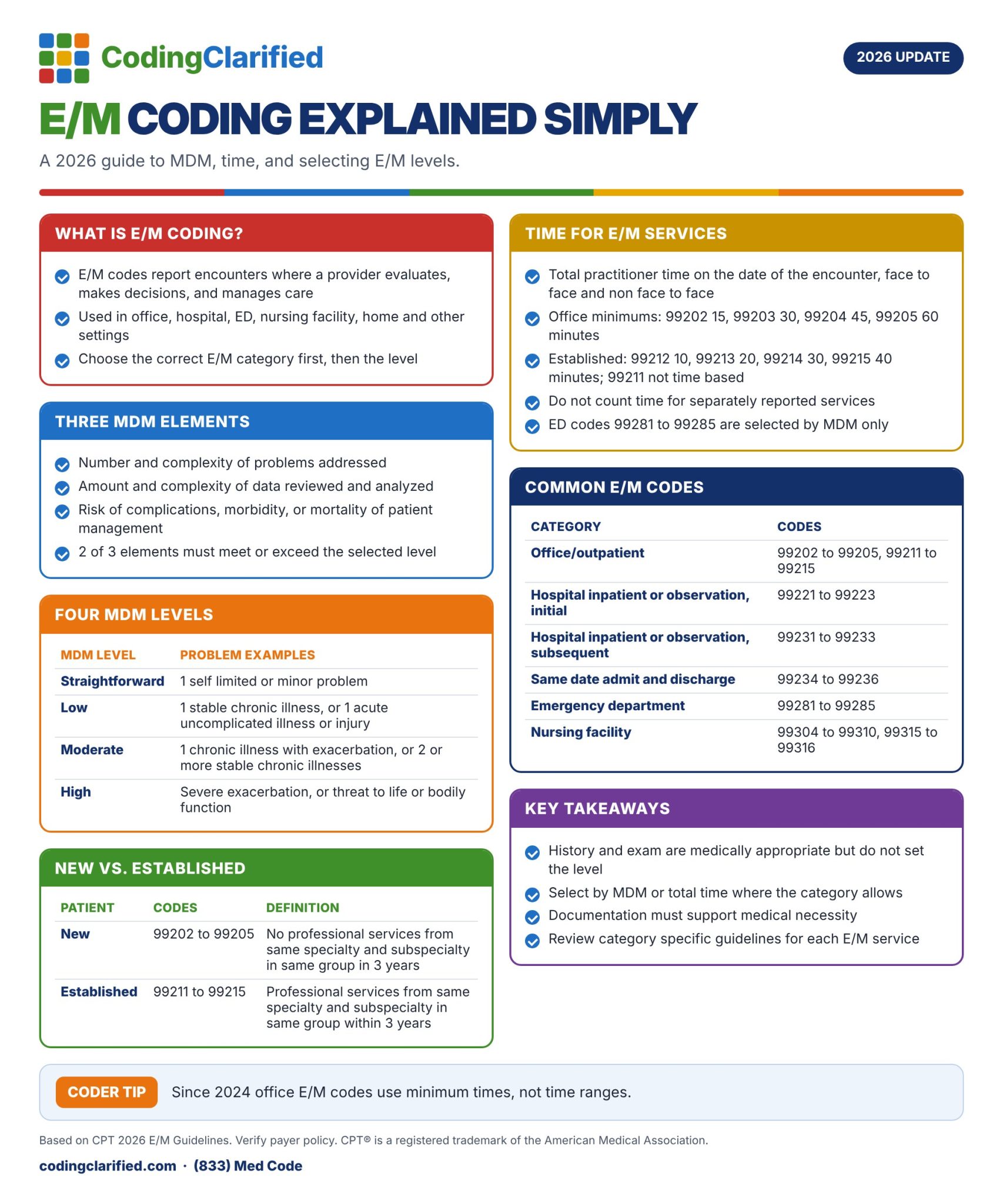
This 2026 guide explains Evaluation and Management coding in simple terms, including Medical Decision Making (MDM), problems addressed, data reviewed, risk, time, new versus established patients, and common E/M coding mistakes.
Key Takeaways: E/M Coding in 2026
- Evaluation and Management codes describe services in which a physician or other qualified healthcare professional evaluates and manages a patient.
- Many E/M levels can be selected using Medical Decision Making (MDM) or total time, depending on the E/M category.
- MDM contains three elements: problems addressed, data reviewed/analyzed, and risk of patient management.
- For MDM-based code selection, 2 of the 3 MDM elements must meet or exceed a level.
- History and physical examination should be medically appropriate; however, their length no longer determines the E/M level for these services.
- A diagnosis listed in the medical record does not automatically count as a problem addressed.
- Prescription drug management is an example of moderate risk, but the entire MDM still needs to be evaluated.
- Medical necessity remains essential. More documentation does not automatically support a higher E/M code.
- When time determines the E/M level, coders use qualifying physician or other qualified healthcare professional time on the date of the encounter.
- CPC students should learn the logic behind E/M coding instead of trying to memorize isolated code levels.
What Is Evaluation and Management (E/M) Coding?
Evaluation and Management services describe encounters in which a physician or other qualified healthcare professional evaluates a patient and determines how to manage the patient’s healthcare needs.
In simple terms, think of an E/M service as:
Evaluate the patient + make medical decisions + manage the patient’s care.
E/M services appear throughout the CPT® manual. Depending on the setting, they may include office visits, hospital inpatient and observation care, emergency department services, consultations, nursing facility care, and home or residence services.
The AMA explains that E/M categories may have their own specific instructions. Therefore, coders should never assume that the rules for an office visit automatically apply to an emergency department, hospital, or nursing facility encounter.
Official reference: AMA CPT Evaluation and Management Guidelines
Step 1: Identify the Correct E/M Category
Before determining the level, first identify where and what type of service occurred.
For example, an encounter may involve:
- Office or other outpatient care
- Hospital inpatient or observation care
- Emergency department care
- Nursing facility care
- Home or residence services
- Consultation services, when applicable
Location matters because E/M levels are not interchangeable between categories.
For example, an office visit code cannot simply replace a hospital E/M code because the MDM appears similar. Instead, start with the correct E/M family and then determine the appropriate level.
Step 2: Is the Patient New or Established?
For office and other outpatient E/M services, coders also need to determine whether the patient is new or established.
Under CPT® guidelines, a new patient generally has not received professional services from the physician or another physician or qualified healthcare professional of the exact same specialty and subspecialty in the same group practice during the previous three years.
An established patient has received those professional services within that three-year period.
Therefore, simply seeing a different doctor does not automatically make someone a new patient.
For office visits, common codes include:
New patients: 99202–99205
Established patients: 99211–99215
CPC students should pay close attention to the words same specialty, same subspecialty, same group, and three years.
Step 3: Understand Medical Decision Making (MDM)
This is where E/M coding starts to become much easier.
Medical Decision Making measures the complexity of the decisions the physician or other qualified healthcare professional makes while evaluating and managing the patient.
MDM has three elements:
- Number and complexity of problems addressed
- Amount and/or complexity of data reviewed and analyzed
- Risk of complications and/or morbidity or mortality of patient management
The four overall MDM levels are:
Straightforward → Low → Moderate → High
Here is the most important rule to remember:
You generally need 2 of the 3 MDM elements to meet or exceed a particular level.
Think of MDM as three columns. Determine the level of each column, and then look for the level supported by at least two columns.
Element 1: Number and Complexity of Problems Addressed
The first MDM element asks:
What problems did the provider actually evaluate or manage today, and how complex were they?
This is not simply a diagnosis count.
A patient could have diabetes, hypertension, COPD, arthritis, obesity, and depression listed in the medical record. However, if the provider only evaluates and manages hypertension during the encounter, you cannot automatically count all six conditions toward MDM.
The AMA specifically explains that comorbidities do not count merely because they exist. Instead, they must be addressed or affect the data or management risk.
Straightforward Problems
Straightforward MDM may involve:
- One self-limited or minor problem
Think of a simple condition that follows a predictable course and is unlikely to permanently affect the patient’s health.
Low-Complexity Problems
Low MDM may include:
- Two or more self-limited or minor problems
- One stable chronic illness
- One acute uncomplicated illness or injury
- One stable acute illness
For example, routine management of stable hypertension may fit within the stable chronic illness definition when the patient’s condition is at the treatment goal.
Moderate-Complexity Problems
Moderate MDM may include:
- One or more chronic illnesses with exacerbation, progression, or treatment side effects
- Two or more stable chronic illnesses
- One undiagnosed new problem with uncertain prognosis
- One acute illness with systemic symptoms
- One acute complicated injury
For example, a patient with diabetes and hypertension whose two chronic conditions are both actively evaluated may support the problem element at the moderate level.
Likewise, worsening asthma that requires additional management could potentially meet the chronic illness with exacerbation definition.
High-Complexity Problems
High MDM may include:
- One or more chronic illnesses with severe exacerbation, progression, or treatment side effects
- An acute or chronic illness or injury that poses a threat to life or bodily function
These cases involve substantially more serious clinical concerns. Therefore, the documentation should clearly show the severity and management of the problem.
What Does “Problem Addressed” Mean?
A problem counts when the provider evaluates or treats it during the encounter.
Additionally, a provider may address a condition by considering further testing or treatment, even when the patient ultimately declines the option or the provider decides against it because of the risks and benefits.
Simply writing that another provider manages the condition does not automatically make it a problem addressed.
CPC Student Tip: Ask yourself, “What did the provider actually do about this condition today?” If you cannot answer that question from the documentation, be careful about counting the condition toward MDM.
Element 2: Amount and Complexity of Data
The second MDM element involves information the provider reviews, orders, analyzes, interprets, or discusses.
Data can include:
- Review of external notes
- Review of test results
- Ordering tests
- Use of an independent historian
- Independent interpretation of certain tests
- Discussion of management or test interpretation with an external physician or other appropriate source
However, data counting has specific rules.
For example, a unique test is generally defined according to the CPT® code set. Multiple results from the same unique test do not automatically become multiple data elements.
Similarly, a laboratory panel represented by one CPT® code generally counts as one unique test rather than every individual component becoming its own test.
Do Not Double Count Data
One of the most important E/M rules involves services reported separately.
If the physician separately reports a CPT® service that includes the interpretation or report, that interpretation generally cannot also increase the E/M MDM data element.
In other words:
Do not get paid separately for an interpretation and then count the same work again toward the E/M level when CPT® rules prohibit it.
That concept is extremely important for both real-world coding and CPC exam questions.
Element 3: Risk of Patient Management
The third MDM element asks:
How risky were the management decisions made during this encounter?
Notice the wording: this element focuses on patient management decisions, not simply how serious the diagnosis sounds.
Risk may involve decisions concerning diagnostic testing, medications, surgery, hospitalization, or other treatment options.
Minimal and Low Risk
Simple management decisions may fall within minimal or low risk.
However, coders should evaluate the actual plan rather than guessing risk based on the diagnosis alone.
Moderate Risk
Examples of moderate-risk management include:
- Prescription drug management
- Decision regarding minor surgery with identified patient or procedure risk factors
- Decision regarding elective major surgery without identified patient or procedure risk factors
- Diagnosis or treatment significantly limited by social determinants of health
Prescription drug management appears frequently in office E/M coding.
However, this does not mean that seeing a medication list automatically gives you moderate MDM.
The documentation needs to show management of the prescription medication as part of the encounter.
High Risk
Examples of high-risk management include:
- Drug therapy requiring intensive monitoring for toxicity
- Decision regarding elective major surgery with identified risk factors
- Decision regarding emergency major surgery
- Decision regarding hospitalization or escalation of hospital-level care
- Certain decisions involving resuscitation or de-escalation of care because of poor prognosis
- Parenteral controlled substances
Therefore, high MDM requires much more than a serious-looking diagnosis.
The 2-of-3 Rule Made Simple
This rule is the key to understanding MDM.
Imagine an established office patient has:
Problems: Moderate
Data: Low
Risk: Moderate
Two elements—problems and risk—meet the moderate level.
Therefore, the overall MDM is moderate.
For an established office/outpatient patient, moderate MDM can support 99214, assuming all other code requirements are met.
Now consider:
Problems: Moderate
Data: Low
Risk: Low
Only one element reaches moderate.
As a result, the overall MDM does not reach moderate based on those facts.
CPC Student Tip: Never choose an E/M level by looking at only the highest MDM column. Find the level supported by at least two of the three elements.
History and Examination Do Not Determine the E/M Level
Older E/M coding methods placed much more emphasis on counting history and examination elements.
That approach has changed for the E/M services covered by the current MDM/time framework.
A medically appropriate history and/or examination should still be performed when needed. However, the extent of the history and physical examination does not determine the E/M level for these codes.
This means a long review of systems or lengthy examination does not automatically support a higher-level E/M code.
Instead, focus on the work and decision making documented during the encounter.
Selecting an E/M Level Based on Time
Many E/M categories also allow level selection based on total time rather than MDM.
When time applies, CPT® considers qualifying physician or other qualified healthcare professional work performed on the date of the encounter.
Depending on the service, qualifying activities may include:
- Preparing to see the patient
- Reviewing tests
- Obtaining or reviewing history
- Performing a medically appropriate examination or evaluation
- Counseling or educating the patient or caregiver
- Ordering medications, tests, or procedures
- Communicating with other healthcare professionals when not separately reported
- Documenting clinical information in the medical record
However, time spent performing separately reported services cannot simply be added to the E/M time.
Additionally, the medical record should document total time when time serves as the basis for selecting the code.
Current Medicare guidance likewise states that, for most E/M visit families, providers select the level based on MDM or practitioner time. Medicare also emphasizes that medical necessity remains central to payment.
Official 2026 Medicare resource: CMS Evaluation and Management Services
E/M Coding Scenario: Established Patient With Diabetes and Hypertension
Consider this example.
A 67-year-old established patient returns to the physician’s office for management of type 2 diabetes and hypertension.
The provider evaluates both chronic conditions. The patient’s hypertension remains controlled; however, the patient’s diabetes is not at the desired treatment goal.
The physician reviews the recent A1C result and adjusts the patient’s prescription diabetes medication.
Step 1: Patient Status
The patient is established.
Therefore, begin with the established office/outpatient E/M family:
99211–99215
Step 2: Problems Addressed
Two chronic conditions are actively evaluated: diabetes and hypertension.
Additionally, the diabetes is not at the desired treatment goal.
The coder must apply the AMA definitions carefully because “stable” is based on the patient’s individual treatment goals. A chronic condition that has not reached the treatment goal is not automatically considered stable merely because it has not recently changed.
Step 3: Data
The physician reviews the patient’s recent A1C.
That contributes to the data analysis; however, one reviewed test alone does not automatically produce moderate data.
Step 4: Risk
The physician adjusts a prescription diabetes medication.
Prescription drug management is an example of moderate risk.
Step 5: Determine the Overall MDM
The problem element can support moderate complexity based on the documented chronic disease status, while prescription drug management supports moderate risk.
Therefore, two of the three MDM elements reach moderate.
Result: Moderate MDM
For an established office/outpatient encounter, moderate MDM supports 99214, assuming the documentation and all other requirements support reporting that code.
Possible ICD-10-CM coding will depend on the provider’s exact documentation. For example, type 2 diabetes without documented complications may involve E11.9, while essential hypertension may involve I10. Always code from the actual documentation and verify the current ICD-10-CM guidelines and Tabular List.
E/M Coding and Modifier 25
Sometimes a provider performs a procedure and a separate E/M service on the same day.
When the patient’s condition requires a significant, separately identifiable E/M service above the work associated with the procedure, modifier 25 may be appropriate on the E/M code.
Importantly, CPT® does not require a different diagnosis simply to report the procedure and qualifying E/M service together.
However, the documentation must support that the E/M service was significant and separately identifiable.
Do not automatically add modifier 25 whenever an E/M service and procedure appear on the same claim.
Common Mistakes to Avoid With E/M Coding
Counting every diagnosis on the problem list. Only conditions actually addressed—or otherwise affecting qualifying MDM as defined by the guidelines—should influence the MDM level.
Choosing the E/M level from one MDM element. Remember the 2-of-3 rule.
Assuming prescription medications automatically equal moderate MDM. Prescription drug management may support moderate risk, but you still need to determine the other MDM elements.
Counting history and examination elements to determine the level. For E/M services using the current MDM/time framework, the extent of history and exam does not select the level.
Double counting separately reported work. A test interpretation or other service separately reported may not also qualify for MDM credit when CPT® rules exclude it.
Assuming more diagnoses equal a higher level. Complexity matters more than the raw number of diagnoses.
Using time without supporting documentation. When selecting the E/M code based on time, make sure the documentation supports the applicable total time.
Automatically using modifier 25. The documentation must demonstrate a significant, separately identifiable E/M service.
CPC Student Tips for Learning E/M Coding
First, memorize the three MDM elements, not dozens of isolated examples:
Problems + Data + Risk
Next, remember:
2 out of 3 determines the MDM level.
Then, learn the four levels:
Straightforward → Low → Moderate → High
When answering a CPC exam question, identify the correct E/M family before analyzing the level. Afterward, evaluate each MDM column separately instead of trying to guess the code from the overall appearance of the note.
Also, underline phrases such as “stable chronic illness,” “exacerbation,” “prescription drug management,” “independent historian,” “external records,” and “decision regarding hospitalization.” Those phrases can point you toward the correct section of the MDM table.
Finally, keep your CPT® E/M guidelines easy to locate during practice. Understanding where the information lives in the CPT® manual is much more useful than trying to memorize every possible E/M scenario.
For more CPC preparation, read What Is on the AAPC CPC Exam in 2026? Complete 100-Question Exam Breakdown and our AAPC CPC Certification Guide 2026.
Why Accurate E/M Coding Matters in 2026
E/M coding remains a major compliance concern because these services are reported so frequently.
CMS currently reports that incorrect coding and insufficient documentation are significant causes of improper E/M payments. Therefore, coders should never approach E/M selection as simply choosing the highest code that documentation might appear to support.
Instead, the reported code should accurately represent the service performed and remain medically necessary.
This becomes especially important as electronic health records and AI-assisted documentation can generate increasingly detailed notes. A longer note does not automatically mean more complex medical decision making.
For additional 2026 E/M information, see our Evaluation and Management (E/M) Guidelines for 2026: The Complete Guide.
You may also find our real-world Medical Coding for a Weight Loss Evaluation in 2026 helpful for practicing how E/M, CPT®, ICD-10-CM, and documentation work together.
Authoritative E/M Coding Resources
Medical coders should always verify E/M rules using current authoritative resources.
American Medical Association (AMA) CPT E/M Guidelines provides the detailed definitions and Medical Decision Making framework discussed throughout this guide.
CMS Evaluation & Management Visits provides Medicare-specific E/M documentation and payment resources.
AAPC also provides education and resources for medical coders, CPC students, billers, auditors, and other revenue-cycle professionals.
Because CPT®, Medicare policies, payer rules, and coding guidance can change, always verify requirements for the applicable date of service.
Frequently Asked Questions About E/M Coding
What does E/M mean in medical coding?
E/M stands for Evaluation and Management. These CPT® services generally describe encounters in which a physician or other qualified healthcare professional evaluates a patient’s condition and manages the patient’s care.
What are the three elements of Medical Decision Making?
The three MDM elements are:
- Number and complexity of problems addressed
- Amount and/or complexity of data reviewed and analyzed
- Risk of complications and/or morbidity or mortality of patient management
Generally, two of the three elements must meet or exceed a level to support that overall MDM level.
What are the four levels of MDM?
The four MDM levels are straightforward, low, moderate, and high.
The correct level depends on the documented problems addressed, qualifying data, and management risk—not simply how long or detailed the medical note appears.
Does prescription drug management automatically support CPT 99214?
No. Prescription drug management is an example of moderate risk, but risk represents only one of the three MDM elements.
For an established office visit to support 99214 based on MDM, the overall documentation must support moderate MDM under the 2-of-3 rule.
Does the number of diagnoses determine the E/M level?
No. A long diagnosis list does not automatically create higher MDM.
The provider must actually address the conditions, or their presence must affect qualifying data or management risk as described in the E/M guidelines. Therefore, coders should focus on what happened during the encounter rather than counting every diagnosis appearing in the chart.
Can an E/M code be selected based on time?
Yes, many E/M categories allow code selection based on total time on the date of the encounter.
However, specific rules apply to what time may be counted. Additionally, certain E/M categories use time differently or do not use time for level selection, so always check the instructions for the applicable E/M family.
Does a detailed history and physical exam increase the E/M level?
Not for E/M services using the current MDM/time framework. The provider should perform a medically appropriate history and/or examination when needed, but the extent of those elements does not determine the level.
Instead, the level generally depends on MDM or qualifying total time.
What is the easiest way for CPC students to understand E/M coding?
Start with three words:
Problems. Data. Risk.
Determine the level of each element and then apply the 2-of-3 rule.
Once that process becomes familiar, E/M coding becomes much easier because you are applying a consistent framework instead of trying to memorize hundreds of scenarios.
Final Thoughts: E/M Coding Does Not Have to Be Complicated
Evaluation and Management coding can seem overwhelming at first. However, the basic structure is much simpler once you understand what the guidelines are asking you to evaluate.
Start by choosing the correct E/M category and determining the patient’s status when applicable. Next, decide whether MDM or time will determine the level.
When using MDM, break the encounter into three parts:
What problems were addressed?
What data were reviewed or analyzed?
What was the risk of the management decisions?
Finally, apply the 2-of-3 rule.
Most importantly, do not code based on the length of the note, the number of diagnoses on the problem list, or the highest-looking element in the chart. Instead, follow the documented work, apply the CPT® definitions, confirm medical necessity, and verify current payer requirements.
That approach makes E/M coding easier to understand, easier to defend, and much easier to apply to both the CPC exam and real-world medical coding in 2026.