Gastroenterology Medical Coding in 2026: CPT, ICD-10-CM, Colonoscopy, EGD, Modifiers & Billing Guide
Gastroenterology medical coding can be challenging because a single encounter may include an office visit, endoscopy, biopsy, polyp removal, pathology, and several diagnoses. In addition, screening procedures may become diagnostic or therapeutic based on findings during the procedure.
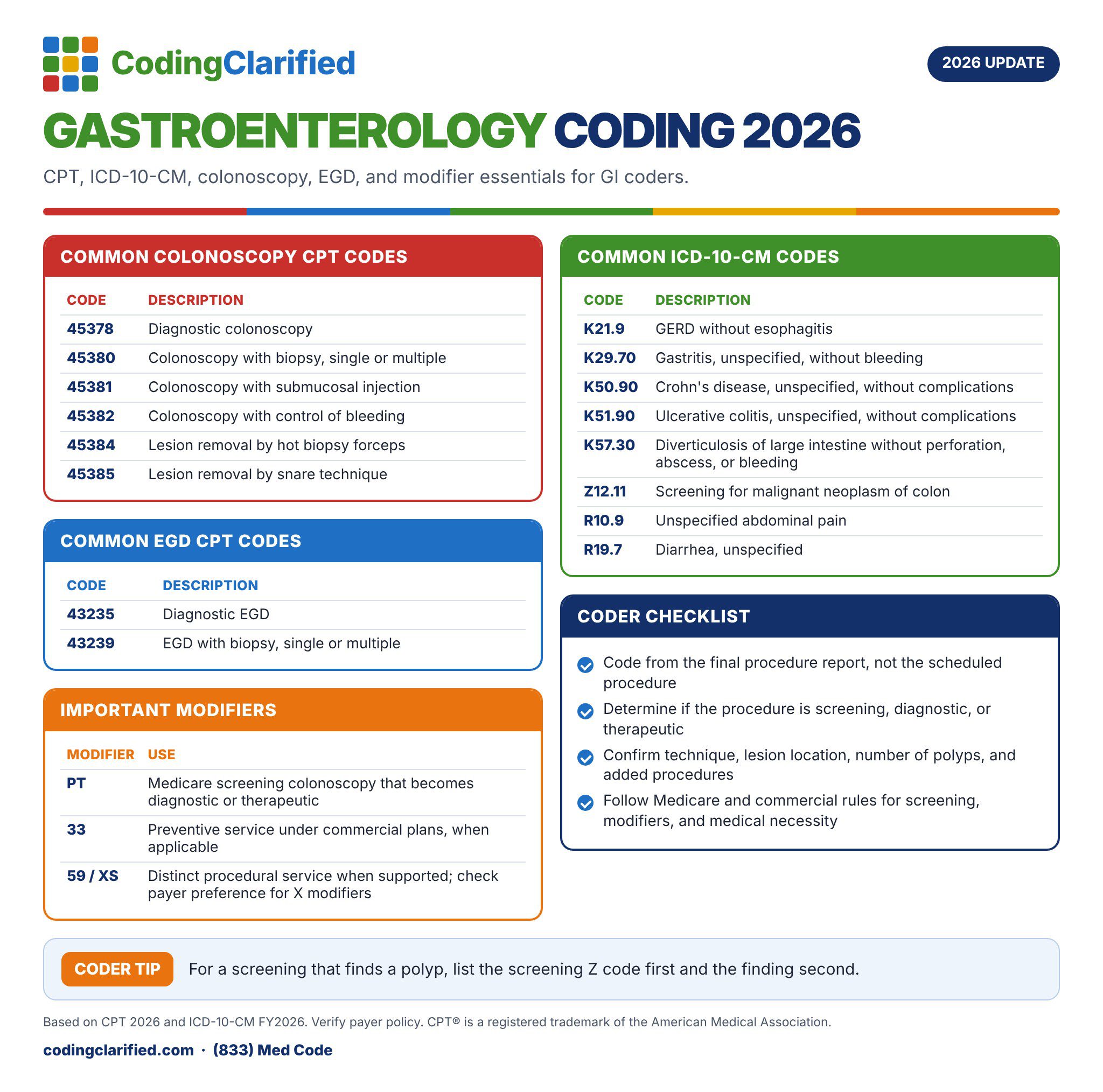
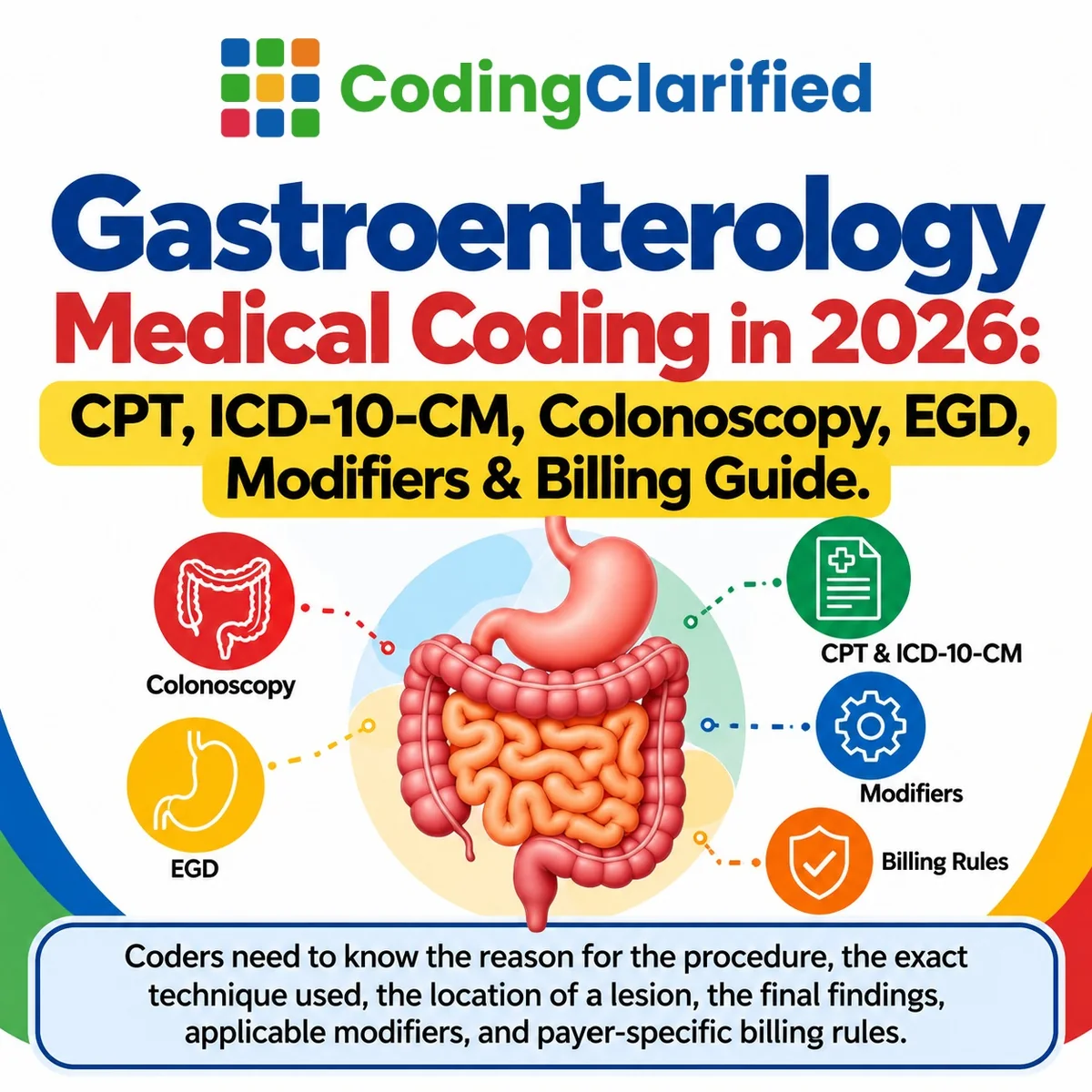
Therefore, gastroenterology coders must understand much more than a list of CPT and ICD-10-CM codes. They need to know the reason for the procedure, the exact technique used, the location of a lesion, the final findings, applicable modifiers, and payer-specific billing rules.
In 2026, accurate GI coding is especially important as Medicare continues to apply specific colorectal cancer screening policies, while ICD-10-CM updates require coders to verify the code set that applies to the date of service.
This guide explains gastroenterology medical coding in practical terms, including colonoscopy, EGD, biopsy, polypectomy, common digestive diagnoses, modifiers, documentation, billing rules, and CPC exam tips.
Key Takeaways: Gastroenterology Medical Coding in 2026
- GI procedure coding depends heavily on the procedure performed and technique used, not simply the diagnosis.
- A screening colonoscopy and a diagnostic colonoscopy may follow different billing rules.
- Colonoscopy with biopsy is commonly reported with CPT 45380, while removal of a lesion by snare technique is commonly reported with 45385.
- Diagnostic colonoscopy without an additional intervention is generally reported with 45378 when documentation supports the complete service.
- EGD coding requires coders to determine whether the physician performed a diagnostic exam, biopsy, lesion removal, dilation, control of bleeding, or another service.
- ICD-10-CM diagnosis coding should reflect the documented reason for the procedure and supported findings.
- Modifier PT plays an important role when a Medicare colorectal cancer screening test becomes diagnostic or therapeutic.
- Modifier 33 may apply to qualifying preventive services under applicable payer rules.
- Multiple endoscopic procedures require careful review of CPT instructions, NCCI edits, and payer policies.
- Documentation should support the indication, extent of the examination, findings, technique, and any treatment performed.
Most importantly, never choose a GI procedure code based only on the procedure name on the schedule. Instead, code from the final procedure report.
What Is Gastroenterology Medical Coding?
Gastroenterology coding covers services used to diagnose and treat conditions involving the digestive system. Therefore, coders may work with diseases affecting the esophagus, stomach, small intestine, colon, rectum, liver, gallbladder, pancreas, and related structures.
Common GI services include:
- Office and outpatient visits
- Colonoscopy
- Esophagogastroduodenoscopy (EGD)
- Flexible sigmoidoscopy
- Biopsy
- Polypectomy
- Dilation
- Control of gastrointestinal bleeding
- Endoscopic ultrasound
- ERCP
- Capsule endoscopy
- Hemorrhoid procedures
- Feeding-tube procedures
Because many GI procedures belong to the same endoscopic families, however, coders must understand bundling and multiple-endoscopy rules.
For a broader review of selecting codes correctly, see our Medical Coding Correctly Using CPT, ICD-10 & HCPCS guide.
Gastroenterology CPT Coding in 2026
The first question should be: What did the gastroenterologist actually do?
For example, a patient may be scheduled for a colonoscopy. During the procedure, however, the physician may biopsy an abnormal area, remove a polyp with a snare, inject a lesion, or control bleeding.
Consequently, the final code may be very different from the originally planned service.
Common Colonoscopy CPT Codes
Several colonoscopy codes appear frequently in GI practices.
45378 — Diagnostic flexible colonoscopy, including collection of specimens by brushing or washing when performed
45380 — Colonoscopy with biopsy, single or multiple
45381 — Colonoscopy with directed submucosal injection
45382 — Colonoscopy with control of bleeding
45384 — Colonoscopy with removal of tumor, polyp, or other lesion by hot biopsy forceps
45385 — Colonoscopy with removal of tumor, polyp, or other lesion by snare technique
Although these codes appear similar, the technique matters.
For instance, biopsy forceps support 45380, while snare removal supports 45385. Therefore, coders should not select a polypectomy code merely because the report says “polyp removed.”
Instead, find the method of removal.
AAPC’s coding resources also emphasize the importance of distinguishing biopsy from snare removal when selecting the appropriate colonoscopy code.
Colonoscopy Biopsy vs. Snare Polypectomy
One of the most common GI coding mistakes is confusing biopsy with lesion removal.
Suppose the physician uses forceps to take tissue from a suspicious lesion. In that situation, 45380 may be appropriate when all CPT requirements are met.
Conversely, suppose the physician loops a snare around a polyp and removes it. That technique generally points to 45385.
Now consider a procedure where the physician removes one polyp by snare and biopsies a different lesion.
Potentially, both services may be reportable. However, the coder must verify that the procedures occurred at separate lesions or sites, review current NCCI edits, and determine whether an appropriate distinct-service modifier is supported.
Never add modifier 59 automatically just because two procedure codes appear in the report.
Screening vs. Diagnostic Colonoscopy
The difference between screening and diagnostic colonoscopy remains one of the most important concepts in gastroenterology billing.
A screening examination is performed on a patient without signs or symptoms for the purpose of detecting disease or disease precursors.
In contrast, a colonoscopy performed because of symptoms such as rectal bleeding, abdominal pain, or another clinical concern is generally diagnostic rather than screening.
A common screening diagnosis is:
Z12.11 — Encounter for screening for malignant neoplasm of colon
However, screening status becomes more complicated when the physician discovers a polyp or another abnormality and performs treatment during the examination.
For Medicare, modifier PT identifies a colorectal cancer screening test that becomes a diagnostic or therapeutic procedure. Therefore, coders should carefully review Medicare’s current colorectal cancer screening instructions rather than simply changing the entire encounter to a routine diagnostic colonoscopy.
CMS provides detailed guidance in its Screening Colonoscopy Converted to a Diagnostic and/or Therapeutic Colonoscopy billing article.
Important 2026 Medicare Update
For calendar year 2026, Medicare continues its phased reduction in beneficiary coinsurance for qualifying colorectal cancer screening procedures that become diagnostic or therapeutic. When the applicable requirements are met and modifier PT is reported, the deductible remains waived and the applicable coinsurance is 15% for CY 2023 through CY 2026.
The percentage changes again beginning in 2027. Therefore, billing teams should not assume that the 2026 patient-cost-sharing rules will remain the same next year.
Follow-On Colonoscopy After a Positive Stool-Based Screening Test
Another important Medicare rule involves a positive non-invasive colorectal cancer screening test.
CMS expanded its definition of a complete colorectal cancer screening to include certain follow-on screening colonoscopies after a Medicare-covered non-invasive stool-based screening test returns a positive result.
As a result, coders should not automatically treat every colonoscopy following a positive screening test as an ordinary diagnostic colonoscopy.
Instead, verify the Medicare requirements, the qualifying test, the circumstances of the colonoscopy, and any required modifier.
This distinction can directly affect the patient’s financial responsibility.
EGD Medical Coding
Esophagogastroduodenoscopy, commonly called EGD or upper GI endoscopy, allows the physician to examine the esophagus, stomach, and duodenum.
Frequently used EGD codes include:
43235 — Diagnostic upper GI endoscopy
43239 — Upper GI endoscopy with biopsy, single or multiple
Other EGD codes describe services such as dilation, lesion removal, control of bleeding, injection, and other therapeutic procedures.
Again, coders should focus on what the physician actually performed.
For example, if the gastroenterologist performs an EGD and takes several biopsies, do not report the biopsy code once for every specimen. Instead, review the descriptor and CPT instructions because “single or multiple” language can limit reporting to one unit for that technique during the session.
Common ICD-10-CM Codes in Gastroenterology
GI coders encounter a broad range of diagnosis codes. Some common examples include:
K21.9 — Gastro-esophageal reflux disease without esophagitis
K22.2 — Esophageal obstruction
K25.9 — Gastric ulcer, unspecified as acute or chronic, without hemorrhage or perforation
K29.70 — Gastritis, unspecified, without bleeding
K50.90 — Crohn’s disease, unspecified, without complications
K51.90 — Ulcerative colitis, unspecified, without complications
K57.30 — Diverticulosis of large intestine without perforation or abscess without bleeding
K62.5 — Hemorrhage of anus and rectum
R10.9 — Unspecified abdominal pain
R19.7 — Diarrhea, unspecified
Z12.11 — Encounter for screening for malignant neoplasm of colon
Still, coders should never select a diagnosis simply because it commonly appears on GI claims.
Instead, code the documented condition to the highest supported specificity and follow ICD-10-CM sequencing rules.
For additional help, review our ICD-10 Updates April 2026 article.
2026 ICD-10-CM Freshness Alert
Gastroenterology coders need to pay close attention to dates during the second half of 2026.
The applicable FY 2026 ICD-10-CM files remain relevant through September 30, 2026. Then, the FY 2027 ICD-10-CM code set becomes effective October 1, 2026, for applicable encounters.
Therefore, coders working claims around October 1 should verify the correct code set based on the date of service rather than assuming “2026” means the same ICD-10-CM version for the entire calendar year.
Always verify current files through CMS ICD-10.
GI Medical Necessity and Documentation
Correct procedure coding does not automatically mean the claim will be paid.
The diagnosis must also support the reason for the service.
For diagnostic colonoscopy, CMS guidance emphasizes documentation supporting medical reasonableness, necessity, and frequency. In addition, the colonoscopy report should document the extent of the examination, abnormal findings, and procedures performed because of those findings.
For example, documentation may include:
- Reason for the procedure
- Relevant symptoms or screening status
- Extent of scope advancement
- Quality of bowel preparation
- Anatomical location of findings
- Number and description of lesions
- Removal or biopsy technique
- Control of bleeding when applicable
- Complications
- Recommendations and follow-up plan
Therefore, detailed procedure documentation supports both code selection and medical necessity.
Learn more in our What Is Medical Necessity in Medical Coding & Billing guide.
Gastroenterology Modifiers Coders Should Know
GI coding often requires modifiers, but modifiers should never be added automatically.
Modifier 33
Modifier 33 identifies qualifying preventive services under applicable rules. For certain non-Medicare preventive colonoscopy claims, it can communicate that the procedure began as a preventive service even when an intervention was performed.
However, payer rules vary. Therefore, always confirm the patient’s payer requirements.
Modifier PT
Medicare uses modifier PT for a colorectal cancer screening test converted to a diagnostic test or other procedure.
For example, a Medicare patient arrives for a screening colonoscopy. During the procedure, the physician discovers a polyp and removes it by snare.
The procedure may be reported with 45385 plus modifier PT when the Medicare requirements are satisfied.
Modifier 59
Modifier 59 identifies a distinct procedural service when documentation and applicable coding edits support separate reporting.
For example, a biopsy of one lesion and snare removal of a separate lesion may create circumstances where both 45380 and 45385 can be reported.
Nevertheless, documentation must clearly support the distinction, and current NCCI edits should always be checked.
For more information about ordering codes and modifiers correctly, see Medical Coding Sequencing: Using Proper Modifier Sequencing.
Gastroenterology Office Visits and E/M Coding
Not every GI encounter involves an endoscopy.
Gastroenterologists also evaluate patients for abdominal pain, GERD, inflammatory bowel disease, liver disease, diarrhea, constipation, GI bleeding, and many other conditions.
Office/outpatient E/M services commonly fall within:
New patient: 99202–99205
Established patient: 99211–99215
For most physician office/outpatient E/M services, code selection is based on medical decision making or total time when applicable requirements are met.
Therefore, coders should not determine an E/M level based on the amount of history or physical examination documentation alone.
Our Evaluation and Management Guidelines for 2026 provides a detailed review of current E/M coding principles.
Practical Gastroenterology Coding Example
A patient with no current GI symptoms presents for a screening colonoscopy.
The physician advances the colonoscope through the colon and identifies a polyp in the ascending colon. The polyp is completely removed using a snare and sent to pathology.
Start with the reason for the procedure:
Z12.11 — Encounter for screening for malignant neoplasm of colon
Next, identify the procedure performed.
Because the lesion was removed by snare, 45385 is the key procedure code rather than 45378 or 45380.
Then determine the payer.
If this is a qualifying Medicare screening colonoscopy that became therapeutic because of the polypectomy, modifier PT may apply. For an applicable preventive service under another payer, modifier 33 may be relevant based on that payer’s rules.
Finally, review the pathology results and documentation before assigning a final diagnosis for the polyp when appropriate.
This step-by-step approach is safer than starting with the codebook and looking for a code that “sounds right.”
Common Mistakes to Avoid in Gastroenterology Coding
Coding the Scheduled Procedure Instead of the Completed Procedure
A scheduled screening colonoscopy does not tell you everything that happened.
Always review the final procedure note.
Confusing Biopsy and Snare Removal
Do not use 45380 simply because tissue went to pathology.
Likewise, do not choose 45385 merely because the physician removed a polyp.
Identify the actual technique.
Reporting Multiple Units for Multiple Biopsies
Some GI codes contain “single or multiple” language.
Therefore, several biopsies do not automatically equal several units of the same CPT code.
Automatically Using Modifier 59
Modifier 59 should represent a truly distinct service when coding and payer rules permit separate reporting.
Never use it simply to force a bundled claim through the payer’s edits.
Ignoring the Original Screening Intent
Finding and removing a polyp does not erase the fact that a qualifying procedure began as a screening service.
Consequently, modifier PT or 33 may become important depending on the payer and circumstances.
Coding a Diagnosis Before Pathology Supports It
Do not assume every colon polyp is an adenoma or malignancy.
Instead, code from the documentation available for the encounter and follow applicable coding rules.
Failing to Verify Annual Updates
CPT, ICD-10-CM, Medicare policies, NCCI edits, and payer rules can change.
For that reason, GI coders should verify current-year resources rather than relying on memorized codes.
CPC Student Tips for Gastroenterology Coding
Gastroenterology questions on the CPC exam often test your ability to distinguish diagnostic procedures from therapeutic procedures.
First, underline the procedure performed.
Next, circle the technique.
Then identify the anatomy and any separate lesions or sites.
For colonoscopy questions, words such as “biopsy forceps,” “snare,” “control of bleeding,” and “submucosal injection” can lead you toward different CPT codes.
Additionally, watch for “single or multiple” wording in CPT descriptors. This phrase often means that performing the same technique several times does not justify reporting the same code multiple times.
Finally, never jump straight to modifier 59. Determine whether the procedures are truly distinct and separately reportable first.
Authoritative Gastroenterology Coding Resources
GI coders should use current primary and specialty resources whenever possible.
Useful references include CMS for Medicare billing, coverage, ICD-10-CM files, and NCCI information; AAPC website for coding education and code-reference tools; and the American Society for Gastrointestinal Endoscopy for GI-specific coding and reimbursement education.
Additionally, always use the current AMA CPT Professional codebook when assigning CPT codes because the official code descriptors and instructions are copyrighted and updated annually.
Final Thoughts: Gastroenterology Medical Coding in 2026
Gastroenterology coding requires coders to connect the patient’s reason for the encounter with the procedure that was actually performed.
A strong GI coder does not stop after seeing “colonoscopy” or “EGD.” Instead, the coder determines the extent of the examination, identifies each technique, reviews the anatomical site, evaluates screening versus diagnostic intent, checks applicable modifiers, and verifies medical necessity.
In 2026, this workflow is especially important because colorectal cancer screening policies, payer rules, NCCI edits, and the October ICD-10-CM update can all affect claims.
Ultimately, accurate gastroenterology coding comes down to three questions: Why was the procedure performed? What exactly did the physician do? Does the documentation support the codes and modifiers being reported?
Answer those questions first, and GI coding becomes much easier to clarify.
Frequently Asked Questions About Gastroenterology Medical Coding
What CPT code is used for a diagnostic colonoscopy?
CPT 45378 generally describes a diagnostic flexible colonoscopy when no separately reportable therapeutic intervention changes the procedure coding. However, coders should always review the complete procedure note and current CPT instructions before assigning the code.
What CPT code is used for colonoscopy with biopsy?
CPT 45380 is commonly used for colonoscopy with biopsy, single or multiple. Therefore, multiple biopsy specimens do not automatically mean multiple units of 45380.
What CPT code is used for colonoscopy with snare polypectomy?
CPT 45385 reports colonoscopy with removal of tumor, polyp, or another lesion by snare technique. Both hot and cold snare techniques can fall under the snare-removal code when the documentation supports the service.
What is the ICD-10-CM code for screening colonoscopy?
Z12.11 is used for an encounter for screening for malignant neoplasm of the colon. However, diagnosis selection and sequencing can change when additional risk factors, findings, or payer requirements apply.
What is the difference between modifier PT and modifier 33?
Modifier PT is a Medicare modifier used when a qualifying colorectal cancer screening test becomes a diagnostic or therapeutic service. In contrast, modifier 33 identifies qualifying preventive services under CPT and applicable payer rules. Therefore, payer type and the circumstances of the service matter.
Can a biopsy and snare polypectomy be billed during the same colonoscopy?
Potentially, yes. For example, 45380 and 45385 may both be reportable when separate lesions receive different techniques and all coding requirements are met. Nevertheless, coders must review current NCCI edits and ensure that documentation supports any modifier used to identify a distinct service.
Should a coder report a screening colonoscopy as diagnostic when a polyp is found?
Not automatically. When a qualifying screening colonoscopy becomes diagnostic or therapeutic because a lesion is found and treated, special preventive-service billing rules may apply. For Medicare, modifier PT may be required when the applicable requirements are met.
What should CPC students remember about gastroenterology coding?
Focus on the scope, anatomy, technique, and reason for the procedure. Moreover, read CPT descriptors carefully for terms such as “single or multiple,” and never assume that every service documented in an endoscopy report is separately billable.