EMS leaders hear the same promise repeatedly: “There is workforce money available for apprenticeship.”
However, finding that money is much more complicated than hearing about it.
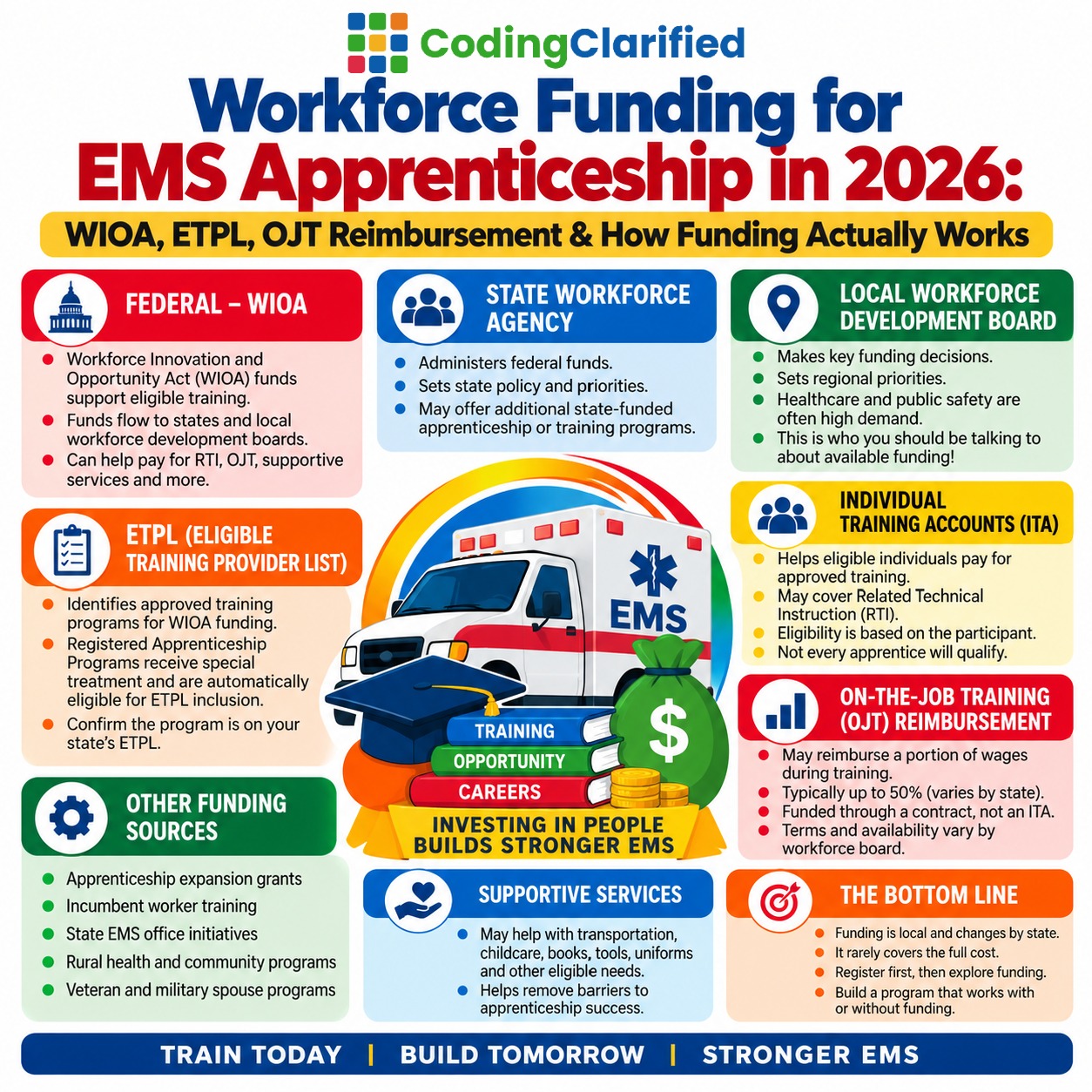
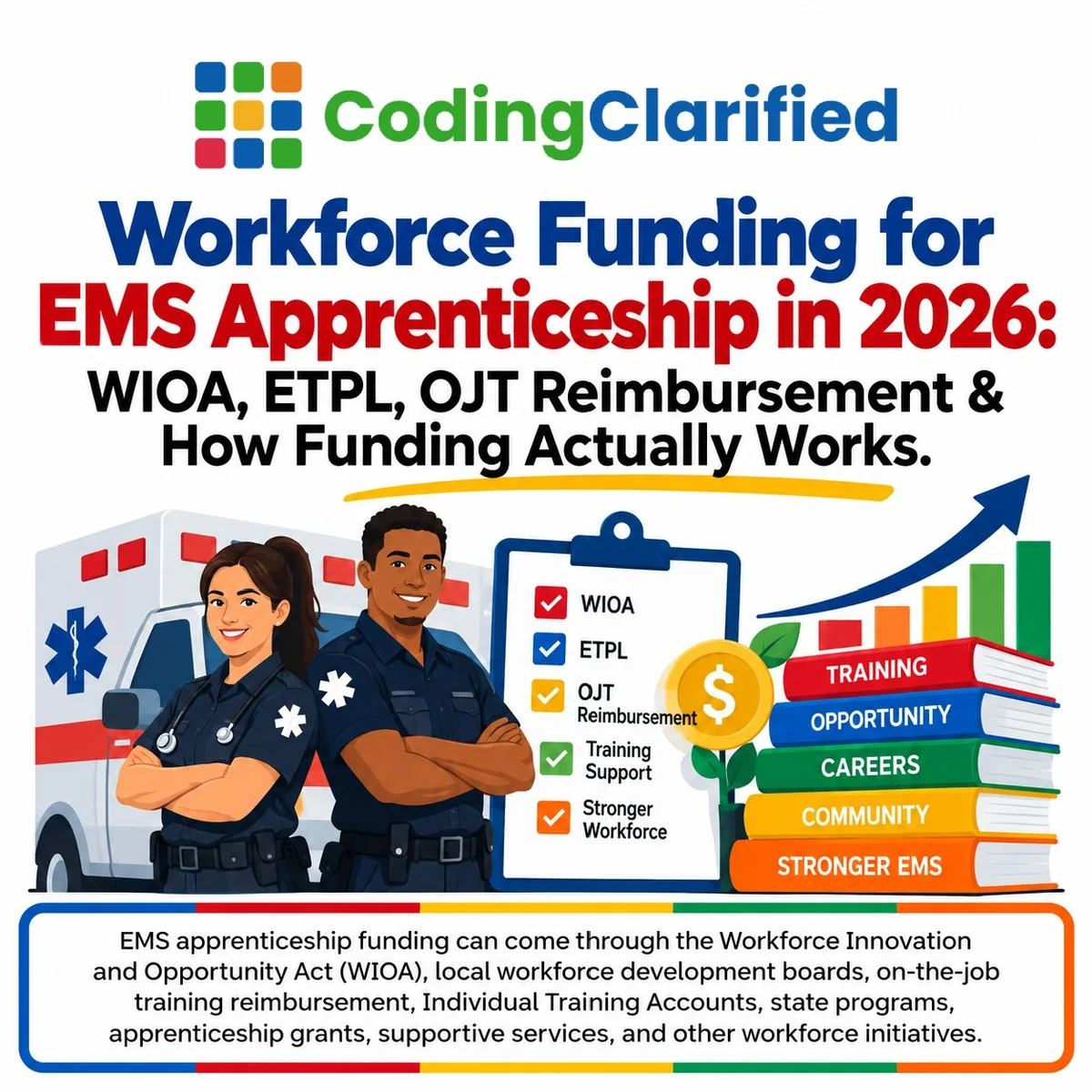
In 2026, EMS apprenticeship funding can come through the Workforce Innovation and Opportunity Act (WIOA), local workforce development boards, on-the-job training reimbursement, Individual Training Accounts, state programs, apprenticeship grants, supportive services, and other workforce initiatives. Yet, funding is not automatic simply because an agency hires EMTs or paramedics.
Instead, EMS agencies need to understand how Registered Apprenticeship connects to the public workforce system, who controls the money, and which funding mechanisms may apply to individual apprentices.
That distinction matters because workforce funding usually does not operate like a grant check written directly to an EMS agency. Rather, different funding streams may pay or reimburse specific allowable costs.
For EMS leaders trying to recruit EMTs, develop paramedics, and reduce turnover, understanding this system can turn apprenticeship funding from a vague possibility into a practical workforce strategy.
Key Takeaways: EMS Apprenticeship Funding in 2026
- Registered Apprenticeship can open access to workforce funding opportunities that may not be available to informal employer training programs.
- WIOA funding is allocated to states and generally administered through state and local workforce systems.
- Local Workforce Development Boards often make important decisions about how WIOA funds are used in their regions.
- WIOA may help pay for Related Technical Instruction (RTI), on-the-job training (OJT), supportive services, recruitment, and other eligible apprenticeship costs.
- Registered Apprenticeship Programs receive special treatment within the Eligible Training Provider List (ETPL) system.
- Individual Training Accounts generally depend on the eligibility of the individual participant, not simply the employer.
- OJT funding normally operates through a contract with the workforce system rather than through an Individual Training Account.
- Funding amounts, priorities, eligibility rules, and availability can vary by state, workforce area, participant, and funding cycle.
- EMS agencies should never build an apprenticeship budget that assumes workforce funding will cover every apprentice or every expense.
- In 2026, the strongest strategy is to combine a registered program, a documented hiring need, an established sponsor, and an early relationship with the local workforce board.
What Is Workforce Funding for an EMS Apprenticeship?
Workforce funding refers to public funds used to help people prepare for employment, develop occupational skills, enter in-demand careers, or advance within the workforce.
For EMS agencies, those funds may potentially support EMT or paramedic apprenticeships.
However, there is an important difference between saying funding can support an apprenticeship and saying an employer will receive funding.
According to the U.S. Department of Labor, WIOA funds may support several components of Registered Apprenticeship, including instructional training, tuition, OJT expenses, supportive services, and recruitment. Nevertheless, actual funding decisions occur at the state and local levels.
Therefore, an EMS agency should treat funding as a potential cost-offset strategy rather than guaranteed revenue.
Start With Registered Apprenticeship Before Seeking Funding
The first major distinction is whether the EMS training pathway is a Registered Apprenticeship Program.
Registered Apprenticeship is an industry-driven workforce model approved by the U.S. Department of Labor or a recognized State Apprenticeship Agency. Moreover, the model combines paid employment, structured on-the-job learning, mentorship, related instruction, progressive wages, and a nationally recognized credential.
An EMS agency can certainly operate an excellent internal training program without registering it.
Still, registration provides access to specific federal and state workforce benefits, including potential funding opportunities and special treatment within the WIOA workforce system.
For a complete explanation of the model, read EMS Registered Apprenticeship Programs in 2026: How EMT & Paramedic Apprenticeships Actually Work.
Who Actually Controls WIOA and Apprenticeship Funding?
One reason apprenticeship funding feels confusing is that several organizations may participate in the process.
Understanding each role can save an EMS administrator weeks of calling the wrong office.
Federal Government
The Workforce Innovation and Opportunity Act creates the federal framework for many workforce programs.
WIOA Title I supports eligible adults, dislocated workers, and youth, among other workforce activities. Additionally, federal apprenticeship grants and other initiatives may periodically create separate funding opportunities.
However, an EMS agency usually should not begin by calling Washington and asking for its share of WIOA money.
State Workforce Agency
States receive federal workforce allocations and operate their workforce systems under federal and state requirements.
Additionally, some states fund their own apprenticeship, incumbent-worker, healthcare workforce, rural workforce, or employer-training initiatives.
Consequently, two EMS agencies in different states may encounter very different opportunities even when both participate in Registered Apprenticeship.
Local Workforce Development Board
For most EMS employers, the local Workforce Development Board is one of the most important relationships to establish.
Local boards help direct workforce resources based on regional labor-market needs, employer demand, available funds, and local priorities. Furthermore, they work with employers and workforce partners to address shortages in specific occupations and industries.
An EMS agency with 15 documented vacancies, expected retirements, high turnover, and a plan to hire apprentices presents a much stronger workforce case than an agency simply asking whether “free apprenticeship money” exists.
State Apprenticeship Agency or U.S. Department of Labor Office of Apprenticeship
These organizations handle Registered Apprenticeship oversight and registration, depending on the state.
They can also connect sponsors and employers with apprenticeship resources. In addition, apprenticeship-specific grants or expansion initiatives may flow through state agencies, intermediaries, or other funded organizations.
How Can WIOA Pay for an EMS Apprenticeship?
WIOA can interact with Registered Apprenticeship in several ways.
However, employers should understand which expense each mechanism addresses.
1. Individual Training Accounts
An Individual Training Account, commonly called an ITA, can help eligible individuals pay for approved occupational training.
In an apprenticeship setting, an ITA may potentially help fund Related Technical Instruction.
However, eligibility generally attaches to the individual participant. Therefore, an EMS employer should not assume every newly hired apprentice will qualify for an ITA.
The participant must meet applicable WIOA requirements, while the training must satisfy workforce-system requirements.
2. Related Technical Instruction
Registered Apprenticeship combines workplace learning with Related Technical Instruction, commonly called RTI.
Depending on the program and funding arrangement, WIOA may help eligible apprentices pay for that instruction. Additionally, cohort training contracts may sometimes provide another route for delivering training to multiple participants.
For EMS employers, RTI can include structured occupational education that supports the competencies required under the registered program.
3. On-the-Job Training Reimbursement
OJT funding can be especially attractive to employers because it may reimburse part of an eligible participant’s wages during a defined training period.
Federal apprenticeship guidance explains that OJT is funded through contracts rather than Individual Training Accounts. Moreover, federal resources describe a typical reimbursement level of 50% of the apprentice’s wage rate, although actual reimbursement terms can vary.
That last point is critical.
An EMS agency should never advertise a specific wage reimbursement percentage until the applicable workforce partner confirms it for that employer, participant, and contract.
4. Supportive Services
Training costs are not the only barriers that can prevent an apprentice from succeeding.
Transportation, childcare, books, tools, uniforms, and other eligible needs can create serious obstacles for workers entering training. Therefore, WIOA supportive services may help qualifying participants overcome some of those barriers.
For an EMS apprenticeship, this support can be particularly important for entry-level workers who are trying to work, attend training, and manage family responsibilities simultaneously.
5. Incumbent Worker and Customized Training
Some workforce boards also use funding for incumbent-worker or customized training.
These mechanisms can work differently from ITAs and traditional OJT. Consequently, an EMS agency developing existing employees should ask specifically whether incumbent-worker or customized-training resources are available locally.
For example, an agency developing current EMTs toward higher-level occupational skills may have a different funding conversation than an employer recruiting people who are unemployed.
What Is the ETPL and Why Does It Matter for Funding?
The Eligible Training Provider List, or ETPL, identifies training programs eligible to participate in certain WIOA-funded training activities.
However, Registered Apprenticeship receives special treatment.
Under federal WIOA guidance, Registered Apprenticeship Programs are automatically eligible for inclusion on a state’s ETPL and must have an opportunity to consent to inclusion. States still maintain processes for placing registered programs on the list and verifying their registration status.
That distinction is important because a Registered Apprenticeship sponsor does not necessarily follow the same initial eligibility process as a traditional training provider.
Still, employers should confirm that the applicable program appears where it needs to appear before promising an apprentice that WIOA will pay for RTI.
In short, registration creates eligibility pathways, but it does not automatically create an approved payment for every apprentice.
EMS Apprenticeship Funding Is Local
This may be the most important practical lesson in this article.
Two EMS agencies located 100 miles apart may receive different answers about workforce funding.
Why?
Local boards have different budgets, priorities, employer needs, participant populations, existing contracts, and remaining funds. Likewise, workforce priorities can change from one program year to another.
Healthcare and public safety workforce shortages may create opportunities in one area. Meanwhile, another region may have committed much of its available funding elsewhere.
As a result, anyone promising an EMS employer a guaranteed reimbursement without first identifying the state, workforce area, participant eligibility, and current funding source is skipping important steps.
A Practical 7-Step EMS Apprenticeship Funding Strategy
Step 1: Define Your Hiring Need
Start with numbers.
Determine how many EMTs or paramedics you expect to hire, which occupations you need, expected starting wages, anticipated vacancies, turnover, and your hiring timeline.
Furthermore, calculate how much current turnover costs the organization.
Our guide, EMS Turnover Costs in 2026: The Retention Math Every EMS Agency Should Run, can help agencies evaluate those costs.
Step 2: Connect the Jobs to a Registered Apprenticeship
Next, determine whether your agency will sponsor its own program or participate through an existing Registered Apprenticeship sponsor.
For many EMS organizations, joining an established program can reduce administrative work because the sponsor already maintains registered standards and program infrastructure.
Additionally, clarify who will provide RTI, track apprentice progress, manage records, and coordinate registration.
Step 3: Contact Your Local Workforce Development Board
Do this early.
Explain that your agency has an actual hiring need and wants to discuss workforce support for a Registered Apprenticeship Program.
More importantly, ask for the staff member who works with employers, Registered Apprenticeship, healthcare, public safety, OJT, or business services.
Step 4: Ask About Every Applicable Funding Mechanism
Do not ask only, “Do you have apprenticeship funding?”
Instead, ask about WIOA ITAs, OJT contracts, supportive services, incumbent-worker training, customized training, apprenticeship grants, state workforce programs, and other employer incentives.
Different funding streams have different rules. Therefore, one “no” does not necessarily mean that no workforce assistance exists.
Step 5: Verify Participant Eligibility Before Promising Funding
An available program does not mean every apprentice qualifies.
Some workforce funding depends heavily on participant eligibility. Thus, build a referral and eligibility-screening process with the workforce partner before telling employees what assistance they will receive.
This step protects the employer, apprentice, sponsor, and workforce board.
Step 6: Document Outcomes
Track enrollment, training completion, competency progression, wage increases, retention, credentials, and other relevant workforce outcomes.
Funding partners need data. Moreover, EMS leadership needs the same information to determine whether apprenticeship is actually improving workforce performance.
Step 7: Maintain the Relationship
Workforce funding is cyclical.
Money can become available, become fully committed, and then reopen during another funding period. Therefore, agencies should stay connected with their local board rather than making one phone call and disappearing for two years.
How Advanced Standing Can Affect the Funding Conversation
Experienced EMTs create another important consideration.
An employee entering an apprenticeship with years of documented experience may qualify for advanced standing when permitted under the registered program’s approved policy.
In 2026, updated federal apprenticeship guidance makes this especially relevant because sponsors have greater clarity around recognizing prior experience and competency.
However, funding and advanced standing are separate questions.
A sponsor may recognize previous experience for apprenticeship progression, while the workforce board separately determines what training or OJT expenses qualify for funding.
For more detail, read EMS Apprenticeship Advanced Standing in 2026: Why Experienced EMTs Shouldn’t Start at Hour Zero.
What Changed With EMS Apprenticeship Funding in 2026?
EMS leaders should avoid relying on apprenticeship presentations or funding information from several years ago.
First, federal apprenticeship guidance continues to emphasize Registered Apprenticeship as a workforce-development strategy. Additionally, the Department of Labor maintains current information about WIOA, open funding opportunities, active apprenticeship investments, and state tax or tuition-support programs.
In 2026, federal apprenticeship investments continue to change by occupation and initiative. Therefore, EMS agencies should check current opportunities rather than assuming that a national grant advertised for another industry applies to EMT or paramedic apprenticeships.
Most importantly, the underlying funding principle remains the same: WIOA can support Registered Apprenticeship, but state and local workforce partners make critical funding decisions.
Where Does the Sponsor Fit Into Apprenticeship Funding?
A sponsor can remove a substantial amount of administrative burden from an EMS employer.
Depending on the program structure, the sponsor may maintain apprenticeship standards, register apprentices, maintain required records, oversee program compliance, coordinate RTI, track progression, and work with workforce partners.
Meanwhile, the EMS agency provides something the sponsor cannot provide alone: actual jobs.
The employer hires apprentices, pays wages, provides supervised workplace experience, supplies mentors or preceptors, and supports occupational development.
Consequently, one of the most effective funding conversations can involve three parties at the same table:
The EMS employer + the Registered Apprenticeship sponsor + the local workforce partner.
The employer explains the workforce need. Next, the sponsor explains the registered training structure. Finally, the workforce partner identifies which current programs may support eligible participants or costs.
That approach is far more productive than asking each organization separate questions without connecting the pieces.
Common Mistakes to Avoid With EMS Apprenticeship Funding
Mistake #1: Assuming Registration Guarantees Money
Registered Apprenticeship creates access to funding opportunities, but it does not guarantee funding.
Instead, availability depends on the specific program, participant, workforce area, eligibility rules, and current budget.
Mistake #2: Promising a Specific Wage Reimbursement
OJT reimbursements can offset employer training costs.
However, actual percentages and contract terms vary. Therefore, confirm the arrangement before including a reimbursement amount in a budget or recruitment offer.
Mistake #3: Assuming Every Apprentice Qualifies for WIOA
Participant eligibility matters.
Even when an employer and apprenticeship program qualify to participate, individual apprentices may have different eligibility outcomes.
Mistake #4: Waiting Until After Hiring to Contact the Workforce Board
Early coordination creates more options.
For example, workforce staff may need to determine participant eligibility or establish an OJT contract before certain activities begin.
Mistake #5: Building a Program That Cannot Survive Without Subsidies
Workforce funding should strengthen the apprenticeship model, not become its only financial foundation.
Funding cycles change. Consequently, employers should understand the underlying return on recruitment, training, productivity, and retention even without a temporary incentive.
Mistake #6: Ignoring Reporting Requirements
Public funding comes with documentation requirements.
Build tracking into the program from the beginning so outcome reporting becomes routine rather than a last-minute project.
Mistake #7: Treating Funding as the Workforce Strategy
Money does not fix a poorly designed apprenticeship.
Instead, strong recruitment, structured training, competent preceptors, wage progression, employee support, and retention practices create the workforce strategy. Funding simply helps offset some of the cost.
CPC Student Tip: Understand WIOA vs. Medicare Funding
CPC students should keep workforce funding separate from healthcare reimbursement.
WIOA supports workforce development and training. In contrast, Medicare payment for ambulance services operates through the Centers for Medicare & Medicaid Services and depends on applicable coverage, billing, documentation, and medical-necessity rules.
Therefore, WIOA apprenticeship reimbursement has nothing to do with selecting an ambulance HCPCS code, reporting a diagnosis, or establishing Medicare medical necessity.
For an example of the reimbursement side of EMS operations, read Why a Clinically Justified Ambulance Transport Still Gets Denied in 2026: EMS Medical Necessity Documentation.
Authoritative Resources for EMS Apprenticeship Funding
EMS agencies should use current federal and state sources when evaluating workforce funding.
Start with Apprenticeship.gov’s WIOA resources for information about RTI, ITAs, OJT, supportive services, and local workforce partners.
Next, review the U.S. Department of Labor for WIOA policy and workforce guidance. Employers can also use Apprenticeship.gov to locate Registered Apprenticeship resources, current funding opportunities, state assistance, and apprenticeship partners.
For Medicare ambulance coverage and reimbursement questions, use the Centers for Medicare & Medicaid Services. However, remember that CMS reimbursement and workforce-development funding serve completely different purposes. Learn more about About Coding Clarified.
Frequently Asked Questions About EMS Apprenticeship Funding in 2026
Can WIOA pay for an EMT or paramedic apprenticeship?
Potentially, yes. WIOA may support eligible Registered Apprenticeship costs such as RTI, OJT, supportive services, and other qualifying workforce activities. However, availability and eligibility vary by state, local workforce area, participant, and funding cycle.
Does an EMS agency automatically receive money for registering an apprenticeship?
No. Registration can create access to workforce funding opportunities, but it does not guarantee a grant, reimbursement, or payment.
Can WIOA reimburse an EMS agency for apprentice wages?
Potentially. OJT contracts may reimburse an employer for part of eligible training-related wage costs. Nevertheless, the local workforce partner must determine eligibility and establish the applicable contract and reimbursement terms.
Does every apprentice qualify for an Individual Training Account?
No. ITA eligibility generally depends on the individual participant and applicable WIOA requirements. Additionally, the training program must meet the requirements for WIOA-funded training.
Does a Registered Apprenticeship have to be on the ETPL?
Registered Apprenticeship Programs receive special treatment under WIOA and are automatically eligible for ETPL inclusion. However, sponsors should work through the applicable state process and confirm their program’s listing before relying on ITA funding.
Who should an EMS agency contact first about apprenticeship funding?
A local Workforce Development Board or American Job Center is an excellent starting point. Specifically, ask for the employer or business-services representative who handles Registered Apprenticeship, healthcare, public safety, OJT, or workforce training.
Can an experienced EMT receive workforce funding if the apprenticeship grants advanced standing?
Possibly. Advanced standing and workforce-funding eligibility involve separate decisions. The apprenticeship sponsor determines appropriate advanced standing under its registered standards, while the workforce partner determines eligibility for WIOA or other funding.
Is EMS apprenticeship funding guaranteed from year to year?
No. Funding priorities, allocations, available balances, grants, eligibility requirements, and local policies can change. Therefore, EMS agencies should design sustainable apprenticeship programs that can operate without assuming a specific subsidy will always remain available.
The Bottom Line: Fund the Workforce Strategy, Not Just the Training
EMS apprenticeship funding is not a single pot of federal money waiting for an ambulance service to claim it.
Instead, it is a network of workforce programs that can potentially support eligible workers, training, wages, supportive services, and employer workforce development.
Registered Apprenticeship provides an important gateway into that system. However, the strongest EMS agencies will go beyond registration.
They will bring a documented hiring need, establish relationships with local workforce partners, screen apprentices for available programs, track outcomes, understand the real cost of turnover, and build an apprenticeship model that remains financially sustainable even when funding changes.
In 2026, that approach matters more than chasing the latest grant announcement.
Coding Clarified maintains Registered Apprenticeship pathways in Medical Coder, EMT, and Paramedic and works with employers to connect registered apprenticeship structure with workforce-development opportunities. If your EMS agency wants to explore what may be available in your state or workforce area, a coordinated conversation between the employer, apprenticeship sponsor, and local workforce board is often the most productive place to start.
Read next: EMS Turnover Costs in 2026: The Retention Math Every EMS Agency Should Run
This article provides general information about workforce funding and Registered Apprenticeship. It does not guarantee funding, reimbursement, tax credits, participant eligibility, or program approval. Funding programs, amounts, eligibility requirements, and availability can change by state, workforce area, participant, and funding cycle.
Coding Clarified LLC is a U.S. Department of Labor Registered Apprenticeship sponsor with registered apprenticeship pathways in Medical Coder, EMT, and Paramedic. Coding Clarified is also an AAPC-affiliated training provider and provides EMS documentation training and QA/QI support.