EMS agencies across the United States continue to face a difficult workforce problem in 2026: recruiting qualified employees is hard, training new providers is expensive, and keeping experienced EMTs and paramedics can be even harder.
However, there is another way to build an EMS workforce.
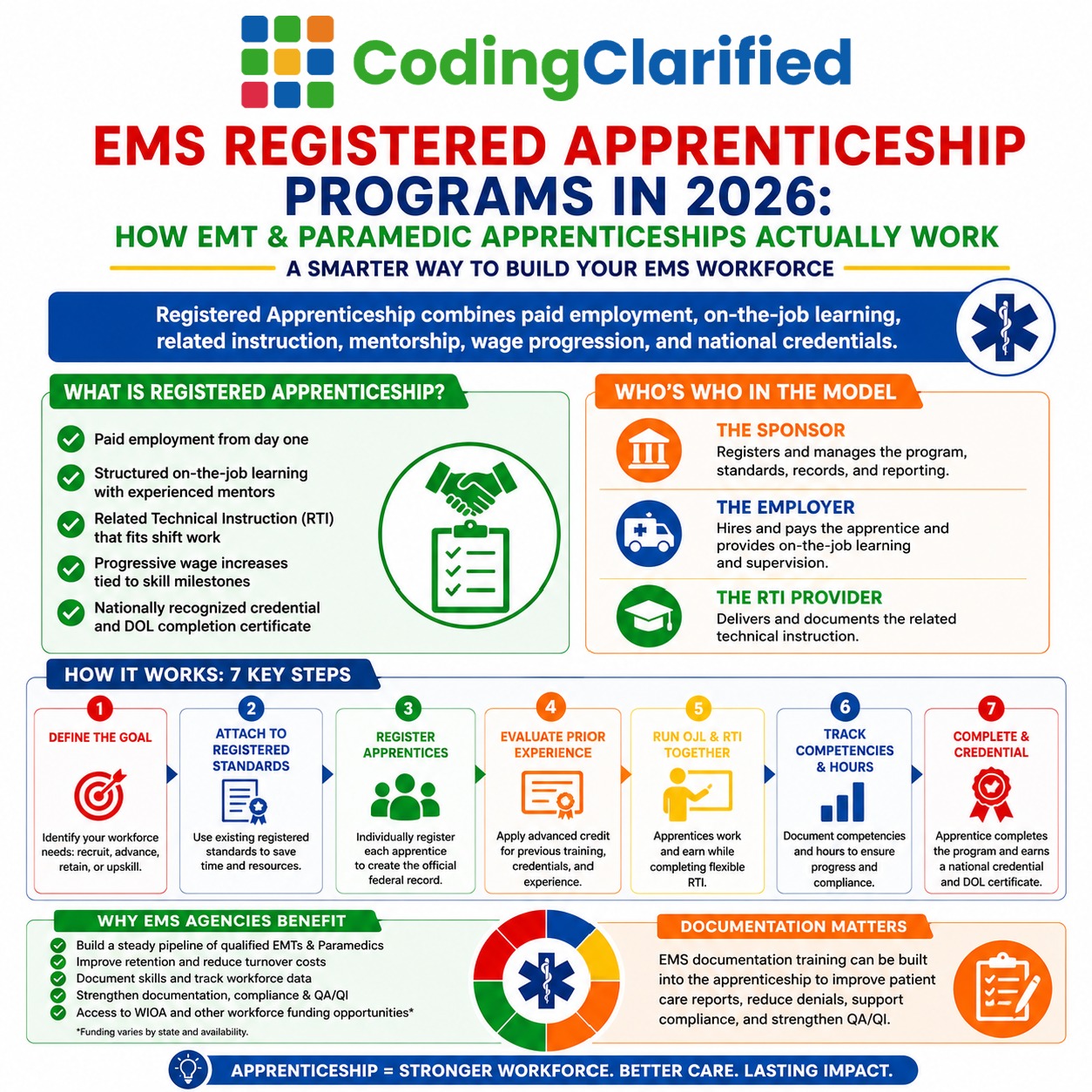
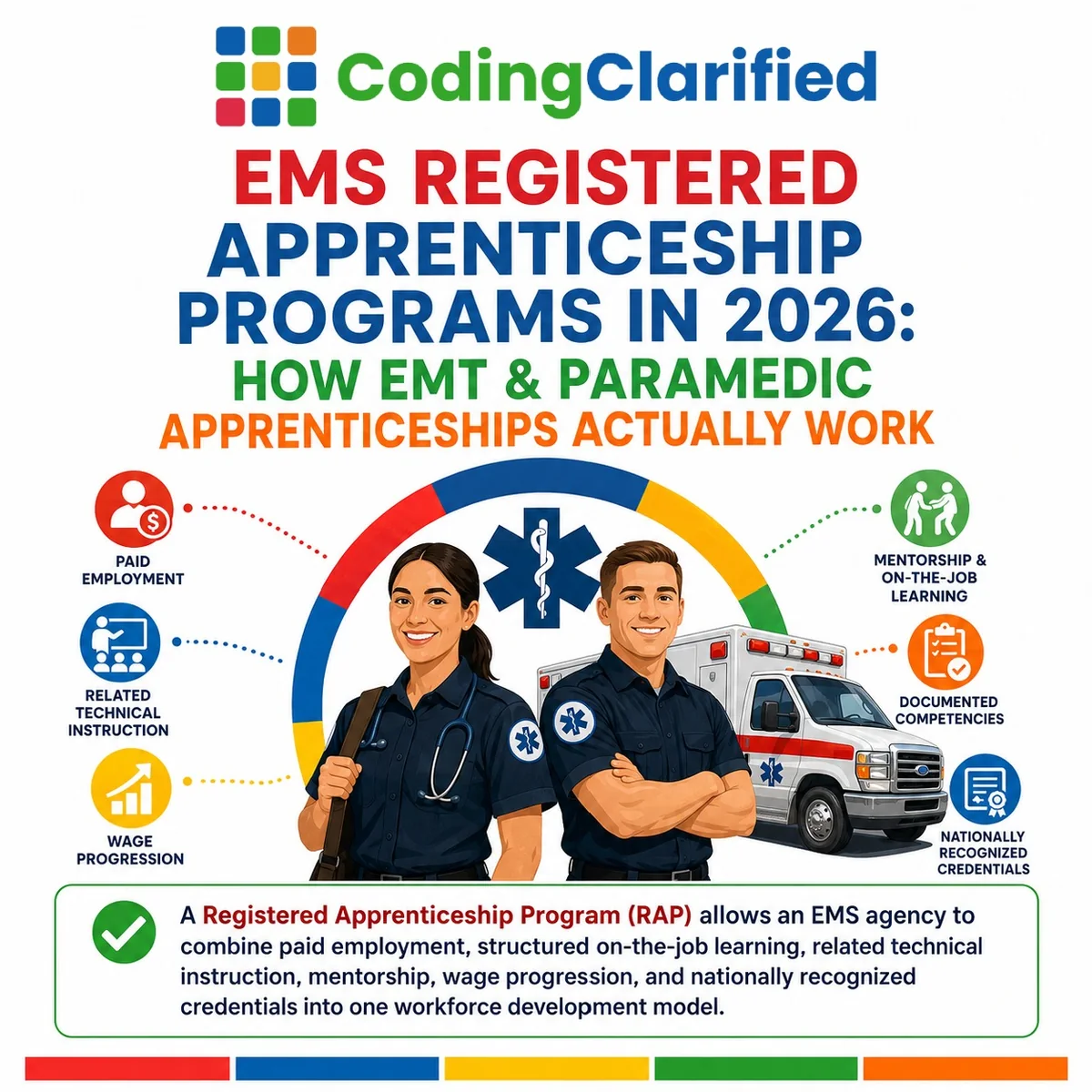
A Registered Apprenticeship Program (RAP) allows an EMS agency to combine paid employment, structured on-the-job learning, related technical instruction, mentorship, wage progression, and nationally recognized credentials into one workforce development model.
Registered apprenticeship is not limited to construction or skilled trades. In fact, the U.S. Department of Labor’s Apprenticeship.gov healthcare resources identify Emergency Medical Technician/Paramedic among high-demand healthcare apprenticeship occupations.
For EMS agencies, therefore, apprenticeship can provide a structured way to recruit new people, develop existing employees, document competency, and create a stronger long-term workforce pipeline.
Key Takeaways: EMS Registered Apprenticeships in 2026
- Registered apprenticeship combines paid employment, on-the-job learning, mentorship, related instruction, wage progression, and credentials.
- EMT and Paramedic are recognized healthcare apprenticeship occupations.
- Apprentices work for an employer while completing structured training.
- An existing registered sponsor can reduce the administrative work required for an EMS agency to participate.
- Prior education, credentials, and experience may qualify for advanced standing when permitted under the registered program’s policies.
- EMS documentation training can become a measured competency instead of a one-time classroom lecture.
- Registered apprenticeship creates useful workforce data, including competency progress, training completion, wage progression, and retention.
- WIOA and other workforce funding may help support eligible apprenticeship activities, although funding varies by state, workforce area, participant, and current funding availability.
- In 2026, EMS agencies should evaluate apprenticeship as both a training strategy and a workforce retention strategy.
What Is an EMS Registered Apprenticeship Program?
A Registered Apprenticeship Program is an employer-driven workforce training model registered with the U.S. Department of Labor or a recognized State Apprenticeship Agency.
According to Apprenticeship.gov, Registered Apprenticeship programs include several core elements: a paid job, structured on-the-job learning and mentorship, supplemental education, progressive wages, and a nationally recognized credential.
Consequently, an EMS apprenticeship is very different from simply paying someone’s tuition for EMT or paramedic school.
The apprentice is an employee.
They work, earn wages, complete structured training, receive mentorship, and advance through an established program.
For agencies struggling to build a reliable pipeline of EMTs and paramedics, that difference matters.
How Does an EMT or Paramedic Apprenticeship Work?
Although program designs can vary, a Registered Apprenticeship normally combines several major components.
Paid Employment
First, the apprentice holds a paid job.
The employer hires the apprentice and places that person into the registered training structure. Therefore, apprenticeship can create an earn-while-you-learn pathway for people who cannot afford to leave the workforce while completing career training.
This feature may also help EMS agencies reach candidates who would otherwise never enter the profession.
Structured On-the-Job Learning
Next, apprentices develop skills while performing supervised work.
EMS agencies already understand this concept because field training and preceptorship have always played major roles in provider development. However, Registered Apprenticeship formalizes that process.
Instead of simply saying someone completed field training, the program identifies the skills the apprentice must learn and documents progress toward proficiency.
Related Technical Instruction
Registered Apprenticeship also includes Related Technical Instruction, commonly called RTI.
RTI provides the classroom, technical, theoretical, and credential-preparation portion of apprenticeship.
The U.S. Department of Labor clarified its Registered Apprenticeship training approaches in 2026 and notes that related instruction may occur through classroom instruction, electronic media, correspondence courses, or other approved formats.
Federal regulations recommend 144 hours of related instruction for each year of apprenticeship, although the exact registered program requirements matter.
For EMS, flexible RTI delivery is especially important because a traditional Monday-through-Friday classroom schedule may not work well for employees working rotating shifts.
Progressive Wage Increases
Registered Apprenticeship also requires a progressive wage structure.
As apprentices gain skills and advance through established milestones, their compensation increases according to the program’s registered wage schedule.
As a result, apprentices can see a defined path from entry-level training toward occupational proficiency.
Coding Clarified EMT and Paramedic Apprenticeships at a Glance
Coding Clarified sponsors two U.S. Department of Labor Registered Apprenticeship programs for EMS. Both are competency based and designed for newly certified EMTs and paramedics who are building field skills with an employer partner.
| EMT Apprenticeship | Paramedic Apprenticeship | |
|---|---|---|
| On the job learning | 2,000 hours (about 1 year) | 4,000 hours (about 2 years) |
| Related instruction | 144 hours, delivered by Coding Clarified | 144 hours per 2,000 on the job hours, delivered by Coding Clarified |
| Mentorship | 1 apprentice to 1 journeyworker | 1 apprentice to 1 journeyworker |
| Wages | Progressive, from about 83% to 100% of the journeyworker rate | Four step progression, from about 83% to 100% of the journeyworker rate |
What EMT Apprentices Do on the Job
- Ambulance operation and vehicle readiness
- Decontamination and infection control
- Safe patient transport and ambulance driving
- Scene reporting, notification, and communication
- Patient care under journeyworker supervision
What Coding Clarified Teaches in Related Instruction
- PCR documentation training built for the EMT level
- Medical necessity and CMS compliance fundamentals
- QA/QI participation with coaching on real charts
Who Is Eligible
Apprentices must be 18 or older, hold a high school diploma or GED, and have the physical capability the role requires. Each apprenticeship begins with a 90 day probationary period. Experienced EMTs may qualify for credit toward the program; see advanced standing for experienced EMTs and paramedics.
How to Apply
Apprenticeships are hosted by employer partners. Candidates and EMS agencies can start on our Registered Apprenticeship programs page. Agencies looking to fund a program should read workforce funding for EMS apprenticeship.
Who Is Responsible for an EMS Apprenticeship?
One of the most confusing parts of Registered Apprenticeship involves understanding who does what.
Generally, three parties play major roles.
The Registered Apprenticeship Sponsor
The sponsor maintains the Registered Apprenticeship Program.
Among other responsibilities, the sponsor manages program standards, apprentice registration, records, compliance, and required reporting.
An individual EMS agency can potentially become a sponsor. However, building and maintaining an entire registered program requires administrative resources.
Therefore, joining an established program can offer another option.
The EMS Employer
The employer hires and pays the apprentice.
Additionally, the employer provides the workplace where the apprentice completes structured on-the-job learning and receives supervision and mentorship.
Under an appropriate group apprenticeship structure, an EMS employer may participate under an existing sponsor’s registered standards rather than developing a completely separate program.
The RTI Provider
Finally, the RTI provider delivers and documents the related technical instruction.
Depending on the program, the sponsor and RTI provider may be the same organization or separate organizations.
Coding Clarified serves as a Registered Apprenticeship sponsor and provides RTI for its registered apprenticeship pathways, including Medical Coder, EMT, and Paramedic.
How an EMS Agency Can Start an Apprenticeship Program
For an EMS leader, the process should begin with the workforce problem rather than the paperwork.
Step 1: Identify the Workforce Goal
First, determine what the agency wants the apprenticeship to accomplish.
For example, is the goal to:
- Recruit people who are completely new to EMS?
- Develop EMTs into paramedics?
- Improve employee retention?
- Create a stronger field training system?
- Build leadership or documentation competencies?
- Create alternative career paths for experienced field personnel?
Each goal can affect the apprenticeship design.
Step 2: Connect With Registered Standards
Next, the employer needs an approved apprenticeship structure.
An agency may develop its own program or, when available and appropriate, work with an existing sponsor.
The U.S. Department of Labor Registered Apprenticeship Program provides additional information for employers interested in developing apprenticeship opportunities.
Step 3: Register Eligible Apprentices
After the employer joins the program, eligible employees can enter the apprenticeship according to the sponsor’s standards.
Individual apprentice registration creates the official apprenticeship record.
Important information can include the apprentice’s occupation, start date, wage information, previous experience, and other required program data.
Step 4: Evaluate Prior Experience and Advanced Standing
This step is particularly important in EMS.
A new employee with no EMS background should not necessarily follow the exact same path as an experienced EMT moving into a paramedic role.
Federal apprenticeship guidance allows registered programs to establish policies for advanced standing based on previous experience, training, or demonstrated competencies.
However, sponsors must document the basis for advanced standing and follow their registered policies.
Therefore, agencies should evaluate existing credentials and experience early rather than automatically treating every apprentice as a beginner.
Step 5: Run OJL and RTI Together
Next, the apprentice works while completing related instruction.
This parallel structure is one of the biggest advantages of apprenticeship.
Instead of completing education first and hoping the employee later connects classroom material to field operations, the apprentice can apply new knowledge directly in the workplace.
Meanwhile, preceptors and supervisors can identify weaknesses that RTI instructors can address.
Step 6: Document Competency
Apprenticeship requires structure.
Consequently, agencies need a reliable process for recording completed competencies, training, instruction, wage progression, and other required milestones.
This documentation also gives leaders something EMS organizations often lack: a clear picture of where each developing employee stands.
Step 7: Complete the Program
Finally, apprentices who satisfy their registered program requirements complete the apprenticeship and earn the applicable completion credential.
Rather than simply documenting that an employee attended training, the agency now has evidence that the employee completed a structured workforce development pathway.
Time-Based vs. Competency-Based EMS Apprenticeships
Not every Registered Apprenticeship measures progress in exactly the same way.
Programs can use time-based, competency-based, or hybrid approaches.
A time-based program focuses heavily on completing a defined number of on-the-job learning hours. In contrast, a competency-based program focuses on whether the apprentice demonstrates the required occupational competencies.
For EMS, competency-based or hybrid approaches can offer important advantages.
For example, an experienced EMT entering a paramedic pathway may already demonstrate many workplace competencies. Meanwhile, someone completely new to EMS may need considerably more development.
Therefore, competency measurement can help programs recognize differences between apprentices while maintaining defined standards.
Why Documentation Training Belongs in EMS Apprenticeship
EMS documentation often receives far less attention during initial education than clinical skills.
However, documentation affects patient care, continuity of care, compliance, reimbursement, audits, medical necessity review, QA/QI, and legal risk.
A provider may deliver excellent care but create a patient care report that does not clearly demonstrate what happened.
For example, the PCR may fail to document reassessment after an intervention. Likewise, the provider may omit important monitoring, response to treatment, medical necessity, or details supporting the transport decision.
Registered apprenticeship provides an opportunity to address this problem earlier.
Instead of treating documentation as a single lecture, an EMS apprenticeship can incorporate documentation into measurable workforce competencies.
Apprentices can practice chart review, receive feedback, correct documentation weaknesses, and demonstrate improvement.
For a deeper look at this issue, read EMS Documentation Training & QA/QI in 2026: How Better Patient Care Reports Reduce Denials and Protect EMS Agencies.
How Apprenticeship Data Can Help EMS Agencies
Registered apprenticeship also creates structured workforce information.
For example, program leaders can monitor competency progress, related instruction, wage milestones, expected completion, and overall apprentice development.
Additionally, agencies can evaluate completion and retention by cohort.
That information can answer important questions:
Which apprentices are progressing?
Where are apprentices struggling?
Which competencies consistently take longer?
Are preceptors applying standards consistently?
How many apprentices complete the program?
How many remain employed afterward?
Furthermore, EMS organizations that combine apprenticeship with documentation QA/QI can monitor documentation improvement over time.
That turns education into measurable workforce development rather than an annual training requirement that disappears once employees leave the classroom.
Can WIOA Help Fund EMS Registered Apprenticeships?
Potentially.
The federal Workforce Innovation and Opportunity Act programs support workforce preparation, training, and work-based learning through the public workforce system.
Registered Apprenticeship Programs also receive special treatment within the WIOA Eligible Training Provider framework. However, the specific funding available to an employer or apprentice depends on the state, local workforce board, participant eligibility, program design, available funds, and current policies.
Therefore, EMS leaders should avoid assuming that every apprenticeship automatically comes with a specific reimbursement amount.
Instead, talk with the local workforce development board or American Job Center about available funding.
Funding opportunities may include support connected with training, eligible participants, on-the-job training, supportive services, apprenticeship initiatives, or state-specific programs.
The key point is simple: registration creates access to workforce-development conversations that an informal training program may not qualify for.
EMS Apprenticeships and Medical Coding Career Pathways
Another opportunity deserves attention.
Not every experienced EMS professional will remain in field operations for an entire career.
Some eventually want a healthcare career that uses their knowledge of anatomy, medical terminology, documentation, payer requirements, and patient care without requiring field work.
Medical coding can provide one possible pathway.
Medical Coder is also an established healthcare apprenticeship occupation. In fact, Apprenticeship.gov published a 2026 success story describing a participant who used Registered Apprenticeship to transition into a full-time medical coding position.
Coding Clarified also operates a Medical Coding Registered Apprenticeship pathway for participating employers.
For additional information, employers can review our Medical Coding Apprenticeship Employer FAQs.
Students and career changers can also read our Medical Coding Apprenticeship FAQ and Medical Coding Internship in 2026 guides.
Common Mistakes to Avoid With EMS Apprenticeships
Mistake #1: Treating Apprenticeship Like Tuition Assistance
Paying for EMT or paramedic school does not automatically create a Registered Apprenticeship.
Instead, apprenticeship requires a registered structure that combines employment, training, mentorship, wage progression, and other program requirements.
Mistake #2: Building the Program Before Defining the Problem
An agency should first decide whether it needs recruitment, advancement, retention, upskilling, or another workforce solution.
Otherwise, leaders may create a training program that does not solve their actual staffing problem.
Mistake #3: Ignoring Previous Experience
Experienced employees may qualify for advanced standing under the program’s approved policies.
Therefore, review previous credentials, education, and experience instead of automatically starting everyone from the same point.
Mistake #4: Separating Education From Field Performance
RTI should connect directly with workplace competency.
When supervisors identify a repeated weakness, instructors should know about it. Likewise, classroom instruction should translate into measurable workplace performance.
Mistake #5: Treating Documentation as an Afterthought
Strong clinical care and strong documentation should develop together.
As a result, PCR documentation, compliance, medical necessity, reassessment, and QA/QI should become part of the training structure rather than an annual reminder.
Mistake #6: Promising Funding Before Verifying Eligibility
WIOA and apprenticeship funding vary significantly.
Always verify current opportunities with the applicable workforce agency before quoting a reimbursement or incentive amount.
Why EMS Agencies Should Look at Registered Apprenticeship in 2026
Registered Apprenticeship gives EMS agencies something traditional recruitment alone cannot provide: a repeatable workforce development system.
Instead of repeatedly hiring people and hoping they stay, an agency can create a defined pathway from recruitment through training, competency development, wage progression, credentialing, and long-term employment.
Moreover, agencies can collect data along the way.
That information helps leaders understand what their workforce pipeline costs, where employees struggle, how quickly apprentices develop, and whether the program improves retention.
For agencies facing continuing workforce pressure in 2026, Registered Apprenticeship deserves consideration as more than a training program.
It can become a workforce strategy.
Coding Clarified works with EMS organizations through Registered Apprenticeship sponsorship, Related Technical Instruction, and EMS documentation QA/QI support. Agencies interested in an EMT, Paramedic, or Medical Coder apprenticeship pathway can contact Coding Clarified to discuss how an existing registered structure may fit their workforce needs.
Frequently Asked Questions About EMS Registered Apprenticeships
Quick answers to the questions EMS agencies ask most about registered apprenticeships.
Are EMT and Paramedic Registered Apprenticeship occupations?
Yes. Apprenticeship.gov currently lists Emergency Medical Technician/Paramedic among high-demand healthcare apprenticeship occupations. Registered programs still must follow their approved standards and applicable federal or state requirements.
Does an EMS apprentice get paid?
Yes. A Registered Apprenticeship includes paid employment. Apprentices are employees and receive wages while developing occupational skills.
Does an EMS agency have to create its own Registered Apprenticeship Program?
Not necessarily. An employer may develop its own program, but agencies may also be able to participate under an existing sponsor’s registered program when the sponsor’s structure and standards allow it.
Can experienced EMTs receive credit for previous experience?
Potentially. Registered programs may provide advanced standing for previous experience, education, training, or demonstrated competencies when allowed under their approved policies. However, sponsors must document and support those decisions.
How much Related Technical Instruction does an apprenticeship require?
Federal regulations recommend at least 144 hours of related instruction per year, although the actual requirements depend on the registered program standards and training approach.
Can WIOA pay for EMT or paramedic apprenticeship training?
WIOA may support eligible Registered Apprenticeship activities, but funding is not automatic. Availability depends on the state, local workforce development board, participant eligibility, available funding, and program structure. Employers should verify current opportunities with their local workforce system.
Can documentation training be included in an EMS apprenticeship?
Yes, when it fits the program’s registered standards and training plan. Documentation competency can complement clinical training by teaching apprentices how to create complete, defensible patient care reports and respond to QA/QI feedback.
Can EMS professionals transition into medical coding through apprenticeship?
Yes, medical coding is another healthcare occupation that has been used in Registered Apprenticeship. For experienced EMS professionals interested in non-field healthcare careers, coding and documentation-related roles may provide another career pathway.
Final Thoughts: Building a Stronger EMS Workforce Through Apprenticeship
EMS agencies cannot solve every workforce problem by posting more job openings.
Recruitment matters. However, developing and retaining employees matters just as much.
Registered Apprenticeship creates a structured way to bring those goals together through paid employment, supervised on-the-job learning, Related Technical Instruction, mentorship, progressive wages, documented competencies, and recognized credentials.
Most importantly, the structure gives agencies a way to measure whether workforce development is actually working.
In 2026, EMS leaders looking for sustainable solutions should consider a different question.
Instead of asking, “Where do we find more qualified people?”
Ask:
“How do we build them?”
Medical Coding Ambulance Services