Key Takeaways: EMS Documentation and QA/QI in 2026
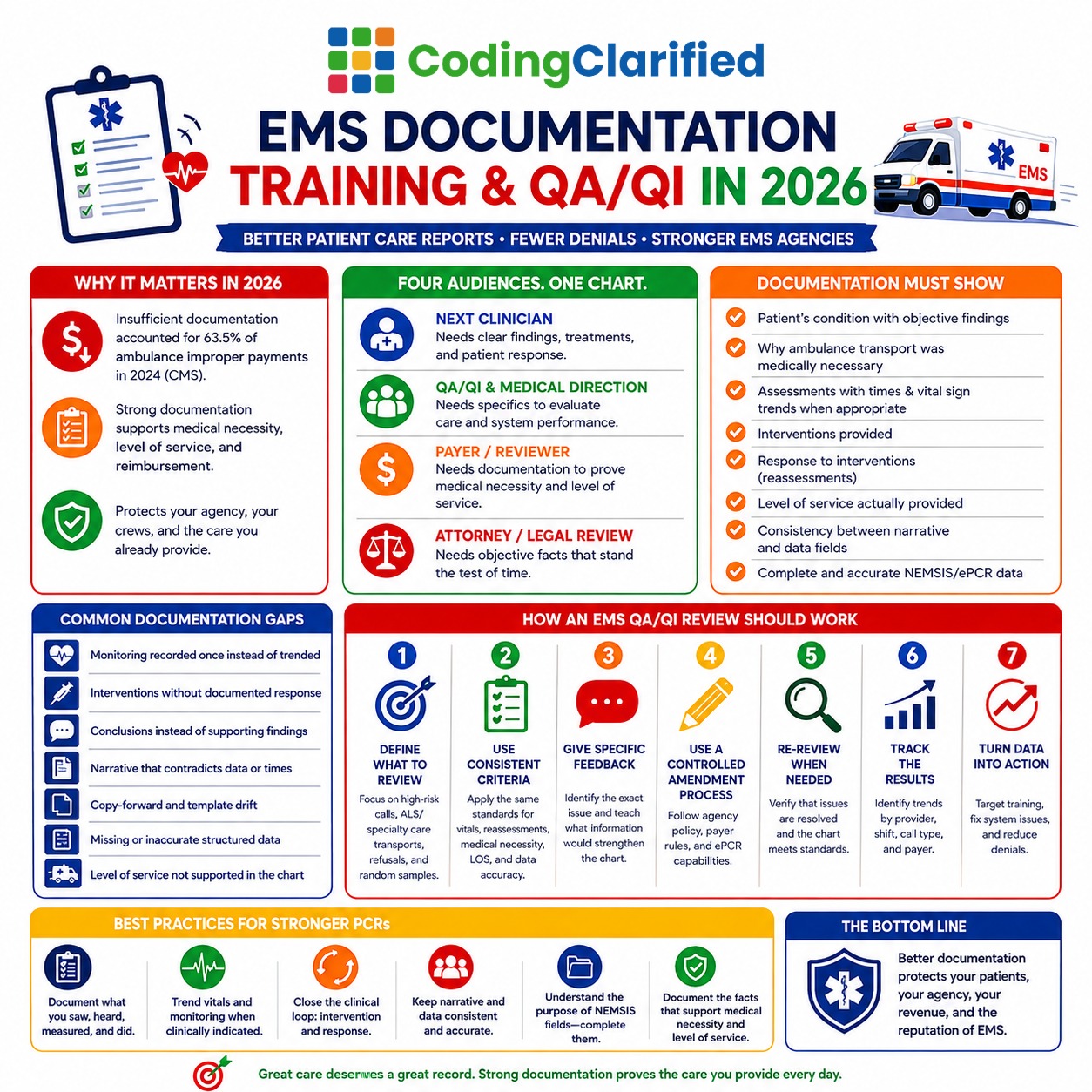
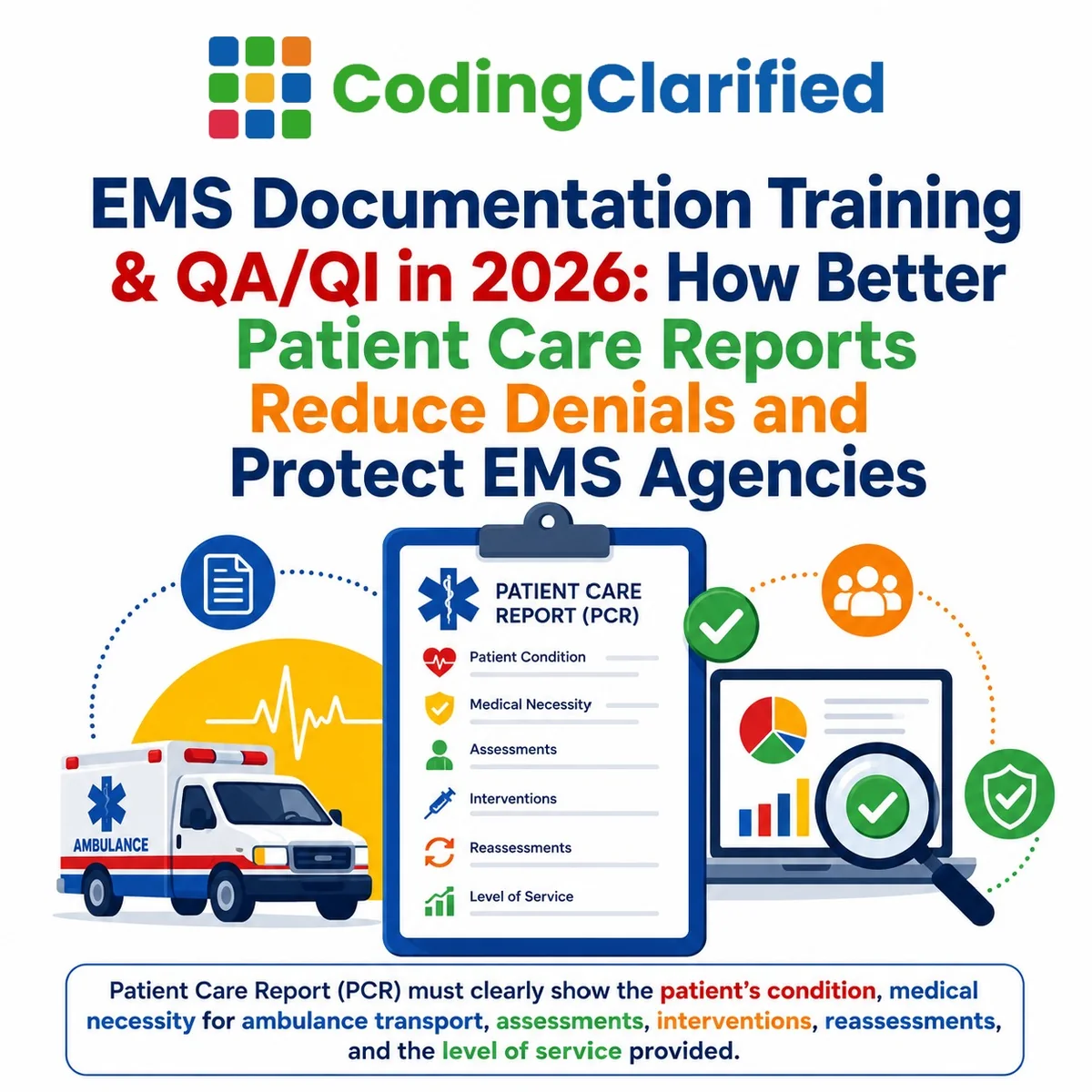
EMS documentation is much more than writing a narrative after a call. In 2026, a patient care report (PCR) must clearly show the patient’s condition, medical necessity for ambulance transport, assessments, interventions, reassessments, and the level of service provided.
Most importantly, good patient care can still result in a weak claim when the PCR does not support what happened during the transport.
EMS agencies should focus on:
- Documenting objective findings instead of vague conclusions
- Recording vital signs and monitoring as a trend when clinically appropriate
- Documenting the patient’s response after interventions
- Showing why ambulance transportation was medically necessary
- Supporting the level of service provided
- Keeping the narrative and structured ePCR data consistent
- Using structured EMS QA/QI chart audits
- Tracking documentation problems across providers, shifts, and call types
- Giving crews specific feedback instead of generic documentation training
- Measuring whether education actually improves future charts
This issue matters financially, too. According to the Centers for Medicare & Medicaid Services (CMS), insufficient documentation accounted for 63.5% of improper payments for ambulance services during the 2024 reporting period.
Therefore, EMS documentation improvement should be treated as a clinical, compliance, and revenue-cycle priority in 2026.
You Were Trained to Save Lives. Were You Trained to Prove It?
Every EMS provider goes through a similar training process. You learn airway management, hemorrhage control, cardiac rhythms, medications, dosages, contraindications, patient assessment, and emergency interventions. Moreover, you repeat scenarios until many lifesaving skills become second nature.
Then the call ends, and you sit down at a computer to write the chart.
For many EMTs and paramedics, formal training becomes much thinner at this point. However, that patient care report may later determine how another clinician understands the call, whether an ambulance claim gets paid, what a QA reviewer finds, and what evidence exists if someone questions the care years later.
The problem usually is not poor patient care. Instead, the PCR sometimes fails to prove the care that actually occurred.
Perhaps continuous monitoring occurred, but the chart shows only one value. Maybe a medication worked, yet nobody documented the reassessment. Likewise, everyone in the ambulance understood why the patient required ALS or specialty care transport, but the record never clearly explains why that level of service was needed.
“If it isn’t documented, it didn’t happen” is familiar advice throughout healthcare. Still, EMS professionals need more than that warning. They need practical training that shows them what strong documentation actually looks like.
That is where structured EMS documentation training and QA/QI can make a measurable difference.
Why EMS Documentation Matters More in 2026
The patient care report sits at the center of clinical care, compliance, billing, quality improvement, and risk management. Consequently, agencies cannot treat documentation as an administrative task that happens after the “real” work ends.
CMS continues to place medical necessity and documentation at the center of ambulance coverage. In addition, its current ambulance compliance guidance explains that documentation must support why the patient’s condition required ambulance transportation when other transportation methods were not appropriate.
CMS also maintains a dedicated Ambulance Services Information Center covering Medicare ambulance coverage, billing, coding, reporting, and compliance resources.
Meanwhile, EMS data has value beyond reimbursement. EMS.gov explains that information collected through EMS patient care reports supports patient care improvement, research, public health work, and EMS safety. The National EMS Information System, or NEMSIS, provides a standardized framework for collecting and sharing that information.
Therefore, better documentation does not benefit only the billing office. It improves the usefulness of EMS data across the entire system.
Four Audiences Read an EMS Patient Care Report
A patient care report is not simply the story of an ambulance call. Instead, one document may need to satisfy several different readers.
1. The Next Healthcare Professional
The receiving nurse, physician, or other clinician needs to understand what EMS found, what changed, which treatments were provided, and how the patient responded. Therefore, clear clinical communication remains one of the PCR’s most important purposes.
2. The EMS QA/QI Team and Medical Director
Medical directors, training officers, and quality teams need enough information to determine whether care followed agency protocols. In addition, they need objective information such as times, vital signs, assessments, treatments, and reassessments.
Vague phrases cannot provide the same information.
3. The Payer or Medical Reviewer
Ambulance reimbursement depends heavily on medical necessity and the level of service supported by the record. Consequently, an appropriate transport may still face a denial when the documentation fails to explain why ambulance transportation was required.
For example, Medicare states that non-emergency ambulance transportation may qualify as medically necessary when the patient’s medical condition requires ambulance transportation or when applicable bed-confinement and other requirements are met.
However, bed confinement by itself does not automatically establish medical necessity.
Read more: What Is Medical Necessity in Medical Coding & Billing?
4. An Attorney or Other Outside Reviewer
EMS records may also become part of legal or regulatory reviews. Therefore, a detailed, objective chart can become important long after anyone remembers the individual call.
“Patient tolerated treatment well” provides limited information.
In contrast, a documented reassessment that records the time, relevant vital signs, symptoms, mental status, and response to treatment creates a much clearer clinical record.
One PCR may eventually serve all four audiences.
Common EMS Documentation Problems
Although agencies differ, several documentation problems appear repeatedly during EMS chart audits.
Monitoring Recorded Once Instead of Showing a Trend
A single set of vital signs provides information about one moment. However, when ongoing monitoring was clinically required and actually performed, the record should accurately reflect the monitoring that occurred.
The chart should never contain invented values simply to create a trend. Instead, crews should document actual assessments and monitoring at the appropriate times.
Intervention Documented Without a Response
Medication administered.
Oxygen started.
Splint applied.
Then the documentation stops.
This pattern leaves an important clinical question unanswered: What happened next?
Therefore, EMS documentation training should teach crews to close the clinical loop. Document the intervention and, when appropriate, document the patient’s response and reassessment.
Conclusions Without Supporting Findings
Phrases such as “patient stable,” “airway patent,” or “neuro intact” may summarize the provider’s clinical judgment. Nevertheless, the objective findings that support those statements make the chart much stronger.
What made the patient stable? How was the airway assessed? Which neurological findings support “intact”?
Specific observations provide reviewers with evidence rather than conclusions alone.
Narrative and Data Fields Do Not Match
Internal conflicts can quickly weaken a PCR.
For example, the narrative may describe hypotension while the recorded vital signs do not support that statement. Similarly, the narrative might describe a long extrication while the documented timestamps create a different timeline.
Therefore, crews should review the full record for internal consistency before finalizing it.
Copy-Forward and Template Problems
Templates can improve speed and consistency. However, copied text becomes risky when it describes care or findings that did not apply to the current patient.
Furthermore, repeated boilerplate may make individual records less reliable.
Templates should guide documentation, not replace patient-specific documentation.
Missing or Inaccurate Structured Data
NEMSIS and ePCR fields should not be treated as meaningless boxes that simply need an answer. Instead, structured EMS data can affect reporting, quality improvement, research, and analysis.
Providers should understand what required fields mean and why the information matters.
Level of Service Is Not Supported
This issue can directly affect reimbursement.
An ALS, critical care, or specialty care transport should have documentation that accurately supports the patient’s condition and services actually provided. Moreover, the record should make it possible for a reviewer to understand why that level of service was appropriate.
For more ambulance coding guidance, read Medical Coding Ambulance Services.
Medical Necessity Documentation for Ambulance Services
Medical necessity deserves special attention because it remains a major source of ambulance claim problems.
Medicare generally requires the patient’s medical condition to contraindicate transportation by other means for covered ambulance transportation. Additionally, CMS explains that both the ambulance transportation itself and the level of service must meet applicable medical necessity requirements.
That means the PCR should answer a practical question:
Why did this patient need an ambulance and this level of care?
Simply documenting a diagnosis may not answer that question.
For example, two patients with the same diagnosis may have very different functional status, symptoms, risks, monitoring needs, and transportation requirements. Therefore, the chart should describe the patient’s actual condition rather than rely on a diagnosis alone to establish medical necessity.
CMS also emphasizes an important point for certain non-emergency ambulance transports: a physician certification statement does not, by itself, prove medical necessity. Other coverage requirements still apply.
As a result, strong PCR documentation remains essential even when another required form exists.
How an EMS QA/QI Documentation Review Should Work
A successful EMS chart audit should do more than find mistakes. Instead, it should create a repeatable process that turns chart findings into better documentation.
Step 1: Define What Gets Reviewed
Reviewing 100% of every chart may not make sense for every agency. Therefore, agencies can create a written audit plan based on risk and operational needs.
For example, an agency might prioritize:
- High-acuity calls
- ALS or specialty care transports
- Certain payer categories
- Refusals
- Specific protocols
- Random samples of routine calls
- Charts meeting automatic escalation criteria
The review process becomes easier to manage when everyone understands the scope.
Step 2: Use Consistent Audit Criteria
Every reviewer should measure charts against the same standards. Otherwise, an EMS audit can become a collection of personal opinions.
Criteria may include:
- Required vital signs and monitoring
- Reassessment after interventions
- Narrative-to-data consistency
- Accurate timestamps
- Medical necessity support
- Required structured data
- Level-of-service support
- Protocol documentation
Consistent criteria also allow agencies to compare results over time.
Step 3: Give Specific, Teachable Feedback
“Poor documentation” does not teach a provider how to improve.
Instead, feedback should identify the exact problem.
For example:
“You documented medication administration at 14:10, but the PCR does not show the patient’s response or a related reassessment.”
Next, explain what information would have made the original chart stronger.
Specific feedback creates a learning opportunity instead of simply recording a failure.
Step 4: Use a Controlled Amendment Process
When an amendment is permitted, corrections should follow agency policy, applicable law, payer requirements, and the capabilities of the ePCR system.
Furthermore, amendments should preserve the integrity of the original record and clearly identify when and by whom the additional information was entered.
Agencies should also understand their ePCR platform’s audit logs, version history, and amendment functions.
Step 5: Re-Review When Needed
Closing the loop matters.
If a chart goes back for clarification or an allowed amendment, the QA process should track whether the issue was resolved. Otherwise, the organization may be measuring how many charts it returned rather than how many problems it actually corrected.
Step 6: Track the Results
One chart identifies one problem. In contrast, months of standardized audit results can reveal a system-wide pattern.
That distinction turns QA/QI from chart checking into useful operational data.
What EMS Documentation Audit Data Can Show Your Agency
Consistent scoring allows agencies to identify exactly where documentation breaks down.
For example, leadership might discover that medication reassessments represent the most common missing element. Moreover, the problem may appear mainly on a certain shift, transport type, or call category.
That finding creates a specific training opportunity.
Agencies can also compare results before and after education. Consequently, training officers gain a way to determine whether documentation training changed behavior.
The same data can help separate an individual coaching need from a system problem. If one provider repeatedly misses the same documentation element, coaching may help. However, if most of the agency makes the same error, the underlying problem may involve training, workflow, policy, or the ePCR template.
Most importantly, agencies can identify documentation-related revenue risks before a denial appears.
Common Mistakes to Avoid in EMS Documentation and QA/QI
Even strong EMS organizations can weaken their documentation programs when the audit process focuses on the wrong goals.
Avoid vague feedback. Telling crews to “document better” rarely changes behavior. Instead, show the missing element and explain what the chart needed.
Don’t turn QA/QI into punishment. Providers are more likely to improve when reviews focus on clear standards and teachable corrections. Moreover, trend data should help agencies identify system problems instead of automatically blaming individuals.
Never add information that was not actually observed or performed. A complete-looking chart is not the goal. Rather, the PCR must accurately represent the patient encounter.
Don’t rely entirely on templates. Templates can help providers remember required elements; however, patient-specific findings still matter.
Don’t assume a diagnosis proves medical necessity. The chart should explain why the patient’s condition required ambulance transportation and the reported level of service.
Avoid inconsistent audit standards. Different reviewers should not judge similar charts by completely different rules. Therefore, use written criteria and train reviewers on the same process.
Target the Documentation Weakness Instead of Retraining Everyone
One of the biggest benefits of a structured EMS QA/QI program is the ability to stop guessing.
If your data shows that reassessment after medication administration is the main weakness, teach reassessment documentation.
Likewise, if medical necessity represents the largest gap, train crews to document the patient-specific facts that explain why ambulance transportation was required.
This targeted approach can make education shorter and more relevant. Furthermore, agencies can use de-identified examples from their own system so providers see documentation patterns they recognize.
Providers often understand the lesson much faster when they can compare an incomplete chart with a corrected example.
Then audit again.
If the scores improve, the education likely addressed the right problem. Conversely, if nothing changes, leadership can investigate whether the real issue involves workflow, policy, technology, or another barrier.
EMS Documentation Training and QA/QI With Coding Clarified
Coding Clarified works on both the documentation and education sides of EMS.
Our EMS Documentation Training, QA/QI & Live Coaching services help agencies build structured documentation programs focused on stronger PCRs, medical necessity, compliance, and repeatable quality review.
On the agency side, documentation review may include audit-scope development, fixed review criteria, chart feedback, closed-loop review processes, and trend reporting. Furthermore, targeted education can address the specific documentation weaknesses found during the audit.
On the education side, Coding Clarified brings medical coding and documentation experience into EMS training. Coders and auditors spend their careers determining what clinical records do and do not support. Therefore, those skills can add a valuable perspective to EMS documentation improvement.
Our apprenticeship and training work can also help agencies build documentation quality into workforce development instead of waiting until poor habits become established.
For a broader look at why complete clinical records matter for coding, compliance, and reimbursement, read Why Is Documentation Important in Medical Coding?.
Final Thoughts: Better EMS Documentation Protects the Care You Already Provide
EMS crews should not have to become professional writers to produce defensible patient care reports.
They do, however, need to understand what the record must show.
A strong PCR tells the clinical story with objective facts. Additionally, it connects assessments to interventions, interventions to reassessments, and the patient’s condition to medical necessity and level of service.
Structured QA/QI makes that process measurable.
In 2026, this approach matters even more because ambulance documentation remains a major compliance and payment concern. Better documentation can support continuity of care, cleaner claims, stronger quality programs, more useful EMS data, and a more defensible record.
Your crews already know how to provide care.
The next step is making sure the chart proves it.
Frequently Asked Questions About EMS Documentation and QA/QI
Quick answers to the questions EMS agencies ask most about documentation and QA/QI.
What should an EMS patient care report include?
A strong EMS patient care report should clearly document the patient’s condition, assessment findings, relevant vital signs, interventions, response to treatment, reassessments, transport details, and other required information. In addition, the documentation should accurately support medical necessity and the level of service when applicable.
Why is medical necessity important for ambulance documentation?
Medical necessity helps determine whether ambulance transportation meets payer coverage requirements. For Medicare, the patient’s condition generally must make transportation by other means inappropriate under applicable coverage rules. Therefore, the PCR should document patient-specific facts that support the need for ambulance transportation.
What are common EMS documentation mistakes?
Common problems include missing reassessments, vague statements, incomplete vital-sign trends, conflicting narrative and data fields, excessive boilerplate, incomplete structured data, and weak support for medical necessity or level of service. Moreover, these problems can affect clinical communication, QA/QI, compliance, and reimbursement.
What is an EMS QA/QI chart audit?
An EMS QA/QI chart audit is a structured review of patient care records against defined standards. Instead of simply finding errors, an effective program identifies trends, provides specific feedback, measures improvement, and helps agencies determine where additional training or system changes may be needed.
Can poor EMS documentation cause an ambulance claim denial?
Yes. Inadequate documentation can contribute to claim denials or improper payments when the record does not support coverage requirements, medical necessity, or the service billed. In fact, CMS reported that insufficient documentation represented 63.5% of ambulance-service improper payments during the 2024 reporting period.
Does a physician certification statement prove ambulance medical necessity?
Not by itself. CMS explains that required certification documentation alone does not establish that an ambulance transport was medically necessary. The provider or supplier must still meet the other applicable Medicare coverage requirements. Therefore, the complete record remains important.
How can an EMS agency improve PCR documentation?
Start by auditing a consistent sample of charts against written criteria. Next, identify the most common documentation gaps and provide short, specific training using real or de-identified examples. Finally, measure the same criteria again to determine whether documentation actually improved.
Where can EMS agencies find current Medicare ambulance documentation rules?
CMS maintains current ambulance coverage, billing, fee schedule, compliance, and educational resources through its Ambulance Services Information Center and Ambulance-Specific Manuals. Agencies should also review their Medicare Administrative Contractor guidance and applicable state, local, payer, and medical-direction requirements.