Key Takeaways: EMS Apprenticeship Advanced Standing in 2026
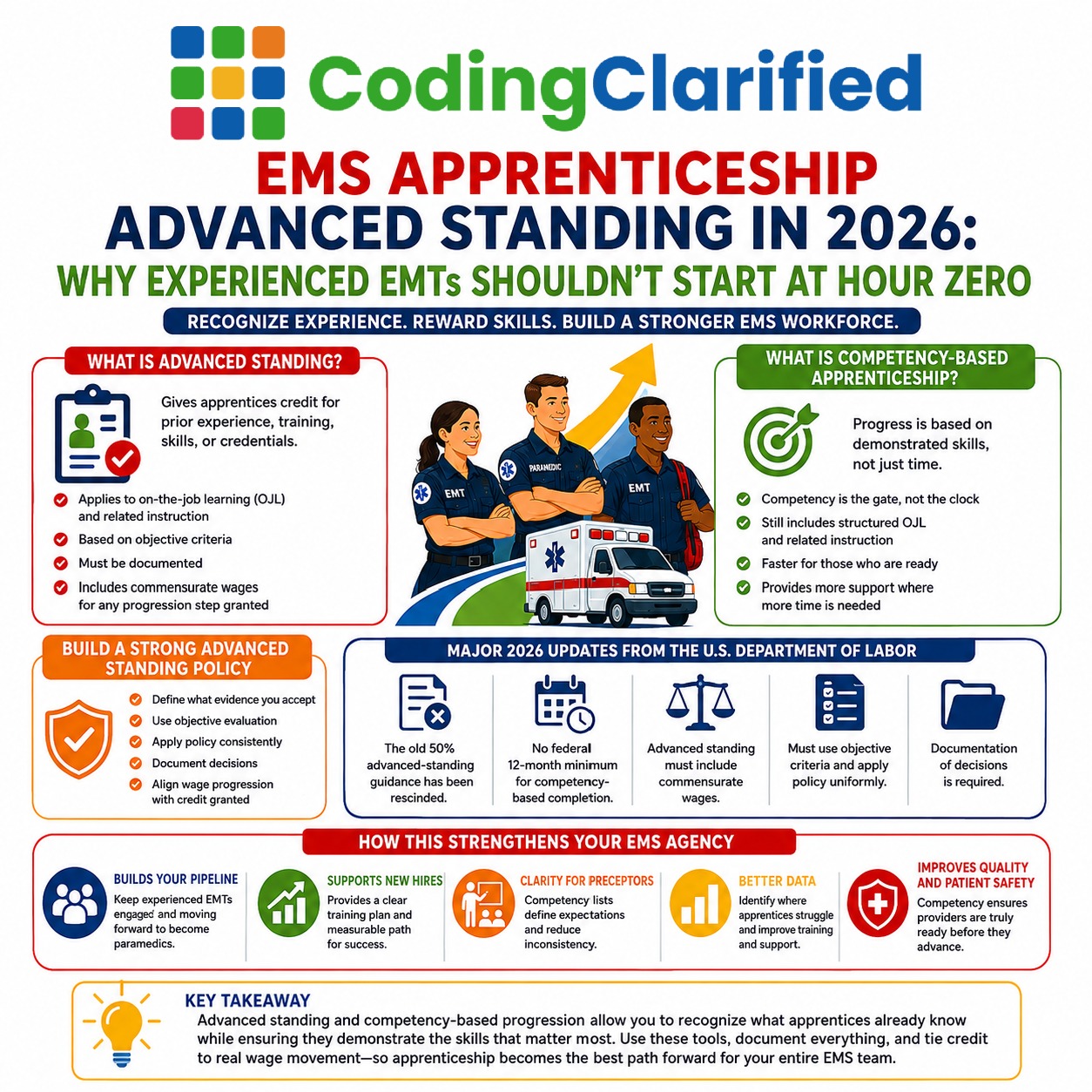
Experienced EMTs and paramedics should not automatically have to start a Registered Apprenticeship Program at the same point as someone entering the occupation with no prior experience. Instead, advanced standing can recognize documented experience, training, skills, or demonstrated competency that an apprentice already brings to the program.
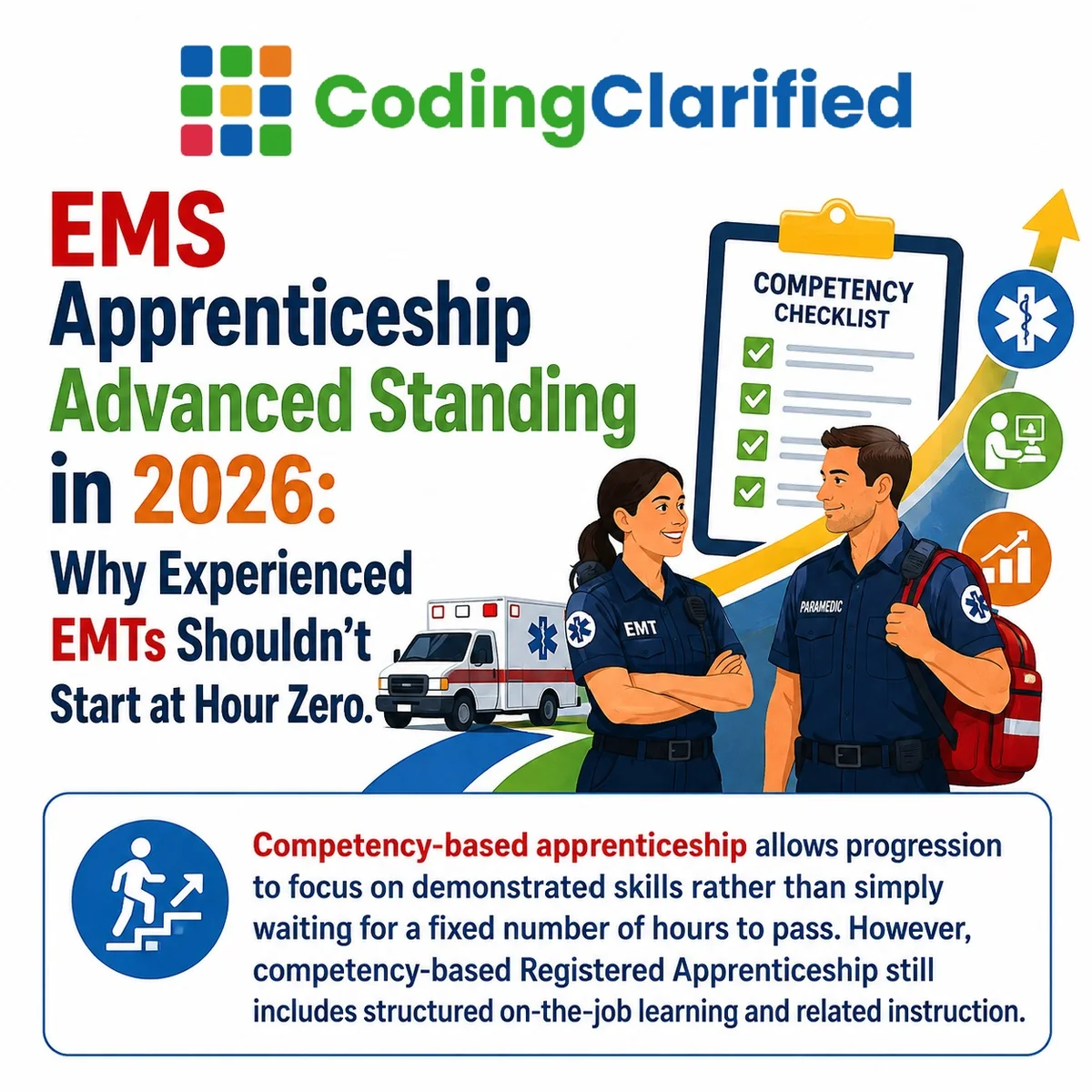
In addition, a competency-based apprenticeship allows progression to focus on demonstrated skills rather than simply waiting for a fixed number of hours to pass. However, competency-based Registered Apprenticeship still includes structured on-the-job learning and related instruction.
Most importantly, new U.S. Department of Labor guidance issued in March 2026 gives EMS agencies and apprenticeship sponsors important clarification:
- Advanced standing can apply to both on-the-job learning and related instruction.
- Sponsors must use objective criteria and apply their advanced-standing policy consistently.
- Advanced standing must come with commensurate wages for any progression step granted.
- The previous federal guidance suggesting a maximum of 50% credit for prior work experience has been rescinded.
- Competency-based apprenticeships do not have a federal 12-month minimum registration period under the updated guidance.
- Sponsors must maintain documentation supporting advanced-standing decisions.
For EMS leaders, these changes make Registered Apprenticeship especially useful for building an internal EMT-to-paramedic career pipeline while recognizing the experience employees already have.
Why Your Experienced EMTs Shouldn’t Start at Hour Zero
One of the fastest ways to lose support for an EMS apprenticeship program is to tell an experienced EMT that none of their previous work counts.
Imagine an EMT who has spent six years responding to emergencies, assessing patients, documenting calls, working with paramedics, communicating with hospitals, and operating inside your agency’s protocols. Then, the agency introduces a paramedic apprenticeship and tells that employee to start at the same point as someone entering EMS for the first time.
Understandably, that can feel less like career advancement and more like starting over.
Fortunately, Registered Apprenticeship does not require agencies to structure programs that way. In fact, the federal apprenticeship system specifically allows sponsors to recognize previous experience and demonstrated competency.
Two important tools make this possible: advanced standing and competency-based apprenticeship.
Together, they can make an EMS apprenticeship more practical for experienced providers while still protecting training quality and patient safety.
What Is Advanced Standing in an EMS Apprenticeship?
Advanced standing allows an apprentice to receive appropriate credit for experience, training, skills, or demonstrated competencies they already possess.
According to the U.S. Department of Labor’s Office of Apprenticeship Circular No. 2026-01, Registered Apprenticeship program standards must address the sponsor’s policy for granting advanced standing or credit. Furthermore, that policy should rely on objective criteria and apply uniformly to apprentices.
Advanced standing can apply to both on-the-job learning (OJL) and related instruction.
For example, an EMS agency might evaluate:
- Previous EMT field experience
- Completed EMS education
- Relevant certifications
- Prior supervised clinical experience
- Documented competencies
- Previous apprenticeship-related training
- Relevant coursework that aligns with the approved program
- Formal skills assessments
However, advanced standing is not simply an informal promise that “we’ll give you credit because you’ve been here a long time.” The sponsor needs a defined process for evaluating what the apprentice already knows and can do.
That distinction matters.
Major 2026 Change: The Old 50% Advanced-Standing Guidance Was Rescinded
This is one of the most important 2026 updates for apprenticeship sponsors.
Older Office of Apprenticeship guidance stated that the maximum allowable credit for prior work experience was 50% of training. However, Office of Apprenticeship Circular No. 2026-01, issued March 9, 2026, rescinded that guidance because the regulation itself does not impose that 50% limitation.
That does not mean sponsors should automatically grant unlimited credit.
Instead, sponsors must follow their approved written advanced-standing policy, use objective criteria, apply the policy consistently, and retain documentation supporting their decisions.
For EMS agencies, therefore, the question should not simply be:
“How many hours can we remove?”
A better question is:
“Which approved competencies, work processes, or instructional requirements has this person already satisfied, and what documentation supports that determination?”
That approach protects both the integrity of the apprenticeship and the experienced employee.
Advanced Standing Should Affect Wage Progression Too
Advanced standing should not exist only on paper.
Federal apprenticeship guidance states that granting advanced standing must be accompanied by commensurate wages for any progression step granted.
That point is especially important for EMS retention.
Suppose an experienced EMT enters an apprenticeship with documented advanced standing. If the agency recognizes the employee’s experience for training purposes but still places that employee at an entry-level wage step that does not correspond with the progression granted, the program can quickly lose credibility.
Instead, agencies should build wage progression and advanced-standing decisions together.
Registered Apprenticeship programs include progressive wage increases as apprentices develop their skills. Therefore, agencies should understand how previous experience affects both program placement and the applicable wage progression before enrolling experienced employees.
For more information about how Registered Apprenticeship works, read EMS Registered Apprenticeship Programs in 2026: How EMT & Paramedic Apprenticeships Actually Work.
What Is a Competency-Based EMS Apprenticeship?
A competency-based apprenticeship measures progress primarily through the apprentice’s successful demonstration of required skills and knowledge.
In other words, competency becomes the gate instead of simply the clock.
This structure can fit EMS particularly well because field providers do not all develop at exactly the same rate.
One apprentice may demonstrate a competency quickly because of extensive prior experience. Meanwhile, another may need additional coaching, supervised practice, or education before a preceptor can confidently approve the same competency.
A competency-based program gives the sponsor a structured way to account for those differences.
Still, competency-based does not mean “no field training.”
The Department of Labor clarified in 2026 that competency-based Registered Apprenticeship Programs must still include an on-the-job learning component. Program standards must explain how OJL integrates into the program, identify competencies, and describe how the sponsor will test and evaluate those competencies.
Additionally, Registered Apprenticeship includes related instruction.
Another Major 2026 Change: No Federal 12-Month Minimum for Competency-Based Completion
Previous Office of Apprenticeship guidance indicated that an apprentice in a competency-based occupation had to remain registered for 12 calendar months of on-the-job learning.
The Department of Labor rescinded that guidance in Circular No. 2026-01.
According to the updated guidance, federal regulations do not impose a specific amount of time that an apprentice must remain registered in a program using a competency-based approach.
Consequently, competency-based progression can better reflect how quickly an individual apprentice actually demonstrates the occupational competencies identified in the program’s approved work process schedule.
For experienced EMS professionals, that clarification is significant.
Someone with substantial background should not necessarily have to wait for an arbitrary calendar date when the approved program allows competency-based progression and the apprentice has properly demonstrated the required skills.
At the same time, agencies should never treat faster completion as the primary goal. Competency must remain the goal.
Why Competency-Based Training Works in Both Directions
Competency-based EMS apprenticeship has an important advantage: it does not only help strong candidates move faster.
It also prevents someone from advancing simply because enough time has passed.
Experienced apprentices can demonstrate skills sooner
An experienced EMT entering a paramedic pathway may already have strong patient assessment, communication, documentation, operational, and emergency response skills.
Therefore, the program can evaluate those abilities according to its approved standards rather than pretending the experience does not exist.
Developing apprentices can receive more support
Conversely, another apprentice may need additional supervised experience before demonstrating a particular skill safely and consistently.
A competency-driven system makes that visible.
Instead of saying, “You completed the hours, so you’re done,” the agency asks:
“Can you perform this competency to the required standard?”
In EMS, where training quality directly affects patients, crews, agencies, and communities, that difference matters.
The EMS Competency List Is Where the Real Work Happens
A competency-based apprenticeship is only as useful as the competencies behind it.
For example, a weak competency might say:
“Demonstrates patient assessment.”
That statement describes a broad category, but it gives a field training officer little guidance about what successful performance actually looks like.
Instead, agencies need observable and measurable expectations.
A strong competency framework can identify specific actions, such as gathering a relevant history, performing the appropriate assessment, recognizing significant findings, communicating findings, selecting interventions within scope and protocol, reassessing the patient, and documenting the encounter accurately.
As a result, two supervisors are more likely to evaluate apprentices against the same standard.
That consistency can also strengthen the agency’s overall field training process.
Documentation Should Be an EMS Apprenticeship Competency
Patient care documentation deserves a defined place in the competency framework.
An apprentice should not simply attend a lecture explaining that documentation is important. Instead, the provider should demonstrate the ability to complete accurate patient care reports that meet clinical, operational, billing, and agency QA/QI expectations.
For example, agencies can evaluate whether the apprentice consistently documents:
- Patient condition and chief complaint
- Relevant history
- Objective assessment findings
- Vital signs and clinically appropriate reassessments
- Interventions and patient response
- Changes during transport
- Medical necessity when applicable
- Transfer of care
- Required signatures and supporting information
- A narrative that matches the rest of the PCR
Additionally, QA/QI results can become part of the feedback loop.
Our guide to EMS Documentation Training & QA/QI in 2026 explains how chart review and provider coaching can help agencies improve documentation before poor habits become routine.
How Advanced Standing Can Strengthen the EMT-to-Paramedic Pipeline
When agencies combine advanced standing with a well-designed apprenticeship structure, the internal career pathway becomes much more attractive.
First, experienced EMTs can see a realistic path toward becoming paramedics without feeling that their previous work has been erased.
Next, employees continue working while developing additional occupational skills through a structured program.
Meanwhile, supervisors gain a clearer framework for coaching and evaluating apprentices.
Finally, leadership gets measurable data about where employees succeed or struggle.
That last point is often overlooked.
If several apprentices repeatedly struggle with the same competency, the problem may not be the individual apprentices. Instead, the agency may have identified a weakness in training, preceptor consistency, curriculum, equipment access, protocols, or field exposure.
Competency data can turn apprenticeship into a workforce-development tool rather than simply another training program.
For agencies evaluating the financial side of workforce development, see EMS Turnover Costs in 2026: The Retention Math Every EMS Agency Should Run.
How to Create an Advanced-Standing Policy
An agency or sponsor should define the advanced-standing process before the first experienced employee asks for credit.
A practical policy should answer several questions.
What evidence will you accept? Examples may include employment records, course transcripts, certifications, training records, evaluations, skills testing, or documented field experience.
Who evaluates the evidence? Assign responsibility instead of allowing individual supervisors to make informal agreements.
How will competency be verified? Prior experience alone may not prove current proficiency. Therefore, skills demonstrations or assessments may be appropriate.
How much credit does each qualifying experience receive? Use objective criteria that align with the approved apprenticeship standards.
How does credit affect wage progression? Determine the corresponding wage step as part of the advanced-standing decision.
How will you document the decision? Keep records supporting what credit was awarded and why.
Most importantly, apply the policy consistently.
The Department of Labor’s 2026 guidance specifically emphasizes objective criteria, uniform application, and appropriate documentation.
Common Mistakes to Avoid
EMS agencies can undermine an otherwise strong apprenticeship program when they make a few common mistakes.
Giving informal credit without documentation: Advanced standing should follow the sponsor’s written policy and have supporting records.
Treating every experienced EMT exactly like a brand-new apprentice: Previous experience may qualify for advanced standing when it aligns with the program’s standards.
Keeping an advanced-standing apprentice at the wrong wage progression: Any progression step granted through advanced standing must have commensurate wages.
Assuming competency-based means no OJL: Competency-based Registered Apprenticeship still requires an on-the-job learning component.
Using vague competencies: Supervisors need observable standards they can evaluate consistently.
Signing off skills automatically: A signature should represent actual evaluation, not administrative completion.
Ignoring documentation skills: PCR documentation should be treated as a job competency, not merely a classroom topic.
Using outdated apprenticeship rules: The Department of Labor issued important updated guidance in March 2026. Agencies should review current standards rather than relying on older program assumptions.
Authoritative Resources for EMS Apprenticeship Programs
EMS leaders developing or reviewing a Registered Apprenticeship Program should start with the official Apprenticeship.gov Registered Apprenticeship Program resources.
Additionally, sponsors should review Office of Apprenticeship Circular No. 2026-01: Registered Apprenticeship Training Approaches. The March 2026 guidance covers competency-based, hybrid, and time-based approaches, as well as advanced standing, related instruction, performance evaluation, and completion.
Agencies can also use EMS.gov for federal EMS workforce, education, and system resources.
For agencies that want to connect apprenticeship with documentation improvement, review Coding Clarified’s EMS Documentation Training, QA/QI & Live Coaching.
The Bottom Line: Don’t Make Experienced EMTs Start Over
If an EMS apprenticeship treats a six-year EMT exactly like someone with no relevant experience, the agency risks pushing away the very employees it wants to develop.
Registered Apprenticeship offers a better option.
Advanced standing allows sponsors to recognize qualifying prior experience, training, skills, and demonstrated competency. Meanwhile, competency-based progression allows apprentices to move based on demonstrated occupational skill rather than an arbitrary calendar alone.
The 2026 Department of Labor guidance makes these options even clearer. The old 50% advanced-standing guidance has been rescinded, and competency-based programs no longer carry the old federal guidance requiring 12 calendar months of registration.
However, flexibility does not mean lowering standards.
Agencies still need structured OJL, related instruction, objective assessments, consistent advanced-standing policies, progress records, appropriate wage progression, and documented competency.
When those pieces work together, apprenticeship can become more than a pathway for new hires. It can become a structured career-development system for the EMS professionals already serving your community.
Frequently Asked Questions About EMS Apprenticeship Advanced Standing
Can an experienced EMT receive credit toward a paramedic apprenticeship?
Potentially, yes. Registered Apprenticeship sponsors may grant advanced standing for demonstrated competency, acquired experience, training, or skills when those qualifications meet the sponsor’s approved policy and align with the program requirements. The sponsor must evaluate the individual’s qualifications rather than automatically awarding credit based only on years employed.
Is advanced standing limited to 50% of an apprenticeship in 2026?
The Department of Labor’s Office of Apprenticeship rescinded its previous guidance stating that prior-work-experience credit could not exceed 50% of training. According to Circular No. 2026-01, federal regulations do not impose that specific limitation. Sponsors must still follow their written advanced-standing policies and maintain supporting documentation.
Does advanced standing affect an apprentice’s wages?
Yes, when advanced standing results in a progression step. Federal guidance states that advanced standing must be accompanied by commensurate wages for any progression step granted.
Does competency-based apprenticeship mean there are no on-the-job learning requirements?
No. Competency-based Registered Apprenticeship still requires an OJL component. However, progression focuses on successful demonstration of the occupational competencies identified in the approved program standards.
Does a competency-based apprentice have to stay registered for at least 12 months?
The Office of Apprenticeship rescinded its previous 12-calendar-month guidance in March 2026 because federal regulations do not impose that specific minimum for competency-based programs. Completion still depends on satisfying the requirements in the program’s approved standards.
Can prior education count toward Related Instruction?
Potentially, yes. Advanced standing can apply to both related instruction and OJL. However, the sponsor must determine whether the prior education, training, or demonstrated knowledge aligns with the approved apprenticeship requirements.
Why should EMS agencies use competency-based apprenticeship?
Competency-based progression gives agencies a structured way to evaluate what an apprentice can actually do. As a result, experienced providers may progress efficiently, while apprentices who need additional development can receive more supervised training before competency sign-off.
What records should an EMS apprenticeship keep for advanced standing?
Sponsors should retain documentation supporting the decision, including appropriate assessments, examinations, training records, experience records, or other evidence used under the sponsor’s written policy. Good records help demonstrate that advanced-standing decisions were objective, consistent, and tied to approved program standards.
Coding Clarified LLC is a U.S. Department of Labor Registered Apprenticeship sponsor with RAPIDS-recognized occupations in Medical Coder, EMT, and Paramedic, an AAPC-affiliated training provider, and a provider of QA/QI documentation review and training for EMS agencies. Learn more at CodingClarified.com Learn more About Coding Clarified.